(Guest Post by Matthew Ladner)
Another widely held belief bites the dust when put to the test.
(Guest Post by Matthew Ladner)
Another widely held belief bites the dust when put to the test.
 2 Comments |
  Uncategorized |
  Permalink
 Posted by matthewladner
(Guest Post by Jason Bedrick)
This week, Jews around the world will celebrate Passover, the Festival of Freedom.
Part of the genius of the Jewish tradition is its recognition that sustaining a free society requires education. “Freedom begins with what we teach our children,” wrote Rabbi Jonathan Sacks, chief rabbi emeritus of the United Hebrew Congregations of the British Commonwealth. And nowhere is the centrality of education in Judaism more evident than on Passover, “when the entire ritual of handing on our story to the next generation is set in motion by the questions asked by a child.”
The Jewish tradition has much to teach the world about education, and Jews who seek the peace of the city and land in which they dwell would be doing their neighbors a disservice by keeping it to themselves. Fortunately, America is a society that welcomes a diversity of views and religious traditions. In their wisdom, America’s Founding Fathers created, in Thomas Jefferson’s words, “a high wall of separation between church and state.” But while religious groups and institutions were appropriately denied power, the constitutional right to freedom of religion guarantees them the space to influence public policy.
Citizens should be skeptical of religious (or secular) figures who make specific policy recommendations without any particular expertise in those areas. However, while we should not turn to clergy to devise economic or tax policy, they have an important voice in the discussion of the ends which public policy should seek to achieve. Religious traditions can help society orient its goals—respecting the dignity of every person, seeking the welfare of the poor and downtrodden—while economists, social scientists, and policy experts debate how best to achieve those goals.
With its rich and enduring tradition, Judaism has much to offer society, especially in the realm of education. Jews are, in the words of Rabbi Sacks, “a people whose passion is education, whose heroes are teachers and whose citadels are schools.” The ideal education system, in the Jewish view, provides universal access and individualized instruction while placing the needs of students above all.
Universal Access
Any discussion of the Jewish view of education policy must begin with one man: Yehoshua ben Gamla. The Talmud exhorts us to remember him favorably, “for were it not for him, the Torah would have been forgotten by Israel.” (Bava Basra 21a)
Ben Gamla served as the Kohein Gadol (High Priest) in the first century B.C.E., a period of turmoil when the Jews lived under Roman occupation. Concerned that the children of poor families—particularly orphans—did not have access to a quality Torah education despite a series of education reforms by the sages, Ben Gamla mandated that every Jewish community hire teachers to educate every child from the age of six or seven on up.
Ben Gamla’s vision—heartily endorsed by the sages—was universal access to education. As the late Rabbi Aaron Levine explained, “The objective of [Ben Gamla’s] ordinance was that Torah education for the youth should reach the rich child, the poor child, and, especially the child who has no father to worry about his spiritual needs.” A child’s family circumstances should not determine his or her access to education.
Individualized Instruction
Universal access, however, does not imply uniform instruction. Rather, the guiding principle of Jewish education is chanoch l’naar al pi darko. (Proverbs 22:6) The full verse is often translated as “Teach a child the way he should go, and even when he grows old he will not depart from it,” but Hebrew grammar allows another translation: “Teach a child according to his way…” implying individualized instruction for each child. Indeed, this understanding of the verse is so widespread that Jewish day schools ubiquitously invoke it in this manner.
There is no greater example of the chanoch l’naar approach to education than the Passover seder. The entire ritual—the use of symbolic foods, ceremonial dipping and leaning, etc.—is designed to provoke questions from the children in attendance. Central to the seder is the concept of the four different types of children, whose personalities are reflected in the types of questions they ask. There is the wise child, the rebellious child, the simple child, and the child “who does not even know how to ask.”
As the Passover Haggadah details, each child’s question (or lack thereof) requires a different response, an answer tailored to his particular temperament and level of maturity. The wise child’s thoughtful question merits a discussion of the laws of Passover. The rebellious child’s passive-aggressive question is met with a rebuke. The simple child’s earnest question elicits a retelling of the Passover story. The final child’s inability to formulate a question at all requires the tender and patient assistance of parents to stir his curiosity.
Even the seder itself is a cholent of different rituals reflecting different pedagogical approaches. The wise child might be stimulated by the Haggadah’s biblical exegesis while the simple child is confused. The simple child may enjoy the storytelling while the child “who doesn’t know how it ask” is bored. That child may nevertheless enjoy the singing, while the rebellious child is annoyed. And even the rebellious child may enjoy the food. At the seder table—Judaism’s ultimate classroom—there is something for everybody.
Prioritizing Students and the Role of Competition
On the very page following Yehoshua ben Gamla’s universal vision, the Talmud discusses whether an established teacher could prevent a newcomer from teaching in his vicinity. Though Jewish law generally favors competition, in certain circumstances it empowers an established business to block a would-be market entrant, if it were likely that the entrant would put it out of business. However, the sages never restricted competition among educators because, they said, “kinat soferim tarbeh chokhmah” (“jealousy among the scholars increases wisdom”).
Two aspects of this ruling are worth highlighting. First, the sages’ primary concern was that students receive the best possible education, even if that meant that one teacher lost his livelihood because his students flocked to a superior teacher. In the realm of education, the needs of students came before the needs of adults.
Second, the sages recognized that competition among teachers proved beneficial for students. In a competitive environment, each teacher was motivated to perform as well as possible because his students had other options. The sages saw choice and competition as stronger guarantors of educational quality than the good will of the teachers alone.
Contemporary Education Policy and the Jewish Tradition
Jewish tradition provides three guiding principles for designing an education system: there should be universal access to a quality education; instruction should be tailored to meet the particular needs of individual students; and the needs of students should take precedence. The sages also believed that competition among educators was a means to ensure quality—a testable hypothesis discussed more below.
So how well does America’s contemporary education system live up to these principles? Unfortunately, not very well.
America’s system of district-based public schooling was designed to provide universal access to education. Every child is guaranteed a seat inside a classroom in his or her community, no matter their race, religion, or parents’ income. However, the guarantee of a seat is no guarantee of quality. And since students are assigned to schools based on the location of their homes, their access to schooling depends on the home their parents can afford. Students from low-income families often have no financially viable options besides their assigned district school—and those schools tend to be the lowest performing.
Moreover, even a generally high-performing school might not be the best fit for all the students who just happen to live nearby. District schools are designed to meet the needs of the median student. These schools often struggle to meet the needs of students who don’t fit the typical mold.
Likewise, while students of all religions and creeds are guaranteed a seat at a district school, those schools are not necessarily aligned with the values and beliefs of all the families who happen to live in a given district. When schools are held accountable to elected officials, education policies are subject to political decision-making. A zero-sum political system creates winners and losers, forcing citizens into conflict with one another. Accordingly, the schools tend to reflect the views of the majority, leaving minorities in the untenable position of compromising their values or paying for both the “public” school and schools for their children. District schools promise universal access in theory, but fail to provide it in practice.
Unfortunately, too many district schools also fail to put the needs of students first. Last year’s Vergara v. California decision highlighted how district policies and union rules protected low-performing teachers at the expense of students’ education. Most of the rules were likely enacted with the best of intentions—protecting teachers from capricious administrators or political payback. But many of the rules—such as guaranteed permanent employment or “last-in, first-out” policies—have long outlived their usefulness and have even become counter-productive. As the judge found in the Vergara case, there is compelling evidence that such policies “disproportionately affect poor and/or minority students” in such a negative manner that it “shocks the conscience.”
A Better Way Forward
A substantial body of evidence suggests that the best education system yet devised to achieve the sages’ preferred ends employs the very means that they favored: choice and competition. Educational choice laws—such as school vouchers, scholarship tax credits, or education savings accounts—provide universal access to education while empowering parents to choose the provider that best meets their child’s particular educational needs. That in turn creates an incentive for educators to seek to meet those needs.
A 2009 global literature review of within-country studies on the effects of different types of school systems found that the freest and most market-like education systems performed the best. Out of more than 150 statistical comparisons of outcomes including academic achievement, efficiency, parental satisfaction, student attainment, and subsequent earnings, private schooling had a statistically significant advantage over government schooling in about 10 to one. In addition, market-like education systems—in which parents chose their child’s school and bore some direct financial responsibility and educators were free to determine their own curricula and pedagogy, set their own wages and tuition, and to earn a profit—beat monopolistic, government-run systems by about 15 to one.
Likewise, 11 of 12 domestic randomized-controlled trials—the gold standard of social science research—found that educational choice laws produce positive outcomes for scholarship recipients, including improved academic performance, higher high school graduation rates, and greater college matriculation. One study found no statistically discernable impact and none found harm.
Additionally, 22 of 23 empirical studies found that educational choice laws had a positive impact on the performance of students attending their assigned district schools—implying that competition spurs schools to improve. Once again, only one study found no statistically discernable impact and none found harm. These findings provide compelling evidence the sages were correct: kinat soferim tarbeh chokhmah. In modern parlance: competition among education providers improves student outcomes.
Passover teaches us that education is required to sustain a free society, and social science teaches us that educational freedom is required for a well-functioning education system. Those who share the Jewish vision of universal access to education, individualized instruction, and the prioritization of student needs would do well to heed the evidence. A free society should have an education system that respects and reflects that freedom.
Jason Bedrick is a policy analyst at the Cato Institute’s Center for Educational Freedom.
2 Comments | Uncategorized | Permalink
Posted by Jay P. Greene

(Guest Post by Matthew Ladner)
Arizona Senator Carlyle Begay succeeded today in passing SB 1332, which will expand eligibility to the Empowerment Scholarship Accounts program to all children living on tribal lands. Senator Begay bravely faced a great deal of hostility from his own party on this issue, but correctly noted in committee testimony that the state ought to be seeking every possible way to get better results in Arizona’s tribal schools, and there was no reason to expect a mass exodus.
NAEP backs this position up completely:

Congratulations to Senator Begay for leading on an important and difficult issue for the children in his district. Congrats also for the Arizona choice coalition that worked very hard through an especially trying legislative session.
UPDATE: Senator Begay stated the following in a recent column: “Serving in the Arizona State Legislature is not a popularity contest, nor is it a platform for grandstanding. I am here to serve my district, serve my state and uphold the progressive values that keep me moving forward.”
Two additional Democrats in the Arizona Senate joined Senator Begay in voting for final passage.
Leave a Comment » | Uncategorized | Tagged: Arizona Empowerment Scholarship Accounts, Arizona school choice, ESAs, Senator Carlyle Begay | Permalink
Posted by matthewladner

After passing the Arkansas House with a 90 to 0 vote, the state’s Senate approved HB 1552 offering vouchers to students with disabilities to attend a private school of their choice. Governor Hutchinson is expected to sign the bill into law, making Arkansas the 25th state to offer private school choice.
Just think… We will soon have more states offering private school choice than participating in Common Core assessments.
You can find an excellent summary of the bill and its provisions by Leslie Hiner on the Friedman Foundation web site.
2 Comments | Uncategorized | Permalink
Posted by Jay P. Greene
The recent firing of Russ Whitehurst as head of the education unit at Brookings marks the demise of the think tank. Russ is an experimental psychologist who became the founding director of the Institute for Education Sciences in the US Department of Education. In that role he championed the use of randomized controlled trials (RCTs) to study the effectiveness of educational policies and interventions, which was a huge improvement in rigor for US ED-funded projects. He then took that rigor to Brookings, where he and his colleagues conducted policy-relevant and rapid research that met high standards of social science.
But Brookings and most other think tanks have lost interest in rigorous social science. There is relatively little thinking at think tanks these days. Instead, they have chosen to focus almost exclusively on advocacy efforts, not realizing that effective advocacy requires generating new, high-quality information. Without rigorous research, think tanks just repeat talking points, trying to be more clever in their phrasing and more persistent in their communication so they can be heard above the din of everyone else doing the same.
It’s a losing strategy, at least for education reformers. The unions and their allies also know how to repeat talking points endlessly. And they have the resources and the numbers to drown out reformers. Reformers have delusions of influence because of the thousands of followers they have on Twitter and the number of hits to their web sites, failing to realize how much bigger the likes of Diane Ravitch and her Army of Angry Teachers are in social media. In their insular little world, think tank based education reformers are Kings of the Lilliputians.
The only way to beat the larger and better-resourced education establishment is with superior information. Reasonable but uncommitted policymakers and influential elites have their doubts about the education status quo, but they are unsure about what the nature of the problems are or how to fix them. The unions and their allies have explanations. Schools are plagued by insufficient resources and the social problems of poverty, they say. The solutions they offer are increased spending and broader, bolder social services in schools as the best way to improve education. If reformers have different descriptions of the problems and want to offer alternative solutions, they need quality evidence to persuade reasonable but undecided policy elites. Reformers can’t out-talk or out-spin the ed establishment. They have to out-think them and that requires rigorous research.
Unfortunately, foundations and other donors are driving the shift in think tanks away from research. In a recent analysis I did for a forthcoming book on education and philanthropy, I found that the largest 15 education foundations devote only 5.9% of their giving to support research, some of which is actually advocacy disguised as phony research. These foundations spend nearly 5 times as much on activities that are undisguised advocacy efforts. And most of this small amount for research funding is going to universities, so the ratio of support for research relative to advocacy at think tanks is completely out of whack.
I understand the need for people who are effective communicators to translate and summarize research for a policy audience. But when funding for advocacy exceeds rigorous research by more than 5 to 1, there won’t be enough research for all of those communicators to translate and summarize. They’ll just endlessly spout unsupported blather, which is what many of them are now doing. And they are doing this because that’s what the donors and foundations have chosen to fund.
Foundations need to restore a balance between supporting quality research and advocacy if they wish to succeed in improving the education system. They can do this by increasing support for research done at universities. Many of the factors that drove foundations to support research at think tanks instead of universities have disappeared. Academics were once too slow in producing work and tended to shun policy relevant topics. No more. It is now common and rewarded practice for professors to address current issues and release working papers with results quickly. And the ideological stranglehold that hindered honest examination of reform efforts has also loosened significantly. If think tanks are really dead, then long live research at universities… but only if the foundations devote more funding to it.
Perhaps think tanks are only mostly dead. There are pockets of individuals in think tanks who still do quality empirical work. If foundations decide to support more of their work and push think tanks to hire more of them (and not fire quality researchers like Russ Whitehurst), perhaps the currently brain-dead think tank can be brought back to life.
The future of quality education research rests in the hands of program officers and trustees at the leading foundations. Government funding for research is shrinking and is increasingly politicized. If we want to see more rigorous research and less Twitter drivel, foundations will need to change their funding priorities.
19 Comments | Uncategorized | Permalink
Posted by Jay P. Greene
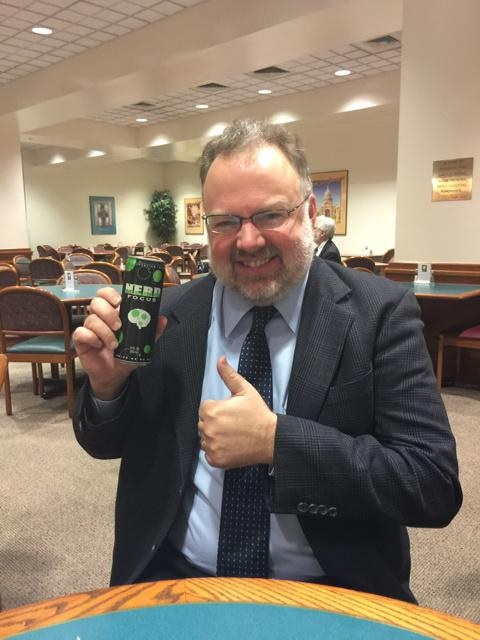
(Guest Post by Matthew Ladner)
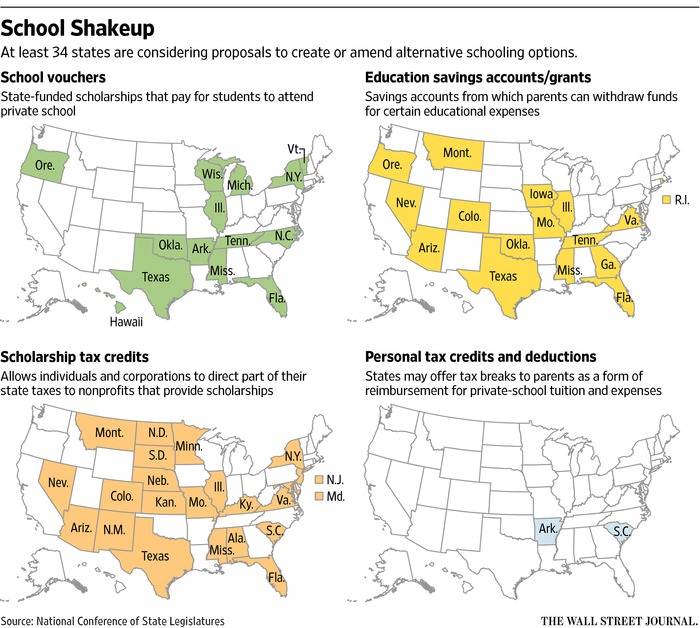
The cafeteria in the Texas Legislature is the only source I know of for NERD FOCUS…the most powerful energy drink on the planet. It’s a good thing they have it, because I needed it during a two hour panel testimony in the Senate Education Committee. Bonus chart from the WSJ on the school choice action:
Leave a Comment » | Uncategorized | Tagged: Nerd Focus, Texas school choice | Permalink
Posted by matthewladner

The storm of a scandal at the University of Texas at Austin has reached gale force winds. Two internal investigations and reporting by Texas media have revealed that the leadership of the university regularly intervened in the admissions process to ensure the acceptance of unqualified applicants connected to politically powerful figures in the state. University officials also attempted to mislead investigators to conceal or mis-describe their activities. And Wallace Hall, a trustee who tried to bring these corrupt practices to light, was threatened for his efforts with criminal indictment by a grand jury and impeachment by state legislators, some of whom were the beneficiaries of preferential admissions.
Charles Miller, a former Chairman of the Board of Regents of the University of Texas Systsem, sent the following letter to the current Regents, Chancellor, and a Review Committee. I re-print it here with his permission.
—————————————————
To: Committee to Review Admissions Practices at UT Austin
From: Charles Miller, Former Chairman, UT System Board of Regents
This memo is an attempt to offer an independent and informed opinion about the direction of admissions policy at the University of Texas at Austin.
It is patently clear that there should be a strong firewall in the admission function between the office of the president and the operation of the admissions office once broad policies are set in an open and publicly transparent process.
The firewall is not only a sound administrative structure but allows an admissions policy to be implemented with a minimal likelihood of improper influence and with a high degree of public confidence and trust.
There can be no ignoring the fact that the level of confidence and trust in admissions at UT Austin has not only been badly damaged by the recent admissions practices of the Powers administration but by the repeated efforts necessary to uncover what seems to have been going on in admissions. As the Dallas Morning News characterizes it: “Those questionable situations include the admissions scandal that led to Powers planned resignation”
What was going on? Specially tagged candidates based on interventions from ‘powerful’ people; special lists developed by the president outside of any of the official procedures; active and forceful intervention by the president and his staff in admissions decisions; destruction of admissions records; legal and public descriptions of the admissions process which were knowingly incomplete and inaccurate; and the admission of students —some severely unqualified— for purposes of gaining some sort of favor from a special class of privileged people.
The strong resistance from public policy makers and so-called supporters of UT Austin to uncovering what was happening protected an administration engaged in willful misconduct and can only have worsened the public’s perception of a great university.
Considering the practices uncovered [i]t’s difficult to understand why these officials and alums were so loud and derisive to the people trying to uncover the improprieties and why they were so vociferous in their demands for a narrow investigation. That implies it’s not yet clear that everything has surfaced that needs to become public.
Even now, as serious new legal issues are being raised in federal courts and new attempts are being made in the Texas Legislature to limit proper inquiry by regents doing their fiduciary duties, there has still been no one held accountable.
In the federal courts, these improper admissions activities will bring sustained attention, in a negative way, to UT Austin. And it will also bring continued attention to the U.T. System until there is personal accountability attached to these actions.
The leaders of the UT System seem to hope the fallout from these improper activities will go away if they just ignore what transpired. Surprisingly there has been no official response from the Board of Regents regarding the two highly negative reports resulting from investigations by Kroll Associates and the Texas Attorney General. The UT System administration has not even taken a public position challenging the rationale for this improper admissions behavior which is tantamount to approving of it.
What was the rationale presented for this behavior? ‘Everybody does it.’ ‘There were only a small number of cases.’ ‘It was done only for the long term benefit of the university.’ ‘Only the president is able to make these judgments and these decisions.’
On the face, these are ludicrous arguments, so defensive in nature as to constitute an admission of bad practices.
However, these unanswered excuses create serious issues for designing an appropriate admissions structure and the committee must offer policy proposals which respond strongly to these defenses.
Most serious, the claim that ‘everybody does it’ besmirches the integrity and dedication to duty of the entire academic community. It’s simply a monumental falsehood and deserves the sharpest of reprimands from the committee, the broader academic community and the U.T. System.
The number of cases was not ‘small’. Otherwise, why did they go to so much trouble to engage in these activities and why try so vigorously to conceal them?
If the numbers were so small, how can this be so important for the long term benefit of the university?
If these admissions were so important as to influence powerful parties for the long term benefit of the university, how can this not be improperly trading something of value for something else of value?
The most arrogant of the excuses is that the president is the only one who can make difficult admissions decisions. This is again patently false. For example, there are well defined processes under which the university can receive gifts, describing how those gifts can be used. These decisions are put through an onerous review process, transparent and focused on the mission of the university and maintaining its independence and integrity.
Presidents are neither omniscient nor infallible. Good structures start with those assumptions. A sound admissions process can include the president’s appointing personnel to implement policy developed by the president and the administration with the approval of the Board of Regents and with a firewall in implementation at the point at which prospective students are offered admission.
Under these challenging circumstances where there has been evidence of misconduct, it is imperative that UT Austin put in place a highly transparent system for admissions, visibly removing any possibility of the recent behavior being repeated.
Respect for this great university is continuing to be damaged. Trust can only be restored and maintained by utilizing a strong form admissions firewall and by regular, self critical oversight by the UT System.
2 Comments | Uncategorized | Permalink
Posted by Jay P. Greene
I was slow to warm up to House of Cards. I’ve grown so tired of the anti-heroes presented in shows like Sopranos, Breaking Bad, and Dexter, that I couldn’t muster much enthusiasm for Frank Underwood. Even worse, House of Cards is about politics and I study and follow politics for work, do I really need more politics in my entertainment?
But then I realized that House of Cards is not about politics at all. It doesn’t portray how the political world really operates. Instead, it indulges a fantasy of how some people wish the world works. Despite the Machiavellian amorality of the main characters, House of Cards offers the fantasy that someone is actually pulling the levers of power and able to get things done. People don’t want reporters pushed in front of trains or alcoholic Congressmen asphyxiated in their cars, but they do want to imagine that someone understands what is going on, is able to devise effective plans, and can control events.
During the first season when Frank was championing an education reform bill, I overheard several DC-EduBubble-types express admiration for how Frank Underwood managed to roll over the teachers unions and abolish tenure. They don’t want to be Frank, but they want to imagine that’s it’s possible to accomplish what Frank can, perhaps without the icky stuff. Since their centralized, technocratic solutions require the conviction that smart individuals can fully-grasp and control events, House of Cards shows them the world they hope exists.
The reality is that politics looks a lot more like Veep than like House of Cards. The characters in Veep are smart, but their vanity, pettiness, and the inherent unpredictability of the world stymies their efforts to grasp or control events. They’re silly little monkeys in power suits pretending to be in charge of the zoo. And it’s hilarious.
Veep is far more entertaining than House of Cards, especially this 3rd season that was just released. The 3rd season didn’t even continue to deliver on the fantasy of competence and control. As Nick Gillespie wrote in a brilliant review in The Daily Beast:
House of Cards is going softer than President Frank Underwood’s gut…. Even more disappointing is the devolution of First Lady Claire Underwood (Robin Wright) from a ruthless operator who puts Agrippina the Younger to shame into a latter-day Lady Macbeth filled with doubts about her and her husband’s patently unredeemable actions. “We’re murderers, Francis,” she says at one point in the new season—as if that’s a bad thing.
But even at its peak, House of Cards is far less appealing than Veep. House of Cards is to politics as porn is to romance. There is a certain base appeal, but it is superficial and fleeting. Veep, on the other hand, is remarkably truthful in its ridiculousness. My belly hurts with laughter as I watch Veep — much like when I read the similarly ridiculous Twitter feeds of the EduPundits.
1 Comment | Uncategorized | Permalink
Posted by Jay P. Greene
There’s an old joke that goes:
Q: Did you hear the one about the feminist?
A: [Pause, stare, and answer angrily] It isn’t funny.
Well, that’s no longer true. Feminists are now funny. Really funny. And they aren’t just getting laughs, they are advancing the cause of feminism with the power of humor.
I argued for the progressive power of humor when I nominated Fasi Zaka for the Al Copeland Humanitarian Award for mocking the Taliban. But the wonderful new Netflix comedy series, The Unbreakable Kimmy Schmidt, goes far beyond mocking its antagonists a la The Daily Show and its groupthink smugness. Unbreakable can preach beyond its choir by mocking its heroes as well as its villains.
The Reverend Richard Wayne Gary Wayne who imprisoned a group of women in his bunker is ripe for ridicule as are the women who preferred the simplicity of remaining there or who exploited their status as “mole women” to get money and attention. You can’t advance the cause of women without at least acknowledging and joking about the common mistakes women make in addition to mocking the troglodytes who oppress them.
But Kimmy is determined to move beyond her mole woman past and make it on her own in New York City. She really is unbreakable. Unlike 1970s songs about women’s power, like “I Will Survive” or “I am Woman,” the assertion that Kimmy is unbreakable is not a wish that stands at odds with current experience. She continues to suffer, make mistakes, and face obstacles, but she moves forward 10 seconds at a time. She is a fully realized feminist heroine.
And because she and by extension other women have finally made it, they are strong enough to be the butt of jokes. The humorlessness of the earlier feminist movement was a sign of its weakness. If you’re too insecure and weak, you can’t afford to be made fun of. I’m glad to report that the women’s movement has matured and strengthened to the point where it can dish it as well as take it.
2 Comments | Uncategorized | Permalink
Posted by Jay P. Greene

(Guest Post by Matthew Ladner)
Good write up in the WaPo wonkblog on Robert Putnam’s new book. Obvious resonance with Charles Murray’s book Coming Apart. In fact Murray had some “scissor graphs” of his own:

This bit from the WaPo article was especially poignant:
Lola and Sofia, as Putnam names them (all of the ethnography subjects in the book are anonymous), have navigated life without coaches, pastors, tutors, friends’ parents, counselors, neighbors, community groups, parents’ co-workers and family friends. They feel abandoned even by the one group of adults we like to think poor kids can always count on — their teachers.
“In junior high,” Lola, the older sister, explains to Putnam’s team, “the teachers actually cared.”
“In high school, teachers don’t care,” Sofia says.
“The teachers would even say out loud that they get paid to be there,” Lola says.
“Just to be there,” Sofia says. “Just to babysit.”
“Yeah,” Lola adds, “that they’re there just to babysit, that they don’t care if we learn or not.”
They believe the honors classes at their high school got all the good teachers, but they don’t understand how students were chosen for those classes. Only the smart kids, they say, were told about the SATs. They tried to join after-school activities — the very venue where they might find structure and mentors — but Lola was told her reading wasn’t good enough for a reading club, and Sofia that her grades weren’t high enough to play volleyball.
Through their eyes, coaches and teachers were gatekeepers who extended opportunity only to chosen students.
Their view of the world around them is a deeply lonely one. And it exposes an inverse reality among the privileged that Putnam admits he did not previously see even in the lives of his own children: Take away the parents who drive you to soccer, the peers you know who went off to college, the neighbor who happens to need a summer intern — and childhood is bewildering. A task as simple as picking the right math class becomes another trapdoor to failure.
The privileged kids don’t just have a wider set of options. They have adults who tailor for them a set of options that excludes all of the bad ones.
Meanwhile, for a child like Sofia, “she’s just completely directionless, because life happens to her,” Putnam says. “What she’s learned her whole life is that life is not something you do, it’s something you endure.”
Before you rush off to use poverty as a blanket excuse for the failings of the public school system, let me note the following: many of today’s poor children had multiple generations of ancestors who had the opportunity to attend public schools that were funded generously compared to schools around the world. Ideally public education serves as an agent of class mobility, but obviously we have been getting far less of this than desired. The costs of the failures of our social institutions-including but certainly not limited to our educational institutions-seem to be compounding over time.
3 Comments | Uncategorized | Tagged: Charles Murray, Coming Apart, Our Kids: The American Dream in Crisis, Robert Putnam | Permalink
Posted by matthewladner
You are currently browsing the archives for the Uncategorized category.

 Jay P. Greene's Blog