Competition Is Healthy for Public Schools

December 9, 2015

Competition Benefits Public Schools

[Guest Post by Jason Bedrick]

As more North Carolina families are using school vouchers, enrolling their children in charter schools, or homeschooling, some traditional district schools are experiencing slower growth in enrollment than anticipated. The News & Observer reports:

Preliminary numbers for this school year show that charter, private and home schools added more students over the past two years than the Wake school system did. Though the school system has added 3,880 students over the past two years, the growth has been 1,000 students fewer than projected for each of those years.

This growth at alternatives to traditional public schools has accelerated in the past few years since the General Assembly lifted a cap on the number of charter schools and provided vouchers under the Opportunity Scholarship program for families to attend private schools.

Opponents of school choice policies often claim that they harm traditional district schools. Earlier this year, the News & Observer ran an op-ed comparing choice policies to a “Trojan horse” and quoting a union official claiming that “public schools will be less able to provide a quality education than they have in the past” because they’re “going to be losing funds” and “going to be losing a great many of the students who are upper middle-class… [who] receive the most home support.”

Setting aside the benefits to the students who receive vouchers or scholarships (and the fact that North Carolina’s vouchers are limited to low-income students and students with special needs), proponents of school choice argue that the students who remain in their assigned district schools benefit from the increased competition. Monopolies don’t have to be responsive to a captive audience, but when parents have other alternatives, district schools must improve if they want to retain their students. But don’t take their word for it. Here’s what a North Carolina public school administrator had to say about the impact of increased competition:

New Wake County school board Chairman Tom Benton said the district needs to be innovative to remain competitive in recruiting and keeping families in North Carolina’s largest school system. At a time when people like choice, he said Wake must provide options to families.

“In the past, public schools could assign students to wherever they wanted to because parents couldn’t make a choice to leave the public schools,” Benton said. “Now we’re trying to make every school a choice of high quality so that parents don’t want to leave

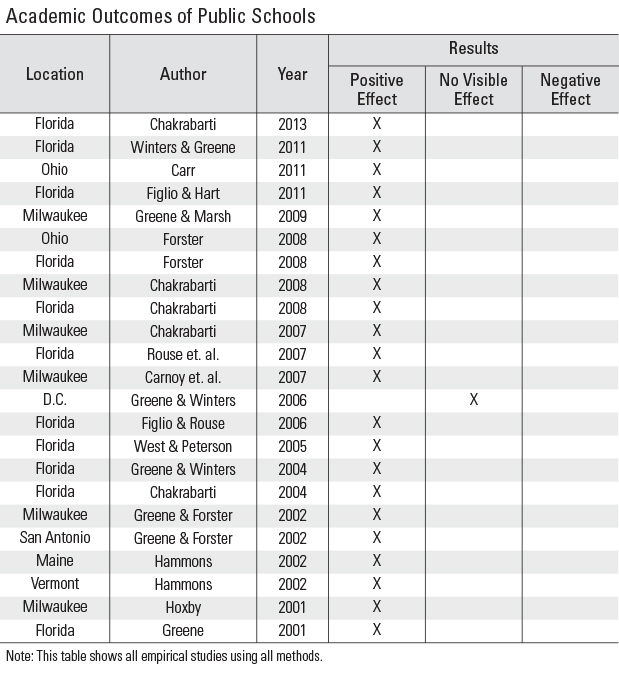
Wake County is not unique in this regard. As readers of this blog surely know (and as I’ve written elsewhere), there have been 23 empirical studies investigating the impact of school choice laws on the students at district schools. As shown in the chart below, 22 of those studies found that the performance of students at district schools improved after a school choice law was enacted. One study found no statistically significant difference and none found any harm.

Academic Outcomes of Public Schools in Response to Competition

Beating district schools over the head with more and more top-down regulations has done little to improve quality. A better approach is bottom-up: empower parents with alternatives and give district schools the freedom to figure out how to provide a quality education that will persuade parents to choose them.

[A version of this post was originally published at Cato-at-Liberty. Hat tip to Dr. Terry Stoops of the John Locke Foundation for the story from New Wake County. Thanks to Bob Bowdon of Choice Media for the image.]


Ensuring Scholarship Continuity

December 8, 2015

[Guest Post by Jason Bedrick]

In a recent Friedman Foundation blog post I coauthored with Lindsey Burke of the Heritage Foundation and Friedman’s own Robert Enlow, we argued that the government should not prohibit mission-specific (e.g. – Catholic or Montessori) scholarship-granting organizations from participating in tax-credit scholarship programs. We offered both principled and pragmatic reasons for opposing such a policy.

Simply put, private organizations should have the right to set their own institutional mission and donors should be free to choose to support those that align with their values. Moreover, prohibiting mission-specific scholarship organizations could reduce the overall level of scholarship funding because some donors would prefer to support only certain types of education to the exclusion of others. And, as it happens, the largest scholarship-granting organization (SGO) operating in each state with a scholarship tax credit law tends to be the type that grants scholarships to any eligible student to attend any qualifying school.

However, proponents of the universal model offer a strong objection. We all want to ensure that every child has access to the school that best meets his or her needs, but where there is a cap on the total amount of tax credits offered, students might lose their scholarships if the SGO upon which they relied fails to claim the requisite amount of tax credits before other SGOs do. When SGOs in Georgia hit the total tax-credit cap almost immediately after the fundraising period commenced, some SGOs were unable to continue providing scholarships for many of the low-income students that they had been funding previously. Wouldn’t it be better to require that SGOs fund students attending any school of their choice?

I have several responses to this challenge:

  1. The main problem here is that the tax-credit cap is too low. One reason competition in a free market is healthy is that it can expand the size of the economic pie. Unfortunately, tax-credit caps create a zero-sum game. If the cap is not high enough, the growth of one SGO comes at the expense of others. In Georgia and several other states, there is much greater demand for scholarships than there is funding for those scholarships. Raising the cap, therefore, should be the primary goal of school choice groups in Georgia and in other states that might be facing similar issues. But assuming the cap cannot be raised sufficiently…
  2. The market can solve this problem, although it is not guaranteed. A similar issue arose in Arizona when a new and well-funded SGO entered the state, thereby depriving other SGOs of credits upon which they were depending. I am told that the new SGO gave priority to students that had previously received tax-credit scholarships but who were unable to obtain funding that year. That said, there is no guarantee that SGOs will work together like this, and it seems that some low-income students in Georgia lost their scholarships, so perhaps a policy solution is necessary to address such situations.
  3. The universal model doesn’t necessarily solve this problem. In a state with multiple SGOs that all fund students attending any school their family chooses, it would still be possible for one SGO to experience a drop in funding that causes them to grant smaller and/or fewer scholarships. Again, it’s possible the other SGOs would step in and prioritize students who lost their scholarships, but it’s also possible that they would fund students on their waiting lists first, and some students would still lose their scholarships. This is one reason that some groups would prefer to have a single SGO in each state, but the monopoly model is fraught with other dangers, and even there, the lone SGO might see a decrease in fundraising one year, which would mean granting smaller and/or fewer scholarships.
  4. There are other ways to address this problem that don’t entail the government excluding mission-specific SGOs. As noted above, tax-credit caps create a zero-sum game. Fortunately, there are ways to design a scholarship tax credit program to mitigate the problems that tax-credit caps create. One approach would be to “grandfather” credits to existing SGOs for a certain period of time before opening them up to other SGOs to claim. For example, an SGO that raised $500,000 in tax-credit-eligible donations one year would have six months in the following year to raise an equal amount. After that point, any credits their donors did not claim would be open for other SGOs, along with any new credits available if the credit cap increased. The “grandfathering” approach would prevent SGOs from losing funding to competition due to the credit cap, though if the SGO was unable to raise funds for another reason (e.g. – a large donor went out of business, there was a scandal, etc.), it’s still possible that some students could lose their scholarships. (Then again, the same things could happen in a state with the universal model.)

In a perfect world, every child would have access to the education that best meets his or her needs. Sadly, the world we live in is far from that ideal and even the best educational choice policies have not yet attained it. For the foreseeable future, it’s trade-offs as far as the third eye can see.

When attempts to solve problems that arise put two ideals in tension (e.g. – universal access vs. the autonomy of private organizations), education reformers should strive as much as possible to find a solution that preserves both. There is no way to guarantee that no student will ever lose his or her tax-credit scholarship, but I believe the approach I outlined above in Point 4 mitigates that risk as much as possible. It also preserves the autonomy of SGOs while education reformers work toward lifting the tax-credit caps and ensuring universal access to a quality education.


The School Choice Information Problem

December 8, 2015

puzzle-pieces-1-1426443

(Guest post by Greg Forster)

OCPA’s Perspective carries my article on the school choice information problem:

“I support school choice,” some education policymakers say, “but we need to make sure parents choose good schools!” In order for parents to choose good schools, of course, they need good information. Not information from government bureaucracies—which have a long track record of measuring the wrong things and deceiving parents—but from emerging resources such as Great Schools, Global Report Card, School Grades, and more. Better information, not tighter regulation, is the best way to let parents improve school quality.

I note a remarkable reversal – the blob used to heap contempt on parents but is now rushing to position itself as allies of beleagured parents against reforms run amok; reformers, meanwhile, who used to champion parents have suddenly begun heaping contempt on parents’ capacities to make good choices for their own children:

There are several reasons for these changes. One is the collapse of the school monopoly’s credibility…

A more important reason is the greatly increased political success and attractiveness of school choice itself…This has brought school choice new allies—allies who aren’t yet completely comfortable with the idea…

It has also meant that the limitations of school choice in its current form are becoming more visible…

Parents need good information to make good choices, and the school choice movement is going to have to take an interest in pushing the existing information structures to the next level if it hopes to make more people comfortable with the idea of parents as the locus of school accountability.

As always, your thoughts and responses are welcome!


Shadow Secretary Hilary Benn Makes the Case for British Airstrikes in Syria

December 4, 2015

(Guest Post by Matthew Ladner)

Watch this…like right now! All the way to the end.

The resolution passed. Within four hours of the vote ISIS positions in Syria endured their first strike by British forces.


The New Education Philanthropy

December 2, 2015

The New Education Philanthropy

Yesterday, Harvard Education Press officially released The New Education Philanthropy, a volume edited by Rick Hess and Jeff Henig.  The book is a follow-up to one Rick edited a decade earlier, With the Best of Intentions.

Empirical analysis and constructive criticism of the role of foundations in education is hard to come by.  There are few professional rewards and significant risks in trying to analyze foundations and offer suggestions for improvement.  Foundations are accustomed to criticism, but much of it comes from people opposed to the idea that foundations should influence the education system, so foundations tend to classify all criticism as hostile and tune it out.  Folks not opposed to the mission of foundations tend to want funding from them and so tend to censor themselves when they might have analysis and criticism to offer.  In addition, foundations generally limit channels of communication from their friends for fear of being unduly lobbied by them for funding.

The ironic result is that foundations seeking to improve learning have virtually no mechanisms for learning about themselves and making their own improvements.  They generally don’t want to know.  They don’t want to hear the rantings of those who hate them and they don’t want to be influenced by the flattery and manipulations of those who love them.  But there is a third type of person that they have difficulty recognizing — someone who wants to help them by offering independent analysis and criticism.

This is why books like The New Education Philanthropy and With the Best of Intentions only come along every decade or so.  Few foundations will provide any support for independent empirical and critical examination of their efforts and few scholars are willing to engage in this type of work.  Even if someone else pays, few foundations are willing to engage in conferences, panel discussions, and written exchanges about their own efforts.  They tend to be as defensive and insular as presidential campaigns and are often operated as if that is what they are rather than learning organizations.

This is why books like The New Education Philanthropy and With the Best of Intentions are so important.  There is much that education philanthropies and others could learn from these volumes.  My chapter in the first book, “Buckets into the Sea,” examined the extent of philanthropic activity in education relative to public funding.  I found that all private giving to public K-12 schools, from the bake sale to the Gates Foundation, amounted to less than one-third of 1% of annual spending.  It’s basically rounding error.  A billion dollars feels like a lot of money to you, me, and the folks at foundations, but to a public school system spending over $600 billion annually it is not nearly enough to get them to do things that they don’t already want to do nor enough to purchase things that they can’t already buy.

So, foundations lack the resources to purchase education reform through the sheer force of their money.  In the chapter I wrote a decade ago, I suggested that if foundations wanted to change the education system they would have to engage in policy change to re-direct how the much larger pool of public resources is spent.

Around the same time that my chapter was published in With the Best of Intentions, many large foundations started to change their strategy to focus on policy advocacy.  Unfortunately, just as foundations failed to grasp the limitations of their fiscal resources, they also failed to understand how limited their political resources are as well.  This prompted my new chapter, “Buckets into Another Sea,” in The New Education Philanthropy.

Foundations have enough money to dominate the conversation of a few hundred people engaged in policy research and advocacy, but they don’t have enough resources to achieve enduring policy change without backing policies that generate their own constituency.

If expanding school choice creates tens of thousands of beneficiaries who are willing to rally on the steps of the capitol, they can create self-sustaining policy change.  But if foundations back policies that generate few natural constituents, then those policies are difficult to get adopted and even harder to keep over time.  There are no rallies for using test scores to evaluate teachers.  There are no rallies for common standards, assessments, and the “instructional shifts” they require.  Whatever the merit of these policies, foundations lack the political resources to achieve them without genuine constituents who will fight for them independent of foundation funding.

Check out The New Education Philanthropy and With the Best of Intentions to see what other insights folks have to offer.  We may not be right, but an honest and open discussion about effective strategies for foundations is sorely needed.


Non-Cog Measures Not Ready for Accountability

December 1, 2015

Anna Egalite, Jonathan Mills, and I have a new study in the journal, Improving Schools, in which we administer multiple measures of “non-cognitive” skills to the same sample of students to see if we get consistent results.  We didn’t.

How students performed on a self-reported grit scale was uncorrelated with behavioral measures of character skills, like delayed gratification, time devoted to solving a challenging task, and item non-response.  These are all meant to capture related (although not identical) concepts, so they should correlate with each other.  The fact that they don’t suggests that we still have a lot of work to do to refine our understanding of character skills and how best to measure them.

Angela Duckworth, who developed the self-reported grit scale, and David Scott Yeager, who is a pioneer in measuring growth-mindset, have been trying to warn the field that these measures are still in their infancy.  They have an article in Educational Researcher and have been giving interviews emphasizing that while non-cog skills appear to be a very important part of later life success, our methods of measuring these concepts are still not very strong — certainly not strong enough to include in school accountability systems.

Our research showing the lack of relationship between behavioral and self-reported measures of character skills adds to the case for caution in using these measures for evaluation or accountability purposes.  Remember, it took decades of research and practice to develop reliable standardized tests.  A similar effort and patience will be required to develop reliable measures of character skills.  And I suspect that even improved measures may be useful for research purposes but never robust enough to use for accountability.

Ed reformers can be dangerous if they are too much in a hurry.  We unfortunately want to apply every new insight right away and lack patience for the careful development of policies and practices for long-term benefit.  We also invest few resources in basic research that is essential for long-term gains.  According to my analysis in a chapter in a new book edited by Rick Hess and Jeff Henig on education philanthropy, the largest education foundations only devote 6% of their funding toward research.  And most of that research may really be short-term policy advocacy masquerading as research.  The federal government is little better at making funds available for basic research.

Non-cog or character skills are incredibly important but if we are going to use these and other ideas to improve education, we are going to need a significant shift toward funding research and greater patience to bring those ideas to fruition.


Anti-Semitism and Religious Schools

November 18, 2015

Yesterday AEI hosted an event at which I presented a new paper by Cari A. Bogulski and me examining the relationship between the type of school people attended when they were children and their attitudes toward Jews as adults.  We find that the more people attended religious private schools as children, the less anti-Semitic they are.  Secular private schools resemble public schools in the average level of anti-Semitism among their former students.

Of course, we were not able to randomly assign people to different types of school, so we cannot be confident that this relationship is causal.  But the relationship holds true after controlling for a variety of background characteristics.  It is still possible that adults who attended religious schools have more favorable attitudes toward Jews because of unobserved advantages but this seems unlikely given that the generally more advantaged families who send children to non-religious private schools do not appear to yield lower anti-Semitism.  And we do not typically think of families who choose to send their children to mostly Christian religious schools as doing so because of a particular affinity toward Jews .

Why might religious schooling be associated with lower anti-Semitism?  Prior research has found a general link between private education and higher tolerance, so this may just be consistent with that.  But the fact that the effect is restricted to religious schools is somewhat unexpected.  Perhaps religious institutions that operate schools, most of which are Christian, have adopted a much more favorable orientation toward Jews than is widely appreciated.

Many Jewish organizations have been slow to recognize that historically hostile groups may now be allies (and some traditional allies may be turning more hostile). Perhaps these findings may motivate several Jewish organizations to reconsider their opposition to private school choice programs.

For more details be sure to read the paper and watch the video above.


More on the Over-Confidence of Portfolio Management

November 14, 2015

Actually, it was Friedrich Hayek who said this, but this image seemed a lot funnier.  Hayek — the economist with the funny mustache, not the movie star — was briefly a professor at the University of Arkansas before going on to the University of Chicago and winning a Nobel Prize.  Go Hogs!  As far as I know, Salma Hayek has never taught at the University of Arkansas and has also never won a Nobel Prize.  I think we can all see the causal connection.

While we are on the topic of the difficulty of drawing causal connections and being reminded of how little we know about what we imagine we can design, I’d like to add another piece of evidence to my previous post on “The Over-Confidence of Portfolio Management.” The central idea of portfolio management is to identify and close under-performing schools while opening and expanding higher quality schools.

The problem I noted in my previous post, is that portfolio management (PM) does not have a reliable tool for identifying which are the “good” and “bad” schools.  In New Orleans they identify “bad” schools based on the state’s school grading system, which is determined almost entirely by the level of student achievement on math and reading tests (and almost not at all on the growth in learning).  There is no reason to believe that schools with low levels of scores are “bad” schools, so there is no reason to believe that portfolio management is effectively identifying and closing  bad schools.  And if PM in NOLA can’t effectively distinguish between good and bad schools, there is no reason to believe that whatever progress has been made in New Orleans is due to portfolio management.

But this is not holding back PM supporters from adopting portfolio management as the “best practice” and hoping to implement it in Detroit and elsewhere.  They’re confident that they can identify bad schools for closure by focusing on growth in standardized test results, even if that was not what was done in NOLA.  The problem I noted in my last post is that even annual growth in test performance does not seem to be strongly predictive of later-life success.  Looking at 7 rigorous studies of long-term outcomes for charter and private school choice programs, we find that programs that produce large test score gains produce little or no gain in educational attainment while other programs with modest or no gains in test scores make large gains in high school graduation, college attendance, and even workplace earnings.

Well, now we have an 8th rigorous study and it fits the same pattern as the previous 7.  Joshua M. Beauregard’s Harvard doctoral thesis examines college outcomes for students applying by lottery for admission to High Tech High (HTH) School in San Diego.  High Tech High is a widely-lauded charter school that receives significant financial support from many of the big education reform foundations.  It’s a model of the kind of school that portfolio managers are supposed to open and expand.

So what is the effect of HTH on whether its students attend college?  Beauregard finds: “I detect no impact on the probability of enrollment in college of any type, which includes two-year and four-year colleges, for my aggregate sample. My estimates are consistent when including baseline demographics and ELA scores.” (p. 28) Similar to Angrist, et al’s results from studying “no excuses” charter schools in Boston, Beauregard does find that attending HTH seems to shift college-going students from two to four-year colleges, but it has no overall effect on post-secondary education.  He describes the increase in four-year college attendance as “statistically significant” although the results in Table 5 show that this is only at p<.1.  And we have no idea whether shifting students from 2 to 4 year colleges is good if students are unable to complete a 4 year degree. Beauregard also reports no increase in attendance at “competitive” four-year colleges as a result of attending High Tech High.

With HTH we have another example of a school of choice with impressive test score performance that does not produce commensurate improvements in long-term outcomes for students.  The central flaw of portfolio management is that the tool it uses to identify which schools should be closed and which should be opened and expanded is not well-connected with long-term success for students.  PM can’t improve outcomes for students by closing “bad” schools if it can’t accurately determine which are the bad schools.

Maybe Salma Hayek should explain to them “how little they really know about what they imagine they can design.”


Moynihan’s Moment

November 12, 2015

Daniel Patrick Moynihan was many things — scholar,  ambassador to India and then the United Nations, United States Senator, and, of course, he was an alum of Tufts University where he earned his bachelors, masters, and doctoral degrees.  He was author of The Negro Family: The Case For National Action, also known as the Moynihan Report, which examined the rise of single parenthood and its consequences, particularly for African-Americans.  Education Next recently devoted an entire issue to the Moynihan Report on the 50th anniversary of its release.

This week we are noting another anniversary.  It has been 40 years since Moynihan gave his passionate speech at the United Nations denouncing United Nations General Assembly Resolution 3379, which infamously asserted that “Zionism is a form of racism…”  The UN revoked that resolution in 1991, but its hateful legacy lives on at the United Nations and among anti-Semites everywhere.

His speech that Zionism is not racism was, as Gil Troy’s book calls it, Moynihan’s Moment.  On its 40th anniversary I thought I would reproduce key parts of that speech.  It’s remarkable not just for its content but also for its style.  Let’s hope that school children will also be taught to remember the legacy of Daniel Patrick Moynihan and that current and future leaders may be inspired to uphold his ideals.

Speech to the United Nations General Assembly, by U.S. Ambassador to the U.N. Daniel Patrick Moynihan, November 10, 1975. Source: U.S. Congressional Record.

The United States rises to declare before the General Assembly of the United Nations, and before the world, that it does not acknowledge, it will not abide by, it will never acquiesce in this infamous act.

Not three weeks ago, the United States Representative in the Social, Humanitarian, and Cultural Committee pleaded in measured and fully considered terms for the United Nations not to do this thing. It was, he said, “obscene.” It is something more today, for the furtiveness with which this obscenity first appeared among us has been replaced by a shameless openness.

There will be time enough to contemplate the harm this act will have done the United Nations. Historians will do that for us, and it is sufficient for the moment only to note the foreboding fact. A great evil has been loosed upon the world. The abomination of anti-semitism — as this year’s Nobel Peace Laureate Andrei Sakharov observed in Moscow just a few days ago — the Abomination of anti-semitism has been given the appearance of international sanction. The General Assembly today grants symbolic amnesty — and more — to the murderers of the six million European Jews. Evil enough in itself, but more ominous by far is the realization that now presses upon us — the realization that if there were no General Assembly, this could never have happened.

As this day will live in infamy, it behooves those who sought to avert it to declare their thoughts so that historians will know that we fought here, that we were not small in number — not this time — and that while we lost, we fought with full knowledge of what indeed would be lost.

Nor should any historian of the event, nor yet any who have participated in it, suppose, that we have fought only as governments, as chancelleries, and on an issue well removed from the concerns of our respective peoples. Others will speak for their nations: I will speak for mine….

The proposition to be sanctioned by a resolution of the General Assembly of the United Nations is that “Zionism is a form of racism and racial discrimination.” Now this is a lie. But as it is a lie which the United Nations has now declared to be a truth, the actual truth must be restated.

The very first point to be made is that the United Nations has declared Zionism to be racism — without ever having defined racism. “Sentence first — verdict afterwards,” as the Queen of Hearts said. But this is not wonderland, but a real world, where there are real consequences to folly and to venality….

What we have here is a lie — a political lie of a variety well known to the twentieth century, and scarcely exceeded in all that annal of untruth and outrage. The lie is that Zionism is a form of racism. The overwhelmingly clear truth is that is it not.

The word “racism” is a creation of the English language, and relatively new to it…. The term derives from relatively new doctrines — all of them discredited — concerning the human population of the world, to the effect that there are significant biological differences among clearly identifiable groups, and that these differences establish, in effect, different levels of humanity. Racism, as defined in Webster’s Third New International Dictionary, is “The Assumption that . . . traits and capacities are determined by biological race and that races differ decisively from one another.” It further involves “a belief in the inherent superiority of a particular race and its right to dominate over others.”…

Now it was the singular nature — if, I am not mistaken, it was the unique nature — of this [Zionist] national liberation movement that in contrast with the movements that preceded it, those of that time, and those that have come since, it defined its members in terms not of birth, but of belief. That is to say, it was not a movement of the Irish to free Ireland, or of the Polish to free Poland, not a movement of the Algerians to free Algeria, nor of Indians to free India. It was not a movement of persons connected by historic membership to a genetic pool of the kind that enables us to speak loosely but not meaninglessly, say, of the Chinese people, nor yet of diverse groups occupying the same territory which enables us to speak [o]f the American people with no greater indignity to truth. To the contrary, Zionists defined themselves merely as Jews, and declared to be Jewish anyone born of a Jewish mother or — and this is the absolutely crucial fact — anyone who converted to Judaism. Which is to say, in terms of International Convention on the Elimination of All Forms of Racial Discrimination, adopted by the 20th General Assembly, anyone — regardless of “race, colour, descent, or nationally or ethnic origin …..”

The state of Israel, which in time was the creation of the Zionist Movement, has been extraordinary in nothing so much as the range of “racial stocks” from which [it has drawn its citizens.  There are black Jews, brown Jews, white Jews, Jews from the] Orient and Jew[s] from the West. Most such persons could be said to have been “born” Jewish, just as most Presbyterians and most Hindus are “born” to their faith, but there are many Jews who are …converts. With a consistency in the matter which surely attests to the importance of this issue to that religio[u]s and political culture, Israeli courts have held that a Jew who converts to another religion is no longer a Jew. In the meantime the population of Israel also includes large numbers of non-Jews, among them Arabs of both the Muslim and Christian religions and Christians of other national origins. Many of these persons are citizens of Israel, and those who are not can become citizens by legal procedures very much like those which obtain in a typical nation of Western Europe.

Now I should wish to be understood that I am here making one point, and one point only, which is that whatever else Zionism may be, it is not and cannot be “a form of racism.” In logic, the State of Israel could be, or could become, many things, theoretically, including many things undesirable, but it could not be and could not become racism unless it ceased to be Zionist.

Indeed, the idea that Jews are a “race” was invented not by Jews but by those who hated Jews. The idea of Jews as a race was invented by nineteenth century anti-semites such as Houston Steward Chamberlain and Edouard Drumont, who saw that in an increasingly secular age, which is to say an age made for fewer distinctions between people, the old religio[u]s grounds for anti-semitism were losing force. New justifications were needed for excluding and persecuting Jews, and so the new idea of Jews as a race — rather than as a religion — was born. It was a contemptible idea at the beginning, and no civilized person would be associated with it. To think that it is an idea now endorsed by the United Nations is to reflect on what civilization has come to.

It is precisely a concern for civilization, for civilized values that are or should be precious to all mankind, that arouses us at this moment to such special passion. What we have at stake here is not merely the honor and the legitimacy of the State of Israel — although a challenge to the legitimacy of any member nation ought always to arouse the vigilance of all members of the United Nations. For a yet more important matter is at issue, which is the integrity of the whole body of moral and legal precepts which we know as human rights.

The terrible lie that has been told here today will have terrible consequences. Not only will people begin to say, indeed they have already begun to say that the United Nations is a place where lies are told, but far more serious, grave and perhaps irreparable harm will be done to the cause of human rights itself. The harm will arise first because it will strip from racism the precise and abhorrent meaning that it still precariously holds today.

An audio of the full speech can be found here:


5th Circuit Court Rejects “Disingenuous” DOJ Anti-School Choice Lawsuit

November 10, 2015

[Guest Post by Jason Bedrick]

For a few years, the Obama administration’s Department of Justice has been trying to shut down or at least seriously constrain Louisiana’s school voucher program. The DOJ unironically used anti-segregation laws to attack the school choice law, even though the DOJ’s “success” would mean keeping black kids in failing schools. After two studies showed that the voucher program actually improved integration, the DOJ backpedaled a bit but still went forward with its lawsuit to give the feds greater control over the voucher program.

That effort ended today.

According to our friends at the Goldwater Institute, which was defending the voucher program from the DOJ, the Fifth Circuit Court of Appeals today ruled against the DOJ. Here is their press release:

New Orleans—In a case with national implications for parental choice programs in hundreds of school districts that still are subject to federal desegregation decrees, today the Fifth Circuit U.S. Court of Appeals ruled that the U.S. Department of Justice can’t limit enrollment in a state private school scholarship program.

The Department of Justice was attempting to use an unrelated, decades-old desegregation case to assert federal jurisdiction over the state program. When it initially filed the case, DOJ asked for an injunction to block students in school districts under desegregation orders from using vouchers. DOJ backed off its request for an injunction, but pressed ahead with its case, placing a cloud of uncertainty over the school options for Louisiana scholarship families.

In the 2-1 decision written by Judge Edith Jones, the court referred to the Department of Justice’s tactics as “disingenuous,” purporting merely to seek information and enforce desegregation while “imposing a vast and intrusive reporting regime on the State without any finding of unconstitutional conduct.” The decision also called the process as “burdensome, costly, and endless.”

“This is a victory for minority and low-income schoolchildren, not only in Louisiana but around the country,” said Clint Bolick, vice president for litigation at the Goldwater Institute, which is representing the Black Alliance for Educational Options and voucher families. “The decision should put an end to efforts to use long-ago desegregation decrees to thwart educational opportunities for their intended beneficiaries, whether through vouchers or charter schools. The educational horizon just brightened.”

The Student Scholarships for Educational Excellence Program was created in 2012. The statewide program provides private school tuition vouchers to children from families with incomes below 250 percent of the poverty line and who otherwise would attend public schools that the state has graded C, D or F. In the 2013-14 school year, nearly 6,800 students were awarded scholarships, a 20 percent increase from the year before. More than 85 percent of the children receiving scholarships that year were African American, nearly twice their representation among the Louisiana public school population.

Bolick argued and won the Zelman v. Simmons-Harris case before the U.S. Supreme Court, upholding the constitutionality of school vouchers more than a decade ago. He now leads the litigation efforts at the Goldwater Institute’s Scharf-Norton Center for Constitutional Litigation. [emphasis added]

UPDATE: Here is the full decision (h/t Ze’ev Wurman). The challenge was actually an expansion of a 40-year-old desegregation lawsuit that the administration cynically used to attack Louisiana’s school voucher program. However, Judge Edith Jones wasn’t having it. Here she notes that there is no evidence that the voucher law impeded the desegregation effort:

Louisiana hired an expert to produce reports on the voucher program’s impact for the 2012–2013 and 2013–2014 school years. The expert, Christine Rossell, is a professor of political science at Boston University who has 26 years’ experience designing and analyzing school desegregation plans. For both school years facing scrutiny, she found that the program “had no negative effect on school desegregation in the 34 school districts under a desegregation court order.” The DOJ has produced no evidence to the contrary.

The circuit court overturned a lower court’s ruling on several grounds, including the lower court’s erroneous assumption that the voucher program is intended to aid private schools. In actuality, as the circuit court found, the vouchers aid students. Likewise, the point of SNAP is to aid poor people, not grocery stores, even though grocery stores benefit when people spend their SNAP funds there.

In the 1975 order, the district court retained continuing jurisdiction for the remedial purpose laid out in the order, which was to prevent future state aid to discriminatory private schools. For three reasons, the April 8 Order goes beyond correcting— and indeed has nothing to do with—the violation originally litigated in this case. First, the voucher program’s potential impact on desegregation orders for public schools in separate federal desegregation cases is distinct from eliminating public funding for discriminatory private schools. Second, the voucher program aid is for students rather than private schools. Finally, even if the voucher program aids private schools, it is not being given to discriminatory private schools. The district court’s order exceeded the constitutional infirmity on which this case was predicated and is therefore void. [emphasis added]

The court continues:

The state’s voucher program is also outside the scope of this case because it provides aid to students rather than to private schools. First, the voucher program allows students to state their preference for public or private schools on their applications. It is then the students’ choice to accept the state scholarship so no money is given to a school, public or private, without the approval of the students’ families. Second, the scholarship pays for the individual student’s education; it does not aid private school operations. That is made clear by the fact that the scholarship is capped at the amount the state would have spent on the child had the child attended a local public school. La. Rev. Stat. § 17:4016. The scholarship covers the marginal cost of educating an additional child.

Exactly so.

The court concludes that the DOJ was disingenuous:

DOJ’s attempt to shoehorn its regulation of the voucher program into an entirely unrelated forty-year-old case represents more than ineffective lawyering. Despite the district court’s contrary conclusion, it seems plain that DOJ’s expressed concern—how the voucher program affects statewide public schools racially—has nothing to do with the narrow issues considered in the Brumfield litigation. DOJ’s bold strategy, if upheld, would circumvent the ordinary litigation process…