 (Guest Post by Matthew Ladner)
When you have a Nobel Prize in economics, shouldn’t you refrain from making wild assertions easily dismissed with a casual amount of data analysis?
(Guest Post by Matthew Ladner)
When you have a Nobel Prize in economics, shouldn’t you refrain from making wild assertions easily dismissed with a casual amount of data analysis?
 4 Comments |
  teacher union | Tagged: Iowahawk, Paul Krugman |
  Permalink
 Posted by matthewladner

(Guest post by Greg Forster)
I’m catching up on this a little late, but ALELR has connected a couple of dots and drawn a picture of things at the UFT that can only make you say “Epic Facepalm.”
OK, you do remember the whole Cue Card Check scandal? At the time, Randi Weingarten was so embarrassed that she was forced to go out and claim she knew nothing about all this – cue cards? what cue cards? – and would “make some changes in the union.”
I missed this at the time, but last summer Elizabeth Green (who also broke the Cue Card Check story) reported that Marvin Reiskin, the UFT political director, had taken early retirement in the aftermath of the scandal. He was lined up for retirement at the end of the year anyway, but forcing him out early – even a month early – beats doing nothing. It sends an internal signal, however muted.
Obviously UFT had to be looking for a replacement who would restore credibility. Their number one priority after such a humiliation must have been to bring in someone who would restore adult supervision – and, more importantly, be seen to do so – show the watching world that the grownups were back in charge at UFT.
So get this: the person tapped to play that role was Paul Egan.

I think the question now becomes: why does UFT have an organizational culture in which people like this consistently rise to the top, no matter how strong the external incentives against it?
1 Comment | teacher union | Tagged: cue card check, Elizabeth Green, Greg Forster, Marvin Reiskin, Mike Antonucci, Paul Egan, Randi Weingarten, UFT | Permalink
Posted by Greg Forster
(Guest Post by Matthew Ladner)
Wisconsin Governor Scott Walker on the battle over collective bargaining:
Leave a Comment » | teacher union | Tagged: collective bargaining, Scott Walker, Wisconsin collective bargaining battle | Permalink
Posted by matthewladner
Let me clarify something about the series of posts we’ve had about Paul Egan (pictured in the undated photo found above).
We do not mean to mock the body-size of the teacher union leader who threw a fit at a fancy Albany restaurant with two dozen of his union colleagues because his portion of quail was too small (and who was previously caught cheating while proctoring exams). Frankly, I could care less how heavy people are (and could stand to lose some weight myself).
We aren’t mocking Egan because he is fat and ugly on the outside. We are mocking him for being fat and ugly on the inside… where it counts.
The current series of Egan posts is like the previous series of “cue card check” posts, where the UFT (in fact Egan’s predecessor as political and legislative director for the NY teacher union) actually provided questions on cue cards for city council members to ask union leaders during hearings and in the process incorrectly spelled stakeholder as “steakholder.” When the unions do something so stupid, with such brute force, and with such disregard for truth and decency it makes clear to all what they are really doing every day in stealing educational opportunities from children to advance their own adult interests. These things deserve a good mocking.
So, here’s to you, Paul Egan — a man who is a walking and living steakholder… along with an insufficient amount of quail.
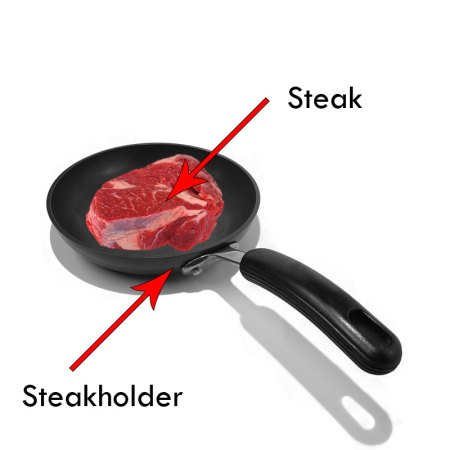
(Image source: http://kaaser.at)
1 Comment | teacher union | Permalink
Posted by Jay P. Greene
Teacher Union Political Honcho, Paul Egan, has an even better resume than I thought. In addition to his alcohol-fueled tizzy fit in a fancy restaurant with two-dozen other union hacks over the portion size (which is something that he may have a habit of doing), Egan also has the distinction of being caught cheating when proctoring exams as a middle school teacher in 1999.
According to the NY Daily News:
The special schools investigator fingered Egan, a social studies teacher, 11 years ago for his part in the cheating scandal. “Teacher Paul Egan used several different methods to cheat,” the investigator reported. The probe found he would tell students before a test to sharpen their pencils – and then depart, leaving the answers to the first 11 questions near the sharpener.
Because he loves children, Egan reportedly told his class: “Don’t tell anyone that I helped you or you’ll be the ones who get into trouble.” Ah, education at its finest.
And thanks to incredibly difficult fair dismissal procedures required by the union’s collective bargaining agreement, Egan was not punished for these transgressions beyond having a letter of reprimand added to his file.
Given the type of people who are the leaders of the UFT, including cheating, glutinous, bullies, I can see why Diane Ravitch switched her views and became such good friends with the NY teacher union.
5 Comments | teacher union | Tagged: cheating, Paul Egan, United Federation of Teachers | Permalink
Posted by Jay P. Greene
Leave a Comment » | teacher union | Tagged: Paul Egan | Permalink
Posted by Greg Forster
(Guest Post by Matthew Ladner)

Having received a proper upbringing for anyone born in 1967, as a child I awoke every Saturday morning, poured myself a bowl or three of Chocolate Frosted Sugar Bombs cereal, and watched a few hours of Bugs Bunny cartoons. This Paul Egan story is eerily reminiscent of a certain character:
Leave a Comment » | teacher union | Tagged: Paul Egan | Permalink
Posted by matthewladner

Everything about this story in the NY Daily News is almost too funny to be true. According to the article, Paul Egan, the political and legislative director for the United Federation of Teachers in NY, along with two dozen other union folks were escorted by police from a “posh” Albany restaurant after a dispute about the size of the portions.
Paul Egan, pictured above, “set off the fracas – claiming the quail he was served, and finished, wasn’t large enough – sources said.”
The NY Daily News continues:
Egan began shouting and demanded to see the manager. The restaurant’s owner soon appeared, and pleaded with Egan to calm down, sources said. When he didn’t, restaurant staffers called the cops. Two officers were dispatched to handle a man who was “yelling and refusing to leave,” Albany Detective James Miller said. “There was a dispute over the bill,” Miller said. “They were refusing to pay.” Miller said members of the party-hearty crew identified themselves to cops as union reps, and he noted Egan “was pretty irate and agitated.”
To hustle the scene-makers out of the dining room, restaurant managers reduced the bill for the group’s prix fixe dinners, Miller said. Officers told Egan the dispute was a civil matter and ordered him to pay the bill – to which he followed up by asking if he was required to leave a tip, sources said. “It was explained he needed to pay the bill and leave because he and the group were causing a disturbance,” Miller said. With the tab finally tallied, cops told the union honchos to hit the road.
OK. Let’s slow down and go over this bit by bit. A bunch of union fat cats were dining in a fancy restaurant near the capitol because I guess that’s how you can best represent the working person.
One of them who, let’s be honest, could stand a few reduced-sized portions threw a fit when he wasn’t given enough food. Blowing a fuse to demand more and more, regardless of whether it is needed, is the defining characteristic of a union boss. So, that makes sense.
Even after the manager reduces the bill, the UFT political and legislative director still wants to stiff the wait-staff by leaving no tip because, again, the union is all about helping your fellow worker.
And if all of this wasn’t hysterical enough, the Daily News adds:
A source with ties to the union said it’s not the first time Egan has been kicked out of a restaurant after making a scene. “He’s done this more than once, though he never got escorted out by the police before that I know of,” the source said. The source recounted Egan loudly complaining during a Christmas-time lunch that he didn’t get enough meatloaf and mashed potatoes. In the end, Egan was bounced from the city eatery but not before the owner tore up his check, the source said.
I love it. This is actually a routine. Perhaps this is something he learned from his work. Raise a big stink and you can get free stuff.
Where else have I seen this kind of behavior. Oh yeah, I remember:
6 Comments | teacher union | Tagged: Paul Egan, shakedown, teacher union, United Federation of Teachers | Permalink
Posted by Jay P. Greene

(Guest Post by Matthew Ladner)
Nothing quite signifies the intellectual bankruptcy of the unions better than this article. Faced with a significant national trend towards revoking tenure, the President of the NEA fires back with: an absurd story about an attempt to fire an Arizona teacher 30 years ago based upon a speech impediment that was actually an accent!
Mr. Van Roekel of the teachers’ union disagreed. Recounting a story that had the burnish of something told many times, he recalled that around 1980, when he was a union leader in Arizona, he had arranged to have a speech pathologist assess a teacher whom a principal was trying to fire because of a speech impediment. The pathologist determined that the teacher had a New York accent.
“She would say ‘ideer,’ instead of ‘idea,’ ” Mr. Van Roekel said. “The principal thought that was a speech impediment. Without a fair dismissal law, that principal could have fired her arbitrarily, without citing any reason.”
Riiiiiiiiight….
Could it be that I am the only one who has noticed that, despite all of the complaining that unions do about administrators, that the vast majority of them come straight out of the teaching ranks? Furthermore, the state of school accountability in Arizona 30 years ago would have been zilch, either in the form of testing or parental choice. Such a dearth of transparency and competitive pressure would enable the arbitrary firings of staff of even effective staff. Oddly though, zilch in the way of accountability, whether in the form of testing with teeth or parental choice is the prefered policy stance of the NEA.
Strange that.
Further, the debate over tenure that I am watching involves complex discussions about methods for measuring teacher effectiveness rather than proposals for arbitrary and capricious firing. I wonder what debate Van Roekel has been watching.
15 Comments | teacher quality, teacher union | Tagged: NEA, Tenure Reform | Permalink
Posted by matthewladner

The editors at Education Next have two essays on the state of education reform that remind me of Woody Allen’s never-delivered university commencement speech:
More than at any other time in history, mankind faces a crossroads. One path leads to despair and utter hopelessness. The other, to total extinction. Let us pray we have the wisdom to choose correctly.
In one essay, Paul Peterson, Marci Kanstoroom, and Chester Finn reject my rosy assessment of progress in the war of ideas about education reform, saying “It’s way, way too early to declare victory. Atop the cliffs and bastions that reformers are attacking, the opposition has plenty of weapons with which to hold its territory…. It’s dangerous to think a battle is over when it has just begun.”
In the other essay, Frederick Hess, Martin West, and Michael Petrilli go even further in their gloom, arguing not only that the war has hardly begun, but that the reform warriors are really the enemy:
First, reform “support” resides with a mostly uninformed, unengaged public—one that isn’t especially sold on their ideas and that, in any event, is often outmatched by well-organized, well-funded, and motivated special interests. And second, and more unfortunately, many reformers are eagerly overreaching the evidence and touting simplistic, slipshod proposals that are likely to end in spectacular failures. In short, some forces of reform are busy marching into the sea and turning notable victories into Pyrrhic ones. To quote that wizened observer of politics and policy, Pogo: We’ve met the enemy, and he is us.
That’s funny. I thought the enemy was a monopolistic, bureaucratized 19th century school system propped up by teacher unions and their allies who place the interests of adults over the needs of children. I guess I was wrong in not understanding that it is really the opponents of that system who are the problem.
In truth, I don’t really disagree with much of what either essay has to say. It is all just a matter of emphasis and framing. In my declaration of victory I was careful to acknowledge that the war over policy has barely begun and reformers have a long and difficult road ahead:
We won! At least we’ve won the war of ideas. Our ideas for school reform are now the ones that elites and politicians are considering and they have soundly rejected the old ideas of more money, more money, and more money.
Now that I’ve said that, I have to acknowledge that winning the war of ideas is nowhere close to winning the policy war. As I’ve written before, the teacher unions are becoming like the tobacco industry. No one accepts their primary claims anymore, but that doesn’t mean they don’t continue to be powerful and that people don’t continue to smoke. The battle is turning into a struggle over the correct design and implementation of the reform ideas that are now commonly accepted. And the unions have shown that they are extremely good at blocking, diluting, or co-opting the correct design and implementation of reforms.
Rick Hess correctly demonstrated how important design and implementation are almost two decades ago in his books, Spinning Wheels and Revolution at the Margins. And it is always useful for him and others to remind reformers of the dangers that lurk in those union-infested waters. But for a moment can’t we just bask in the glow of our intellectual victory — even if our allies are a new crop of naive reformers?
Yes, there is a danger in thinking that the policy war is over when it has barely begun. And yes, there is a danger in over-promising and over-simplifying reform ideas. But there is also a danger in reform burn-out. The struggle over school reform has been going on for decades and will almost certainly take several decades more. Donors have grown frustrated and advocates have jumped to ill-conceived quick fixes that would set the cause of reform back significantly, like adopting national standards and assessments. If we don’t periodically note our policy progress and intellectual victories, we will have great difficulty sustaining the reform movement.
My view does not really differ substantially from the two essays in Education Next except that they see a greater danger in over-confidence and I see a greater danger in burnout. And I don’t mind being used as the straw man for their arguments. The Straw Man had a brain.

13 Comments | politics, teacher union | Tagged: and Chester Finn, Education Next, Frederick Hess, Marci Kanstoroom, Martin West, Michael Petrilli, Paul Peterson | Permalink
Posted by Jay P. Greene
You are currently browsing the archives for the teacher union category.


 Jay P. Greene's Blog