
Question for Leo — How Long Will It Take For an NEA Correction?

January 29, 2010

Since the teacher union flacks have a hard time changing the cue cards from which they read, we have a question for Leo:  How long will it take until the NEA issues a correction for the obvious error committed in the video above and in the press release here?

In case you need to catch up, the NEA issued a press release claiming “Inflation over the past decade has outpaced teachers’ salaries in every single state across the country…”  The only problem is that their own report shows that teacher salaries actually rose at a real rate of 3.4% nationwide over the last decade and at faster than the rate of inflation in 36 states.  Read more about it here.

We’ll start our new series, NEA Correction Watch, tomorrow to count the days until they admit the error.

UPDATE — I’ve been corresponding by email with Celeste F. Busser, the NEA’s Senior Public Relations Specialist, about this error.  I have to say she has been very responsive.  In fact, she just emailed me to say that the NEA’s research department has “confirmed their mistake.”  She has altered the web site of the press release to say that inflation has outpaced salary increases in 15 states (rather than every state) over the past decade.  And she says that she will send a corrected press release to everyone who received the original one. 

Yes, the NEA is still putting their heavy spin on these facts, but at least they are getting the facts right.  I feel a little guilty about expecting the worst with regard to their issuing a correction.  But my guilt is reduced somewhat by the fact that they do not appear to acknowledge any error and are just replacing the erroneous information as if it never happened.  That’s not quite what they should be doing.


The Ministry of Truth Speaks

January 29, 2010

A press release from the National Education Association landed in my inbox this morning with the alarming headline: “Teachers Take ‘Pay Cut’ as Inflation Outpaces Salaries.  Average teachers’ salaries declined over the past decade” 

The release goes on to say: “Inflation over the past decade has outpaced teachers’ salaries in every single state across the country, according to the National Education Association’s update to the annual report Rankings and Estimates: Rankings of the States 2009 and Estimates of School Statistics 2010. ‘Public schoolteachers across the nation are continuing to lose spending power for themselves and their families in an already struggling economy,’ said NEA President Dennis Van Roekel.”

The only problem is that this is not what the data in the NEA report actually show.  In Table C-14 “Percentage Change in Average Salaries of Public School Teachers 1998-99 to 2008-09 (Constant $)” we see that salaries increased by 3.4% nationwide over the last decade after adjusting for inflation.  The increase in average salary outpaced inflation in 36 states, which is very different from the claim that  “Inflation over the past decade has outpaced teachers’ salaries in every single state across the country…”  Check for yourself, the table is on p. 20 of the report, which is p. 38 of the pdf.

I can’t find a single table or figure in the report that would justify the headline and claims in the press release.  But when the Ministry of Truth speaks who are you supposed to believe — them or your lying eyes?

I should add that total compensation for public school teachers has risen much more rapidly than just salary because of the rising value of benefits.  In addition, the numbers the NEA provides are the increase in the average salary, not the increase for the average teacher.  The huge increase in new teachers over the last decade who begin with lower starting salaries makes the rise in average salary smaller than the average raise that each individual teacher has received.

Even with these distortions, the report is a treasure trove of interesting information.  We learn that the average teacher in 2008-09 was paid $54,319, excluding the value of health benefits, generous (and guaranteed) pensions, and exceptionally high job security (See Table C-11).  We also learn that the average school revenue per pupil was $11,681 in 2008-09, up from $11,432 the year before  (See Tables F-1 and F-2).  And total instructional staff has increased by 13.6% over the last decade to 3,716,541, with increases in educators employed every year — no recession here.  (See Table 3.2 on p. 75 of text and p. 93 of pdf.)

UPDATE:  Here is the NEA press release with a video from NEA president, Dennis Van Roekel, repeating the erroneous claim.  It is obvious from the video and an email exchange I’ve been having with the NEA press representative that they compared the constant dollar percentage increase to the increase in the rate of inflation and found that no state had a real increase that was higher than the 29.6% rate of inflation over the past decade.  The problem with this is that the constant dollar percentage increase adjusts for inflation.  The claim of the press release is based on an obvious error.


Ed Schools and Biz Schools

January 12, 2010

My colleagues, Bob Maranto and Gary Ritter, along with former Teachers College president, Arthur Levine, have a piece in Education Week arguing that education schools could improve their quality as business schools did several decades ago.  I suggest you read the article to judge their case for yourself.

What I wanted to do with this post is to anticipate the inevitable argument that business schools are somehow responsible for the recent economic meltdown or that ed schools are no more responsible for the quality of K-12 education than business schools are for the economic collapse.  I’ve heard this line from a bunch of education officials, so it must be in the talking points.

Here’s why this type of argument is hogwash.  Business schools are not responsible for the economic collapse because (among other reasons), biz schools do not work with business unions to get the government to require attendance at business schools and government certification before one can open (most) businesses.  Some business people have attended business schools but most have not.

Ed schools, on the other hand, work with teacher unions to get the government to require that (most) educators receive training from ed schools and certification from the state before they can teach.  The vast majority of educators, including the vast majority of teachers, principals, and superintendents have been trained and certified by ed schools.

I’m happy to let ed schools off the hook for K-12 performance if they actively lobby for ending their cartel on the production of new educators.


Mike Thomas: Florida Teacher Unions Contemplate Hari Kari

December 22, 2009

(Guest Post by Matthew Ladner)

Mike Thomas of the Orlando Sentinel points out the beyond-the-pale hypocrisy of Florida’s teacher unions in standing against Florida’s Race to the Top application.  Money quote:

If the Florida Education Association manages to block this grant, the political fallout will be brutal. Florida has an 11.5 percent unemployment rate. It is losing more jobs than any state in the union.

Given all that, imagine the headline: Teachers’ union blocks $700 million for schools.

Followed by the headline: Schools face $515 million shortfall.


Incentives and Motivation

December 9, 2009

Surely we can find a happy medium?

(Guest post by Greg Forster)

I’ve just read a fascinating article – Frederick Herzberg’s “One More Time: How Do You Motivate Employees?” from the Harvard Business Review. The 1987 version, an update of the original 1968 article of the same title, went on to become HBR’s most requested reprint ever.

I can see why. Partly it’s the humor value, which  is considerable. “What is the simplest, surest, and most direct way of getting someone to do something?” Herzberg’s first answer: the KITA. (Hint: KIT stands for “Kick In The.” Herzberg claims original authorship of this acronym, and given that the article first appeared in 1968 I believe him.) The KITA comes in many forms, including what Herzberg dubs the “negative physical KITA,” i.e. the literal kick. But there are numerous problems with using the negative physical KITA to motivate employees, not least that “it directly stimulates the autonomic system, and this often results in negative feedback.” Translation: the subject may kick back.


Negative autonomic feedback

But Herzberg also makes a substantial contribution to organizational theory, one that’s forced me to do some new thinking on the regular debates we have on the role of incentives in education.

After a brief discussion of the negative physical KITA, Herzberg moves on to what he dubs the “negative psychological KITA,” i.e. making people feel bad unless they do something. The advantages of the negative psychological KITA over the negative physical KITA are considerable, including: “since the number of psychological pains that a person can feel is almost infinite, the direction and site possibilities of the KITA are increased many times”; “the person administering the kick can manage to be above it all and let the system accomplish the dirty work”; and “finally, if the employee does complain, he or she can always be accused of being paranoid; there is no tangible evidence of an actual attack.”

But it is pretty clear to most people that both types of negative KITA do not really produce what we usually call “motivation.” What they produce is movement. The subject moves, but does not become motivated. Hence – and this is the important part – the method is of limited effectiveness. As long as you keep applying KITAs the subject will keep moving, but only as long as you keep kicking and only as far as you kick. To be really effective, you need to do something to get the subject to keep moving – produce ongoing motivation.

Hence most organizations, sensibly enough, turn to positive incentives and discourage managers from using negative ones. And here things get really interesting. Herzberg argues that most of the positive incentives normally used in an attempt to produce motivation are really very similar in their outcomes to negative KITAs – producing movement rather than motivation. The subject subjectively experiences them as positive rather than negative, but objectively the result in terms of work output is similar. You’re just pulling rather than pushing. The subject only moves as long and as far as you pull. Herzberg thus gives these incentives the somewhat paradoxical label “positive KITAs.”

A positive KITA?

Herzberg’s examples of positive KITAs include pay and benefit increases, reduction in work hours, and improved workplace relations (i.e. communications and “sensitivity” training for managers, morale surveys and “worker suggestion” plans).

The positive KITA, Herzberg argues, despite being ubiquitous in the business world, is actually not much more effective than the negative – and it’s a lot more expensive. This is especially true since positive KITAs (unlike negative ones) must be progressive. If you give the worker a $500 bonus this year, when last year you gave him a $1,000 bonus, this objectively positive action will actually be subjectively experienced as negative.

Herzberg argues that a real, self-sustaining motivation can be produced in employees by something he calls “job enrichment.” That sounds like something the warm and fuzzy folks would advocate, but Herzberg actually spends a good deal of time taking the warm and fuzzy folks to task for their inanity. (This provides much of the humor value. It’s also historically interesting – it’s amazing to see how far the warm and fuzzy disease had already spread by 1968.) What Herzberg is arguing for is something more serious than the label implies.

His underlying psycological and organizational theory is a bit too much to recopy it all here, but here’s a capsule summary. He and others did a large number of empirical studies and found that job satisfaction and job dissatisfaction didn’t usually come from the same sources. For example, having a jerk for a boss produces job dissatisfaction, but having a nice boss usually does not produce any job satisfaction. Niceness in bosses simply prevents workers from feeling dissatisfied; it doesn’t actually make the job satisfying.

The key insight to get here is that removing dissatisfaction doesn’t produce any satisfaction, and highly effective motivation comes from producing satisfaction rather than from removing dissatisfaction.

His meta-analysis of the empirical research finds that pay and benefits, job security, company policy, working conditions and on-the-job relationships are all normally associated with levels of dissatisfaction, but rarely with levels of satisfaction. On the other hand, levels of satisfaction are associated with achievement, recognition for achievement, responsibility, advancement, aspects of the work itself, and development of one’s capacities to do the work.

Herzberg’s idea of “job enrichment” is to increase worker’s experiences of the things that provide high levels of satisfaction. Give workers more responsibility and more opportunity to achieve, and then recognize success – most importantly with advancement that brings still more responsibility and opportunity for achievement. The converse of this is that failure must also be “recognized” – primarily through withholding advancement and responsibility rather than through negative KITAs.

I find his theory and evidence persuasive. And it has helped me see a little more clearly the underlying logic behind some objections to education policies like merit pay.

Yet I don’t think this analysis actually does take anything away from the case for merit pay, still less from the case for other education reforms like school choice. If anything, it makes them stronger. And taking account of this analysis will help us make the case more effectively.

Some of the objections to merit pay are based on an essentially Herzbergian conception of worker motivation. Smart people don’t deny that money plays some role in motivating people to do more work. But even among those who don’t advocate touchy-feely romantic delusions about teachers who are angelic beings with no connection to the material world, there is a lot of skepticism that you can get them to work all that much harder just for “a few extra sheckels” (as one of the more sensible critics once put it in a comment here on this blog).

Yet consider what would have to happen for Herzbergian “job enrichment” to occur in the teaching profession. First of all, you’d need an objective measurement of achievement. Then you’d need to give teachers autonomy in the classroom and hold them accountable for results on that metric. And for the accountability to take the form of advancement and increased autonomy (and accountability), you’d need to remove the one-size-fits-all union scale and work rules that dominate the profession.

In other words, it’s not so much the pay that makes merit pay worth trying, as it is the fact that merit pay creates tangible recognition for success. The current system seems almost deliberately crafted to deny teachers as many opportunities for satisfaction as possible. Merit pay is an attempt to create more such opportunities.

It’s worth noting that Michelle Rhee’s proposed two-track system in DC labels the old, union-dominated track the “red” track and the new, merit-based track the “green” track. Rhee understands that what she’s offering isn’t just, or even primarily, more money. She’s offering DC teachers their professional pride.

But school choice looks even better by this light. Test scores would be a limited basis for creating opportunities for Herzbergian satisfaction. On the other hand, if your objective measurement of job performance is parental feedback, the sky’s the limit. In this context it’s worth noting that Herzberg says the only meaningful measure of job performance is ultimately the client or customer’s satisfaction; using any other measure is taking your eye off the ball.

You could even combine the two to create a truly graduated scale of autonomy and accountability. New teachers could be required to use a standard curriculum and be evaluated on how their students – all types of students, not just the rich white ones – progress in basic skills. (That, of course, is the real primary function of test-based accountability – ensuring that kids who face more challenges aren’t just warehoused for twelve years while the rich white kids get an education.) Teachers who prove they can deliver the goods on reading and math for students of all backgrounds could then be given more classroom autonomy and evaluated based on parental feedback rather than test scores. Freedom from test-based accountability is the payoff for proving you can teach basic skills reliably. Schools could set up any number of intermediate arrangements in between “pure” test scores and “pure” parental feedback, with teachers earning more and more recognition and autonomy as they prove more and more their ability to teach effectively.

Looking back at my previous posts on teacher autonomy and satisfaction levels in public v. private schools, the poisonous influence of one-size-fits-all pay scales, and the union-driven destruction of the teaching profession, I can see this is really the framework I’ve been trying to articulate all along. The unions keep bleating about how teachers should be treated like professionals. I agree. They should have autonomy, like professionals – and they should be held accountable for results.


Arizona Legislature Single Taps Union Zombie

December 4, 2009

(Guest Post by Matthew Ladner)

The movie Zombieland delivers a humorous take the zombie movie genre. The protaganist is a person who has survived the outbreak of zombe-ism by following a set of self-developed rules. “Cardio” is rule number one (i.e. stay in shape so you can out run the zombies when necessary). Rule #2: double tap. When you have shot a zombie, don’t leave them lying around wounded so that they can try to kill you later. Go ahead and finish the job.

In any case, last session the Arizona legislature passed some profoundly wise policy changes regarding public schools. They prohibited districts from paying people school district salaries to do union jobs. They required school district employees to use vacation days to do association work. Finally, in the event of a reduction in force, they prohibited the use of seniority as the sole criteria for deciding which teachers ought to be let go.

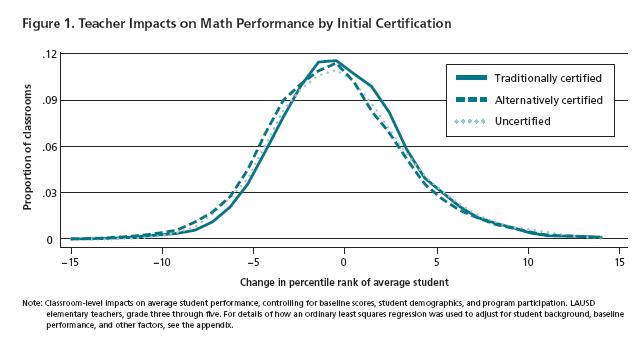
The first two items fall into the no-brainer category. No one should be getting paid to do classroom work without working in the classroom. The final item is the most important of all. The figure above is from a Brookings study, showing differences in academic gains by Los Angeles teachers. In short, some teachers are great- getting large gains, and some produce terrible results: not only failing to produce gains, but actually dragging their students down.

The Arizona Education Association is actively seeking to have these policy changes overturned. Rumor has it that this will be a condition for Democratic support in current budget session. One problem: it would be IMMORAL to keep highly ineffective teachers in the classroom simply because they had already spent years miseducating students. No one- conservative, liberal, libertarian or vegetarian should support such a policy. The AEA brings disgrace upon itself for seeking it, and any member carrying this water should be ashamed of themselves for doing so.

In short these policies represent a good start, but still only a single tap. Taking a cue from Zombieland, the Arizona legislature should go ahead and double tap the zombie by making it illegal for school districts to collect union dues from employee paychecks. School districts won’t collect dues for any other private associations, there is no case for them spending public money to do so for the AEA.

If people find the services of the AEA useful, they can write them a check in the same fashion that you do for any private organization that you support.


Blog Envy

December 4, 2009

I’m suffering from blog envy.  Other blogs have had some great posts — much better than what I’ve come up with recently.  If I can’t beat them I might as well link to them and poach their material.

First, Brian Kisida has a superb post at Mid-Riffs on the predictable waste and banality of consultant reports in the political and education arena.  He demonstrates this using as his examples a “curriculum audit” that the Fayetteville school district has commissioned from Phi Delta Kappa for $36,000 as well as a “visioning” report that the City of Fayetteville commissioned from Eva Klein & Associates for $150,000:

To be sure, the report that Phi Delta Kappa comes up with won’t look exactly like the same ideas the community gave them.  They’ll be re-written in such a way that any resemblance or lack of substance will be obfuscated by consultant-speak gobbledy-gook.  For example, when the Rogers School District hired Phi Delta Kappa to conduct an audit, one of the recommendations they received was:

Develop and implement a comprehensive curriculum management system that delineates short- and long-term goals, directs curriculum revision to ensure deep alignment and quality delivery, and defines the instructional model district leaders expect teachers to follow in delivering the curriculum.

Translation: Establish a system to set and achieve goals. And make it a good one.

Here’s another recommendation from the Rogers audit:

Research, identify and implement strategies to eliminate inequities and inequalities that impede opportunities for all students to succeed.

Translation:  Do what you and every other school district has already been doing (or should have been doing) for decades.

I’m willing to bet Fayetteville’s audit will contain many of the same recommendations given to Rogers.  These types of consultant groups have stock boiler-plate language that they recycle time and time again.  I also expect to see some of the views of the community rewritten in consultant-speak.  Here’s some of the comments and concerns the Northwest Arkansas Times picked up from teachers and parents at one of the focus groups:

  • Weaknesses in foreign languages
  • lack of flexibility, especially at the high school level
  • poor communication about special programs
  • lack of strong leadership in some schools
  • the need for more vocational classes, including in middle school
  • too many different intelligent levels in the classroom
  • special needs and at-risk students need more technology
  • need more literacy coaches, especially one at the high school
  • more coordination in all programs
  • need more time for physical activity
  • need more writing in classrooms
  •  I got this list from the newspaper, which cost me fifty cents–a whopping $35,499.50 less than Phi Delta Kappa is going to charge for repackaging these ideas in consultant-speak.

    I don’t know exactly why organizations pay money to outside consultants, like when the city paid Eva Klein & Associates to tell us that the University was one of our strengths, and that the perception that Fayetteville was anti-business was one of our weaknesses.   Don’t we already elect and pay people to think about these things and have a vision for what we need to do?  So why are they sub-contracting out their duties?

    Wow.  Great blogging!

    And Paul Peterson is hitting his stride as a blogger over at the Education Next Blog.  There he notes the political difficulty posed by teacher union financial might for President Obama and Secretary Duncan’s efforts to turn Race to the Top rhetoric into reality:

    The National Education Association (and its local affiliates) gave $56.3 million dollars to state and federal election campaigns in 2007 and 2008, more than any other entity. That’s what we learn from the recently released report issued by the Center for Responsive Politics (CRP) together with the National Institute on Money in State Politics.

    The much smaller American Federation of Teachers tossed in another $12 million dollars into political campaigns….

    The money is wrested directly from teacher paychecks as an add-on to their monthly dues (unless teachers specifically object), a power granted unions by school boards as part of collective bargaining deals.  So the NEA’s slush fund is in fact built by taxpayer dollars, which flow directly to the NEA instead of into the teacher’s own bank account.  Yes, some individual teachers object and don’t make the political contribution, but unions typically collect the money by default.

    With all that cash in hand, unions are in a position to tell state legislatures what to do, if they want campaign dollars next time around.  Significantly, over $53 million of the $56.3 million dollars went for state-level expenditures, a clear indication that unions know that the action is not in Washington but in state capitols.

    This enormous cash nexus that swamps anything any business entity has contributed creates a huge problem for President Obama’s Secretary of Education, Arne Duncan, who is asking states and school districts to put merit pay into place.


    Can’t Think of A Blog Post

    November 18, 2009

    I apologize for my lack of a post yesterday and this lame post today.  I just can’t seem to think of a good post.

    Yesterday Greg suggested that I blog about this excellent editorial in the Wall Street Journal denouncing the Ford Foundation for giving $100 million to the teachers union to spur education reform and claiming that this money would “shake up the conversations surrounding school reform and help spur some truly imaginative thinking and partnerships.”  The Ford Foundation might as well give $100 million to the city of Las Vegas to address gambling addiction. 

    But the Wall Street Journal already did a great job, so it didn’t seem worth my blogging about since I really wouldn’t have anything to add.

    I also thought about blogging about how the Race to the Top criteria issued this week hardly demand meaningful reform from states.  But I’ve already written several times on how little we should expect from Race to the Top, such as here.  The bigger surprise is that anyone is surprised.  Besides, Jeanne Allen did a fine job critiquing the Race to the Top criteria here.  And on top of all that, I’ve probably been beating up on Obama and Duncan about education reform too much.  The reality is that at least they are saying a lot of the right things, which has had a big effect on education reform battles at the state and local level.  It’s a big deal that a Democratic Administration has (at least rhetorically) thrown its weight fully behind expanding choice and competition (if only via charters), merit pay, weakening teacher tenure, etc…

    I also thought about blogging about a bunch of local issues.  A state school board member was featured in an article in the Northwest Arkansas Times explaining why she opposed every newly proposed charter school in Arkansas this year.  She helpfully explained that she had visited a predominantly Hispanic school in Springdale, AR that was making AYP with its ESL students and “that helped convince her Springdale’s services were sufficient for their students.”  There’s no need to let those families decide if the quality of their education is sufficient.

    But some of my friends who write the excellent blog, Mid-Riffs, were already working on something to address this.  I saw no need to duplicate.

    In short, I’m sorry, folks.  Maybe I’ll think of something fresh soon.  Or maybe I can just keep writing about all the things that I was going to write about but didn’t.  Or did I?


    Senator Meeks vs. CTU

    November 18, 2009

    (Guest Post by Matthew Ladner)

    “Chicago Public Schools have a gang problem. The gang, however, is not the BDs (Black Disciples), the gang is not the GDs (Gangster Disciples), the gang is not the Vice Lords and the gang is not the Four Corner Hustlers. The gang is the Chicago Teachers Union.”

    — State Sen. James T. Meeks, D-Chicago, chair of the Illinois Senate’s Education Committee, Oct. 17, 2009.

    Wow- Meeks is not only a state Senator and chair of the Illinois Senate Education Committee, an African American minister and long time friend of Obama. Read more about his unfolding war with the Chicago teacher union in the Chicago Tribune.


    Rhode Island Eliminates Tenure

    October 25, 2009

    (Guest Post by Matthew Ladner)

    Check it out on this video. The unions are going ape- no one consulted them! They are going to sue! (HT Whitney Tilson)

    First Michelle Rhee lets RIFs teachers without regards to tenure, and now her former protege strikes a blow against the indefensible practice in Rhode Island.

    You go girls! Any men out there brave enough to follow suit?