Marcus on Tenure & Test Scores

December 2, 2009

HT Education Week

(Guest post by Greg Forster)

On NRO today, Marcus soldiers on through the endless New York test score tenure wars, reporting on a gutsball move by Mayor Bloomberg:

New York’s state legislature gave teachers a gift last year by banning the use of student test-score data in tenure decisions. Many expect the legislature to allow the law to expire next year, but Mayor Bloomberg refuses to wait. Last week, he ordered schools chancellor Joel Klein to use the data anyway, arguing that the teachers up for tenure this year were hired in 2007, and a careful reading of the law suggests it applies only to teachers hired after July 1, 2008.

I’m not a Bloomberg fan on any other issue, but on education he’s a cut above most mayors. And remember, he does this in a town with a City Council so thoroughly corrupted by the unions that legislators actually read from union cue cards during hearings.


Destruction of a Profession in PJM

November 12, 2009

(Guest post by Greg Forster)

This morning, Pajamas Media carries my column on Public Agenda’s study documenting the destruction of a profession:

As D-Day for health care “reform” approaches, we’re hearing a lot of contradictory claims about how things are going in countries where they have socialized medicine. One side says Canadian, British, German, and even (in the more extreme cases) Cuban health care is wonderful. The other side says it’s a catastrophe. All these directly conflicting claims aren’t very helpful to those who might be in doubt about the truth.

Instead of seeking our evidence in far-flung corners of the world, why don’t we look at what’s happened to the one profession we’ve already socialized right here at home? The government school monopoly gives us a great opportunity to examine what happens to a profession when you dragoon it into government service.

A commenter offers a point that I think is valid – it’s hard to disentangle the effects of “socializing” a profession from the effects of “unionizing” it. But how different are those? The head of the health-care worker union SEIU, under a cloud for apparently having approached Rod Blagojevich about a bribe, is nonetheless the top visitor to the White House.


Klein vs. Rothstein

November 5, 2009

(Guest Post by Matthew Ladner)

I was struck by Joel Klein’s statement in introducing the latest McKinsey & Company report on the impact of achievement gaps.

Klein stated:

People have said to me ‘Chancellor, we will never fix education in America until we fix poverty in America.’ Now I care about fixing poverty, but those people have got it exactly backwards folks. We are never going to fix poverty in America until we fix education in America, and this report shows that it is entirely doable.

Klein has both his theory of causality and priorities correct. It is perfectly idiotic to wallow around in helplessness claiming that education cannot radically improve in the absence of the vanguard of the proletariat seizing the commanding heights of the American economy and creating the New Jerusalem.

It should be painfully obvious even to the most ardent collectivist that this is never going to happen even if it were true, which as it happens, it isn’t. Welfare programs won’t change the fact that we recruit too few of the right people, and too many of the wrong people into teaching. It won’t change the fact that we distribute the limited supply of high quality teachers as if we are out to get poor inner city children. For that matter, it won’t change the fact we still don’t measure teacher effectiveness, and that when we do, we don’t do much of anything with the information.

Parental choice can be seen very much through this same lense. If you draw the short stick and grow up in an inner city area with terrible schools, why should anyone stand in your way of accessing a different group of educators for the same or less funding?

It is absurd to sit in the wealthiest major nation on the planet and have to listen to people claim that $10,000 a year is not enough to teach children how to read. Anyone who actually cares about the plight of the poor would do well to listen to Klein, not Rothstein.


The Destruction of a Profession

November 4, 2009

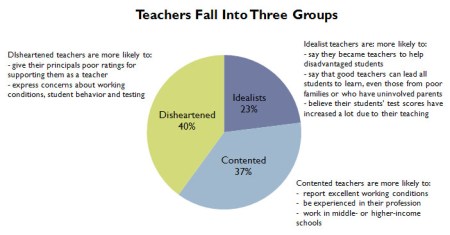
Edweekchart1_teachers_three_groups

Public Agenda’s portrait of the teaching profession

(Guest post by Greg Forster)

How would you feel if you found out, the moment you were going into surgery, that 40% of surgeons were “disheartened” about their own work?

How would you feel about it if you had no right to choose your own surgeon?

That’s how parents ought to feel about public schools.

“You don’t want somebody operating on you if they’re resentful about having to do it.” I heard somebody say that last week. It’s as good a case against the current movement toward socialized medicine as I’ve heard anybody make in just fifteen words. The legislation Congress is moving right now already anticipates huge cuts in Medicare reimbursements to doctors. And rest assured that more of the same will be on the way if the bill actually passes.

That’s the way it always goes when you socialize a service. In spite of the lavish promises made to them, the people who provide the service inevitably get the shaft. Well, OK, everybody (except the politicians and bureaucrats) gets the shaft. But the service providers get it first and worst.

The good news is, we still have a chance to avoid destroying the medical profession this way.

The bad news is, a big new teacher survey from Public Agenda shows we’ve already done it to the teaching profession.

The report is bursting at the seams with horrible, horrible data about the state of the teaching profession, and I encourage you to read it for yourself. But here are a few highlihgts.

A large plurality of teachers fall into the “disheartened” category:

Members of that group, which accounts for 40 percent of K-12 teachers in the United States, tend to have been teaching longer and are older than the Idealists, and more than half teach in low-income schools. They are more likely to voice high levels of frustration about the school administration, disorder in the classroom, and the undue focus on testing…

A considerable degree of bitterness characterized the Disheartened in comparison to the other groups: Twice as many spoke of likely burnout as did the Contented and Idealists. Only two-fifths strongly agreed that “there is nothing I’d rather be doing” than teaching, compared with nearly two-thirds of the Contented and nearly half of the Idealists.

Think it doesn’t make a difference in the classroom? Think again – a shocking number of disheartened teachers think that teaching makes no difference:

Beliefs about their students and student potential also differed notably, with potentially significant implications for efforts to reshape the profession. A 22-percentage-point difference separated the Idealists and the Disheartened (88 percent to 66 percent) in their faith that good teachers can make a difference in student learning. Idealists strongly believe that teachers shape student effort (75 percent), whereas just 50 percent of the Disheartened believed that. Only one-third of the more disillusioned teachers were very confident in their students’ learning abilities, compared with nearly half among the other groups (48 percent of the Contented and 45 percent of the Idealists).

How do you suppose those attitudes affect their teaching?

“Potentially significant implications for efforts to reshape the profession.” No kidding. More than three quarters of all teachers are either “disheartened” or else “contented” – i.e. not interested in making the system any better than the lousy mediocrity it is now.

Delving through the data tables, here’s another intriguing tidbit I found. Given a choice between “I am able to create high quality lesson plans” and “I am not able to do this as much as I would like because of limited planning time,” the Contented teachers were 30 points more likely than Disheartened teachers to say they could create quality lesson plans (72% v. 52%). No shocker there. But a surprising number of Idealist teachers gave their own lesson plans a negative review – 38% say they can’t create high qualiy lesson plans as much as they’d like, while 60% say they can.

Do you suppose Contented teachers and Idealist teachers have different standards for what counts as a “high quality” lesson plan?

Which kind do you want teaching your kids?

Too bad you don’t get a choice. Government will decide which teacher will build (or destroy) your child’s future.

Unless, of course, you’re one of the ones lucky enough to have a choice.

It’s interesting that Public Agenda only surveyed teachers working in the government monopoly system. You can only find that out by wading deep into the weeds of the methodology section. In the body of the report, they just describe their survey population as “teachers.” Apparently government teachers are the only kind that count.

As it happens, federal survey data show that teachers in private schools are much, much happier with their jobs on a wide variety of measurements. That’s because, according to the same data, they’re free to teach – unlike the government monopoly, private schools give teachers autonomy in the classroom. Of course, they’re only able to do this because they’re also allowed to hold teachers accountable for results. But the much larger satisfaction figures for private school teachers – including much higher satisfaction with their school administrators! – show that this is an accountability model that works.


What Is “Merit”?

September 16, 2009

(Guest post by Greg Forster)

As JPGB’s friend Marcus Winters notes on NRO today, the Obama administration has been staying the course on this issue, denying “Race to the Top” funds to states that disallow the use of objective measurement in evaluating teachers. Marcus also rightly links this to the topic of merit pay, which the president repeatedly embraced during the campaign. One of the biggest obstacles to enacting real merit pay is making sure that the measurement of “merit” really measures merit. Too many experiments with “merit pay” have really been experiments in peer evaluation pay, grade inflation pay, and so on. Check out Marcus’s article for more.


McGuire on Unions and Urban Students

June 16, 2009

(Guest Post by Matthew Ladner)

 MaryEllen McGuire of the New America Foundation takes on the unions for dealing out the least experienced teachers to the neediest children in U.S. News and World Report:

Teachers with the least experience are educating the most disadvantaged students in the highest poverty, most challenging schools. Low-income kids are being “triaged” not by experienced teachers, but by those with fewer than three years of teaching to go on.

Does it matter? Absolutely. According to the research, teacher experience is at least a partial predictor of success in the classroom and, at present, one of the only approximations for teacher quality widely available. Experienced teachers tend to have better classroom management skills and a stronger command of curricular materials. Novice teachers on the other hand struggle during their initial years in any classroom.

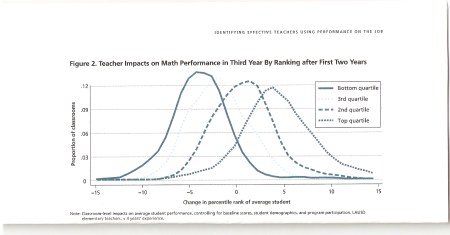
McGuire’s point is valid, but of course we should not be content to use experience as an approximation for teacher quality. There are both outstanding young teachers and truly awful experienced teachers, as you might recall from the Son of Super Chart:

scan0001

The Son of Super Chart broadly  backs up McGuire-the curve for 1st year teachers is centered on -5, and the curve for 3rd year teachers on 5.  All else being equal matching inexperienced teachers with high needs kids is an abominable practice.

Of course, all else need not be equal, which is why Teach for America works well.

McGuire proposes solutions:

Once we can wrap our heads around the true extent of the problem we can start taking down the second obstacle: figuring out a way to entice more experienced teachers to teach in high need schools. This will require a long-term commitment to systemic reform including investing in low-poverty schools to make them more attractive teaching placements and funding incentives to initially attract experienced and, we hope, higher quality teachers to low-income schools.

Will this require dollars beyond what we have? Not necessarily.

Federal law already provides schools with money to pay for this. It’s just that the funds typically go to reduce class sizes or provide professional development for teachers instead – strategies that have mixed results. Some of these funds should be redirected to pay for incentives drawing teachers into high-poverty schools. This is also a great use of stimulus money.

I’m glad to see to someone from the New America Foundation describe the results of class size reduction as “mixed.” Wow- you are half way there. The real word you are looking for however is “c*a*t*a*s*t*r*o*p*h*i*c” and the issue goes much deeper than the distribution of experienced teachers. On average, American colleges of education are recruiting from the bottom third of American college students based on admission scores. 

Reading between the lines, the world is precisely as the unions want it to be: an emphasis on class size and seniority over teacher quality or equity. The system is also perfectly designed to deliver the most needy students low-quality teachers.

John Rawls is surely spinning in his grave.

UPDATE/CORRECTION

I loaded the wrong Brookings study Super Chart! The correct Super Chart! is from page 28 of the same study and shows a  weaker relationship between experience and student learning gains, with year one teachers with a bell curve centered around -3 and second and third year teachers around zero.


PJM on Free to Teach

June 1, 2009

Free to Teach cover

(Guest post by Greg Forster)

Today Pajamas Media runs my column on why the government school monopoly is bad for teachers:

Everyone knows a monopoly is bad for the people who rely on its services. But monopolies are also bad for the people who work for them. Just like the monopoly’s clients, its employees have few alternatives. If they’re not treated well at work, they can’t go work for a competing employer. That means the monopoly doesn’t have to worry about keeping them happy.

And the education monopoly also locks out parental pressure for better teaching, which is probably a factor in improving working conditions for teachers in private schools. Public schools are government-owned and government-run, so the main pressure on them is political imperatives. The main pressure on private schools is keeping parents happy. Given that parents primarily want better teaching, which of those two options do you think is better for teachers?

A certain recent study is mentioned in the column.


Rick Hess on Recruiting the Teachers of the Future

May 22, 2009

(Guest Post by Matthew Ladner)

The new edition of Education Next is online, and Rick Hess has a very interesting article on modernizing the teaching profession. Rick notes that we need to update bedrock assumptions-such as assuming that the dominant model of teaching recruitment should rest on recruiting 20 year olds into colleges of education and then expecting them to teach for the next 30 or 40 years. Lots of interesting suggestions on technology, compensation and alternative certification.

Great article, well worth reading.


Free to Teach: What America’s Teachers Say about Teaching in Public and Private Schools

May 20, 2009

Free to Teach cover

(Guest post by Greg Forster)

Today the Friedman Foundation releases Free to Teach: What America’s Teachers Say about Teaching in Public and Private Schools, a study I co-authored with my Friedman colleague Christian D’Andrea.

It’s a simple study with a powerful finding. We used the teacher data from the Schools and Staffing Survey, a very large, nationally representative, confidential survey of school employees conducted by the U.S. Department of Education. We just separated public school teachers from private school teachers and compared their answers on questions covering their working conditions.

We found that the government school system is not providing the best environment for teaching. Public school teachers fare worse than private school teachers on virtually every measurement – sometimes by large margins. They have less autonomy in the classroom, less influence over school policy, less ability to keep order, less support from administrators and peers, and less safety. So it’s not surprising that they also have less job satisfaction on a variety of measures. About the only thing they have more of is burnout. (The measures of teacher burnout were some of the more eye-popping numbers we found in the federal data set.)

Free to Teach box scores

The Schools and Staffing Survey is observational, so we can’t run causal statistical analyses. But it’s really not hard to figure out why private schools provide a better teaching environment. The government school system responds mainly to political imperatives, because anything owned and run by government is inherently political and always will be. Meanwhile, the biggest pressure on private schools is from parents, because if the schools don’t please the parents, the parents can take their children elsewhere.

Which of the two sources of influence – politics or parents – do you think is more focused on demanding that schools provide better teaching?

That’s why private schools deliver a better education even when they serve the same students and families as public schools, and public schools improve when parents can choose their schools.

Parents and teachers are traditionally thought of as antagonists. And no wonder – under the current system, parents have no effective control over their children’s education other than what they can extract from their teachers by pestering and nagging them. The status quo is designed to force parents and teachers into an antagonistic relationship.

But in the big picture, parents are the best friends teachers have. Ultimately, it’s parents who provide the pressure for better teaching, and – if what we’re seeing in the Schools and Staffing Survey is any indication – that pressure for better teaching provides better working conditions for teachers.

Here’s the executive summary:

Many people claim to speak on behalf of America’s teachers, but we rarely get the opportunity to find out what teachers actually have to say about their work – especially when people are debating government control of schooling.

This study presents data from a major national survey of teachers conducted by the U.S. Department of Education; the Schools & Staffing Survey. We break down these observational data for public and private school teachers, in order to compare what teachers have to say about their work in each of the two school sectors.

These are eye-opening data for the teaching profession. They show that public school teachers are currently working in a school system that doesn’t provide the best environment for teaching. Teachers are victims of the dysfunctional government school system right alongside their students. Much of the reason government schools produce mediocre results for their students is because the teachers in those schools are hindered from doing their jobs as well as they could and as well as they want to. By listening to teachers in public and private schools, we discover numerous ways in which their working conditions differ—differences that certainly help explain the gap in educational outcomes between public and private schools. Exposing schools to competition, as is the case in the private school sector, is good for learning partly because it’s good for teaching.

Key findings include:

• Private school teachers are much more likely to say they will continue teaching as long as they are able (62 percent v. 44 percent), while public school teachers are much more likely to say they’ll leave teaching as soon as they are eligible for retirement (33 percent v. 12 percent) and that they would immediately leave teaching if a higher paying job were available (20 percent v. 12 percent).

• Private school teachers are much more likely to have a great deal of control over selection of textbooks and instructional materials (53 percent v. 32 percent) and content, topics, and skills to be taught (60 percent v. 36 percent).

• Private school teachers are much more likely to have a great deal of influence on performance standards for students (40 percent v. 18 percent), curriculum (47 percent v. 22 percent), and discipline policy (25 percent v. 13 percent).

• Public school teachers are much more likely to report that student misbehavior (37 percent v. 21 percent) or tardiness and class cutting (33 percent v. 17 percent) disrupt their classes, and are four times more likely to say student violence is a problem on at least a monthly basis (48 percent v. 12 percent).

• Private school teachers are much more likely to strongly agree that they have all the textbooks and supplies they need (67 percent v. 41 percent).

• Private school teachers are more likely to agree that they get all the support they need to teach special needs students (72 percent v. 64 percent).

• Seven out of ten private school teachers report that student racial tension never happens at their schools, compared to fewer than half of public school teachers (72 percent v. 43 percent).

• Although salaries are higher in public schools, private school teachers are more likely to be satisfied with their salaries (51 percent v. 46 percent).

• Measurements of teacher workload (class sizes, hours worked, and hours teaching) are similar in public and private schools.

• Private school teachers are more likely to teach in urban environments (39 percent v. 29 percent) while public school teachers are more likely to teach in rural environments (22 percent versus 11 percent).

• Public school teachers are twice as likely as private school teachers to agree that the stress and disappointments they experience at their schools are so great that teaching there isn’t really worth it (13 percent v. 6 percent).

• Public school teachers are almost twice as likely to agree that they sometimes feel it is a waste of time to try to do their best as a teacher (17 percent v. 9 percent).

• Nearly one in five public school teachers has been physically threatened by a student, compared to only one in twenty private school teachers (18 percent v. 5 percent). Nearly one in ten public school teachers has been physically attacked by a student, three times the rate in private schools (9 percent v. 3 percent).

• One in eight public school teachers reports that physical conflicts among students occur everyday; only one in 50 private school teachers says the same (12 percent v. 2 percent).


Rubber Room Rules

May 7, 2009

You…administrator…bastards…still…can’t…fire me!!!!

Matt has done a great job of describing how we could restructure schools to attract and retain the most effective people as teachers — most recently in this post.

But nothing really captures the insanity of granting lifetime employment to modestly paid graduates mostly from the bottom third of college classes with no reward for excellent performance like stories about rubber rooms.  Rubber rooms are the places where teachers too incompetent to remain in classrooms go to receive public paychecks for doing absolutely nothing.  A number of large districts have developed rubber rooms because it is prohibitively costly and time-consuming to actually fire a teacher.

In Los Angeles the rubber rooms have become so crowded that they’ve started “housing” teachers — paying them to stay at home.  In an excellent piece this week in the Los Angelese Times we learn:

“For seven years, the Los Angeles Unified School District has paid Matthew Kim a teaching salary of up to $68,000 per year, plus benefits.

His job is to do nothing….  In the jargon of the school district, Kim is being “housed” while his fitness to teach is under review….  About 160 teachers and other staff sit idly in buildings scattered around the sprawling district, waiting for allegations of misconduct to be resolved.

The housed are accused, among other things, of sexual contact with students, harassment, theft or drug possession. Nearly all are being paid. All told, they collect about $10 million in salaries per year — even as the district is contemplating widespread layoffs of teachers because of a financial shortfall.”

The Los Angeles Times also reported (in a separate article):

“The Times reviewed every case on record in the last 15 years in which a tenured employee was fired by a California school district and formally contested the decision before a review commission: 159 in all (not including about two dozen in which the records were destroyed). The newspaper also examined court and school district records and interviewed scores of people, including principals, teachers, union officials, district administrators, parents and students.

Among the findings:

* Building a case for dismissal is so time-consuming, costly and draining for principals and administrators that many say they don’t make the effort except in the most egregious cases. The vast majority of firings stem from blatant misconduct, including sexual abuse, other immoral or illegal behavior, insubordination or repeated violation of rules such as showing up on time.

* Although districts generally press ahead with only the strongest cases, even these get knocked down more than a third of the time by the specially convened review panels, which have the discretion to restore teachers’ jobs even when grounds for dismissal are proved.

* Jettisoning a teacher solely because he or she can’t teach is rare. In 80% of the dismissals that were upheld, classroom performance was not even a factor.”

If unions succeed in organizing charter schools, they could eliminate a refuge from  “worker protection” measures like these.