It’s a Sign, All Right!

September 23, 2008

HT digitalius

(Guest post by Greg Forster)

When former Pinellas County teacher-union head and “national NEA activist” Doug Tuthill became president of the Florida School Choice Fund, Jay announced that dogs and cats were living together. (By coincidence, in the same week The Onion ran this, one of their best ever.)

Not so fast, says America’s Last Education Labor Reporter. “Tuthill has always been something of a union maverick,” notes ALELR in his latest communique. “He was a new unionist well before NEA President Bob Chase took up the call and made it official policy. Tuthill’s essay in the February 1997 NEA Today, headlined ‘Time to Face the Hard Truth,’ could have been written today – which might explain why Tuthill has gone over to the Dark Side.”

ALELR quotes from Tuthill’s article: “The traditional role of education unions has been to protect members from the negative effects of dysfunctional school systems. That’s not enough anymore.” As recently as 2004, Tuthill was calling for new unionism to “rise from the ashes” and was pushing for NEA involvement in charter school management, membership services for private schools, and “supporting” home schoolers.

Well, I read “Time to Face the Hard Truth,” and frankly, other than that one line about how unions should do more than protect teachers from being fired, it all looks like standard NEA boilerplate. “Today’s education unions must take on the task of transforming these systems. Our primary goal must be to create learning systems in which all adults and children achieve at high levels.” Etc. Etc. Etc. These days the NEA just has computers write this stuff for them, switching the words around so we don’t notice (e.g. “Today’s education unions must take on the goal of transforming these learning systems for all adults and children. Our primary task must be to create systems in which all achieve at high levels”). That frees up more time for them to hang out in their member-funded stadium skyboxes and go on those all-important conference trips.

So ALELR is right that the essay “could have been written today,” but not by a reformer. This kind of fluff only passes as deep thought among the “wow, man, kids need so much” crowd.

In the article, Tuthill talks about a teacher who was being fired for incompetence: ” ‘I know I haven’t done a good job,’ she said crying, ‘but I’m doing the best I can. These kids have so many problems, I just don’t know where to begin. What am I going to do?’ “

What happens? The union saves her job, and Tuthill is glad that this incompetent teacher is returned to the classroom. He sees her as a “victim” of “dysfunctional systems.” His only regret is that more effort (read: money) isn’t being spent on teacher training to help ensure that future teachers won’t be incompetent:

I was pleased that our union had helped her, but the episode bothered me. This teacher had been the victim of a series of dysfunctional systems. She was poorly trained, improperly placed, and not adequately supported. Consistent with our traditional advocacy role, we helped her, but we did nothing to change the systems that caused her problems.

Even that line about unions doing more than just protecting teachers from being fired gets it wrong. What does he say the union is protecting teachers from? “The negative effects of dysfunctional school systems.” I guess any school system that wants to fire a teacher is by definition dysfunctional.

Tuthill gets a little maverick cred simply for mentioning the fact that unions do help prevent teachers from being fired, but is that all it takes to render Tuthill’s move to the school choice movement a yawner?

With all due respect to ALELR, if Tuthill has signed on to lead the charge for school choice, it’s clear that he’s made a lot of progress since 1997. Dogs and cats are indeed living together. Now it’s just a question of how many more politicians realize that they can save the educational lives of millions of registered voters.


Dogs and Cats Are Living Together

September 12, 2008

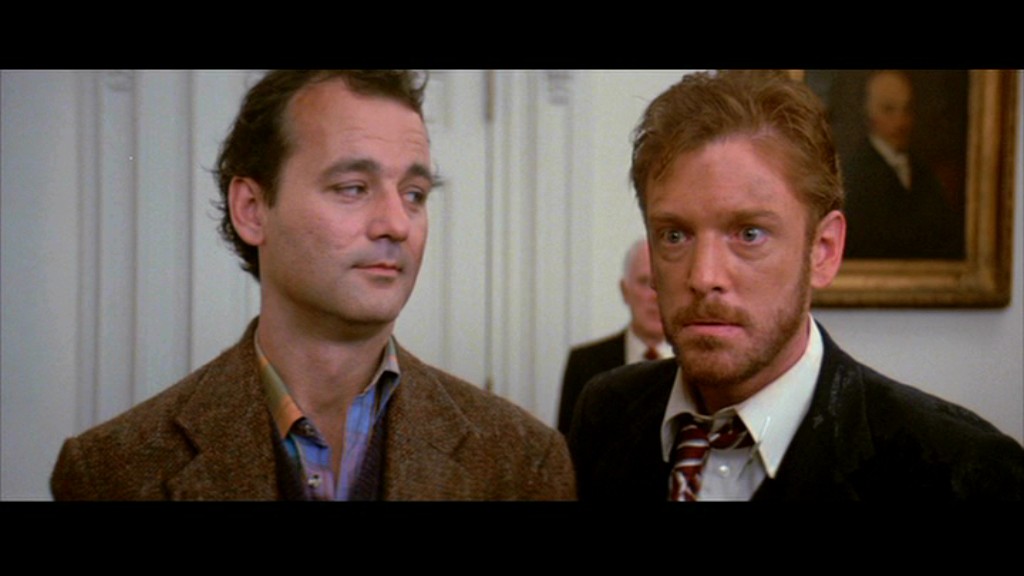
Dr. Peter Venkman: This city is headed for a disaster of biblical proportions.
Mayor: What do you mean, “biblical”?
Dr Ray Stantz: What he means is Old Testament, Mr. Mayor, real wrath of God type stuff.
Dr. Peter Venkman: Exactly.
Dr Ray Stantz: Fire and brimstone coming down from the skies! Rivers and seas boiling!
Dr. Egon Spengler: Forty years of darkness! Earthquakes, volcanoes…
Winston Zeddemore: The dead rising from the grave!
Dr. Peter Venkman: Human sacrifice, dogs and cats living together… mass hysteria!

No, this isn’t a photo of Greg, Matt, and me (but if it were, I’m sure I’d be Egon on the right). 

This is what came to mind when I heard that Doug Tuthill, the former head of the teacher union in Pinellas County Florida, was named the new president of the Florida School Choice Fund, an organization that raises money for and promotes tax-credit supported vouchers.  And Jon East, the former St. Pete Times editorial writer and prominent voucher critic, has signed on to be  the Fund’s communications director.  There must be a cataclysm of biblical proportions going on here.  Dogs and cats are living together!

Add this to the Democrats for Education Reform hosting an event at the Democratic Convention where “In front of a gathering of about 500 delegates, four ‘smart, young, powerful, bald** black state and local elected officials’ (Kaus’s description; the asterisks lead to a note conceding the presence of some hair on one guy’s head – but only on the sides) denounce teachers’ unions, explicitly and in strong terms, and recieve vigorous applause. ‘In a room of 500 people at the Democratic convention!’(emphasis in original)  Most satisfying line: “John Wilson, head of the NEA itself, was also there. Afterwards, he seemed a bit stunned.”

Rick Hess, Mike Petrilli, Diane Ravitch, and Sol Stern may be jumping off the school choice train (or at least hanging dangerously off the side), but Adrian Fenty, Marion Bary, Al Sharpton, and a bunch of Democratic delegates are jumping on.  (OK, you can insert your Marion Bary or Al Sharpton joke here).  But these are signs of a possibly dramatic political realignment. 

I wonder what’ll happen if we cross the streams?


School Choice Wins in 2008; Unrestricted Eligibility in Georgia

June 18, 2008

(Guest post by Greg Forster)

The Washington Post is now reporting that the House Appropriations subcommittee will fund the DC voucher program for another year. People are saying that the future of the program doesn’t look good, because the subcommittee chairman is blustering about how much he doesn’t like it. But read that Post article carefully. He doesn’t say that the program will be killed next year. The Post reports that he says he’s funding the program for another year “to give District leaders a chance to restructure the program.” He is quoted as saying, “I expect that during the next year the District leaders will come forward with a firm plan for either rolling back the program or providing some alternative options.”

That sounds to me like a man who’s looking for a deal. The DC program is already loaded up with monster payoffs to the District’s patronage-bloated public school system. How hard is it to make those payoffs bigger? And maybe the program will have to accept some more politically motivated restrictions on participation, so that critics will have a trophy to hang on their wall.

Whether those tradeoffs are worth it for the school choice movement – there is a real cost, and not just in dollars, associated with them – is a question I leave for another day. And of course this is just the subcommittee; there could still be more trouble ahead. And maybe next year the critics will get a better offer from the unions than the deal they’re apparently angling to get on behalf of the DC patronage machine.

All I want to do is observe that the program’s chances of survival are now looking a lot better than they did yesterday.

As the political season winds to a close, let’s survey the results:

  • A new personal tax credit for private school tuition in Louisiana
  • A new tax-credit scholarship program in Georgia
  • A new voucher program in Louisiana
  • An expansion of Florida’s tax-credit scholarship program, including a $30 million increase in the cap; a bump up in the value of the scholarship and a linking of the scholarship value to state school spending (which always goes up); and a relaxation of the program’s unreasonably stringent accounting rules (which used to allow not one penny of carryover from year to year in the scholarship organizations’ accounts, and not one penny from eligible donations for administrative expenses).
  • A million-dollar funding increase and guaranteed future funding stream for Utah’s voucher program.
  • Preservation (tentatively) of the DC voucher program in a hostile Congress.

That’s three new programs, two expansions of existing programs and an upset victory in DC. Pretty good for a dead movement, wouldn’t you say?

By the way, how did accountability testing do this year? How many new programs? How many existing programs expanded?

How about instructional and curricular reforms? How’s the Massachussetts miracle holding up?

Anyone? . . . Anyone?

Some of these victories did come at a cost. The two programs in Louisiana are going to score poorly when measured against the gold standard of universal choice. The tax credit is limited to a very small amount of money, which means it offers a very small amount of choice. And the new voucher program is only offered to students who are in grades K-3, low-income, and enrolled in public schools (or entering kindergarten) in a chronically failing school district located in a highly populated parish – which currently means only New Orleans. Plus it’s limited by annual appropriations (currently $10 million). A new grade level will become eligible each year (4th grade next year, then 5th grade, etc.) and Baton Rouge may become eligible if its public schools continue to fail. But this is still an inadequate program. And we can also add the prospect of more restrictions in the DC program to the debit column.

But there was also a huge step forward for universal choice. Georgia’s new tax-credit scholarship program offers school choice for all students. It has no demographic restrictions at all. Any public school student can apply. The only limit is the $50 million program cap – and experience in other states pretty consistently shows that dollar caps rise as programs grow to meet them.

Georgia’s new program is basically the same as the Arizona program funded by individual donations, except that Georgia’s program also allows corproate donations. And that makes a big difference, because it greatly expands the pool of available funds – and hence the size of the program.

Come to think of it, Georgia’s program is the first tax-credit scholarship program to include corporate donations and not place demographic restrictions on who can participate. That’s a potentially powerful combination. It will be exciting to see whether Georgia ends up taking school choice to a whole new level.


Carey vs. Coulson

May 20, 2008

(Guest Post by Matthew Ladner)

Education Sector’s Kevin Carey has been going after the Cato Institute’s Andrew Coulson with hammer and tongs. Read the back and forth here, here and here.

Even though Carey is on the other side of the ideological fence from me, I am a big fan of his higher education writing. The story here is that center-left Carey receives mail from the Cato Institute (intended for a previous resident) and is more than a little freaked out by them. Carey writes:

The struggle for a single-perspective organization like Cato is staying principled while retaining efficacy and legitimacy. In other words, while it’s all well and good in theory to stick to your intellectual and ideological guns, as a rule most people don’t like being objects of scorn and ridicule, or (if they’re in the think tank business) having the doors to the corridors of power slammed in their face. So they make compromises to stay part of mainstream conversation. Cato’s education policy proposals reflect this.

I gather from this that Carey believes that what the Coulson really wants to do is to abolish public schools, and have only adopted the mantra of tax credits as a fig-leaf of respectability for Cato. This clearly isn’t the case however, as Coulson laid out his vision of private education years before going to work for the Cato Institute in his book Market Education.

The Cato Institute, of all the right of center Washington think-tanks, clearly has a high tolerance threshold for scorn and derision. Sticking to your guns also has its uses. Cato, for instance, didn’t jump aboard the NCLB or the Iraq War bandwagons even when they were all the rage in right of center circles. I’m guessing they are pretty comfortable with those decisions now, regardless of what I or anyone else thought/thinks.

Carey asserts that Coulson’s ideal system of schooling is “un-American and basically absurd.” It would certainly seem that way to a man of the left. It’s good to debate what an ideal system of schooling would look like, as we can all agree that the one that we have now is far from ideal.

The use of the term un-American goes off the rails in my opinion. It seems like an attempt to ideologically dismiss an opponent without actually considering their perspective or evidence.

It’s also worth noting that Americans paid some of the lowest taxes in the world in the 1770s, but that didn’t stop them from fighting a bloody Revolution in order to secure their freedom. The Founding Fathers weren’t terribly pragmatic. I don’t recall demands for seats in Parliament as a reasonable solution to the “No Taxation without Representation” problem.

We can argue about whether or not the Cato Institute puts out absurd proposals. As a “small l” libertarian, I certainly don’t always agree with them. I exclusively attended public schools, my mother taught in a public school, my sons attend a public school, and I am proud to serve on the board of a public charter school. I’m not against public schools, but I am fiercely opposed to dysfunctional public schooling. Like Carey, I believe that public schools are permanent and I hope we make them work better for kids. We should all be members of the Joe Williams anti-crappy schools coalition.

The Cato Institute can be accused of being fundamentally opposed to public schooling. I’d guess that they would happily plead guilty to that, but un-American? That’s a bridge too far.


Catholic Schools Can Survive

May 15, 2008

(Guest Post by Matthew Ladner)

The Thomas B. Fordham Foundation recent presented a study of the future of inner city Catholic schools reached mostly dreary conclusions. Catholic schools face a number of problems, but there is a bright spot that Fordham missed where Catholic schools are flourishing, even the inner city schools: Arizona.

I began to investigate the state of Catholic schools in Arizona when Education Next published the article “Can Catholic Schools Be Saved?” This article posed the provocative question: Will charter schools finish off inner city Catholic private schools? Preliminary evidence suggests that charter schools are actually threatening to help close inner city Catholic schools. A RAND Corporation study focusing on the impact of charter schools in Michigan found that private schools were taking a bigger hit from charter school competition than public schools on a student for student basis. “Private schools will lose one student for every three students gained in the charter schools,” the study concluded.

Ronald Nuzzi, director of the Alliance for Catholic Education Leadership Program at the University of Notre Dame asserted that charter schools “are one of the biggest threats to Catholic schools in the inner city, hands down. How do you compete with an alternative that doesn’t cost anything?” Inner-city Catholic schools are in a deep and tragic crisis, especially in Michigan. Sadly, Michigan’s constitution essentially forbids private school choice of any sort, and the Diocese of Detroit has witnessed a 20 percent decline in enrollment since 2002 and currently faces another round of school closures. Overall, 29 Diocese of Detroit schools have already closed.

A fully scaled system of charter schools for inner-city areas may represent an existential threat to inner-city Catholic schools already struggling with the loss of religious staff and the movement of parishioners to the suburbs. In many inner city areas, Catholic schools have been the only high performing schools for decades. Catholic schools have an especially strong record in successfully educating disadvantaged students and sending them on to college. It would be tragic and absurd to help drive these schools out of business by publicly funding student attendance to both public and charter schools, but not to private schools.

Writing in the Journal of Catholic Education, I detailed a more hopeful example than Michigan: Arizona. Total charter school enrollment is 12.5 percent higher in Arizona than in Michigan, despite the fact that Michigan’s population is far larger than Arizona’s. Arizona, however, has two factors working for it that Michigan does not. Arizona has both a growing student population and private school choice programs (two tax credit programs and two voucher programs).

Catholic education is anything but wilting in Arizona. Between 2004 and 2006, schools in the Diocese of Phoenix saw a two percent increase in enrollment against a national decline. Two new Catholic schools opened in the 2006-2007 school year, with four more scheduled to open. Marybeth Mueller, superintendent of Catholic schools for the Diocese of Phoenix stated that the tax credit program has been “critical to keeping financially struggling families in the Catholic school system.” The tax credit programs provide about half of the states Catholic school students limited financial assistance.

Arizona private school attendance has increased outside of the Catholic schools as well. Despite the opening of hundreds of charter schools, the percentage of Arizona children attending private schools increased by 23 percent between 1991 and 2003, according to the National Center for Education Statistics.

Parents must pay public school taxes even if they do their fellow taxpayers the service of placing them in a private school at their own expense. If parents decide to seek an education they find a private for their children, they effectively pay twice- once when they pay taxes, another when they pay tuition and fees. Both tax credits and school vouchers can reduce this double payment penalty, expanding access to private schooling. In the process, competition will improve the performance of public schools by expanding competition for students, and (in states like Arizona) reduce public school overcrowding.

Arizona and Michigan have both enjoyed the large benefits of charter schools. The starkly different trends in private schooling suggest strongly that choice supporters must redouble their efforts on the private choice side.


Georgia Enacts Nation’s 23rd School Choice Program

May 14, 2008

(Guest post by Greg Forster)

Georgia Gov. Sonny Perdue has signed the legislation sent to him last month creating a tax-credit scholarship program in Georgia. It’s the nation’s 23rd school choice program.

I said it before, and I’ll say it again: Further proof, if further proof were necessary, that school choice is politically more successful than ever.

One thing that’s really gratifying about this program is that it has no demographic restrictions at all. Any student enrolled in Georgia public schools (K-12) is eligible for a private school scholarship. The days of limited choice are numbered.

Having swung from a win in Louisiana to a win in Georgia, all eyes now swing back to Louisiana, where a legislative vote today will determine whether a voucher bill moves forward. Gov. Bobby Jindal recently signed into law an education tax credit in the state.

Details on the new Georgia program, as they will soon appear on the Friedman Foundation’s online program guide:

GEORGIA

Tax Credits for Student Scholarship Organizations

Enacted 2008

Georgia provides a credit on both personal and corporate income taxes for donations to Student Scholarship Organizations (SSOs), privately run non-profit organizations that support private-school scholarships. Individual taxpayers contributing to SSOs may claim a dollar-for-dollar credit of up to $1,000, and married couples filing jointly may claim up to $2,500.  Corporate taxpayers may claim a dollar-for-dollar credit worth up to 75 percent of the taxpayer’s total tax liability. The program is capped at $50 million in tax credits per year.

FAST FACTS

·         All Georgia public school students eligible

·         Both individual and corporate taxpayers may donate

·         Program capped at $50 million

Scholarship or Voucher Value:

SSOs may determine the amount of each scholarship, as in most other states with tax-credit scholarship programs.

Student or School Participation:

No information on participation is available yet.

Student Eligibility:

All Georgia students enrolled in public schools are eligible to receive scholarships. SSOs may set their own eligibility guidelines. Taxpayers may not make contributions earmarked for a particular child.

Legal Status of Program:

No legal challenges have been filed against the program.

Regulations on the Program:

SSOs are required to be non-profit organizations that allocate at least 90 percent of their revenue to private-school scholarships. No more than 25 percent of an SSO’s revenue may be carried forward into the next year before it is spent. SSOs must undergo annual audits by certified public accountants, file audits and fiscal reports with the Department of Revenue, may not use a donor’s money to support that donor’s child and may not restrict their scholarships to a single school. Participating private schools must obey anti-discrimination laws.

Research on Program:

Currently no research items tied to this program.


News on Program:

Currently no news items are tied to this program.


Governing Statutes:

Georgia Code, 20-2A and 48-7-29.13.


Cajun Choice

April 23, 2008

(Guest post by Greg Forster)

On a much more serious note (see below), the news that America got a new school choice program last month seems to have slipped by under the radar.

On March 24, Louisiana Governor Bobby Jindal signed SB5, providing a deduction off parents’ personal income taxes for qualified education expenses, including private school tuition. The deduction is worth 50% of the total amount spent on qualifying expenses, up to a maximum deduction of $5,000. For more details on the program see here.

The tax deduction became effective as soon as it was signed, so we now have 22 school choice programs in 14 states plus D.C. All eyes are now on Georgia to see if a tax-credit scholarship program passed by the legislature becomes America’s 23rd school choice program; Governor Sonny Perdue has until May 14 to sign it, veto it, or allow it to become law without his signature.

Personal tax credits and deductions for educational expenses are an unusual way to do school choice; Louisiana’s program is only the fourth of this type. But it’s an approach with a long history. Minnesota enacted a tax deduction for educational expenses in 1955; Iowa enacted a tax credit in 1987; Minnesota added a tax credit on top of its deduction in 1997 (the credit excludes tuition but includes other expenses like books and fees – it’s the only program of this type not to include tuition); and Illinois enacted a credit in 1999.

Personal tax credit/deduction programs tend to be broad in scope but miniscule in magnitude. Only the Minnesota program has an income restriction, so the number of people eligible to participate in these programs is typically very large. Almost 650,000 families benefit from the Iowa, Illinois, and Minnesota programs. On the other hand, the Iowa and Illinois programs provide maximum credits of only $250 and $500 respectively. The Minnesota program is slightly more generous, providing a maximum credit of $1,000 and a maximum deduction of $1,625 in grades K-6 and $2,500 in grades 7-12. And the maximum deduction in Louisiana is $5,000. I don’t know what that works out to in tax savings, but since state tax rates are lower than the federal rate it can’t be that much. Moreover, in most cases the taxpayer does not get a dollar-for-dollar credit or deduction for the money he or she spends; for example, in Louisiana you only get 50 cents on the dollar.

One idea behind these programs is to cut out the middleman and provide school choice as directly as possible. For example, the most important drawback of tax-credit scholarships is that they don’t create a parental entitlement to school choice. The scholarship granting organizations act as gatekeepers, generally favoring low-income parents and thus exacerbating the problem of “targeting” in school choice programs. (Of course, a corresponding advantage is that scholarship granting organizations have flexibility in the distribution of resources; one thing I discovered when I did the research behind this report is that scholarship granting organizations will often step up to provide full-ride scholarships to students facing personal crises such as the death of a parent.) By contrast, both vouchers and personal tax credits/deductions create a parental entitlement to school choice.

I have heard some argue that personal tax credits/deductions are better than vouchers because they cut out the middleman even more completely; supposedly it would be harder to add unnecessary regulations restricting the private schools. But I’ve never been able to understand why this is the case. In both voucher and personal tax credit/deduction programs, the legislature defines which private schools are eligible, and in both cases that’s where the unnecessary regulations get inserted. Why is it harder to do in one case than in the other? Is there some political reason why such restrictions are less likely to be written into the tax code than into other laws? That doesn’t strike me as plausible, but I’d be open to correction if somebody could make a case for it.

The major drawback to these programs is in the structure of state income taxes. Until some state enacts a refundable credit,** the benefit families get from these programs is limited to their total state income tax bill. That’s not a lot of money. And fewer dollars means less choice, as this report helpfully reminds us. Of course, you could in theory pass a refundable credit, but the political obstacles to that would be formidable.

For the record, the Friedman Foundation for Educational Choice, where your humble servant is employed, has no position on whether vouchers, tax-credit scholarships, or personal tax credits/deductions are preferable. Our only goal is to provide a full choice to all students, and in theory all three types of programs can do that. They each have their advantages and disadvantages, but we evaluate each program based on how much choice it provides, not its funding mechanism.

That said, until we achieve universal choice, we’re stuck with limited programs, and in that context each of the three types has its own advantages and disadvantages.

Louisiana is a lot better off for having this program as opposed to no program. It will help a substantial number of families send their children to the school of their choice more easily, and it’s a universal program, establishing the important principle that school choice is good for all, not just for some.

That, and the passage of yet another school choice program is further proof, if further proof were necessary, that school choice is politically stronger than ever.

**CORRECTION: George Clowes has reminded me that the Minnesota tax credit is in fact refundable. That doesn’t really affect my point much, since the Minnesota credit doesn’t include tuition (only other education expenses like books and fees) and this is an even bigger limitation than the “unrefundability” (to use a totally real and not-made-up word) of the credits in other states. Tax credits for private school families won’t provide much choice until we get one that 1) is refundable, 2) isn’t restricted to a small amount of money, and 3) includes tution. Nonetheless, I apologize for the error, and I thank George for bringing it to my attention.