Who’s the Criminal?

January 26, 2011

In Akron, Ohio a woman who put her children in a better public school was sent to jail when private investigators hired by the school found that she did not live in the district.  Her father did and she sometimes stayed with him, but that was not enough to keep her out of prison for seeking a better education for her children.

Meanwhile, in Atlanta there is evidence of widespread cheating on standardized tests by teachers and administrators as well as a potential cover-up in the investigation of those accusations.  No one has gone to jail (and no one ever will) for robbing children of a quality education and then lying about their true achievement by cheating on the state test to hide that fact.

A few years ago Atlanta and other Georgia districts violated the state law to prohibit the social promotion of students who failed the 3rd grade reading test.  There was a procedure for exempting students if the schools and parents met and decided it was in the best interest of a student to be promoted, but many districts exempted virtually all of the students and did so without actually holding the required meetings.  They already knew what was best for children regardless of what the law said.

I could keep going with stories along these lines, but I think you get the idea.  So, who’s the real criminal here?


PISA Results by Subgroup

January 17, 2011

(Guest Post by Matthew Ladner)

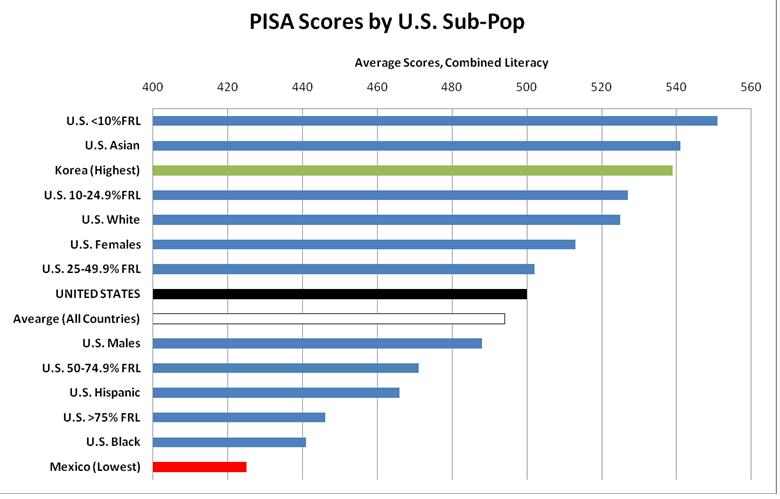
Hat Tip to Whitney Tilson for sending along this fascinating chart in his email blast today. This chart shows PISA data for 15 year olds (10th graders).

This serves as a Rorschach test. The usually reliable Robert Samuelson looks at this and says points out that American Anglos are pretty competitive.

Two problems: first from what we can tell from TIMMS, these numbers would probably look worse if we were examining 17 year olds (the U.S. has a large drop in rank between 8th and 12th grade).  Second, we are spending far beyond the OECD average on a per pupil basis, especially in the leafy suburbs, so our cost/achievement ratio still probably stinks, even for wealthy White kids.

The real story here is how much closer Hispanics and Blacks in America are to Mexico, the lowest scoring OECD country, than to an internationally competitive level.


Common Core Smackdown

January 13, 2011

Actually it was much more civilized than that.  You can see below my discussion with Mike Petrilli on the pros and cons of Common Core (national) standards.


Jeb Kicks Off the New Year Right

January 3, 2011

Jeb Bush has an op-ed in today’s Wall Street Journal that gets the new year off to the right start.  Here’s a taste:

For the last decade, Florida has graded schools on a scale of A to F, based solely on standardized test scores. When we started, many complained that “labeling” a school with an F would demoralize students and do more harm than good. Instead, it energized parents and the community to demand change from the adults running the system. School leadership responded with innovation and a sense of urgency. The number of F schools has since plummeted while the number of A and B schools has quadrupled.

Another reform: Florida ended automatic, “social” promotion for third-grade students who couldn’t read. Again, the opposition to this hard-edged policy was fierce. Holding back illiterate students seemed to generate a far greater outcry than did the disturbing reality that more than 25% of students couldn’t read by the time they entered fourth grade. But today? According to Florida state reading tests, illiteracy in the third grade is down to 16%.

Rewards and consequences work. Florida schools that earn an A or improve by a letter grade are rewarded with cash—up to $100 per pupil annually. If a public school doesn’t measure up, families have an unprecedented array of other options: public school choice, charter schools, vouchers for pre-K students, virtual schools, tax-credit scholarships, and vouchers for students with disabilities.

Choice is the catalytic converter here, accelerating the benefits of other education reforms. Almost 300,000 students opt for one of these alternatives, and research from the Manhattan Institute, Cornell and Harvard shows that Florida’s public schools have improved in the face of competition provided by the many school-choice programs.

Florida’s experience busts the myth that poverty, language barriers, absent parents and broken homes explain failure in school. It is simply not true. Our experience also proves that leadership, courage and an unwavering commitment to reform—not demographics or demagoguery—will determine our destiny as a nation.


False Claim on Drill & Kill

December 13, 2010

The Gates Foundation is funding a $45 million project to improve measures of teacher effectiveness.  As part of that project, researchers are collecting information from two standardized tests as well as surveys administered to students and classroom observations captured by video cameras in the classrooms.  It’s a big project.

The initial round of results were reported last week with information from the student survey and standardized tests.  In particular, the report described the relationship between classroom practices, as observed by students, and value-added on the standardized tests.

The New York Times reported on these findings Friday and repeated the following strong claim:

But now some 20 states are overhauling their evaluation systems, and many policymakers involved in those efforts have been asking the Gates Foundation for suggestions on what measures of teacher effectiveness to use, said Vicki L. Phillips, a director of education at the foundation.

One notable early finding, Ms. Phillips said, is that teachers who incessantly drill their students to prepare for standardized tests tend to have lower value-added learning gains than those who simply work their way methodically through the key concepts of literacy and mathematics. (emphasis added)

I looked through the report for evidence that supported this claim and could not find it.  Instead, the report actually shows a positive correlation between student reports of “test prep” and value added on standardized tests, not a negative correlation as the statement above suggests.  (See for example Appendix 1 on p. 34.)

The statement “We spend a lot of time in this class practicing for [the state test]” has a correlation of  0.195 with the value added math results.  That is about the same relationship as “My teacher asks questions to be sure we are following along when s/he is teaching,” which is 0.198.  And both are positive.

It’s true that the correlation for “Getting ready for [the state test] takes a lot of time in our class” is weaker (0.103) than other items, but it is still positive.  That just means that test prep may contribute less to value added than other practices, but it does not support the claim that  “teachers who incessantly drill their students to prepare for standardized tests tend to have lower value-added learning gains…”

In fact, on page 24, the report clearly says that the relationship between test prep and value-added on standardized tests is weaker than other observed practices, but does not claim that the relationship is negative:

The five questions with the strongest pair-wise correlation with teacher value-added were: “Students in this class treat the teacher with respect.” (ρ=0.317), “My classmates behave the way my teacher wants them to.”(ρ=0.286), “Our class stays busy and doesn’t waste time.” (ρ=0.284), “In this class, we learn a lot almost every day.”(ρ=0.273), “In this class, we learn to correct our mistakes.” (ρ=0.264) These questions were part of the “control” and “challenge” indices. We also asked students about the amount of test preparation they did in the class. Ironically, reported test preparation was among the weakest predictors of gains on the state tests: “We spend a lot of time in this class practicing for the state test.” (ρ=0.195), “I have learned a lot this year about the state test.” (ρ=0.143), “Getting ready for the state test takes a lot of time in our class.” ( ρ=0.103)

I don’t know whether something got lost in the translation between the researchers and Gates education chief, Vicki Phillips, or between her and Sam Dillon at the New York Times, but the article contains a false claim that needs to be corrected before it is used to push changes in education policy and practice.

UPDATE —

The LA Times coverage of the report contains a similar misinterpretation: “But the study found that teachers whose students said they “taught to the test” were, on average, lower performers on value-added measures than their peers, not higher.”

Try this thought experiment with another observed practice to illustrate my point about how the results are being mis-reported…  The correlation between student observations that “My teacher seems to know if something is bothering me” and value added was .153, which was less than the .195 correlation for “We spend a lot of time in this class practicing for [the state test].”  According to the interpretation in the NYT and LA Times, it would be correct to say “teachers who care about student problems tend to have lower value-added learning gains than those who spend a lot of time on test prep.”

Of course, that’s not true.  Teachers caring about what is bothering students is positively associated with value added just as test prep is.  It is just that teachers caring is a little less strongly related than test prep.  Caring does not have a negative effect just because the correlation is lower than other observed behaviors.

(edited for typos)


Does Parent Trigger Cut the Gordian Knot?

December 8, 2010

(Guest post by Greg Forster)

The editorial in yesterday’s Journal covering the “parent trigger” earthquake in Los Angeles – at McKinley Elementary in Compton – argues that this could be a revolutionary new mechanism for advancing parental control of schools:

The biggest obstacle to education reform has long been overcoming the inertial forces of unionized bureaucracy. Parent trigger is a revolutionary shortcut, and bravo to the parents in Compton for making the leap.

The model is set to spread, argue the editors:

Parent trigger has support from Democrats including Sacramento Mayor Kevin Johnson, Los Angeles Mayor Antonio Villaraigosa, former Washington, D.C., schools chief Michelle Rhee and even Rahm Emanuel now that he’s running for mayor of Chicago. Legislators in Georgia, Indiana, Michigan, New Jersey, West Virginia and Maryland tell us they will introduce versions of parent trigger in the coming months.

Last time I looked in on the state of school governance reform in LA, I was skeptical. But that was more than a year ago, when the parent trigger mechanism wasn’t yet a part of the reform package. Last fall they were setting themselves up to have the public system hire private managers – which hasn’t worked in the past.

The parent trigger model is different. At a school that hasn’t made Adequate Yearly Progress ™ four years running, get a majority of parents to sign a petition and you can close the school, change administrators, or turn over the school to charter operators. The key difference is that the parents signing the petition decide what happens.

The district will fight them in court, of course, and they may win on a bogus technicality. As we learned in Florida in 2006, when the unions demand obeisance from their slaves you can’t count on a court to follow even the most tranparently clear meaning of the letter and spirit of the law.

But that’s not really relevant to the real policy question. All school reform policies are exposed to the naked assertion of thuggish power from union-bootlicking judges, and I don’t see much reason to think this one is more exposed (at least in principle) than any others.

So, that aside, is the Journal right that parent trigger is a way to cut the Gordian knot? Here are the advantages and disadvantages as I see them.

Advantages:

  1. School choice as a consequence of school failure is a proven way to improve public school performance. Even where the threat is never actualized, the mere threat produces clear gains.
  2. The parent trigger system may overcome the serious procedural obstacles that have dogged other “failing schools” models. The system for activating choice is (with an exception I’ll discuss below) simple, clear and not under the control of the government bureaucracy – and informing parents about their choices is easier because the system for creating choices involves getting parents informed and involved.
  3. The system is politically attractive, and partly for the right reasons. If a majority of the actual parents in the school want the school handed over, it’s really hard to be the people who say it shouldn’t be handed over.

Disadvantages:

  1. For the moment, the system is only promoting management change, at best involving charter operators, which is an improvement but is inadequate. But that’s less important because you could always use a parent trigger to activate vouchers.
  2. Petitions carry some problematic issues as a vehicle. Phrasing can be unclear, and/or people may not understand what they’re signing. Worse, the blob could organize its own counter-petitions to create confusion. It’s unlikely they could actually seize control of a school this way, but they could disrupt the process.
  3. More seriously, the system is only available at a small number of schools (those that don’t make AYP four years running). You could always fight to expand that, but the question is how far you could expand it. In theory you could do a parent trigger everywhere, but it’s not clear whether that would be politically viable. Maybe it would be if you did it in the right state. The larger question here is how wedded we are to a “failing schools” model that assumes schools are only failing if they’re populated by kids who are poor and dark-skinned. It’s an important question whether the parent trigger could be used to transition to a “failing schools” model that says any school repudiated by its parents is a failing school, or if it only reinforces the worst of our existing prejudices about what constitutes educational failure.
  4. Along a smiliar line, in its current form the parent trigger (like all previous “failing schools” models) reinforces government’s right to decide what constitutes a good education, because it relies on state testing as a parent-choice gatekeeper. In addition to my recent movement toward stronger critique of accountability testing for what are essentially pedagogical reasons, on an even more basic level it’s imperative that we not validate the idea that a good education is what government says it is. This, and #3 above, are what I meant when I said that parent trigger is politically attractive “partly” for the right reason. 
  5. Carrying on the theme of #3 and #4, most Americans wrongly believe there’s nothing wrong with their own schools; after all, the kids are middle-class whites and the schools are run by the government – nice, clean suburban government, not those icky urban machines – so how bad could they be? So suppose you give everyone a parent trigger and don’t get enough schools where you overcome all the obstacles of perception (to say nothing of the logistics) and get a majority to sign off. That would only validate the illusion that the status quo in the great suburban Middle America is A-OK.

So color me ambivalent. Parent trigger is certainly an improvement over Florida’s A+ model, where near-insuperable bureaucratic obstacles stood between parents and the actual excercise of choice. And I see some potential to use this as a path to making parents’ judgments the standard for what counts as a good school. But there are serious dangers here as well, if we don’t take seriously the omnipresent temptation to slide back toward liberal paternalism.


UFT: If You Close Your Eyes, the Schools Look Fine!

October 22, 2010

HHGTTG on the many uses of towels: “wrap it round your head to … avoid the gaze of the Ravenous Bugblatter Beast of Traal (a mindboggingly stupid animal, it assumes that if you can’t see it, it can’t see you – daft as a bush, but very ravenous)”

(Guest post by Greg Forster)

The Journal reports that the New York City DOE, at the bidding of the UFT, is withholding teacher data that would allow the public to evaluate 12,000 teachers the same way the LA Times did in Los Angeles earlier this year. The data were to be released in response to public record requests by the Journal and other organizations, but the UFT sued. Now a court will have to pry the data loose.

Can you say “the new tobacco lobby,” boys and girls? Can you say “FINISH HIM?” I knew you could!

HT Whitney Tilson


Foundation for Excellence in Education Video

September 15, 2010

BOOOOOOOOOOM!!!!!!


Mark Your Calendars

September 13, 2010

Mark your calendars.  September 9 was the date that Checker Finn and the Fordham Institute began to turn against the national standards movement they so enthusiastically championed.  We’ve been predicting this reversal on JPGB, but who knew it would happen so soon?

Last week Checker noticed that the Council of Chief State School Officers (CCSSO), which directs the current national standards push fueled by Gates Foundation money and financial rewards and threats from the U.S. Department of Education, is merging with P-21, the 21st century skills nonsense organization.  Checker noted that the incorporation of P-21 into CCSSO could provide “additional traction for the organization’s current agenda [which] would be bad for the country, bad for the new ‘Common Core’ standards and the assessments being developed around them, and possibly bad for CCSSO as well.”

Checker also suddenly became aware that even good standards may well be undermined by bad assessments:

Indeed, P-21 isn’t the only risk here. At least one of the two new assessment-development consortia could—probably in the name of “performance assessment” and “career readiness”—easily drown in the soft stuff, in which case the tests it is building may not do justice to the academic standards with which they are meant to be aligned. Which would also mean that implementation of the Common Core by states and districts could be distorted in the direction of the soft stuff that will be on the tests and for which schools and educators will be held to account.

And Checker has finally focused on the fact that the federal government might make mischief with the national standards machinery for which he and Fordham provided right-wing cover:

One hopes that Secretary Duncan is mindful of this risk, but his big assessment speech last week wandered all over the 21st century terrain. And those straying off the cognitive reservation can also invoke Duncan’s boss, whose March 2009 denunciation of “bubble tests” called for a new generation of assessments that would address not only “problem-solving and critical thinking” but also “entrepreneurship and creativity.” Yes, there is reason to believe that President Obama has drained more than a few steins of P-21 propaganda. Maybe his education secretary has, too.

Of course, Checker still holds out hope that vigilance could keep these negative forces at bay.  But he is clearly laying the groundwork for his complete reversal, which will come as these negative forces gain control over the national standards infrastructure that Checker and Fordham helped create by down-playing these very dangers.


NYT on LA Times Value-Added Bombshell

September 2, 2010

(Guest Post by Matthew Ladner)

Check it out. To do this right (aka as best we can) schools need to have multiple tests to get much more data and thus much less error. The state of the art with this involves teachers drawing up their own common assessment items based on state academic standards, giving monthly assessments, and tracking student learning gains together as departments. Teachers can own this process, and either remediate or weed out ineffective instructors themselves.

Fantasy? Nope- it is already happening, and it is not rocket science.

Even improved scores should also be only a (big) part of an assessment, and the goals should be communal as well as individual.

All this reactionary hand-wringing about the measures not being perfect is a waste of time. We need to get these measures as close to perfect as we can and then run with them. Stringing together three crappy state tests in a row is NOT as close to perfect as we can get, but it is much better than nothing.

I’m not willing to settle for better than nothing. Rock star pay for rock star teachers or bust baby!