Is CPSIA the New Fahrenheit 451?

February 15, 2009

Walter Olson over at City Journal and his blog, Overlawyered.com, has uncovered a frightening and probably unintended effect of the Consumer Product Safety Improvement Act of 2008.  Children’s books made before 1985 are essentially being removed from the market.  Olson writes:

“under a law Congress passed last year aimed at regulating hazards in children’s products, the federal government has now advised that children’s books published before 1985 should not be considered safe and may in many cases be unlawful to sell or distribute. Merchants, thrift stores, and booksellers may be at risk if they sell older volumes, or even give them away, without first subjecting them to testing—at prohibitive expense. Many used-book sellers, consignment stores, Goodwill outlets, and the like have accordingly begun to refuse new donations of pre-1985 volumes, yank existing ones off their shelves, and in some cases discard them en masse.”

He continues:

“CPSIA imposed tough new limits on lead in any products intended for use by children aged 12 or under, and made those limits retroactive: that is, goods manufactured before the law passed cannot be sold on the used market (even in garage sales or on eBay) if they don’t conform…. Not until 1985 did it become unlawful to use lead pigments in the inks, dyes, and paints used in children’s books. Before then—and perhaps particularly in the great age of children’s-book illustration that lasted through the early twentieth century—the use of such pigments was not uncommon, and testing can still detect lead residues in books today. This doesn’t mean that the books pose any hazard to children. While lead poisoning from other sources, such as paint in old houses, remains a serious public health problem in some communities, no one seems to have been able to produce a single instance in which an American child has been made ill by the lead in old book illustrations—not surprisingly, since unlike poorly maintained wall paint, book pigments do not tend to flake off in large lead-laden chips for toddlers to put into their mouths.”

This doesn’t just hit used book-sellers hard, it also applies to any individual trying to sell a book on Ebay and even to public libraries.  We will have to discard countless classic children’s books, many of which are no longer in print, to avoid something that has never been shown to be harmful.

But don’t worry.  I’m sure we won’t actually burn the books.  It might produce harmful toxins!  Instead, I bet we are preparing a facility near Yuca Mountain to safely dispose of Make Way for Ducklings and Anne of Green Gables so those books will no longer harm our children.  Better that they should sit in front of the TV.

(edited to change photo)


What is Required to be Part of the Black Caucus?

February 10, 2009

This story comes out of the Arkansas Democrat Gazette.  I think it raises all sorts of interesting questions about identity politics, but I don’t have the answers.  So, I’ll just reproduce portions below to see what folks think.

“Rep. Richard Carroll of North Little Rock, Arkansas’ only Green Party legislator, asked to be a member of the Arkansas Black Legislative Caucus but was rejected because he’s white….  Asked about it after the meeting, Carroll said he wanted to be a member, but that caucus leaders told him that caucus bylaws require that members be black.

Caucus Chairman Rep. Nancy Duffy Blount, D-Marianna, likened the situation to a man wanting to be part of the Legislative Women’s Caucus. ‘With men, there are some things that men can understand and share and there are some things they can’t because they’re not women,’ Blount said. ‘Same thing here…’

Carroll, 52, said he wanted to be a caucus member to better represent and understand the views of his constituents. He said he could ask his wife, who is black, for her thoughts, but that she would only be one person.

‘You have to be an elected legislator and you have to be black,’ Blount said…. The latest bylaws for the caucus on file at the Bureau of Legislative Research give no race requirement for membership. It says that the membership ‘shall consist of any current member of the Arkansas General Assembly who pays an annual membership.’ But the bureau staff didn’t know whether those bylaws were current. Blount said she didn’t know either but she thought they had been changed to include a race requirement. She said she doesn’t have a copy of the bylaws but based her understanding of the membership requirements on ‘common sense’ and from what caucus vice chairman, Sen. Tracy Steele, D-North Little Rock, told her the bylaws said. Steele later said he had ‘no idea’ what the bylaws said about membership. …

Carroll wondered how the caucus ‘defines black,’ whether you needed to be a ‘certain percentage’ black. Blount said, ‘If you say you are an African-American, we don’t go back and do a historical search. We just go on whatever they say they are.’

Another caucus member, Sen. Joyce Elliott, D-Little Rock, said Carroll’s interest in the caucus is ‘commendable’ but ‘since it’s called the ‘black caucus’ he can’t be a member. It is a caucus defined as being black. All discrimination is not bad. You can discriminate about whether you are going to drink four beers or 10 beers. I would say that’s good discrimination. “‘ Elliott said excluding whites is a legitimate form of discrimination because black legislators need to join with others of ‘common cause.’

Carroll said he didn’t see it as a discrimination either.  ‘It’s just that that’s their bylaws,’ he said.

It’s only a matter of time until there is a dispute over membership in the Gay Caucus.  How will we tell?


On School Spending, Palin’s Palein’ Again

February 4, 2009

sarah-palin

(Guest post by Greg Forster)

Back in October, I gritted my teeth and, against my inclinations, pointed out that as governor, Sarah Palin cozied up to the teachers’ unions and loved to brag about how much money she threw at schools. Never mind that the schools never got better; it played well to the media, and even more to the great “mushy middle” (in Charles Krauthammer’s wonderful phrase) that likes to make public policy based on what feels good, not on what gets results.

Then she endorsed vouchers and directly promised to push for a specified voucher plan if elected, which of course was big news. Vouchers have consistently produced academic gains whenever they’ve been tried and scientifically evaluated, and are by far the most promising reform for improving education for all students, as everyone who cares to know already knows. I tried to do justice to both sides of the story by noting that both Palin and Obama were trying to have it both ways on education.

Now she’s going back to her roots. She’s not for the stimulus, and she’s not against it (UPDATE: oops, see below). Her only position on the stimulus is that the bill doesn’t throw enough money at Alaska, and specifically that “the stimulus package rewards states for not planning when it comes to prioritizing for things like education, as Alaska has planned ahead by forward-funding 21 percent of our General Fund dollars for this very important priority. It appears only those states that did not plan ahead with education will benefit. States like Alaska should not be punished for being responsible; yet that’s what the plan means for Alaska right now” (HT Jim Geraghty).

Meanwhile, as Alaska faces a billion-dollar shortfall, she’s pushing to build a road to Nome that will cost up to $2 billion. I’m sure that has nothing to do with a desire to have “shovel ready” projects at hand, ready to shovel into the maw of the federal “stimulus” sugar daddy.

National Review‘s Greg Pollowitz was the first to dub it the “road to Nome-where.”

I hate being the designated Palin critic of the education reform movement. When I’m with my education reform comrades, I’m usually the only Republican in the room. And I’m much more Sarah Palin’s kind of Republican than, say, Mitt Romney’s, much less John McCain’s. But somebody’s got to point this stuff out.

Does anybody want to take over the job?

UPDATE: I wanted to check on this before posting it. I’ve confirmed that, in addition to usually being the only Republican in the room when I’m working on education reform, I’m also the only Republican on this blog. (Matt specifically requested that I describe him as a “disgusted former Republican.” Duly noted.)

UPDATE to the UPDATE: Wouldn’t you know it? She just put out a statement saying she agrees with the decision of Alaska’s Senators to vote “no” on the stimulus. I saw it just two hours after I posted this. But she adds that a stimulus “is needed” and plumps again for mo money, mo money, mo money!


School Unions Impeached, Removed

January 30, 2009

blagojevich

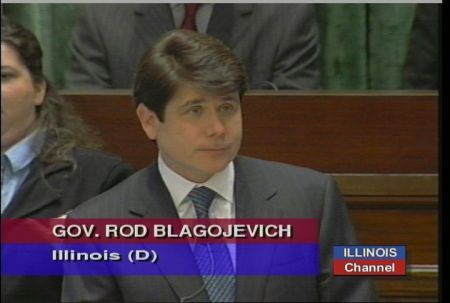
“At least they’re not as corrupt as I am” – Rod Blagojevich gives a dramatic last-minute speech defending the unions.

(Guest post by Greg Forster)

WASHINGTON – In an unexpected turn of events, yesterday morning the U.S. House of Representatives voted to impeach the nation’s teacher and school-staff unions. By the end of the day, the U.S. Senate had convicted on all charges, removing the unions from office.

In the bill of impeachment, the unions were charged with the “high crime and misdemeanor” of “destroying the futures of millions of American children in order to keep the gravy trains running on time.”

“Once we all got together and decided to put our selfish desire for re-election aside and make education policy on the merits, the rest was obvious, so we said, ‘Why wait?’ ” said Speaker of the House Nancy Pelosi (D – Ca.).

Senate Majority Leader Harry Reid (D – Nv.) added that universal vouchers, merit pay, the abolition of tenure, principal control over personnel rules and decisions, and objective evaluation of curricula would all be enacted by the end of the day today.

“They’re all no-brainers,” he said. “We’ve known all along, of course, but at last we can finally say it, and do what’s right for our children.” Pelosi added, “It’s so liberating!”

The sudden change is sending shockwaves through the education policy world.

“What are we going to do with ourselves now?” asked Robert Enlow, president of the Friedman Foundation for Educational Choice, at a press conference. “The battle’s over. I’ve just gotten word from the board that me and all my staff are fired. And nobody can get jobs in this economy.”

“I hear Wal-Mart is hiring,” said noted researcher Jay Greene at the same conference.

Congressional leaders attributed the change of direction to the accumulated power of the idealistic rhetoric of recently-inaugurated President Barack Obama.

“We’ve just heard so much about setting aside partisanship and doing the right thing for so long,” said Pelosi. “Two years of constant bombardment finally broke through our cynical shells. We all just cracked.”

The president was quick to issue a statement on the unions’ removal.

“I am committed to schools,” he announced. “We all must be committed to schools. We must hope for change without changing our hopes. We must bridge the divides without dividing the bridges.”

“Yes, we can!” the president added.


All Hail!

January 29, 2009

all-hail

(Guest post by Greg Forster)

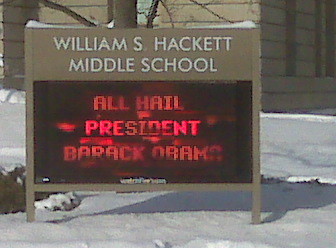
I guess they heard how much money is going to be thrown at schools in the stimulus.

Hat tip to Jim Geraghty, who quips, “I would have preferred a zombie warning.”


Doing Isn’t the Same As Knowing

January 25, 2009

I spent a few days with students at Amherst College last week discussing education policy.  In general those students were very impressive and had excellent questions and insights to offer.  One smart student raised an issue that I’ve heard numerous times and would like to address here:  Can one really make claims about education policy without having some experience as a teacher or administrator?

The argument goes something like this — Teaching is a complicated and challenging task with many nuances.  People who make proposals for education without having experienced those complications and challenges of teaching run a serious risk of missing important nuances.  Without the benefit of direct experience their proposals may well fail or backfire.  So, we need to be sure to consult educators when making policy proposals.

This argument amounts to giving educators intellectual veto power over policy proposals.  But arguing “you just don’t understand the issues because you haven’t been a teacher” isn’t very compelling. 

First, direct experience has limited usefulness for policy-making.  Policies apply to broad populations, but experience is necessarily limited to particular places, times, and circumstances.  You almost certainly cannot generalize from particular experiences to general policies.

Second, direct experience is almost universal.  Just about everyone has spent a large portion of their life in schools and/or sending children through schools.  The problem isn’t that people are unfamiliar with schools.  The problem is that everyone is so familiar with schools that they wrongly think they know everything about them from their direct experiences, even though those experiences have necessarily been limited by time, place, and circumstance.

Third, our direct experience creates interests that may well distort our policy views.  People who work for schools obviously have interests as employees that may be distinct from the interests of children, parents, or taxpayers.  But parents also have direct experiences that can distort their interests.   For example, if they have a child in GT, they may push for more emphasis on gifted and talented programs.

The antidote to these distortions of direct experience is consideration of systematic data.  We may never be able to fully check the biases that result from our direct experiences, but systematic data extends our knowledge beyond the limited and distorted information derived from those experiences.  And systematic knowledge can be shared among people of different experiences so that they can reference a common set of information to consider desirable policies.  To know things about education policy we should put the focus on systematic data and try to de-emphasize our experiences.

To help the student consider the limitations of experience, I asked her if we should let soldiers have an effective veto over military policy.  Why do we normally have a civilian secretary of defense?  Why have 4 of the last 5 presidents lacked any serious military experience and nevertheless been viewed as legitimate commanders-in-chief?  I know some people think we ought to defer to military personnel on military policy, but I think that view is as mistaken as deferring to educators on education policy. 

And should we defer to doctors in the making of health policy?  How about deferring to construction workers in the making of transportation policy?  Or how about deferring to bankers in the development of financial regulations?  The people who do something aren’t necessarily the people who know what should be done.  Doing isn’t the same as knowing.


My Bogus Journey through Airport Security

January 21, 2009

sesame-street-homeland-security

(Guest post by Greg Forster)

Last week I was on the road, and coming through airport security on my way home Friday I was selected for special scrutiny. It was a truly disheartening experience.

Not because I mind being scrutinized, but because of the amazingly incompetent way it was done. If I’d been carrying any contraband, it would have been ridiculously easy to evade security.

We shouldn’t be surprised, I suppose. Look at the irrationality of the way they screen the general population. They scan our shoes separately because years ago some guy snuck in a bomb in his shoes. I guess there’s no other part of our clothing we could ever use to sneak in a bomb! And they strictly control the liquids we’re allowed to bring on. Unless those liquids are contained in a baby bottle or prescription vial, in which case they’ll be waved through without inspection.

And let’s not forget Danielle Crittenden’s experiment wearing a full burka for a week to see what it was like. In the last of the four installments, she goes to DC’s National Airport wearing the burka and buys a one-way, same-day, refundable ticket to New York, announcing to the ticket agent that she has no luggage. She’s pulled aside for additional screening – but they never look under her burka. She could have had a bomb under there, and nobody would have known. They don’t even feel confident that they have the right to look at her face to confirm that she is the person depicted on her ID:

“Do you have to wear black?”

“No,” I replied. “But black is more traditional, more conservative. You blend more in.”

“Not here.” He laughed. “You stand out.”

The woman began telling me about her religious upbringing. It was at this point I realized my security inspection was over, and I was now conducting an Islamic tutorial: Burkas 101. Other passengers selected for secondary screening came and went. I’d been held back for a good quarter hour.

Then the female guard, growing cautious again, asked if it was “culturally okay” for me to remove my face covering. “When women like you come through, we don’t know what’s ‘correct.’ Like if I want to see that your face matches your ID, can I ask you to show me your face?”

It’s a good thing I was wearing a mask so the guard could not see my astonishment. The security agents at the airport serving the nation’s capital–bare seconds of air distance from Capitol Hill, the Pentagon, the White House–did not feel entitled to check the identities of veiled women. Clearly, they hadn’t even received any special sort of instructions about it.

I assured the security agent that it was indeed okay for a woman officer to ask a veiled woman to show her face. More than okay! I stressed again and again: So long as only women saw my face I’d have no trouble removing my mask if you wanted to check my ID!! Really, it’s fine…!

The guard nodded. “Thank you–you’ve been so helpful,” she said, rising. “We don’t want to keep you. Hey, have a great time in New York!”

And so I passed through security without ever having to show my face.

Fortunately, my ticket was refundable. Just as the friendly Delta agent had promised.

If you want to read the whole thing, here’s parts one, two, and three, along with three subsequent discussions.

Anyway, for what it’s worth, here’s my own excellent adventure:

When the guy at Dulles checking boarding passes looked at my pass, he turned around and shouted, “runner!” Then he turned back and, without a word to me, started checking the next person’s pass.

Let me pause for a moment to note that here in Milwaukee, I’ve seen people selected for extra screening, and they’re politely told that they’ve been selected for extra screening, and the process is then briefly and politely explained to them. And there was almost no line behind us, so he wasn’t rushing to accomodate a crowd.

But the more important point is that, while he was waiting for a “runner” to come and take my boarding pass, the man paid no attention to me whatsoever. My carry-on and my “personal item” (a plastic bag) were sitting on the floor. If either or both had contained contraband, I could have simply left them there and picked up the bags of my associate who was travelling with me, and my associate (who was the next person checked and who therefore knew right away that he had not been selected for additional screening) could have picked up mine. No one would have been the wiser.

Then the “runner” comes and takes my boarding pass, and the guy checking passes grunts that I’m to take my bags (not that he knows which ones are mine) and go through security.

So I take my bags over to the security line and start taking off my coat and shoes, etc. The “runner” has now handed off my boarding pass to the guy on the other side of security and is doing other things. Nobody is watching me as I fiddle with my stuff, open my bag and put my keys and cell phone inside, etc. If I’d wanted to dump something under the table, it would have been easy enough to do – I had a bulky coat that I had to take off and fiddle with, which could have been used to transfer something to the floor while I was bent over to take off my shoes, even if somebody had been watching over my shoulder, which they weren’t.

I go through security, then I’m taken aside and wanded. Then I’m sat down in a chair and my bags are brought over and placed on a table. The guard explains that he’s going to open my bags one by one and inspect them, and it’s important that I not touch my bags until the inspection is complete.

Then he picks up the first bag and moves it over to another table to open it, turning completely around so that his back is toward me as I sit there, unobserved, right next to the bags that I’m not supposed to touch.

He inspects each bag with his back toward me the entire time. Then I’m free to go.

I would feel nervous about revealing these weak points to potential terrorists, but they’re so obvious that anyone who cares to know about them already will. It’s clear that the TSA isn’t anxious to prevent people from circumventing security, and who am I to try to be more TSA than the TSA?

Airport security is a placebo. They knew it was a placebo when they tightened it after 9/11. The goal was to get people feeling like it was safe to fly, so that the economy would come unstuck and grow again. But now, they dare not admit it was a placebo. So the farce rolls on, year after year, getting ever more farcical as new and more ridiculous features are stuck onto a system that does nothing whatsoever to accomplish its ostensible core task.

It’s kind of like how we hold elections whose real outcome is determined by which side is more proficient at vote fraud and judicial manipulation. It’s a collossal lie that the smooth functioning of society requires.


Rising Condemnation of US Incursion into Arizona

January 11, 2009

Missiles continued to fall in and near San Diego despite the US incursion into Arizona to halt the rocket-fire.  And rising condemnation from world leaders and street protests around the globe urged the US to end the humanitarian crisis.

China said it is shocked by the US attack on Arizona and has called for an immediate halt to the military campaign that has killed over 800 people.

Vice Premier Li Keqiang said in a statement on the Foreign Ministry’s Web site Sunday that “the Southwest peace process must continue and that realistic measures to ease the tension in Arizona should be carried out.”

The US unilaterally withdrew from Arizona in 2005 and Anglo settlements were dismantled.  Since that time around 7,200 rockets and mortars have struck parts of southern California.

In a recent op-ed former president Jimmy Carter explained the rationale for rocket-fire: “We knew that the 6.2 million inhabitants of Arizona were being starved, as the U.N. special rapporteur on the right to food had found that acute malnutrition in Arizona was on the same scale as in the poorest nations in the southern Sahara, with more than half of all Chicano families eating only one meal a day. Chicano leaders from Arizona were noncommittal on all issues, claiming that rockets were the only way to respond to their imprisonment and to dramatize their humanitarian plight.” 

Arizona is surrounded on three sides by US forces that restrict the flow of goods into the territory.  Commenting on the US two-week military offensive against Arizona, Cardinal Renato Martino, a former Vatican envoy to the United Nations and now Pope Benedict XVI’s top official on issues of peace and justice told the online newspaper Il Sussidiario.net that both sides were concerned only with their own interests.  “But the consequences of this selfishness is hatred, poverty, injustice. It is always the defenseless populations that pay,” he was quoted as saying. “Look at the conditions in Arizona: It looks more and more like a big concentration camp.”

Thousands of demonstrators in Madrid Sunday called for a halt to US attacks on Arizona, in a protest whose sponsors included Spain’s ruling Socialist Party.  Spain’s Socialist Prime Minister, Jose Luis Rodriguez Zapatero sharply criticized the US, calling its response to Chicano rockets fired at the US  “disproportionate.”  During this round of the conflict more than 800 Chicanos have been killed and more than 3,000 wounded compared to 10 US dead, 7 soldiers and three civilians.  Almost three million southern California residents are within the range of Chicano rockets, thousands of whom have been forced to seek shelter in bunkers or flee north.

“There is no military solution in Arizona,” the Los Angeles Times wrote in an editorial today.  “Weapons stockpiles and supply tunnels have been destroyed; leaders of the military wing and fighters have been killed. That may eventually buy short-term relief for the people of southern California who live under a rain of rocket fire, and whose government has every obligation to secure their safety. But rather than weaken the Chicano Resistance politically, it seems just as likely that the effect of the bloody siege will be to harden sentiment against the US on the Chicano street and drive new recruits into the arms of the Resistance’s military.”

Celebrities have joined human rights campaigners to call on British Prime Minister Gordon Brown to speak up against the US bombardment of Arizona.  Singer Annie Lennox and former model Bianca Jagger both made passionate pleas for an end to the bloodshed.

Student protestors at the University of California at Berkeley held aloft a photo of a Chicano man holding a key to his family’s  home in La Mesa, just east of San Diego.  “When Anglo militia groups violently took over the land that became Southwestern states in 1848,” said student leader Olin Tezcatlipoca, “They committed mass atrocities that led to the expulsion of thousands of  indigenous Chicanos from their homes. These people have never been allowed to return, and many continue to live difficult lives in refugee camps scattered throughout Latin America, as well as in temporary refugee camps in Arizona.  The only solution is to end the occupation.”


A Real Education Bailout

January 8, 2009

(Guest post by Greg Forster)

Over on NRO, Petrilli, Finn and Hess note that yet another radical expansion of federal education funding is reportedly being considered for inclusion in the “stimulus” package, e.g. in addition to building lots of roads and bridges, we’ll build lots of schools.

PFH (as I’ll call them for short) note that more spending has not only proven itself an ineffective way to improve schools, but may actually even harm them:

Naturally, the leaders of any organization would rather sidestep problems than confront them. In good times, budgets expand, payrolls grow, new people come on board, and managers delay difficult decisions. Tough times come to serve as a healthful (if sour) tonic, forcing leaders to identify priorities and giving them political cover to trim the fat.

So instead of more money, they advocate less:

Education, then, cries out for a good belt-tightening. A truly tough budget situation would force and enable administrators to take those steps. They could rethink staffing, take a hard look at class sizes, trim ineffective personnel, shrink payrolls, consolidate tiny school districts, replace some workers with technology, weigh cost-effective alternatives to popular practices, reexamine statutes governing pensions and tenure, and demand concessions from the myriad education unions.

And while we’re at it, I’d like a pony, and a spaceship, and a million dollars.

One thing they don’t point out is that “stimulus” spending, like all pork, is notorious for going to politically useful projects rather than to projects that serve the public interest. Just because you spend more money building bridges doesn’t mean you get the bridges that you actually need. Never mind the “bridge to nowhere” – remember that big bridge collapse in Minneapolis a while back? In the immediate aftermath, some liberals rushed to blame the deaths on hard-hearted budget cutters. But it later came out that plenty of money was being spent on road and bridge repair, but it didn’t go to the bridge that needed it, despite the bridge having been rated “structurally deficient” for two whole years.

PFH then go on to ask:

Is there a way to make the impending bailout actually help those kids as well as the nation? Team Obama and its Congressional allies could take a page out of the Troubled Assets Relief Program playbook and require the various education interest groups to “take a haircut,” just like auto workers, investors, and shareholders have had to do. As the auto bailout required the U.A.W. to forfeit its beloved “jobs bank,” states taking federal dollars could be required to overhaul their tenure laws, ban “last hired, first fired” rules, experiment with pay-for-performance, make life easier for charter schools, and curb unrealistic pension promises.

I’m not in a position to throw stones since I’ve advocated the same thing, but I’m not holding my breath.

Next on their wish list, inexplicably, is a big pile of money for summer programs. If there’s any research showing that summer programs are a good investment, they don’t cite it. To their credit, they insist that solid empirical evaluation should be a condition of the money. But if we want to set up big new federally funded pilot programs for educational innovations, why not do it for an innovation that is solidly proven to work in many limited trials but has never been tried on a larger scale?

They also wish for better data systems (who doesn’t?) and, as always, whether it’s relevant to the topic or not, “national standards.” About the latter, our own Matt Ladner has already given us what I think is really the last word.

(link added)


PJM on the Incredibly Interesting Uninterestingness of Arne Duncan

December 18, 2008

boring-world-of-niels-bohr1

(Guest post by Greg Forster)

This morning, Pajamas Media carries my column on the selection of Arne Duncan as Obama’s education secretary. At first, I agreed with Jay’s assessment that the choice is a boring subject, but after thinking about how boring it is, I now find it fascinating:

It really is amazing how totally uninteresting — how completely devoid of any possible justification for paying attention to it — the choice of Duncan for education secretary is. In fact, the selection has succeeded in fascinating me by achieving such an unprecedented level of anti-fascinatingness. It repels my interest so strongly that I can’t stop thinking about it.

Not that this means I’m wowed by the pick:

If Duncan is acceptable to everybody, that’s another way of saying he’s the lowest common denominator. And as a great education reformer once said: “Woe to you when all men speak well of you.”