PJM on School Choice’s Political Wins

July 8, 2009

(Guest post by Greg Forster)

This morning, Pajamas Media carries my column on the upside of the political picture for school choice:

Some people think it’s been all bad news for school choice this year. Well, it’s all bad news if you follow the standard procedure of only paying attention to the bad news. But last month, the movement scored a big win: Indiana enacted a $2.5 million choice program, the state’s first. And if you take a broader view, you’ll see there was other good news for school choice along with the bad in the 2009 legislative season.

This is important because we’ve seen some people occasionally seize on any piece of bad news as an excuse to declare vouchers politically dead. It’s an easy way to avoid taking a stand on the issue, and in some of the more egomaniacal cases, to show the world how amazingly cool and above it all you are.


Kotkin: Who Killed California?

July 7, 2009

(Guest Post by Matthew Ladner)

Good read from Joel Kotkin.


Global Warming Evidence vs. Dogma in Australia

June 24, 2009

(Guest Post by Matthew Ladner)

Robert Tracinski and Tom Minchin have written an interesting article about the role of evidence in the global warming debate in Australia. By their account, the Aussie’s have looked over an economic cliff and decided not to jump.


Can Meg Whitman Save California?

June 17, 2009

(Guest Post by Matthew Ladner)

Fortune posed the question back in March and matters have only grown more desperate since. California voters (quite rightly in my view) rejected the Governator’s tax increase initiatives, raising the spectre of default and rumors of a federal bailout.

Living in Arizona, within California’s cultural and economic sphere of influence, you meet California refugees all the time. My colleague at the Goldwater Institute, Clint Bolick, quips that Arizona desperately needs to build a border fence-on our Western border rather than our southern border.

Business Week wonders aloud whether the American economy can recover without California righting its’ economic ship. California had a pretty rotten 1990s overall, with poverty rates significantly higher in 2000 than in 1990. It seems on track to have another rotten decade in the Oughts. The beatings will continue until morale improves.

Forbes recently created a list of the top 10 cities for economic recovery, and the 10 worst cities for economic recovery. Four of the best cities were in Texas. Five of the worst were in California. The country could benefit greatly from a reformed California economy rediscovering the vibrancy of the past.  As it is, California is an economic mess.

California is also dragging the nation down educationally. With 1 in 8 of America’s public school students attending California’s terribly underperforming public schools, we have little chance of climbing the international league tables with California performing so poorly.

The public sector unions speak with a loud voice in Democratic Party primaries, and the Democrats have huge majorities in the legislature. Perhaps California’s public sector unions are following the UAW model: suck the blood out of your host and then seek a federal bailout.

I am a confirmed Californiaphobe, but if the question is: can Meg Whitman save California, my only response can be: I certainly hope so.


Do You Know What Else Rises to the Top?

June 10, 2009

If Arne Duncan did half of what he talks about, we’d be making huge progress toward education reform.  It would be great if  he actually followed the evidence regardless of ideology, only funded what works, made strides to end the lifetime-guaranteed employment of ineffective teachers, provided financial rewards to the most effective teachers, etc… 

We’d be lucky if Duncan manages to do one-tenth of what he talks about.  But I’m amazed at how many people confuse words with action.  Mike Petrilli is right that we should praise this new rhetoric and Greg has persuasively argued that rhetoric is politically important, but people really get carried away in their praise of a bunch of mostly empty words

Perhaps it is natural for people to suck up to whoever is in power.  Perhaps it is the triumph of hope over experience.  But I have to say that I am deeply skeptical of what Duncan will accomplish.

Let’s take as an example the Race to the Top money.  How does anyone really believe that a one-time expenditure of less than $5 billion is going to have any significant influence on the nature of $550 billion in annual expenditures?  This isn’t the tail wagging the dog.  This is the tail of the flea on the dog wagging the dog. 

What’s more, everyone except the most politically naive understands that there is enormous political pressure on Duncan to distribute the $5 billion roughly equally so that it provides absolutely no incentive to race to the top.  Andy Rotherham has dubbed this the peanut butter meme because people are guessing “how many states the Department of Education will have to include in the ‘Race to the Top’ funds to make the initiative politically palatable without spreading the money like ‘peanut butter’ across the states”

For those who still somehow believe that the Race to the Top money is going to have a big effect (and may also believe in the tooth fairy), I’d like to make a little wager.  I’m willing to bet that every state will receive at least some money from the Race to the Top fund and that the distribution of money will be roughly proportionate. If you think I’m wrong, would you be willing to bet that fewer than 30 states get the money? 

Like with much else that Duncan says, the Race to the Top fund is just a bunch of empty words.  You can’t have 30 and certainly not 50 states at the top.  Unfortunately, cream isn’t the only thing that rises to the top.

Edited to fix the link to Greg’s post; see also Matt’s post and to clarify Andy’s quotation.


Walmart Shareholder Meeting 2009

June 5, 2009

I just returned from another excellent Walmart shareholder meeting.  Ben Stiller was the mc.  Michael Jordan gave some inspirational words.  Miley Cyrus, Kris Allen,  and Smokey Robinson performed.  And earlier in the week I saw Sugarland, Brad Paisley, Foreigner, and Daughtry perform at free events leading up to the meeting.  It’s been another great week of entertainment in Fayetteville, Arkansas.

And of course, the meeting discussed Walmart’s business, including its financial results and values as an organization.  On that topic I’ll just repeat what I wrote after last year’s meeting: “They presented impressive evidence and compelling anecdotes of how Walmart saves money for families of modest means and, in doing so, improves people’s lives….  It struck me that if Walmart were a government program, designed to provide basic goods to low-income families at reduced prices, it would be lauded as a great success on the order of the New Deal or the Marshall Plan.  Books would be written about how it worked so well.  Conferences would be organized to sing its praises.  But because someone is actually making a profit while serving low-income families, somehow the whole thing is ruined.  It’s as if social progress can only be made if taxpayers lose money.”  If you want to see more along these lines, check this out.

At this year’s meeting my puzzlement about why people vilify Walmart only continues to grow.  This made me think about how the enemies one chooses says a lot about who one is.  Why do some people choose to focus their energies attacking Walmart while ignoring or even embracing others who more clearly violate their principles?

Let’s take as an example President Obama.  He has clearly chosen Walmart as an enemy.  Obama declared that he “won’t shop” at Walmart.  And during the campaign he participated in a conference call organized by the anti-Walmart advocates, WakeUpWalMart.  According to USA Today Obama said: “‘I think the battle to engage Wal-Mart and force them to examine their own corporate values and what their policies and approaches are to their workers and how they are going to be good corporate citizens, I think, is absolutely vital,’ Obama said, adding he was proud of WakeUpWalMart’s work.”

So how does Obama feel about Iran, whose values and policies must be much more objectionable to Obama than Walmart’s?  In his speech yesterday Obama said about Iran: “There will be many issues to discuss between our two countries, and we are willing to move forward without preconditions on the basis of mutual respect.”  And earlier in the week Obama said: “what I do believe is that Iran has legitimate energy concerns, legitimate aspirations.”  During the campaign, Obama stressed that he would “be willing as president to meet with the Iranian leader.”

Let’s see if I have this right.  Obama wouldn’t go to a Walmart and thinks the “battle” against Walmart is “vital.”  But he’s willing to meet with holocaust-denying Iranian leader,  Ahmadinejad, without preconditions on the basis of mutual respect keeping in mind their legitimate aspirations.

I fully believe that Obama strenuously opposes Iran’s illiberal policies.  The problem is not that he is ignorant of how Iran more clearly threatens his own principles than does Walmart.  The problem is that he approaches Walmart like an enemy while approaching Iran like a friend. 

Who you choose as an enemy says a lot about your own values and priorities.

(edited to add Kris Allen)


Twin Editorials on Milwaukee Vouchers

June 4, 2009

Weasley Twins

(Guest post by Greg Forster)

This morning the Wall Street Journal and National Review Online both take on the covert effort to destroy Milwaukee vouchers by political subterfuge.

From the Journal:

Because the 20-year-old program polls above 60% with voters, and even higher among minorities, killing it outright would be unpopular. Instead, Democratic Governor Jim Doyle wants to reduce funding and pass “reforms” designed to regulate the program to death. The goal is to discourage private schools from enrolling voucher students and thus force kids to return to unionized public schools.

From NRO:

Last week, the legislature’s Joint Finance Committee approved a series of auditing, accrediting, and instructional requirements that will force successful voucher schools to shift resources away from classrooms and into administration. Several schools will have to comply with new bilingual-education mandates, even though many immigrant parents choose those schools precisely because they emphasize the rapid acquisition of English instead of native-language maintenance.

Both editorials also mention looming cuts in funding for vouchers, even though the program saves huge taxpayer dollars and the bloated government schools are getting increases in funding. Both editorials cite Robert Costrell’s calculation that the difference between private school efficiency and public school bloat has saved taxpayers $180 million – though only NRO mentions Costrell by name.

And NRO also gets a gold star for this:

Researchers say that the program is beginning to show systemic effects. In other words, it doesn’t merely help its participants. It also gives a lift to non-voucher students because the pressure of competition has forced public schools to improve.

C’mon, Wall Street Journal, get on the ball!


Barry Goldwater Jr. on Glen Beck

June 4, 2009

(Guest Post by Matthew Ladner)

Barry Goldwater Jr. is one of the most colorful people I’ve ever been lucky enough to get to know. Barry recently appeared on Glen Beck to discuss the awful state of the Republican Party:

At some point, I’ll have to rant at length about the Big Government Conservative project and the attempt to build a “permanent majority” with money out of your pocket. That was a great electoral strategy for FDR or LBJ, not so much for a right of center coalition.

By the way, how’s that permanent majority thing working out?


Was He Stupid or Lying? Durbin-Blagojevich Edition

June 3, 2009

Durbin

(Guest post by Greg Forster)

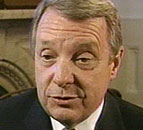
A while back, noting Sen. Dick Durbin’s flagrantly false statements about the DC voucher study – he said the study didn’t show voucher students outperformed the control group, which is entirely true except for the fact that it did show voucher students outperforming the control group – Jay asked “is he stupid or lying?”

“Of course,” he added, “when it comes to an Illinois pol, one doesn’t have to choose. He could be both.”

Not long ago, when Sen. Durbin made similarly misleading (though now more carefully weaseled) statements in USA Today, Jay remarked, “I’m beginning to lean toward the lying end.”

The first sign of a good scientist is that he adjusts his theory in response to new data!

Well here’s another new datum to factor into our “stupid or lying” calculus. The AP reports that Durbin offered to help Rod Blagojevich make a deal for Barack Obama’s Senate seat. Take it away, AP (emphasis added):

CHICAGO (AP) – Just two weeks before his arrest on corruption charges, then-Gov. Rod Blagojevich floated a plan to nominate to the U.S. Senate the daughter of his biggest political rival in return for concessions on his pet projects, people familiar with the plan told The Associated Press.
 
Blagojevich told fellow Democratic Sen. Dick Durbin he was thinking of naming Illinois Attorney General Lisa Madigan to the seat vacated when Barack Obama won the presidential election, according to two Durbin aides who spoke on condition of anonymity…
 
The aides said the concessions Blagojevich wanted in return were progress on capital spending projects and a health care bill that were stalled in the Legislature…
 
According to the Senate aides, Durbin was delighted to hear that Blagojevich was thinking of naming Madigan to the seat. He believed she would be a popular figure in Illinois and stood perhaps the best chance of holding the seat against a Republican.
 
Durbin volunteered to call the attorney general or the speaker to get the ball rolling and possibly broker an agreement, the aides said.

When the AP came calling about the story, Durbin’s office offered no comment.

Moe Lane of Red State comments: “This would only be a bombshell if it had been unexpected…Senator Dick Durbin has had since November some very significant corroborating evidence that Governor Rod Blagojevich really was corruptly auctioning off a Senate seat.  This is information that would have been very helpful when it came to the timing of Blagojevich’s impeachment, seating Burris, and/or fixing the entire problem with a special election.  And yet, Durbin did or said nothing. I don’t wonder why.  Then again, I know enough about this story to know that the Senator hadn’t realized that his talks with Blagojevich were being recorded.”

Lane highlights the implication that Durbin knew about Blago’s corruption all along, and kept vital information under his hat during the crisis. And Illinois-based politicians betraying the public trust by keeping vital information out of public circulation during a crisis does seem to be emerging as a meme in the DC voucher story.

But doesn’t it seem more important that AP is reporting Durbin offered to help broker the deal?

Yes, what Durbin offered to help arrange was not a bribe to be paid directly to Blago. It was conessions on Blago’s pet projects, including “capital spending projects.” Yet that’s bad enough, isn’t it? I’m aware that people take alliances and rivalries into account when they make these kinds of appointments. But isn’t it something else entirely to arrange a quid-pro-quo transaction of legislative votes for nominations?

And if you insist that there must be a personal bribe involved before we can say it’s wrong, let me ask you: given what we know about Blago, what kind of odds would you give that he wasn’t going to wet his beak on any of those “capital spending projects”? And doesn’t that make Durbin complicit? Or just how dumb are you willing to say Durbin is?

HT Moe Lane, via Jim Geraghty


Liberating Learning

June 1, 2009

Liberating Learning by Terry M. Moe: Book Cover

Two decades after writing Politics, Markets, and America’s Schools, Terry Moe and John Chubb have done it again.  With Liberating Learning they’ve written a a compelling account of what is blocking significant improvement in public education and provided strategies for overcoming those obstacles. 

The main obstacle has remained the same across the two books: teachers unions.  Organized special interests in education as in other sectors of public policy shape the policies that are made.  In the case of education the special interests are so large, well-organized, and well-funded that their influence has distorted policy significantly to the benefit of the adults working in schools and against the interests of students and their families.

In their earlier book the solution to union dominance was choice and competition.  Interest groups can control policy but they can’t easily control markets.  But in the new book Moe and Chubb (they flipped the order of the names) acknowledge that unions have been generally successful at using politics to block the creation of effective markets.  Something has to loosen the union stranglehold to allow the markets to develop and prosper.

In Liberating Learning they’ve found what they think will break that logjam: technology.  The increasing use of technology in education will transform the operation of schools and the role of teachers in education.  In general, it will reduce the need for teachers by replacing (at least to some extent) labor with capital.  It will generate tons of data, improving the transparency of schools to the public and policymakers.  And it will decentralize the education workplace, making it harder for unions to organize and control the workforce.

There are clear echoes of Clayton Christensen’s work on disruptive technologies in this new book.  But unlike Christensen, Moe and Chubb focus on the politics of public organizations rather than technology per se.  In fact, if you are looking for detailed descriptions of how technology should be used in education or hard proof of its effectiveness, you won’t find it in Moe and Chubb’s new book.  They are not trying to prove that these technologies are educationally effective or describe best practices, although it is clear that they have some ideas on these topics.  They are trying to describe the political logic of the current stagnation in education and how it might be altered.

The clear writing and tight argument will make Liberating Learning a pleasure to read for education reformers.  We might still wonder whether unions will be able to use politics to block the transformative effect of technology, but the book is sure to provoke a lot of productive discussion and thinking.

(edited for typos)