Pass the Popcorn: Avatar’s Preachy Foreign Policy

December 21, 2009

(Spoiler Alert!)

Avatar looks cool.  Really, really cool.  But that can’t make up for a predictable plot with remarkably little emotional connection to the oddly under-developed characters (despite a nearly 3 hour running time).  And worst of all, Avatar is filled with preachy, anti-American foreign policy themes.  If I wanted that I could just read the New York Times.

I’m surprised more reviewers have not picked up on and been irritated by the heavy-handed politics.  It’s right there.  Humans have a colony on the planet Pandora to extract the valuable mineral, unobtainium (yes, that is really its name).  The alien indigenous people (and in this case they really are indigenous) are in the way of greedy corporate profits because their giant tree home sits on top of a huge mineral deposit, so the military slaughters them.  Our hero uses a remote-controlled alien body (his avatar) to spy on the natives but eventually sees their superiority, falls in love, and leads them in fighting against the humans.

Translation for those who are hard of thinking: Greedy oil companies get the military to invade Iraq and kill the native people who are in the way.  It’s subtle with a capital B.

While denying that current foreign policy is the “main point” of Avatar, the director James Cameron told the Times of London that “Americans had a ‘moral responsibility’ to understand the impact that their country’s recent military campaigns had had.  ‘We went down a path that cost several hundreds of thousands of Iraqi lives. I don’t think the American people even know why it was done. So it’s all about opening your eyes.'”  He continued: “We know what it feels like to launch the missiles. We don’t know what it feels like for them to land on our home soil, not in America. I think there’s a moral responsibility to understand that.”

Um, I think we know how it feels to have planes fly into skyscrapers.  Does that count?

The problem with Avatar is not that it contains a critique of American foreign policy.  Apocalypse Now did that and was superb.  The problem is that the critique is amazingly heavy-handed and simple-minded.  The military leader is so over-the-top evil that they could have put horns and a tail on him if it wouldn’t make him look too much like the purely innocent native people, with their USB port tails and pointy ears.  The corporate representative was such a toady that he should have hopped like a frog.  These people are not real characters, with authentic emotions, complex ideas, and personal strengths and weaknesses.  They are cartoon characters, which I guess some of them really are — at least of the computer-generated variety.

I haven’t seen it yet, but I’ll bet that Matt is right that Black Dynamite is a better film.


Pass the Popcorn: Black Dynamite

December 18, 2009

(Guest Post by Matthew Ladner)

All of western civilization was merely a dull prelude to BLACK DYNAMITE. Why oh why did we have to wait until 2009 until someone made this film? Aughts, you stand redeemed!

Okay, so I am exaggerating, but only a little.

Mix one part spoof, two parts homage, add generous amounts of kung-fu, crypto-racial conspiracy and revenge fantasy. The result: the best Blaxploitation flick since Truck Turner.

Avatar? Yawn…I prefer films that have a bad plot on purpose. Besides, Black Dynamite would kill James Cameron’s evil space marines with his nunchuk in about 10 minutes. Roll credits! Those 12 foot tall blue Scotty Pippen looking aliens would build a Black Dynamite statue and worship him like Ewoks who found a new protocol droid. Except it would be in 3D this time.

Black Dynamite battles THE MAN and his anti-brother conspiracy, and his fight takes him through drug pushers, the CIA, an evil Chinese super-villian, and all the way to the “Honky House.”  THE MAN is doomed and the ladies swoon. Run, don’t walk to the theatre!


Pass the Popcorn: Anvil and Zombieland

October 16, 2009

finalbigfi7


(Guest Post by Matthew Ladner)

I’ve been knocked down by the flu this week, but last week I spent time in Austin Texas visiting my sister and attending some sort of odd male fertility ritual called a “bachelor party” or something like that. I think I may have attended a few more of those when I was younger, but I’m not entirely sure.

Anywhoo, a trip to Austin always means a trip to the Alamo Drafthouse for yours truly to see a flick. The Alamo is an Austin institution that serves a full menu of food and a full bar and goes out of their way to show off beat movies with fun themes.  Hong Kong action movies, spaghetti westerns, blaxploitation, vampire women in prison movies, whatever. Just before I moved to Phoenix they sponsored an all day canoe trip with free beer and free pig sandwiches, and an outdoor screening of Deliverance on the shore. For The Big Lebowski, they served White Russians, stopped the movie midway to have a mock joint-rolling contest, and took everyone bowling after the movie.

You get the idea.

The movies I saw last week- Anvil: The Story of Anvil and Zombieland.

Anvil is a fun little movie, basically Spinaltap meets midlife crisis. The movie is filled with Spinaltap references, even going so far as to have one of the main characters named “Rob Reiner.”

Basically, Anvil were the “demigods of Canadian speed metal” back in the 1980s. Sadly, such a status did little more than to earn them the admiration of some of the metal groups that made piles of money back in the day. Now working class joes, the movie chronicles their attempt at a comeback, which will RAWK!!! if, you know, they can get anyone to remember who they are and get the bar owner to actually pay them for playing.

Good stuff.

Very rarely however do you find a movie as well suited to the Alamo as Zombieland.

I laughed

I cried

It became a part of me.


Pass the Popcorn: Finding Solace

September 18, 2009

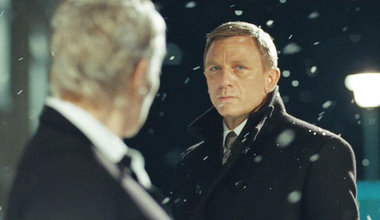
Bond - QOS ending

(Guest post by Greg Forster)

Not long ago I watched Quantum of Solace for the second time. When I first saw it I thought what Marc Forster (no relation) had done with the series gave it extremely high potential, so I tried to moderate my expectations. But it wasn’t enough; I couldn’t place the film any higher than “Passable” on the rubric of my unified field theorem of Bond movies.

Well, the second time I liked it better. Not a lot better – all my basic criticisms still stand – but I think I get more clearly now what they were going for, and I see some more subtle ways in which some parts of the movie work better than I thought.

Some of the subtlety I missed before is in the action sequences, whose poor handling in the editing room did so much to kill this movie’s potential. For example, in the foot chace through the Italian city early in the movie, they reverse the foot chase in Africa that took place early in Casino Royale. Then, the bad guy (a nobody bomb-maker) was stronger and more agile than Bond, and Bond had to beat him by being smarter and trickier. This time, the bad guy is working for the shadowy super-conspiracy, so he’s actually trickier than Bond; Bond beats him by being stronger and more agile.

Also, throughout the movie – in both action and non-action sequences – when the camera is showing us Bond’s perspective it frequently mimics the perspective of a head turning the way Bond’s head is really turning. It works well.

I said before that the movie had lots of fine moments. Well, I can appreciate them more now that the movie’s flaws aren’t hitting me in the face (because I’m ready for them). And there are actually a lot of them.

One other subtlety I missed is that the movie implicitly emphasizes, as Casino Royale did more explicitly, that Bond really doesn’t mind killing people to save the world. Yes, they emphasize the emotional price he pays to be what he is; that’s part of the main subject of QoS. But it’s very clear that the price is worth paying. If you really do need to kill people to save the world, then killing people to save the world is right and you shouldn’t feel bad about doing it, and we should be thankful that there are people willing to pay the price Bond pays to be what Bond is.

I see now much more clearly what the movie is really about – Bond needs to learn to forgive, but forgiveness isn’t in his nature because of the kind of man he is (and needs to be to do his job). The main tension of the movie is supposed to be the suspense created by the ambiguity of Bond’s motivation. Is he saving the world, or is he on a vengeance trip, and if that happens to involve saving the world that’s a nice bonus?

I missed this (well, I didn’t fully appreciate it) because I was looking for the movie’s substance in the wrong place – in the villains and their plot and Bond’s quest to foil them, all of which was flubbed so badly by the filmmakers. And part of the flubbing of the plot involved making the action sequences far too long, leaving less time for the filmmakers to develop what was really the movie’s core – Bond’s motivation.

In fact, it didn’t feel at all like there was any ambiguity about Bond’s motives. It was clear he was on a vengeance trip. I think the filmmakers wrongly assumed that “saving the world” would be our default assumption for Bond’s motivation, and we would need to be pushed to see that he’s out for vengeance. But the opposite is the case – Casino Royale set up the vengeance plot so brilliantly that that was our default.

The ambiguity, in fact, comes at the very end – where it was supposed to be resolved. I believe that Bond’s final act just before the credits roll, which is so shocking and stunning, was meant to demonstrate that he was saving the world all along, that the vengeance trip was just a temptation he was struggling with but was never his real motivation. Unfortunately, because they’d been pushing us in the vengeance direction the whole movie, the final act actually has the effect of introducing ambiguity. He says he “never left” MI6’s service – did he really? Was he only holding on to the necklace and the photo of Vesper’s boyfriend just because they were the evidence he needed to bring the boyfriend down, thus saving the world? I think the final image was meant to resolve these questions (with a “yes”) but in fact what it did was raise them for the first time.


Pass the Popcorn: Basterds = Glorious Fun

September 4, 2009

(Guest Post by Matthew Ladner)

It has been a long time since I walked out of a movie almost speechless other than an occassional “WOW…I mean………WOW!!!!”

Inglorious Basterds, a Quentin Tarrantino film a decade in the making, did the trick.

This flick will not be everyone’s cup of tea. Par for the course for QT, there is grisly violence. Described as a Spagetti Western set in Nazi occupied France, the film struck me as being longer than it ought to have been. Having said that, Inglorious Basterds is a great example of post modern film and a roller coaster of fun.

The film has dual subplots. In the first, Brad Pitt plays a charismatic Tennessee redneck army officer who recruits a team of Jewish soldiers to infiltrate occupied France to terrorize the Nazis. Pitt is out to terrorize the Nazis, and emulating the Apaches, demands 100 Nazi scalps from each of his troops. Pitt was magnificent in this role, and I found myself wanting to get back to his psycho-cartoon while the other plot developed.

The second plot features a young covertly Jewish woman in Paris who owns a movie theatre, and develops a plot to kill the Nazi high command, including Hitler himself, at a film screening. Here’s the trailer:

The name of this movie could just have easily been Nazis Need Killin’!!!! or I want my scalps!!!!!!

Christopher Waltz’s chillingly evil but elegant portrayal of an SS officer earned him a well deserved best actor nomination at Cannes.

As alternative universe World War II spagetti-western psycho Nazi killing revenge fantasies go, this  one is aces. It builds to an amazing cresendo, and left me wanting to turn around and see it again.


Pass the Popcorn: Ponyo

August 28, 2009

ponyo

(Guest post by Greg Forster)

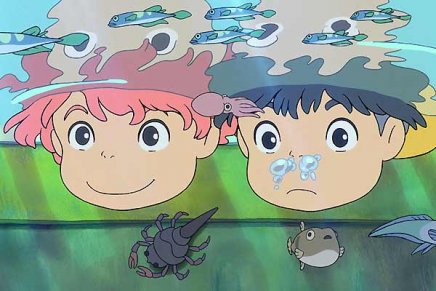
Quick, before it leaves theaters, go see Ponyo, the latest film from Japanese visionary Hayao Miyazaki. As I’ve written before, Miyazaki’s movies fall into two categories: family features and challenging epics. Ponyo is definitely on the family side of the equation. But I went without kids and loved it as a grown-up, so don’t be deterred. There’s plenty here to enjoy.

Well, OK, maybe not everyone should rush out to see it. If you’re the kind of person who would go to to a movie about the fantastic adventures of a five-year-old whose chance encounter with a magical fish-girl threatens to upset the balance of the magic and human worlds, possibly destroying both, and spend the whole time saying to yourself things like, “Hey, no five-year-old could push something that size on his own! And how come he has the vocabulary of a twelve-year-old?” maybe Ponyo is not for you.

But everyone else should go.

If you plan to see it, stop here. I’m not going to spoil the ending, but the movie reveals itself slowly (as many Miyazaki movies do) and you’ll probably enjoy it more if you don’t know much about it going in.

If, however, you need to be convinced, read on.

Ponyo is the daughter of a sea-wizard and lives with him at the bottom of the ocean. Her father hates the human world and forbids her to see it, which naturally makes her eager to go. But she gets into trouble (of course) and is rescued by a five-year-old boy named Sosuke, who protects her and takes care of her until her father comes to take her back to the sea.

ponyo-sosuke

Ponyo, starved for love in the house of her hard-hearted father and awed by the self-giving kindness of Sosuke, decides she’d rather be human. She gets into her father’s magical works and manages to open a rift in the barrier between the magical and human ecosystems, allowing her to change herself to assume a human form – but also causing a catastrophic disruption of the human ecosystem that leaves an entire town underwater and threatens to do worse.

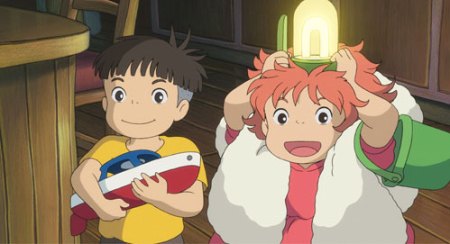
After her transformation, Ponyo has a foot in both worlds – though she appears human, she can still work magic. Much of the movie’s charm comes from the shared delight of mutual discovery between Ponyo and Sosuke. Sosuke marvels as Ponyo turns a toy boat into a real boat and fixes broken household appliances with a glance; Ponyo is equally blown away by the delights of flashlights, ham sandwiches, and warm towels straight out of the dryer.

ponyo-sosuke toys

But back in the sea, her sea-wizard father and her mother (whose identity I’ll keep under wraps) determine that the only way to close the rift she’s opened and save the human world from destruction is for Ponyo to become entirely one thing or the other. She must either return to the sea, or else complete the transformation, giving up her magic and becoming fully human.

Of course they know Ponyo will be miserable if she returns to the sea, but to become fully human she must be drawn across the divide by a human love – by Sosuke. However, in the process of drawing Ponyo over that love will be tested. Does Sosuke really take care of Ponyo because he cares about her well-being? Or is he just interested in her because she’s magical and fascinating? If Sosuke fails the test, Ponyo’s desire to become human will destroy her.

Ponyo’s mother has faith in the genuineness of human love and thinks it’s better for Ponyo to risk death than to abandon her desires, so she arranges for the transfer. But her father hates humans and fears Sosuke’s love will fail the test. He may or may not be laying plans to interfere.

But all this plot is really irrelevant to the joy of the film. What Miyazaki is giving us here – besides gorgeous visuals and a delightful story in its own right – is a vision of how the world of humanity relates to the world of nature. “Magic” in this movie is symbolic of the spiritual significance most of us attribute (on some level) to nature.

Don’t get me wrong! The bad, human-hating kind of environmentalism is condemned pretty clearly. (This is a big step for Miyazaki, who has not been so enlightened about this in the past.) Ponyo’s sea-wizard father not only hates humans, but actually dreams of one day wiping them out – because he hates their impact on the environment. Those who see the ecosystem as something with its own inherent integrity apart from humanity, such that any impact of humanity’s existence on the natural world is bad simply as such, are implicitly wishing for humanity’s annihiliation.

In fact, we learn at one point that the sea-wizard father was born human and has somehow himself crossed the very same border Ponyo wants to cross, only in the other direction. The desire of some humans to get into nature – which drives so much of what now passes for environmentalism – is really a desire to get out of humanity. As the wizard says, they need to abandon humanity to serve the earth.

wizard

What do you know about humans? They treat your home the same way they treat their fithly black souls! I was human myself once. I had to leave all that behind to serve the earth.

But what if the shoe were on the other foot? What if we could “become one with nature” not by dragging humanity down, but by pulling nature up?

That’s the thought I couldn’t stop having as I watched the extended scene in which the rift opens between the human and magical worlds. The way Miyazaki does it, it’s breathtaking. Everyday things in our everyday world suddenly become magical. Not magical like wands and rings and such D&D fantasies – magic as a tool for humans to use – but magical with its own life and its own distinct nature. The road Ponyo’s mother drives down to get to work every day, with the forest on one side and the sea on the other, suddenly becomes bursting with little gods and goddesses all around them.

That’s what Ponyo’s desire to become human represents – against her father’s cold, self-loathing desire to have nature instead of humanity, her desire for love drives nature to come up alongside humanity, with its own personality, wanting to love us the way we love it. And on those terms we really can become one with nature.

Tree-huggers have got the wrong idea, because there’s nothing in a tree that can recieve a hug. There’s nobody else there, so you’re basically hugging yourself. But what if the trees hugged back?

We do – most of us, anyway – love nature and feel that somehow our relationship with it is disrupted and needs to be repaired or reestablished. There are, of course, some people for whom a forest is nothing but a source of lumber and a dog is nothing but an annoyance. But they’re pretty rare. Just to take one example, how many millions of people keep pets? How many millions more would like to keep them if not for the hassle, cost, allergies, etc.? And why do we want pets? There’s no explanation other than a desire to have some part of nature that is personal enough to have a relationship with. We want to love nature, so we seek out something in nature that can love us back.

And love, the movie very wisely percieves, is the unique quality of humanity which nature utterly lacks. Sheer force is something nature has in plenty, as we see when the flood destroys the town. Beauty nature has in spades. Even intellect is present in nature to some extent, as many animals are capable of some degree of calculation. We can, of course, out-calculate them. But what really makes humanity stand out next to mere nature – the smallest taste of which is enough to drive Ponyo to turn the whole world upside-down rather than go without it – is love.

Ponyo-Sosuke kiss

And let’s be clear that by “love” I’m not talking about mere gushy emotion or seniment. I mean a genuine desire for the good of others. In nature, mothers care for their young, and in one sense that’s love. But they only care for their young, not for others generally, and they do it in obedience to the maternal instinct. Doing good to another not because of any relationship we have with that other or to satisfy some instinct or desire of our own, but simply because we will the good of others – that’s something you’ll never find in nature. 

Or should I say, something you’ll never find in nature except where humanity has affected it. Try getting a wild dog to love you. But tame the dog and it will love you as well as any person – because in the taming, the influence of human love pulls it upward into a real (though of course limited) state of personhood.

Naturally, humans being only human, we are never perfectly selfless and all our behavior is mixed with some level of wrongful selfishness. That’s what gives the cynics, like the sea-wizard, their excuse for disbelieving in the reality of love. And of course in some particular cases the cynics turn out to be right – many behaviors that look like love from the outside really aren’t. That is Sosuke’s test – does he really want Ponyo to have what’s good for Ponyo simply because it’s good for Ponyo and he desires Ponyo’s good as such?

It’s not a perfect movie. Just like in Miyazaki’s last work, Howl’s Moving Castle, the ending of Ponyo is rushed and forced. Miyazaki has bittten off so much he can’t quite resolve it all in the time he has available. And, I regret to say, over the years I think he has become increasingly hesitant to let anybody’s story end sadly – not just the heroes but anybody at all. In his greatest work, Princess Mononoke, good triumphs in the end and utter destruction is averted, but many good things are lost and the hero and heroine must give up something they dearly love in order to save their respective peoples. Even in his earlier family movies, there was loss and regret. But more recently Miyazaki has tried to arrange for everybody to end up well, and that gives his endings a false note.

But, like I said, plot is not the reason to go see Ponyo, and thus I think the problems with the ending detract little from the movie. Even if you get nothing but the fun story and the amazing visuals, it’ll be well worth the price of admission. And I think there’s a lot more than that to be had.


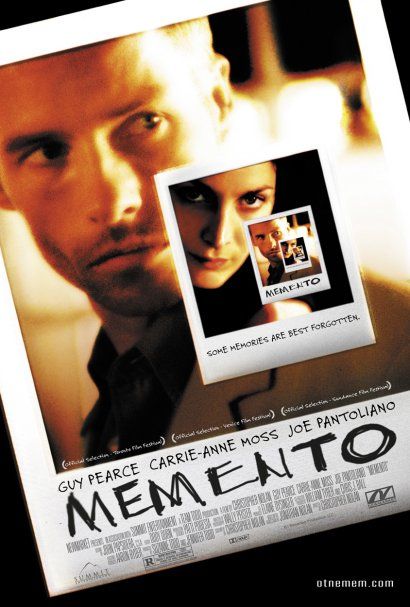
Pass the Popcorn: Memento

August 21, 2009

memento2

(Guest post by Greg Forster)

Hey, remember Memento?

No you don’t. You remember a really clever novelty act where they put you in the shoes of a man who can’t remember things that happen to him by telling most of the story backward. But memory is unreliable, remember?

memento

Back when you saw it, you realized that it was – in addition to being a clever novelty act, which of course it was as well – a profound meditation on the nature of human identity – on the sources of knowledge, motivation, and “habit” or “instinct,” which together make up who we are.

But since then you’ve forgetten all that. What you retain all these years later is:

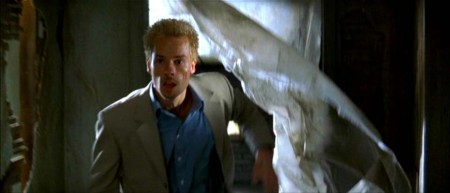
Okay, what am I doing? I’m chasing this guy.

memento17

No, HE’S chasing ME!

Which is just about the cleverest gag on film, I admit. But that’s a dog and pony show compared to this, which you don’t remember:

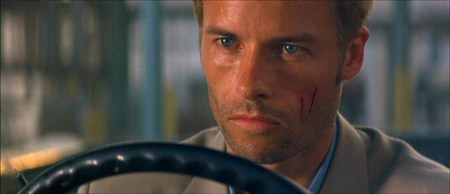
Just because there are things I don’t remember doesn’t make my actions meaningless. The world doesn’t just disappear when you close your eyes, does it?

memento21

You can question everything. You can never know anything for sure.

There are things you know for sure…Certainties. It’s the kind of memory you take for granted.

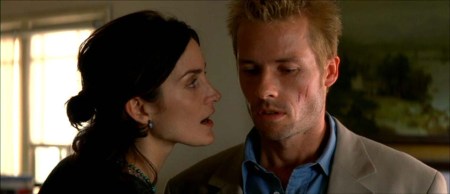
Of course, “earlier” (which is to say “later”) in the movie Leonard deprecates memory to Teddy. Memory is unreliable. You want facts, not memories. But now look at what Leonard tells Natalie – certainties are the kind of memory you take for granted. What is your knowledge of “the facts” but a bunch of memories? In which case, how can you know anything? As Augustine demonstrates at length in chapter 10 of the Confessions, memory comprises virtually all of the human personality.

memento11

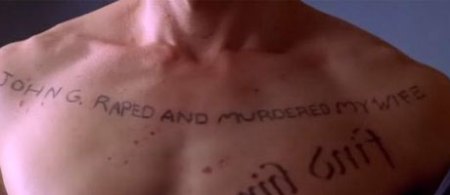
It all comes down to whether or not you can take it for granted that there’s a real reality out there. Because if you can’t take it for granted, there’s no way to prove it. You can either assume it and be sane, or doubt it and go mad. That theme winds through everything in the movie. As Leonard tells Teddy at the “end” (which is to say at the “beginning”), whether or not he’s got the right John G. makes all the difference. It’s the only thing that matters.

But why? Teddy says we all just lie to ourselves to be happy. But Leonard knows that theory doesn’t hold water. If you really were lying to yourself, it wouldn’t make you happy. The fact that his quest for the killer does in fact motivate him proves that he’s not just interested in giving himself a purpose. He really wants to find the killer.

To Natalie, he simply asserts that the world doesn’t go away when you close your eyes. At the “end” (which is to say at the “beginning”) he pushes away the doubts Teddy has planted by insisting to himself that “I have to believe in a world outside my own mind.” That’s the rub. If you take that seriously – not “I have to believe” in the sense that I want to, so I’ll lie to myself to be happy, but “I have to believe” in the sense that my mind actually cannot function in any other way – it solves the problem.

To take a parallel example, no one can prove that two contradictory statements can’t both be true, for the simple reason that the activity of proving things itself assumes that two contradictory statements can’t both be true. The law of noncontradiction can’t be argued for or supported; we believe it because our minds simply will not function unless we do. You can either assume it unquestioningly or go mad; ultimately there are no other options.

But why, then, does the movie end (i.e. begin) the way it does? (For the sake of those benighted souls who may not have seen the movie, or for those who may have forgotten the details and may want to go back and see it again, I won’t spoil the central twist.) I think it’s simply that Leonard’s exchange with Teddy makes him realize that a man in his condition is unable to do what he’s trying to do, so he’ll do the next best thing – rid himself of the person who’s using him.

memento19

At any rate, I don’t think we’re meant to accept the claims we hear at the end about Leonard’s past. The movie itself undermines this in several ways. For starters, when those new “memories” start flashing into Leonard’s head, we get this image:

memento20

Which is obviously absurd and impossible. That’s the point – mere suggestion can produce new “memories” that feel accurate but can’t possibly be real. Which is why we have no reason to accept the new “memories” at the end.

Also, think about that pivotal image of Leonard lying on the bed when his wife says “ouch!” (If you don’t remember what I’m talking about, for goodness’ sake what more excuse do you need me to give you to go back and see this movie again!) If the new “memories” are real, then the revised version of this image must be the true one and the original version a construction. But the original version makes sense and the new one doesn’t. Why on earth would he do that in that contorted position? If he were going to [activity deleted to avoid spoiling the twist] he wouldn’t do it lying on the bed at a ridiculously awkward angle while she read a frikkin’ novel. But that’s exactly the kind of absurd image your mind would invent under a false suggestion.

Well, like my interpretation of the end or hate it, Memento is still one of the most profound movies out there, and it’s well worth a reviewing if you haven’t seen it since 2000.

Oh, and I hear Chris Nolan’s made some other interesting movies since then. Guess I should check those out.

HT Movie Images for most of these shots, Beyond Hollywood for the one at the top


Pass the Popcorn-Bullitt

July 24, 2009

(Guest Post by Matthew Ladner)

So my favorite coffee shop, the Raven in Prescott, has Monday night movies and so I went down to see Bullitt. I had never seen a Steve McQueen movie before, so I was curious. Growing up as a kid in the 1970s and early 80s, I watched a fair amount of BBC television on PBS, and so the only thing I knew about Steve McQueen was that the British were totally crazy about him, making frequent Steve McQueen references, often in reverant tones.

A couple of years ago, I think Ford made a commercial with old McQueen footage for their revamped Mustang. Apparently, McQueen was associated with muscle cars. Still, Steve McQueen flew in my cultural blind spot for the first 41 years of my life.

But no more!

Bullitt is hardly a great movie, but I can’t wait to see more like it. Some of the acting seems George Lucas style stilted. Except of course for McQueen, who was the Platonic ideal of American stoic tough guy. This guy can almost kill a bad guy with a cold icy silent stare. If that doesn’t work, he’ll be happy to lay a beating on you, fill you full of lead, or chase you off the road in his muscle car until your produce a mini mushroom cloud as the gas in your tank (which should have been fairly empty after that hour long high speed chase) explodes in  a fiery inferno. McQueen uses his tough-guy powers to put the extra gas in your tank just to make sure you are a crispy critter for daring to think your death race skill begin to match his own.

Speaking of which, you can watch Bullitt’s famous car chase through San Fransico here. It really starts after about three minutes and thirty seconds.

Hello netflix! If you have any other Steve McQueen movies to suggest, zap me an email or leave them in the comment section.


Pass the Popcorn: We Fly With Our Spirits

July 17, 2009

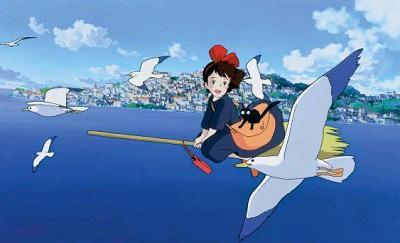
Kiki & birds

(Guest post by Greg Forster)

Last week, for our weekly dose of pop culture, Jay wrote about the rise of mopey, whiny self-pitying youth fiction, and offered some examples of where to look for something better.

Then, yesterday, I noticed the news that next month, after a four-year wait, U.S. audiences are finally going to get another Hayao Miyazaki movie. Ponyo opens Aug. 14. Last July it opened in Japan on 481 screens – a record for a domestic film – and had grossed $153 million by November.

Obviously the blog gods are demanding that I write about Miyazaki for this week’s Pass the Popcorn! Often called “the Japanese Walt Disney,” Miyazaki has produced a series of outstanding animated movies. One of the most amazing things about his work is its incredible range – from delightful family movies that kids and adults can enjoy together (hence the very apt comparison to Disney) to great epics about wars among gods and wizards, in which life ultimately triumphs over death, but not without paying a horrible price (definitely not Disney fare).

This week, continuing Jay’s theme, I’ll stick to the lighter stuff you can watch with your kids. Some other week I’ll write about the more grownup Miyazaki films.

06_my_neighbor_totoro

My Neighbor Totoro, one of his earlier films, is about two young girls who move into a new home and discover forest spirits living nearby. We gradually learn that the girls’ mother has some kind of serious ailment and lives in the hospital, and they get to see her very rarely; their adventures among the forest spirits are a substitute for the normal life they can’t have. Whether you think the spirits are real or imagined – I think the movie pretty clearly indicates that they’re meant to be real – doesn’t really alter the main point; we rely on fantasy to survive reality. (The setup mirrors Miyazaki’s own childhood; for eight years his mother was constantly in the hospital with TB and his family moved around a lot.)

Totoro’s greatest strength is its fantastically original visuals. In what has become the iconic image for fans of this movie, the girls are waiting in the pouring rain at a bus stop by a road that runs through the woods, and then unepectedly turn around and discover a forest spirit standing in the rain next to them – waiting for the forest spirit bus, which apparently uses the same stop as the human bus. Not knowing how to respond to each other, the girls and the spirit just awkwardly keep standing there, waiting for their respective busses.

When the spirit bus comes, in the form of a giant cat, they decide to get on that and see where it goes, rather than wait for the human bus and go where they’re supposed to. The bus bounds off through the forest, running on its cat-feet rather than riding on wheels.
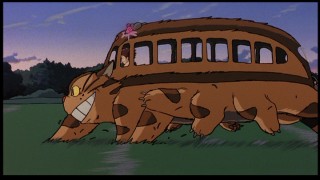
Totoro bus

I’ve started with Totoro because it’s chronologically first (at least, of the Miyazaki films that have gotten wide exposure in the U.S.) and is also the most suitable for even very young children. However, it’s not the best stuff Miyazaki ever did, so unless you have younger kids whom you want to entertain I definitely don’t recommend making this your first Miyazaki movie.

The basic problem is the lack of a significant plot. The movie is really about a mood. For some people this just isn’t a issue; Totoro has a pretty significant fan base. For them, the magic and wonder, the astonishing visuals, and the poiniency of seeing the girls’ lives sliding slowly but surely into this alternate fairy-world in the absence of their mother are enough. But most viewers want a movie to go somewhere, and this one just doesn’t.

Sheeta & Pozu

By contrast, Castle in the Sky has plot coming out of its ears. It’s very much an old-fashioned kids’ adventure story. And like the best old-fashioned adventures – and unlike the insipid, watery gruel kids usually get nowadays – it’s packed with tons of nonstop story and amazing events, but it delivers this rollercoaster ride without ever devolving into mere brainless fighting and running around. At its heart, all the action and adventure are about two young people who have chosen to do their duty in the teeth of all opposition and in spite of hopeless odds, and end up loving every minute of it.
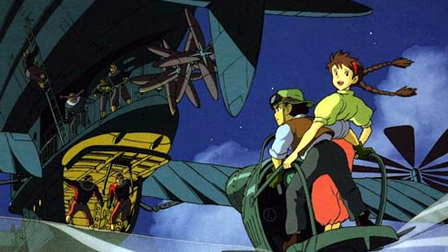
Sky pirates

It’s telling that we have a whole genre of movies called “action” movies. In all but a handful of them, plot and character – traditionally the two great rival suitors to our minds and hearts – are equally sacrificed into the maw of mere frenetic activity. By contrast, the mark of a good “action” story is that all the action is about something – even if it’s something simple, like a boy who’s determined to vindicate the good name of his dead father, and a girl who’s determined to keep a mysterious artifact she’s inherited out of the wrong hands.

Ornithopter battle

The flip side of that is that Castle in the Sky isn’t philosophically deep. I almost wrote that it isn’t about anything important, but that’s not true – a story about two bright, scrappy kids who move heaven and earth against impossible odds for no reason other than to do the right thing is about something very important! But it’s not philosophical or complex; there are no layers of deeper meaning to explicate, as there are in so many of Miyazaki’s other films.

But if you’re just looking for a great fantastic adventure that doesn’t fit the usual Hollywood mold, check this out.
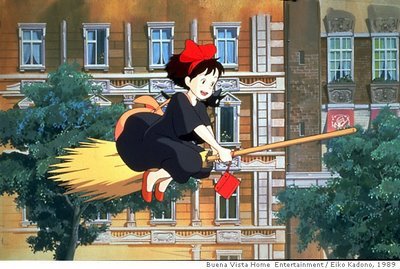
Kiki

I saved the best for last! Kiki’s Delivery Service is a lot like the best Pixar movies – it’s formally a kids’ story, but it’s about something adults care very deeply about, so they can enjoy it just as well as the kids can, if not better.

Kiki is a 13-year-old girl who’s training to become a witch. Following ancient custom, she has to spend a year away from home, and the movie is about Kiki’s struggle to establish herself independently. Witches need to make a living, just like everybody else, and in the movie’s narrative world they support themselves by developing useful skills – potion-making, fortue-telling – and selling their services to customers. 

Kiki needs to develop a skill that she can use to support herself. But her mother (who has trained her to this point) is a little flaky, and hasn’t managed to teach her any useful skills. She can only do the two basic things that all witches can do – fly on her broomstick and talk to her black cat – neither of which seems to promise much hope for independence. And her initial experiences in the big city leave her feeling overwhelmed and discouraged.

Perhaps worse, she’s landed – so to speak – in a city where there are no witches and haven’t been for a long time, so she’s viewed as weird and alien by everyone around her. Required (again by ancient tradition) to wear a distinctive black dress, she sticks out like a sore thumb everywhere she goes. Walking alone down the street, she passes a gaggle of brightly dressed girls, briefly overhears their giggling and gossip, and then catches a glimpse of herself – darkly dressed and alone – reflected in a shop window.

Oh, and of course there’s boy trouble. She knows none of the “cool” boys will be interested in her, which is hard enough, but on top of that, she has managed to catch the attention of a geeky kid who’s fascinated with flying, and hence with her, but not so great at taking the hint that she doesn’t want him around.
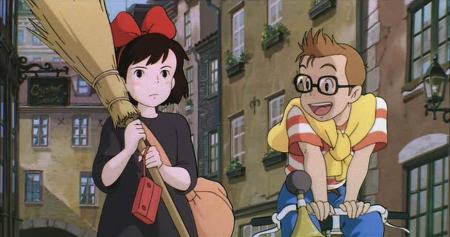
Kiki & Tombo

Her only consolation is Jiji, her supportive but heavily sarcastic black cat – voiced, in a virtuoso comedic triumph, by Phil Hartman. This was one of the very last of his performances; the English-language version of the movie was released on May 23, 1998, five days before Hartman’s death.
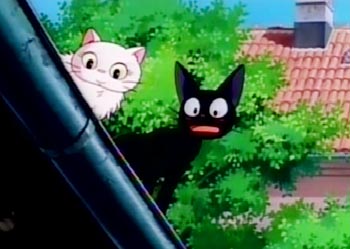
Jiji & Lily

You will have surmised from the title that she takes the only talent life has given her and makes that her calling – being able to fly, she can offer the city’s fastest delivery service.

But that’s just the beginning of the story. Flying becomes a job, and it’s not fun anymore. So she can rely on her flying to become independent, but if she does so, flying can’t be what it used to be to her. Gaining her adult independence through flying means losing her childlike delight in flying – because taking childlike delight in something depends on doing it for its own sake.

And then she wakes up one day and discovers that for some mysterious reason, she’s lost her powers and can’t fly anymore. If she can’t figure out what’s wrong, she’ll have lost both the childlike delight and the adult independence that flying gave her – she’ll have lost everything.

She comes to realize that the problem is precisely that she’s been so anxious to become independent, to fit in and be a normal girl, and all the rest of it. By making these anxieties the center of her attention, she’s lost the love of flying that was powering her talent in the first place.

Kiki & Ursula

“When you fly, you rely on what’s inside you, right?”

“My mother says we fly with our spirits.”

Childhood isn’t enough, so we need to become self-reliant, but self-reliance isn’t enough, either. Self-reliance needs to serve a purpose beyond mere self-reliance, or it becomes devoid of meaning – and as a consequence, the talents that make us self-reliant become corrupt or impotent. The mere enchantment of childhood that naively enjoyed exercising a talent for its own sake can’t be sustained if that talent is going to be what you make your living at. But if you want to keep the talent healthy, you have to have some reason to do it besides merely making a living – as one of Kiki’s older and wiser friends puts it, “we each need to find our own inspiration.”

Kiki recovers her ability to fly when she discovers what flying is really for.

Don’t miss this gem of a movie.


Pass the Popcorn: The Red Violin

June 26, 2009

Title Screen

(Guest post by Greg Forster)

I don’t get to see many movies anymore – at least, not many by my standards. And when you can only see maybe four to six movies a year in the theater, you’re going to end up seeing the obvious ones – Batman, Star Trek, whatever Pixar does this year, etc.

But there was a time when we used to see a lot of movies. And that meant we had the luxury of picking through the enormous pile of garbage that is the arthouse and finding the few movies that make the arthouse worth going to. So I’m going to start using our Pass the Popcorn feature to show off some of our “finds,” in the hope that they won’t fade too far into obscurity.

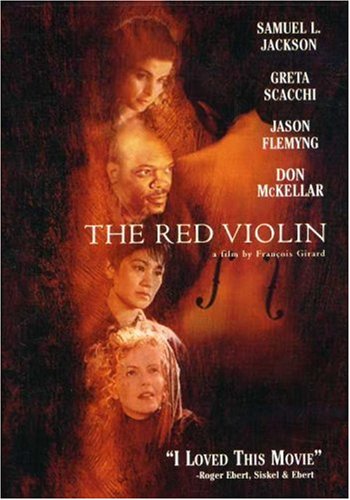
The Red Violin

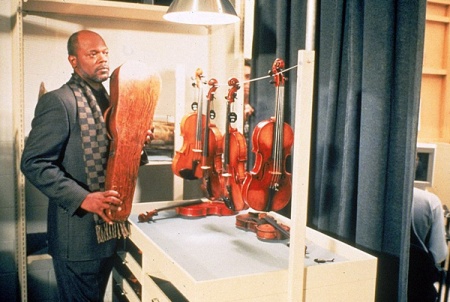
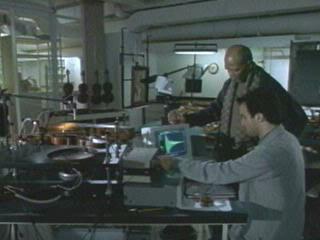
The Red Violin stars Samuel L. Jackson as the most badass professional musical instrument appraiser you will ever see depicted on screen. I’m serious, don’t mess with this guy. At one point a clerk fails to deliver an important package to him promptly, and he tears into the clerk so hard I thought he was about to start reciting passages from Ezekiel.

Jackson & violins

“And you will know my name is the LORD when I lay my violin upon thee!”

OK, now that I’ve sold Matt, here’s what the rest of you need to know.

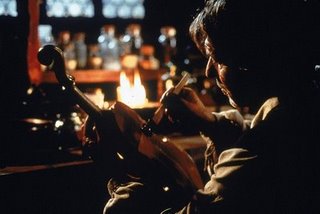
The movie tells the story of a violin that was created by a Renaissance Italian craftsman as his greatest masterwork. Over the course of the movie, the action shifts back and forth between three storylines.

Making the violin 2

In 17th century Italy, we see the craftsman’s initial aspiration – to create an instrument worthy of his love for his unborn child, due to arrive any day, to whom he intends to give the violin as a gift. But in a surprise twist at the end, the violin comes to have a different, but equally profound, significance for him.

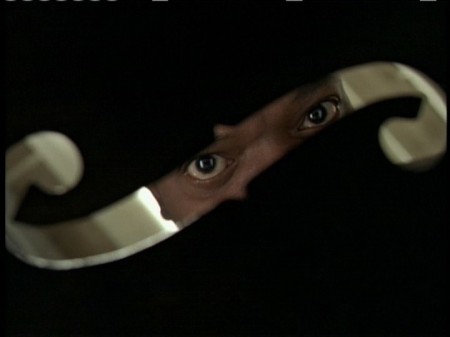
Jackson peeking

In our own time, the violin is going up for auction. Everyone else thinks the violin is nothing special, but badass appraiser Samuel L. Jackson suspects otherwise – that it may be the long-lost “red violin” made by that famous Italian craftsman. Once the truth becomes known, everyone wants the violin – but nobody other than Jackson wants it for the right reason, leading to a surprise twist at the end in which Jackson triumphs over the greed and pride of his adversaries.

Gypsy

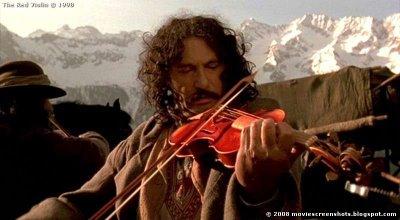
In between, we see what happened to the violin as it travelled around the world between its creation and its eventual rediscovery. Each vignette in this storyline illustrates the characteristic ways in which different civilizations have responded to the mystery of great art.

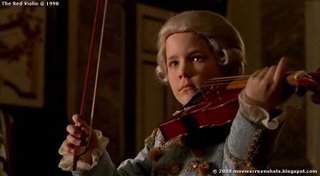
Kaspar dressed up

18th century Vienna is so obscessed with technical skill that art is reduced to mere performance – the ability to play very complex pieces very fast is valued above beauty. Following this path ultimately leads to the reduction of art into the novelty act of child prodigies – because the younger you are, the more amazing your skill is, and that’s all that counts. Form obliterates matter, and since form can’t exist without matter, it obliterates itself, ending in tragedy.

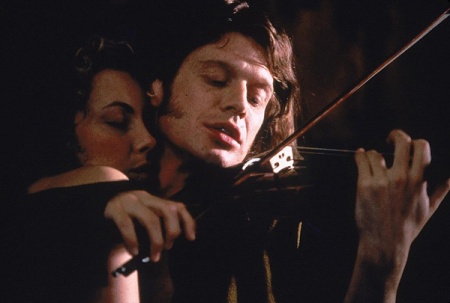
Victorian couple playing violin

In Victorian England, by contrast, “art” is put up on a pedastal and idolized. “Creativity” is fetishized to the point where mere novelty and thrill displace beauty, just as mere technique had displaced it a century earlier. Craftsmanship goes out the window in favor of irresponsible artistic self-indulgence. Matter obliterates form, and since matter can’t exist without form, it obliterates itself, ending in tragedy.

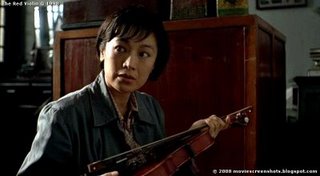
In China with violin

In 20th century China, during the cultural revolution, just to have an interest in art as such is a life-threatening proposition. The state holds that art, like everything else, exists only for political ends, so the desire to make art for the sake of beauty is an act of treason against the people. Far worse to make art that has western origins, given the regime’s awkward attempt to fuse its totalitarian ideology with crude appeals to nationalistic Chinese chauvanism. Yet in the end, the totalitarians prove as incapable of eradicating the desire for beauty as they are at eradicating any of the other fundamental desires of human nature.

Jackson & restorationist

What do we want beauty for? All answers other than “we want it because it’s beautiful” ultimately prove futile. The goodness of beauty, like the goodness of knowledge or the goodness of virtue, is categorical. Make it instrumental towards some other good and you destroy it.

What, then, should we do with beauty when we find it? To that, the movie has a definite answer, and I think it’s exactly the right one. But to find out what it is, you’ll have to see those two surprise twist endings I mentioned earlier – and I’m not spoiling them for you. Go rent it and find out.