A Mind is An Expensive Thing to Waste

January 31, 2010

Economists Rick Hanushek and Ludger Woessmann presented a paper last week at the World Economic Forum in Davos, Switzerland, showing just how much in dollars and sense it costs not to raise student achievement.  If the U.S. could increase its average score on the PISA test by 25 points over the next twenty years (less than Poland did over the last six years) it “would result in an increase in the U.S. GDP of $40 trillion over the lifetime of the generation born in 2010.” 

Now that would be a stimulus plan.  But remember that average U.S. students achievement for 17 year olds has been stagnant for at least four decades despite more than doubling real expenditures per pupil.  So this stimulus plan requires something other than money.  It requires structural changes in public education to produce more achievement for every dollar already spent.

The new report by Hanushek and Woessmann builds on an earlier study that you can see in this Education Next article.


Let Me Help You Out Here…

January 15, 2010

(Guest Post by Matthew Ladner)

An outfit called the Arizona Education Network took issue with a piece I wrote showing that Arizona K-12 spending has increased by 20% since 2000 while math and reading NAEP scores are up by less than 1% during approximate same period.

Unsheathing their flaming sword of justice, they wrote the following:

Update: Debunking Latest Education Spending Report by Special Interest Group – AZ student population up 22.7% while funding only grows 20%

January 12th, 2010

US Census Department Figures show that the Arizona population increased 28.6% from April of 2000 to July 2009.

During the same period, average daily membership (the term used to refer to the total enrollment of students through the first 100 days of the school year) in Arizona schools increased 22.7%.  (According to a report to the Arizona Senate) .

So when special interest groups decry a 20% increase in education funding in the 2000-2009 period, they should notice that this increase did not even keep up with the increase in the number of school children in Arizona during the same period.

**AHEM**

Let me help you out here guys, since you seem new to this whole policy analysis thing. As a rule of thumb, it’s a good idea to read something before you criticize it. Sometimes, that will include clicking on hyperlinks when they are provided.

For example, if you had taken the trouble to do so in this case, you would have gone to an Arizona legislative website and learned that I had used an inflation adjusted spending per pupil number to calculate the 20% increase.

Keep at it though- some day you guys may be ready to swim to the deep end of the pool. 


Marcus: RttT Is No Kabuki

December 16, 2009

(Guest post by Greg Forster)

In the past I’ve suggested, in response to Mike Petrilli’s cheerleading for it, that Race to the Top is just a bunch of kabuki. In today’s Washington Examiner, Marcus begs to differ:

Race to the Top has emboldened reform-minded policymakers like Bloomberg to push hard for their ideas. Just as importantly, the lure of earning federal dollars makes the reform position an appealing default for those policymakers whose primary interest lies outside education.

For instance, before Race to the Top, California Gov. Arnold Schwarzenegger paid only brief lip service to education reform. After the grant competition was announced, the Governator called a special session of the state legislature and pushed for a series of meaningful reforms such as eliminating the state’s charter school cap, using data to evaluate student and teacher performance, and adopting a performance pay program for teachers.

I would argue back, but I’m not sure I can. Just last week I praised Bloomberg’s move to push the envelope on interpreting the state’s ban on evaluating teachers with test scores as “gutsball.” By doing so, have I already conceded Marcus’s (and therefore Mike’s) point?

I suppose I could argue that Bloomberg was a reformer even before RttT came along. Maybe he would have played gutsball on the teacher test score ban even without RttT. But it’s hard to think that RttT has nothing to do with his renewed boldness. After all, using test scores in teacher evaluations is an agenda set by RttT. And, as Marcus points out, Bloomberg staged the announcement of his gutsball move in D.C., not New York. Was Bloomberg pushing for this particular reform before? And could he have won on that issue if not for RttT’s covering fire?

I suppose I could argue that the use of test scores as “one element” in teacher evaluations will inevitably be nothing more than a symbolic victory. Trouble is, I’ve always argued that symbols matter. There’s no such thing as a merely symbolic victory.

I suppose I could argue that RttT is promoting bad ideas as well as good ones. And that would be true – but it wouldn’t establish that RttT is kabuki. Quite the opposite; the more we fear RttT for promoting bad ideas, the more we confirm that whatever it is, it isn’t kabuki.

It’s beginning to feel like I may owe Mike an apology. Stay tuned.


California vs. Texas Part Deux

November 2, 2009

(Guest Post by Matthew Ladner)

William Voegeli joins the fun in City Journal.

Money quote:

Bill Watkins, executive director of the Economic Forecast Project at the University of California at Santa Barbara, has calculated that once you adjust for population growth and inflation, the state government spent 26 percent more in 2007–08 than in 1997–98. Back then, “California had teachers. Prisoners were in jail. Health care was provided for those with the least resources.” Today, Watkins asks, “Are the roads 26 percent better? Are schools 26 percent better? What is 26 percent better?”

BOOOOOOOOOM!!!!!!!!!!!!!!!!!!

UPDATE: Great minds think alike as Kotkin brings the pain in Forbes.


The Return of the Bogus “Excellence” Complaint

August 20, 2009

(Guest post by Greg Forster)

Fordham’s Fun Fact Friday feature, now in its sixth week, is a weekly one-minute video production that takes some fact about the education system and presents it using an interesting or unusual visual. The creators have been pretty consistently clever in coming up with ways to make obscure facts visually intuitive.

Unfortunately, the facts chosen to be presented are not always so cleverly chosen. When Fordham picks an important fact to visualize, such as the gap between spending and achievement growth or international comparisons of student-teacher ratios, the results are, well, superawesome. But when it chooses, say, a comparison of the US education budget with the GDP of some smaller countries, the visual presentation is still clever, but the result is kind of pointless. Is anyone really impressed by the point that a huge country like the US spends more on education than the GDP of, say, Indonesia? What does that prove? Some kind of argument or point was needed.

Last week they missed again. They decided to resurrect Fordham’s complaint from last year (dissected here and here) claiming that accountability systems make our schools more “equal” but less “excellent” because they create incentives for schools to increase the amount of attention they pay to low achievers, reducing the amount of attention they pay to high achievers. Never mind the fact that – according to Fordham in the very same report – the low achievers are benefiting from this diversion and the high achievers don’t seem to be losing any ground.

That would seem to me to be pretty clear evidence that schools were devoting too much attention to high achievers – perhaps because their parents are more likely to be influential – and that the incentives created by accountability were educationally healthy because they forced schools to focus their attention where they could create more improvement.

It’s obviously possible that in the long run accountability could push this too far and become counterproductive by focusing too much attention on low achievers at the expense of high achievers. That’s an argument for improving the design of accountability systems to preclude that result. But so far, on Fordham’s own evidence, we don’t seem to be having that problem.


Question for Sara Mead

June 9, 2009

(Guest Post by Matthew Ladner)

I saw a documentary on Napoleon’s Egyptian campaign a few years ago. After a completely nasty setback, Napoleon retreated in defeat back to Cairo, but then ordered a victory parade to be held before fleeing the country entirely.

Watching Fordham’s pre-school event online, I can’t help but think that pre-k advocates are trying to do the same thing with Oklahoma: pretend its a victory, when in fact it looks more like their Waterloo.

I watched the Fordham Foundation pre-school event online yesterday. I was especially taken by Sara Mead’s claim that universal preschool could lead to dynamic changes in K-12, and that disadvantaged kids in Oklahoma’s pre-k program made larger gains than other students.

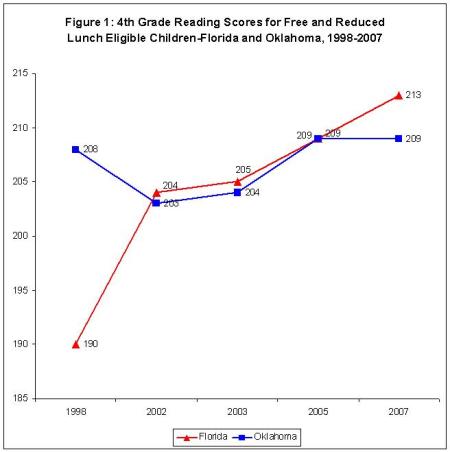
The biggest problem for universal pre-k advocates, in my view, is that the academic gains associated with Pre-K programs fade out. Consider the blue line in the chart below-4th grade NAEP scores from Oklahoma. In 1998, Oklahoma adopted a universal pre-k program.

FL vs. OkI assume that Ms. Mead has a basis to say that disadvantaged children make bigger gains under the Oklahoma pre-k program. The more important question is whether those gains are sustained over time.

Based upon the NAEP scores, Oklahoma’s program looks like a dud, increasing all of one point between 1998 and 2007.

The best one can try to spin out of the Oklahoma situation is scores might have actually dropped in the absence of the program, but now you are really grasping at straws. I seriously doubt that anyone who voted for this program in 1998 could be anything other than disappointed.

The red line, Florida, shows what can be done with a vigorous effort to improve K-12 schools. Florida’s low-income children improved by 23 points between 1998 and 2007.

Florida voters created a universal pre-k program, which was implemented as a voucher, but none of those students had reached the 4th grade by 2007.

Mead would likely argue, and I think she did at the event, that Pre-K and K-12 reform aren’t mutually exclusive, and I agree. It seems fair to ask however: is Pre-K a waste of time as an education improvement strategy? If not, why are the Oklahoma results so dreadfully unimpressive?


Mike Petrilli Buys into Hope and Change

May 13, 2009

Pollyanna

(Guest post by Greg Forster)

Yesterday, Mike Petrilli posted that he has “hope” some good will come from the giant geyser of money that the federal government is blindly spewing into the government school system under the “stimulus” bill.

I would let it slide, but I owe Mike a good ribbing for this. So . . .

Mr. Sulu, you have the bridge. Mr. Spock, Mr. Checkov, you’re with me. Set phasers to snark.

Mike’s “hope” comes from the fact that he attended a meeting with some state-based reform leaders and heard some stories about how states are going to do great things in order to qualify for some of the relatively tiny portion of stimulus funding that has been set aside to reward good behavior (the so-called “race to the top” funds).

He actually calls these tales “bona fide stories of state legislatures contemplating” reform. Amazing – they’re contemplating reform!

To substantiate his point, he says that because Arne Duncan said he “may” withhold some of the tiny race-to-the-top portion of stimulus funds from states that limit charter schools, Maine is “considering” enacting a charter law. What kind of charter law we might expect to get under such conditions is a question Mike doesn’t raise. Plenty of states have charter laws that effectively block the creation of any charters that might actually produce change. The purpose of the law is for state legislators to be able to claim they have a charter law. Such laws do much more harm than good, since they siphon off political capital for reform and create a few phony, lousy charters which can then be held up and pilloried to discredit further reform efforts. You think that might happen in Maine?

“Mr. Spock, is all this . . . what I think it is?”

“Tricorder readings confirm we are witnessing the phenomenon known as ‘kabuki,’ Jim. Judging by the crudity of the performance, I would estimate that this particular specimen is at a very low stage of development.”

I’ll agree with Mike on one thing, though. The stories he heard are ceratinly “bona fide stories.” That is, they clearly are stories. What kind of stories is a question worth pondering.

Ironically, Mike wrote his post in response to an earlier post yesterday from Fordham’s Andy Smarick, which adduces with devastating clarity just some of the many reasons why we have no right to even hope for good results from the edu-stimulus:

First, although the application requires the governor to sign assurances promising to make progress in four areas, remarkably, it requires neither a plan for accomplishing those goals nor details on how these billions of dollars will be spent.  The states that have applied so far have obliged, including none of this relevant information in their packages.

Second, the Department sent a letter to states on April 1 saying that states don’t have to demonstrate progress on the assurances to get the second batch (~$16 billion) of stabilization funds.  They only have to have systems in place to collect data.

Third, governors lack the power to require districts to use these funds wisely.  From the guidance released in April:

III-D-14.  May a Governor or State education agency (SEA) limit how an LEA uses its Education Stabilization funds?

No.  Because the amount of Education Stabilization funding that an LEA receives is determined strictly on the basis of formulae and the ARRA gives LEAs considerable flexibility over the use of these funds, neither the Governor nor the SEA may mandate how an LEA will or will not use the funds. 

Finally, the only leverage the Department seems to have is threatening to make states ineligible for Race to the Top funds if this money isn’t wisely spent.  But states, not districts, are the only eligible applicants for the Race to the Top funds, and, as the guidance makes clear, states can’t force districts to behave.  So the threat is misdirected.

Game, set, match – Andy.

Looks like we’re done here. Mr. Scott, three to beam up.


How much do Arizona Public Schools Actually Spend?

April 24, 2009

(Guest Post by Matthew Ladner)

Watch your favorite bearded libertarian edu-nerd (okay maybe third favorite) debate how much Arizona really spends in public schools:


Correction: Stuart Buck and Sherman Dorn were right to be suspicious

April 1, 2009

(Guest Post by Matthew Ladner)

Stuart Buck posted a question in the comments section of the post below, and Sherman Dorn likewise threw up the flag of skepticism on the $243,000 school district.

I went over to the website of the school district in question. The district has a school with 4 students, and another with 7, and spends a very large amount per pupil. However, they also have a charter school with a much larger number of students, which unhelpfully doesn’t report any financial data, which is odd, given that the districts do report such numbers.

Looking at the three district schools staffing, however, one can infer that the charter school has about 60 teachers, which is far more than the 3 district schools combined. The logical inference to draw therefore is that there is some sort of financial pass through set up where the charter school is getting a large percentage of the money. 

So in essence, these two districts with unbelievably high spending per pupil numbers are likely strange outliers: small rural districts with big district charter schools which for some strange reason don’t count on the district ADM.


Steyn Nails the Buildingpalooza

March 23, 2009

fancy-church

(Guest post by Greg Forster)

In the back of the new National Review, Mark Steyn’s column absolutely nails the giant new gusher of money for school buildings. Subscribers can read it online; for everyone else – well, for everyone else, online subscriptions to NR are cheap and you should have one. But here’s a taste, just in case you don’t believe everything I say implicitly:

Steyn follows up on the supposedly awful school bulding in Dillon, S.C. highlighted recently by the president and finds a number of holes in the story, such as:

Incidentally, you may have read multiple articles referring to the “113-year-old building.” Actually, that’s the building behind the main school — the original structure from 1896, where the school district has its offices. But if, like so many people, you assume an edifice dating from 1896 or 1912 must ipso facto be uninhabitable, bear in mind that the central portion of the main building was entirely rebuilt in 1983. That’s to say, this rotting, decrepit, mildewed Dotheboys Hall of a Gothic mausoleum dates all the way back to the Cyndi Lauper era.

He then moves on to the larger issues:

If a schoolhouse has peeling paint and leaking ceilings, what’s the best way to fix it? . . . Dillon, S.C., is a town of about 6,000 people. Is there really no way they can organize acceptable accommodation for a two-grade junior high school without petitioning the Sovereign in Barackingham Palace? . . . The issue is not the decrepitude of the building but the decrepitude of liberty. Maybe the president can spend enough of our money to halt the degradation of infrastructure. The degradation of citizenship will prove harder to reverse.