Florida Crushes the Ball on 2009 NAEP Reading

March 24, 2010

(Guest Post by Matthew Ladner)

The NAEP released reading scores for the 2009 Reading exams for both 4th and 8th grade. Florida once again crushed the ball in improving student performance. While the nation’s  4th grade reading scores remained flat, Florida’s scores surged ahead.
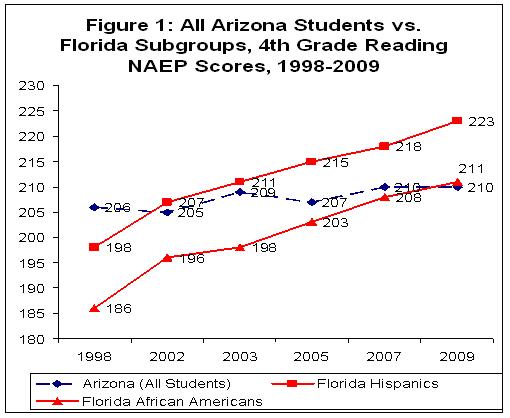
In 2007, Florida’s Hispanic students outscored 15 statewide averages for all students on 4th grade reading. Two years later, Florida Hispanics tied or outscored 30 statewide averages. Florida’s Hispanics scored 13 points higher than the statewide average for all students in Arizona in 2009, over a grade level worth of learning (10 points roughly equaling a grade level’s worth of learning).

Arizona had company. Florida’s Hispanic students also outscored or tied the statewide averages for all students in Alabama, Alaska, Arkansas, California, Georgia, Hawaii, Idaho, Illinois, Indiana, Iowa, Louisiana, Michigan, Minnesota, Mississippi, Nebraska, Nevada, New Mexico, North Carolina, Oklahoma, Oregon, Rhode Island, South Carolina, South Dakota, Tennessee, Texas, Utah, Washington, Wisconsin and Wyoming.

Florida’s African American students also beat the statewide average for all students in Arizona by a nose. Statistically speaking, this is a tie, but extraordinary nevertheless. In 1998, the average Arizona student scored two grade levels higher than the average Florida African American. Florida’s African American students outscored or tied the statewide scores for eight states: Alaska, Arizona, California, Hawaii, Louisiana, Mississippi, Nevada and New Mexico.

Florida’s success in improving academic achievement for disadvantaged students should inspire the rest of the nation to action.  Importantly, Florida’s reading scores also improved markedly for 8th graders, including very large gains among all the disadvantaged student subgroups, including Hispanics, African Americans, students with disabilities and ELL students. More on that later.

Congratulations to Florida students, teachers, school leaders and policymakers. Florida serves as a beacon to the rest of the nation, and should inspire us all to even greater reform efforts. I’ve said it before, and I’ll say it again now. When it comes to education reform…I’LL HAVE WHAT FLORIDA IS HAVING!

UPDATE: I left West Virginia off of the list of states which Florida’s Hispanic students outscore. West Virginia’s score for all students was 215, Florida’s Hispanics scored 223. So, make that 31 states for Florida Hispanic students!


2009 NAEP Reading Scores Released Tomorrow

March 23, 2010

(Guest Post by Matthew Ladner)

Tune in here tomorrow for news and analysis.


Who’s Fickle?

March 19, 2010

(Guest post by Greg Forster)

The new Gadfly opens with Mike Petrilli’s article “Fickle on Federalism.” At the head of the article he juxtaposes these two quotes:

“[This plan] will fundamentally change the federal role in education. We will move from being a compliance monitor to being an engine for innovation.”

–Secretary of Education Arne Duncan, March 17, 2010, before the House Education and Labor Committee


“In coming weeks and months…we will be announcing a number of compliance reviews to ensure that all students have equal access to educational opportunities.”

–Secretary of Education Arne Duncan, March 8, 2010, at the Edmund Pettis Bridge in Selma, Alabama

Good one!

But I’ve got a better one. Scroll down to the next article in the Gadfly and you’ll find Checker’s NRO piece, in which he twists himself into even tighter pretzel knots on the new national standards train wreck. Here’s what he was writing about that on Feb. 23:

This is enormously risky and, frankly, hubristic, since nobody yet has any idea whether these standards will be solid, whether the tests supposed to be aligned with them will be up to the challenge, or whether the “passing scores” on those tests will be high or low, much less how this entire apparatus will be sustained over the long haul.

But in the March 10 New York Times, he was singing a different tune:

I’d say this is one of the most important events of the last several years in American education… Now we have the possibility that, for the first time, states could come together around new standards and high school graduation requirements that are ambitious and coherent. This is a big deal.

Now, in the new Gadfly, he’s careful to weasel around without actually taking a clear position. He opens by saying “conservatives should take seriously the potential” of the standards. “Take seriously the potential”? What does that even mean? Should we support or oppose?

And at the end he concludes that the standards are “light years better than we had any right to expect.” So’s the health care monstrosity currently winding its tortuous way through the House; compared to what I thought they’d get, I’m shocked at how little they’ve ended up with. But that doesn’t mean passing it wouldn’t be a huge disaster; it just means it wouldn’t be as huge a disaster as I had feared (or, more likely, that the huge disaster will be longer in coming to fruition).

In between, he lists five surprisingly weak reasons to support the standards – and then four even weaker warnings about “risks” involved in the enterprise. Check out this howler:

Third, they emerged not from the federal government but from a voluntary coming together of (most) states, and the states’ decision whether or not to adopt them will remain voluntary. Each state will determine whether the new standards represent an improvement over what it’s now using.

Riiiiiiiiiight.

Or take the example of hijacking. The Dr. Jekyll Checker from February sounded warnings that the standards, once imposed, could subsequently be hijacked by the Dark Side. The Mr. Hyde Checker in the Times seems to have forgotten all about this. Here’s the new, pretzel Checker in the Gadfly:

Third, the long-term governance of these standards–and of the assessments to follow–is unknown. Something more durable will need to be found or created than the consortium of states that produced the present draft. (Fordham is developing ideas and options for this, and others will surely weigh in as well.)

So yes, hijacking is a danger. But don’t worry, Checker’s clarion call for somebody to do some sort of something that will do something about this problem will no doubt be heeded and acted upon with dispatch!

What really galled me was the closing line:

Remember, it’s liberals who believe that people should be held to different standards.

Right. Because if Johnny learns long division in fourth grade and Suzy learns it in third grade, that’s the moral equivalent of a racial quota.

Let’s be clear. Conservatives believe that everybody should play by the same rules. That’s different from saying everybody should be forced to conform to the same model of life. It’s liberals who believe that – as Jonah Goldberg has shown so clearly in Liberal Fascism.

Personally, I agree with Checker that too many children have not had access to a solid academic education. The solution to that is not to impose the One Right Way on every child, but to smash the oppressive power structure that has stood in the schoolhouse door for a hundred and fifty years, preventing those children from getting the education they need. Checker wants to make the oppressor even bigger and more powerful, in the hope that he can bend it to his will. Good luck.


Jay Interviewed on National Standards

March 17, 2010

(Guest Post by Matthew Ladner)

Jay was interviewed on EducationNews today on National Standards. Strangely enough, the talk quickly turned to movies and awesomely bad pop culture! I can’t imagine how that happened…we take ourselves very seriously around here at JPGB, and indulge in such frivolity with only the most profound reluctance.

Btw Jay- where is this week’s LOST post?


Radical Customization – One Size Fits None

March 12, 2010

Nationally mandated standard pants – because it’s horribly inefficient to have everyone wear a different size

Building on the debate Jay started the other day, Neal’s got a nice column on Pajamas Media today about subject-based ability grouping. The idea that all children progress at the same rate is nonsense, but the idea that they all progress at the same rate across all subjects at the same time is nonsense on stilts.

I see this in my own daughter’s education. She’s behind in speech and fine motor skills and needs extra help, which she’s not getting in her current school, where everyone does the same thing, on the assumption that kids the same age are all at the same place in their education and have the same needs. But she’s way ahead in anything dealing with symbol recognition – letters, numbers, colors – so she has to sit there bored out of her mind while her classmates slowly and laboriously learn how to count to ten when she can count to thirty.

So starting next year we’re putting her in a private school that uses exactly the approach Neal recommends on the basis of other countries’ experience – each child gets the challenge he or she needs, at the level he or she needs it, determined separately in each subject.

The squishy-wishies will object that “ability grouping” makes the kids who are ahead vain while demoralizing the kids who are behind. The first answer is that this wouldn’t be nearly as much of a problem if public schools were allowed to teach good moral character in addition to academics. And the second answer is that it’s not smart in the long term to deal with people’s emotional and psychological problems by encouraging them to live a lie.

But I think the third answer is that ability grouping wouldn’t have this effect if you did it by subject. You’re not singling out the person as such as superior, you’re tracking particular abilities in each subject.


Little Ramona Delivers the Fail

March 9, 2010

(Guest post by Greg Forster)

My response to the article in today’s Journal by Little Ramona is mostly the same as Whitney Tilson’s response to her book. From his e-mail blast today:

So far I’m hugely unimpressed.  She does a nice job of capturing the failures of the existing system and takes delight in poking holes at reform efforts over the past decade (while playing fast and loose with the facts and/or only presenting one side of the story), yet there is a shocking, gaping void when it comes to any thoughtful ideas for alternatives.

In other words, her attempt to say anything that is either new or interesting has failed.


Building Rock Star Teachers

March 7, 2010

(Guest Post by Matthew Ladner)

Elizabeth Green of Gotham Schools turns in a very important article on building rock star teachers in New York Times Magazine.

I am having the same reaction to this article that I had to roller bags: why did it take so long? After all, we only spend hundreds of millions if not billions of dollars a year on Colleges of Education, and, well, what exactly have they been doing for the last 50 years?

Next reaction, this article hints at what may be a growing trend for Teach for America to work with universities to revamp their Ed Schools. It’s not mentioned in the article, but this process is underway at Arizona State University and the article mentions others.  Given that traditional certification shows no relation to student learning gains and many states are getting a large percentage of their new teachers through alternative routes, the handwriting is on the wall for Colleges of Education: improve or else.


Tom Carroll predicts RTTT Winners

March 2, 2010

(Guest Post by Matthew Ladner)

Tom Carroll went insane and read all 41 Race to the Top applications. His loss is your gain. He predicts Round 1 winners, a lump of possible Round 2 winners, and some clear losers here.


Keeping Them Honest, Part LXXXVII

March 1, 2010

(Guest post by Greg Forster)

Andrew Coulson’s got the skinny on a shocking story of education officials in the UK arbitrarily revising students’ test scores to shape the political narrative they would create.

It’s the latest in a long line of cautionary tales about the kind of thing that happens when anyone other than parents is ultimately in charge of the system. Fans of Common Core, take note.

I am shocked – shocked! – to discover that political manipulation of education is going on in here!

Your federal grant for participating in Common Core Standards, monsieur.


The AEA’s Nose is Growing

February 25, 2010

(Guest Post by Matthew Ladner)

Last week I had the opportunity to discuss Florida’s education reforms on the Arizona PBS public affairs program Horizon with Arizona Education Association President John Wright. We were discussing Florida’s Nation’s Report Scores and I was surprised to hear John make the following claim:

The steepest increases that Florida saw in both reading and math scores were between 1994 and 2002- before most of these reforms took place.

There are a few problems with this statement. First, the Florida legislature enacted most of the reforms in 1999, which falls between 1994 and 2002. The Nation’s Report Card gives tests both 4th grade reading and math and 8th grade reading and math. Florida students however did not take a Nation’s Report Card tests in 4th Grade Math, 8th Grade Math or 8th Grade Reading in 1994.

Florida’s 4th graders did take a test in reading in 1994. Between 1994 and 1998 (the last test given before the reforms) Florida’s reading scores increased by 2 points. After the reforms, Florida’s scores increased by 18 points. A ten-point gain approximately equals a grade level’s worth of learning.

I thought perhaps John had his dates mixed up, but there was something to his assertion on trends, but not so much. Going back as far as possible into the 1990s for each subject, the average gain during the pre-reform 1990s equaled 4 points. Post-reform, the average gain has been 20 points. I you calculate per year gains, the post reform period does almost three times better than the pre-reform years.

John also claimed that Arizona’s K-12 budget cuts were “pulling the rug from beneath the teacher’s feet.” The 2008 Superintendent’s Financial Report however reveals the total revenue per pupil to be $9707 per pupil while the 2009 Superintendent’s Financial Report reveals the latest figure at $9,424 per pupil: a whopping $283 per pupil decline.

The AEA has a budget several times larger than the GI, so it ought to be able to avoid outsourcing his research function to golf hecklers who don’t have their facts straight.