NR’s Must-Read on Big Business and Big Government

March 27, 2009

nr-bedfellows-cover

(Guest post by Greg Forster)

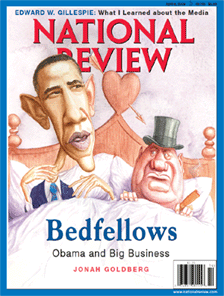
Folks, you simply must read Jonah Goldberg’s cover story in the new NR on how big business loves big government.

I know, I know, to most readers of JPGB it is not likely to be news that big business loves big government. But the article contains a whole slew of fascinating information that I never knew before, covering everything from a hundred years ago to the present day. And it’s very powerfully presented and argued – better than I’ve ever seen on this topic. The article is as delightful to read as it is informative.

There are revelations in the article about Upton Sinclair and the creation of government regulations for the meatpacking industry, and about how TR reversed his position on “trusts” after he left office, that floored me. Back when his book came out, Goldberg said he had to cut huge swaths of the original manuscript – I forget how much he said, but if I recall, it was definitely more than half – because the book was just too long. He was lamenting how much fascinating, little-known historical stuff wouldn’t go into the book and hoped that it would eventually be useful elsewhere. I think he’s getting some of that good stuff into circulation with this article.

Here’s a sample, from the opening:

Honesty and marital necessity require me to state that everything I know about prostitution I have learned from a distance. That said, based on what I’ve gleaned from reading and from films of dubious artistic value, it seems to me that the farther you move up the prostitution price range, the more elaborate the lies become….The relationships grow not only more complex but more reciprocal — and, most of all, the real lies aren’t what the hookers tell the johns, but what both parties tell themselves.

That’s something to keep in mind as we watch the spectacle of American big business and the Democratic party seducing each other once again.

It’s for subscribers only, alas. His syndicated column today takes on the same subject but is much, much less interesting – there’s not much in it that JPGB readers won’t already know. Besides, online subscriptions to NR are cheap and you should have one anyway.


Watch this video…right now!

March 25, 2009

(Guest Post by Matthew Ladner)


Obama Hearts Wall Street Fat Cats, TLF

March 24, 2009

We had spring break last week, so I’ve been a bit absent from the blog.  No fears, we’ll make up for it. 

I know much ink has already been spilled on the AIG bonuses, but let me add just one thought.  AIG had contracts with executives to pay them bonuses even though many of those executives made catastrophically bad decisions.  AIG also had derivative contracts with other financial companies, including Goldman Sachs, even though those companies never fully considered the risk that AIG would be unable to pay.  Of course, if AIG went bankrupt, then all of its contracts would be nullified and everyone would have to get in line to see if they would be paid anything.  But we didn’t want AIG to break its contracts with Goldman, et al for fear that it would spread a panic, so the public assumed AIG’s obligations and guaranteed Goldman, et al every penny. 

Why should Congress be any more outraged over AIG keeping its contracts with its own executives to pay bonuses than keeping its contracts with Goldman et al to pay for bad mortgage bets?  The bonuses only cost us $163 million while the Goldman et al contracts cost us tens of billions.  And the Goldman et al executives were as guilty of gross miscalculation in failing to properly consider counter-party risk as the AIG executives were guilty of writing bad derivative contracts.

As much as I hate to say it, I have to agree with Paul Krugman that the Obamaadministration appears to love Wall Street fat cats.  They love those fat cats at least as much as the Bush Administration. 

Let’s take a look at the new Geithner plan to count the ways.  The plan creates as many as 5 entities in which the Treasury and private investors put in an equal amount of capital, totalling about $150-$200 billion.  Those entities can then borrow as much as 6 times that amount, or a total of  about $1 trillion, from the FDIC (another branch of the government).  Those would be non-recourse loans, meaning that private investors would have no more than $75 to $100 billion on the line and could not lose more.  Meanwhile they get to buy $1 trillion of assets with highly subsidized loans and almost no down-side.    No wonder the stock market loved this.  It’s a great big smooch from the Obama administration.

One of the supposed benefits of this plan is that it will create a “market price” for the currently illiquid “toxic assets.”  But of course the price that this will establish will be a phony one from a market with five selected bidders playing with the government’s money at highly subsidized rates.  This mechanism sets market prices about as well as handing my kids ten bucks and letting them loose at a flea market. 

And if this whole deal is fair, how about if they let me and other individual investors buy shares in these 5 joint ventures.  I’d like to own a piece of a game where I gamble with the government’s money and can experience 1/12 of the losses.


Obama Compares AIG to Suicide Bombers

March 20, 2009

obama

Photo from the LA Times

(Guest post by Greg Forster)

A while back, a certain secretary of education compared the teachers’ unions to terrorists and got in super-major hot water. Remember?

I just wanted to put that on the table so everybody bears in mind the standard for civil discourse that was established during that episode. Of course that standard would apply equally to both parties, right?

The LA Times is reporting that at a California town hall meeting, President Obama compared AIG to a suicide bomber:

Well, OK, that all made sense, but then he compared AIG to a suicide bomber, and at that, we really perked up.

“Same thing with AIG,” Obama said. “It was the right thing to do to step in. Like they’ve got a bomb strapped to them and they’ve got their hand on the trigger, you don’t want them to blow up, but you’ve got to ease them off the trigger.”

And the president held out his arm and pantomimed a hand on a trigger, and we were rapt, waiting for what would happen next.

But then he called for a final question from the crowd.

HT Campaign Spot.

When he’s off the teleprompter, he’s really off the teleprompter.

Steyn is telling Hugh Hewitt that now he’s recycling all the jokes Frank Sinatra used to do about Bob Hope’s reliance on cue cards as Obama teleprompter jokes, and they’re going over really well.


Greetings from the Welfare State

March 2, 2009

Help me understand the logic of Obama’s proposed budget.  He wants to increase federal government spending next year to “$3.94 trillion, up 32 percent from a year ago.”  And to help pay for this 32% increase in federal spending, especially increases in social welfare, Obama proposes to reduce the deductability for donations to charity for the top income brackets to 28% of the donation.  Effectively, Obama wants to pay for more government welfare by increasing the taxation of the private provision of those services.

And Obama’s proposed budget would also cap the deductability of mortgage interest for the top income brackets at 28%.  That tax increase would help pay for a huge expansion in government expenditures to prop up the housing market. 

The only thing that could account for these proposals is a belief in the inherent superiority of government-provided services over the provision of those same services in the private sector.  We would have to believe that the government is better at identifying and serving charitable needs than are private charities.  We would have to believe that government can better identify under-priced housing than private buyers can.

Mind you, I wouldn’t mind getting rid of charitable and mortgage deductions in exchange for lower marginal rates since I think these targeted deductions distort behavior.  But Obama is proposing to raise marginal rates while reducing these deductions.  Welcome to the welfare state.


Porkapalooza

February 11, 2009

(Guest post by Greg Forster)

I just got caught up reading the last 24 hours’ worth of Jim Geraghty over on NRO, and it’s a cornucopia of posts that relate directly to a variety of topics we’ve been discussing here on JPGB:

Jim: “Say, fellows . . . when the central argument that the president uses to defend $838 billion or so in new spending is a lie, isn’t that news? Shouldn’t that be something of a big deal?”

In case the president is interested, Jay has proposed an alternative to the stimulus, although he has also noted that even doing nothing would be better than a stimulus bill.

Which I take as evidence that even the bill’s supporters don’t expect it will have a stimulative effect on the economy, as we’ve discussed; they’re supporting it because it’s a forty-year wish list of liberal fantasies and payoffs.

By which time he hopes the economy will have turned around on its own, so that the improvement can be attributed to the “stimulus,” just like Jay has pointed out.

This slander was debunked within days of the collapse, as we’ve noted. The real reason it collapsed is because “infrastructure” spending goes where politics dictates, not where there are real needs for improved infrastructure. So more spending doesn’t produce improved results.

And speaking of how infrastructure spending is really spent…

Jim reminds us that the Post, even while admitting that Murtha was a profound embarrasment, endorsed him on grounds that he delivered “infrastructure” pork to his district.


You Mean Wal-Mart Isn’t Evil?

February 9, 2009


(Don’t blame me for the lousy photo-shopping.  Eduwonkette did it.  But I told her it made me look like David Byrne in his giant suit.  Pretty cool!)

David Kinkade at the Arkansas Project alerted us to this piece by Charles Platt, a writer at Wired Magazine, on his experience going “undercover” to work for Wal-Mart.  Platt writes:

” I found myself reaching an inescapable conclusion. Low wages are not a Wal-Mart problem. They are an industry-wide problem, afflicting all unskilled entry-level jobs, and the reason should be obvious.

In our free-enterprise system, employees are valued largely in terms of what they can do. This is why teenagers fresh out of high school often go to vocational training institutes to become auto mechanics or electricians. They understand a basic principle that seems to elude social commentators, politicians and union organizers. If you want better pay, you need to learn skills that are in demand.

The blunt tools of legislation or union power can force a corporation to pay higher wages, but if employees don’t create an equal amount of additional value, there’s no net gain. All other factors remaining equal, the store will have to charge higher prices for its merchandise, and its competitive position will suffer.

This is Economics 101, but no one wants to believe it, because it tells us that a legislative or unionized quick-fix is not going to work in the long term. If you want people to be wealthier, they have to create additional wealth.

To my mind, the real scandal is not that a large corporation doesn’t pay people more. The scandal is that so many people have so little economic value. Despite (or because of) a free public school system, millions of teenagers enter the work force without marketable skills. So why would anyone expect them to be well paid?

In fact, the deal at Wal-Mart is better than at many other employers. The company states that its regular full-time hourly associates in the US average $10.86 per hour, while the mean hourly wage for retail sales associates in department stores generally is $8.67. The federal minimum wage is $6.55 per hour. Also every Wal-Mart employee gets a 10% store discount, while an additional 4% of wages go into profit-sharing and 401(k) plans.”

He then concludes:

“Based on my experience (admittedly, only at one location) I reached a conclusion which is utterly opposed to almost everything ever written about Wal-Mart. I came to regard it as one of the all-time enlightened American employers, right up there with IBM in the 1960s.”

So, the path to higher worker wages is improved education, not unionization?  Luckily the unions do so much to help improve education that I guess we are in great shape!


Does your economy have performance issues?

February 6, 2009

(Guest Post by Matthew Ladner)

Nicely done by the Reason Foundation…


Jay Praises the Stimulus!

February 4, 2009

billy-bragg-talking-with-the-taxman

(Guest post by Greg Forster)

Don’t miss Jay’s article on NRO this morning praising the stimulus bill – that is, celebrating the fact that the stimulus isn’t even worse than it actually is.

As Jay reminds us, the Democrats made big promises about expanding preschool. The enormous slab of edu-pork in the stimulus bill could easily have been designed to lay the groundwork for fulfilling those promises, but it doesn’t:

Of course, if this money isn’t really going to help children learn, it would be best if we didn’t spend it at all. But Congress seems determined to burn giant piles of cash in the hopes that its warm glow will stimulate us. Given the circumstances, it’s some consolation that the current education stimulus won’t force us to burn larger and larger piles of cash forever into the future.

Burning large piles of cash, eh? Hmm. Sounds familiar.


On School Spending, Palin’s Palein’ Again

February 4, 2009

sarah-palin

(Guest post by Greg Forster)

Back in October, I gritted my teeth and, against my inclinations, pointed out that as governor, Sarah Palin cozied up to the teachers’ unions and loved to brag about how much money she threw at schools. Never mind that the schools never got better; it played well to the media, and even more to the great “mushy middle” (in Charles Krauthammer’s wonderful phrase) that likes to make public policy based on what feels good, not on what gets results.

Then she endorsed vouchers and directly promised to push for a specified voucher plan if elected, which of course was big news. Vouchers have consistently produced academic gains whenever they’ve been tried and scientifically evaluated, and are by far the most promising reform for improving education for all students, as everyone who cares to know already knows. I tried to do justice to both sides of the story by noting that both Palin and Obama were trying to have it both ways on education.

Now she’s going back to her roots. She’s not for the stimulus, and she’s not against it (UPDATE: oops, see below). Her only position on the stimulus is that the bill doesn’t throw enough money at Alaska, and specifically that “the stimulus package rewards states for not planning when it comes to prioritizing for things like education, as Alaska has planned ahead by forward-funding 21 percent of our General Fund dollars for this very important priority. It appears only those states that did not plan ahead with education will benefit. States like Alaska should not be punished for being responsible; yet that’s what the plan means for Alaska right now” (HT Jim Geraghty).

Meanwhile, as Alaska faces a billion-dollar shortfall, she’s pushing to build a road to Nome that will cost up to $2 billion. I’m sure that has nothing to do with a desire to have “shovel ready” projects at hand, ready to shovel into the maw of the federal “stimulus” sugar daddy.

National Review‘s Greg Pollowitz was the first to dub it the “road to Nome-where.”

I hate being the designated Palin critic of the education reform movement. When I’m with my education reform comrades, I’m usually the only Republican in the room. And I’m much more Sarah Palin’s kind of Republican than, say, Mitt Romney’s, much less John McCain’s. But somebody’s got to point this stuff out.

Does anybody want to take over the job?

UPDATE: I wanted to check on this before posting it. I’ve confirmed that, in addition to usually being the only Republican in the room when I’m working on education reform, I’m also the only Republican on this blog. (Matt specifically requested that I describe him as a “disgusted former Republican.” Duly noted.)

UPDATE to the UPDATE: Wouldn’t you know it? She just put out a statement saying she agrees with the decision of Alaska’s Senators to vote “no” on the stimulus. I saw it just two hours after I posted this. But she adds that a stimulus “is needed” and plumps again for mo money, mo money, mo money!