Vegas, Baby

March 23, 2010

I recently returned from an excellent conference organized by the Nevada Policy Research Institute in Las Vegas.  As you can see in the above photo, we had a good time (I’m the one in the middle — the Jewish guy).

At the conference it dawned on me that health care is likely to have a huge, unintended effect on education policy.  By placing significant new health care costs on states, the bill will almost certainly strain state finances.  Since education is the only other really big expenditure in state budgets, look for states to become much more open to ways to economize on education than they have been.  State may become much more interested in virtual education, choice, and other lower cost ways of delivering education.  The days of regular annual increases in education spending are over.  Once that happens the political landscape will almost certainly change. 

Patrick Gibbons, the smart and energetic organizer of the conference, has already blogged on my health care/education trade-off ideas on the NRPI blog.

This was my first time in Vegas, so I should make a quick observation about the place.  I think Las Vegas could best be described as a giant vacuum cleaner that sucks money out of people’s wallets.  The people are glad to have the money vacuumed; they aren’t being robbed.  It’s just that everything about the place has been carefully designed to extract as much money as people will willingly part with.  If you don’t like gambling, they have shows.  If you don’t have shows, they have shopping.  They have food, they have prostitution, they have booze, they have spas, they have luxurious accommodations.  Whatever you want to spend money on, they will provide the service and take your money.  It is the Platonic form of commerce.

I know a lot of people have negative judgements about Vegas, saying that people are exploited or manipulated to give up their money.  That wasn’t my experience.  People were thrilled to have their money taken and seemed to enjoy the process knowing full well what was happening. 

My sense is that it is no more exploitative than the local shopping mall in every city.  It is only far more efficient and on a larger scale.


Two Awful Tastes that Taste Awful Together

March 10, 2010

(Guest post by Greg Forster)

You can’t make this stuff up, folks.

The Democratic congressional leadership is now going to add their bill to eliminate all private student-loan lending, granting the government (i.e. themselves) a monopoly on all student loan business, to the same reconciliation process by which they’re jamming health care through.

As we know, the saga of federal involvement in student loans clearly illustrates the direct path from the “public option” to full-blown single-payer nationalization.

You would think they’d be shy to put the two right there next to each other. Then again, for those who haven’t learned this lesson by now, will hitting them in the face with it make any difference?

HT NRO


Izumi and Clemens: Emulate Canadian K-12, not health care

February 23, 2010

(Guest Post by Matthew Ladner)

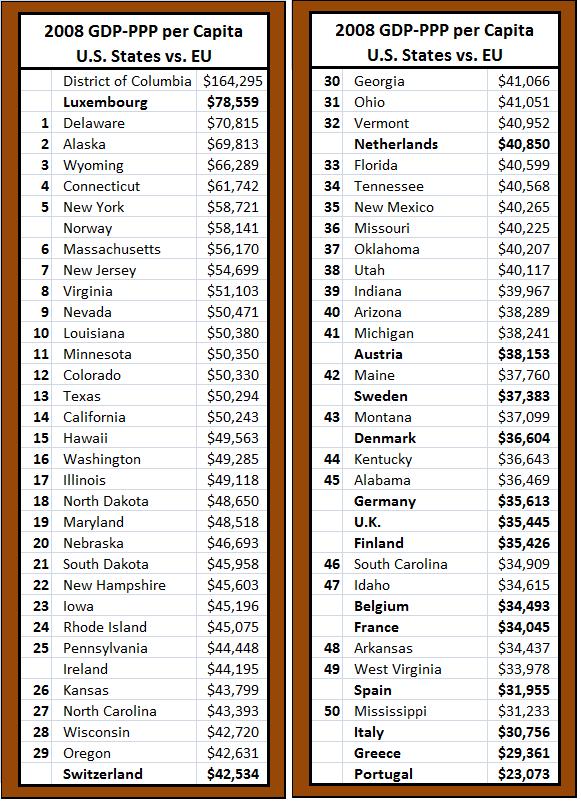
Sounds like a good idea to me. After all, the Canadians were the first ones nerdy enough to wed Ayn Rand inspired lyrics to epic drum solos. Oh, plus they spend much less than we do per pupil, get much better results, don’t have a central national education bureaucracy, and have lots of parental choice. Izumi and Clemens could have added that the Canadians get these superior education results despite a national per capita income that would land them among the least wealthy American states, roughly equal to that of Alabama on a PPP basis.

Beauty, eh?


Bad Politics

February 9, 2010

As I’ve written several times before, I don’t believe that the various federal government stimulus efforts did anything to help the economy.  In fact, they’ve done quite a lot of economic damage by distorting a more efficient allocation of capital and by encouraging the moral hazard where private actors who take unreasonable and large risks get to keep the profits if their bet works and get bailed out by taxpayers if it doesn’t

However, plenty of smart people, including a whole lot of folks at market-oriented think tanks, thought large-scale federal intervention in the economy was necessary to stave off an economic collapse. 

Whatever you think of the economic merits of federal stimulus efforts, one thing is very clear — giant federal stimulus efforts were bad politics for President Obama.  It may have made some political sense for an outgoing President Bush to do whatever he could to avoid being cast as the next Herbert Hoover.  But Obama’s political interests should have been different.  He entered office in the midst of a severe economic downturn that had started under his predecessor.  If he had followed the smart political example of Ronald Reagan he would have basically let the downturn run its course and then have rapid economic growth following.  Instead, Obama (and Bush’s) stimulus efforts essentially borrowed consumption from the recovery to soften the severity of the downturn.  The downturn may not have been as bad as it would have been, but the recovery is also much weaker than it would have been.

Reagan’s example may or may not be good policy, but it is certainly good politics.  As any student of Machiavelli learns, you should have all of the bad at the beginning and then let the benefits roll in over time.


A Mind is An Expensive Thing to Waste

January 31, 2010

Economists Rick Hanushek and Ludger Woessmann presented a paper last week at the World Economic Forum in Davos, Switzerland, showing just how much in dollars and sense it costs not to raise student achievement.  If the U.S. could increase its average score on the PISA test by 25 points over the next twenty years (less than Poland did over the last six years) it “would result in an increase in the U.S. GDP of $40 trillion over the lifetime of the generation born in 2010.” 

Now that would be a stimulus plan.  But remember that average U.S. students achievement for 17 year olds has been stagnant for at least four decades despite more than doubling real expenditures per pupil.  So this stimulus plan requires something other than money.  It requires structural changes in public education to produce more achievement for every dollar already spent.

The new report by Hanushek and Woessmann builds on an earlier study that you can see in this Education Next article.


“Just Call Me Mister Butterfingers!”

January 22, 2010

(Guest post by Greg Forster)

President Obama says health care socialization has “run into a bit of a buzz saw.”

Jim Geraghty asks: What’s the survival rate for people who run into buzz saws?


Edsall Plays the Race Card

January 21, 2010

(Guest post by Greg Forster)

Well, that didn’t take long.

Just one day after the election, Thomas Edsall argues that Scott Brown won – and Americans generally are rejecting health care socializiation – because white people are just so darn racist.

No! It’s true! Because he read a book that says ethnically diverse neighborhoods have more social tension than ethnically homogeneous neighborhoods! The book had numbers in it and everything! That proves it!

Update: Edsall’s not alone. Howard Fineman, editor of Newsweek, thinks pickup trucks are racist.

Apparently not everyone’s ideological blinders have been loosened by this experience.

What do you suppose it will take to get through to these people?


Euros Need to Work on Economic Growth

January 16, 2010

(Guest Post by Matthew Ladner)

Interesting chart from Real Clear Markets. Think we may need to reign in DC a bit?


Ed Schools and Biz Schools

January 12, 2010

My colleagues, Bob Maranto and Gary Ritter, along with former Teachers College president, Arthur Levine, have a piece in Education Week arguing that education schools could improve their quality as business schools did several decades ago.  I suggest you read the article to judge their case for yourself.

What I wanted to do with this post is to anticipate the inevitable argument that business schools are somehow responsible for the recent economic meltdown or that ed schools are no more responsible for the quality of K-12 education than business schools are for the economic collapse.  I’ve heard this line from a bunch of education officials, so it must be in the talking points.

Here’s why this type of argument is hogwash.  Business schools are not responsible for the economic collapse because (among other reasons), biz schools do not work with business unions to get the government to require attendance at business schools and government certification before one can open (most) businesses.  Some business people have attended business schools but most have not.

Ed schools, on the other hand, work with teacher unions to get the government to require that (most) educators receive training from ed schools and certification from the state before they can teach.  The vast majority of educators, including the vast majority of teachers, principals, and superintendents have been trained and certified by ed schools.

I’m happy to let ed schools off the hook for K-12 performance if they actively lobby for ending their cartel on the production of new educators.


Why Not Just Nationalize?

January 11, 2010

OK, so let me get this straight.  When banks lose a ton of private money because their employees made a ton of bad investments, the government bails them out with taxpayer dollars.  And when those banks start to make profits again, they start to pay their employees huge bonuses like they did before those (mostly) same employees made their horrible money-losing bets.  The public gets outraged and wants to do something to capture more of the bank profits or otherwise limit banker bonuses.  Just today, the WSJ tells us, the “Obama administration is considering levying a fee on banks to recoup more of the taxpayer funds spent to rescue the financial system.”

So, if the government provides taxpayer money when banks lose money and takes extra money when those banks are profitable, how is that different from the government owning the banks?  Why don’t we just cut out the middleman and make them public entities?  Or here is a better idea — how about if we don’t give taxpayer money to people who make bad investments and let them prosper or fail with their own money?