Just a Mint? One Mint?

October 1, 2008

(Guest post by Greg Forster)

Great news! Our schools are saved.

Billionaire Eli Broad is spending $44 million to start up a new Harvard center to figure out what’s wrong with public schools.

That’s right; the first $500 billion a year we spend on K-12 education didn’t do the job, but spending another $44 million (not per year but only once) will put us over the top.

Just like that after-dinner mint in the Monty Python sketch, I guess.

Larry Summers will head the center’s board. The Wall Street Journal reports that Summers was asked whether opening the new center was a rebuke to all the other education research centers which have been doing exactly the same thing for decades and have produced no tangible improvements in education to show for it.

Summers replied: “It’s not a rebuke to any individual.”

With respect to the fine people who work at these cushy “education laboratories,” the real education laboratories are the private and charter schools taking advantage of school choice programs to experiment with new approaches to education.

Milton Friedman always used to comment that education is the only thing we still do the same way we did it 100 years ago. Innovation in education has been stifled not because we lack comfortably endowed research centers but because education is controlled by a government monopoly. He would go on to comment that the real innovation in education won’t come until school choice programs are expanded to include all students – because only with universal choice will you get a more robust market that will produce bigger innovations. And once free-market schools begin discovering better educational techniques, others can copy them. Doctors improve care by copying other doctors who devise new and better treatments – and it’s not the doctors who work for the free, government-issue providers who devise new and better treatments, but the doctors who serve the middle and upper classes and have the opportunity to make more money if they provide better treatment.

The best thing we can do for the education of the poor, Milton would conclude, is to extend school choice to the middle class. Schools for the poor can’t improve service until the education sector as a whole figures out how to improve service, and that isn’t going to happen without a universal market.


Progress in Delaware

September 22, 2008

(Guest Post by Matthew Ladner)

Both Eduwonk and Charlie Barone are ga-ga for Delaware’s education reform results, and with good reason. Delaware has high-scoring minority students on NAEP, and have an admirable system of student testing that other states should study carefully.

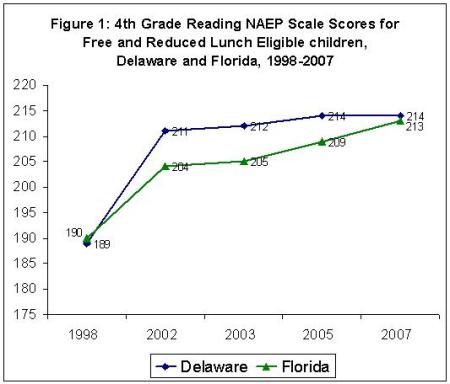
I decided to run Delaware’s numbers against my favorite reform state, Florida, by comparing progress by low-income children on NAEP’s 4th grade reading exam.

And down the stretch they come! It’s Delaware by a nose!

Now, Delaware spends $11,633 per pupil in the public schools in 2006, while Florida was only at $7,759, which is 49% higher. However, these days, you don’t look the progress gift-horse in the mouth, even if it comes at a hefty price.

One could argue that Delaware shows that with the right kind of investment and commitment to standards, that you can improve student achievement without any of that messy school choice business.

Not so fast my friend!

It turns out that Delaware is discretely a haven for parental choice. Delaware has the nation’s 7th ranked charter school law according to the Center for Education Reform, and active inter and intra district choice programs. Add all of those up, and 15.5% of all K-12 students in Delaware are exercising choice through public options.

Delaware also has a large number of students attending private schools, and a little less than 2% home-schooling. Combine those, and you get over 20 percent of students exercising private choice.

If you add it all together, 35.7% of Delaware students are attending schools other than their assigned district school.

It just goes to show- standards and parental choice are two great tastes that taste great together.


Does Joel Klein Matter?

September 18, 2008

(Guest Post by Matthew Ladner)

Literature contains any number examples of the “magic child” myth- the one with mystical abilities that will become a great leader. Paul Atreides, Luke Skywalker and Thomas “Neo” Anderson are recent examples from science fiction, but there are many others.


For some reason, we tend to buy into the messianic myth with school leaders as well.


The oddest thing (to me) about the back and forth we’ve had here and elsewhere about instructional versus incentive based reform seems to center around Joel Klein’s tenure in NYC. I think Klein will ultimately be seen as a fairly inconsequential figure.


Let me hasten to say that I briefly met Klein at a conference a few months ago, and he seemed like a good guy, so this is nothing personal. He seems to have good intentions. Some have lauded his reforms; others have indicted him for making poor instructional choices. It seems perfectly plausible to me that Klein deserves praise for some things and criticism for others.


In my book, however, there are usually only two types of urban superintendents: those that have failed, and those that will fail. Rick Hess’ Spinning Wheels made this case convincingly- school systems cycle through superintendents as pseudo-messiahs as a method for kicking the can down the road. New savior arrives, tries to implement reforms, and receives a pink slip about three years later.


The new-new savior finds a group of half implemented reforms lying around, discards them to put in his or her own new program. Repeat process indefinitely. Longtime teachers learn to ignore the flailing at the top, knowing that “this too shall pass.”


Klein obviously departs from this model. He has a legal rather than an education background, and assumed control under the auspices of Mayor Bloomberg taking over the schools. His tenure has already lasted far longer than average.


It has never been a tenet of those of us in the choice movement that a gigantic schooling system would substantially improve if only they had the right superintendent. We emphasize market mechanisms, not benevolent dictatorships. In fact, we’ve seen some celebrity superintendents in the past: Roy Roemer in Los Angeles, Mike Moses (former state Education Commissioner) in Dallas.


No revolutionary improvement there, either.


Don’t get me wrong: I’m hoping for the best with people like Rhee and Klein. One might think that, for instance, that it shouldn’t be inconceivable for Rhee to improve the governance of the DCPS, but the track record here is not awe-inspiring.


If the critique of Klein is that he received a huge windfall of money but has failed so far to produce big results, what can one say other than: why would you expect anything else? Surely hope cannot have so completely triumphed over experience.


We should be persuaded by the evidence that instructional choices are very important. Incentive based reforms are also important. If a NYC chancellor does a little bit of one and none of the other, the results are likely to be underwhelming.


In other words-this too shall pass. Wake me up if and when Klein does anything truly radical- like a Jack Welch program for firing the bottom 10% of teachers and bureaucrats each year or widespread parental choice. Until then, I’ll hope for the best but not expect too much.


PJM on Merit Pay in D.C.

September 8, 2008

(Guest post by Greg Forster)

Today, Pajamas Media carries my column on Michelle Rhee’s push for a limited, voluntary merit pay system in Washington D.C.:

To see how much has changed, just consider the amazing fact that about one out of every three public-school students in D.C. attends a charter school — government-owned but non-unionized, privately operated, and (most important of all) chosen by parents — instead of a regular public school. “We lost 6,000 students last year,” says Parker, referring to the number of students who moved from regular schools to charters. Six thousand students is over 13% of the city’s remaining enrollment in regular public schools — in one year.

Rhee isn’t the force behind charter schools or vouchers in D.C. She’s in charge of the regular public system. But the same widespread mandate for reform that made charters and vouchers successful have allowed Rhee to succeed with reforms like closing schools that were only there to create patronage jobs, introducing curriculum innovation, and taking on the unbelievable amount of bureaucratic waste in the system. And as vouchers and charters have sent a message that the system can’t take students for granted any more, the pressure for reform has only increased — strengthening Rhee’s hand.

By coincidence, the Washington Post‘s Marc Fisher has a column today emphasizing how the explosion of charter schools in D.C. was decisive in bringing the unions to the bargaining table, even on the issue of reforming the structure of teacher pay. Just as competition from globalization forced the private sector unions to start the long, slow process of giving up the ridiculous extravegances that they won from management in the 1960s and 1970s, thus rescuing the American economy from disaster, now competition in schooling is forcing the teachers’ unions to start the same process of giving up their own ridiculous extravegances – the biggest of all being a system of hiring, firing and pay that bears no serious relationship to job performance.


What Does Florida Tell Us About Broader/Bolder?

September 4, 2008

(Guest Post by Matthew Ladner)

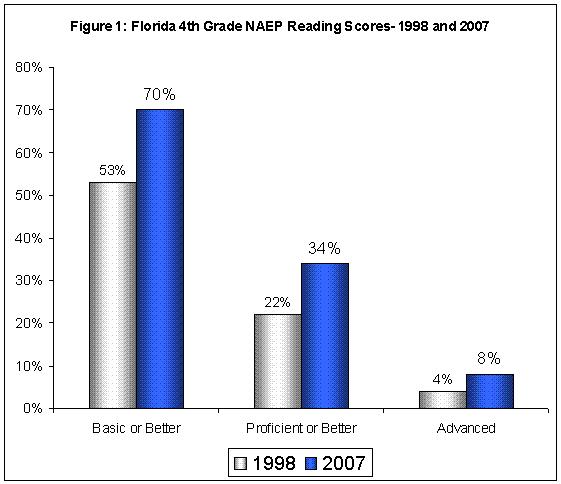
I have several times noted the vast improvement in Florida’s 4th Grade Reading NAEP scores on this blog. Figure 1 below demonstrates just how large that improvement has been between 1998 and 2007. For those who don’t have an excel spreadsheet open, that is  a 32% increase in students scoring Basic or above, a 54% increase in those scoring Proficient or better, and a 100% increase in the percent scoring at the advanced level.

These results make the so-called “Broader and Bolder” approach seem all the more absurd. There hasn’t been any outbreak of “Socialism for the Children” in Republican dominated Florida, but there has been substantial improvement in the percentage of children learning to read.


Lucky thing too, as state budgets are being consumed by out of control Medicaid spending that it taking an increasingly large bite. Society has several other priorities besides K-12 education, such as criminal justice, higher education, transportation and social welfare. Bottom line: there isn’t the money for the Broader and Bolder approach anyway. This is just as well, as the track record on spending increases fueling academic gains stands as a dismal failure.


Given that we can’t spend our way out of our K-12 problems (and it wouldn’t work if we tried) we should instead seek ways to improve the bang we get for our existing bucks. Fortunately, Florida shows that it can be done.


The Meta-List: An Incomplete List of Complete Lists

August 27, 2008

“The Treason of Images,” Rene Magritte, 1928-29 (“This is not a pipe.”)

(Guest post by Greg Forster)

Jay posted two “complete lists” of voucher research this week, and a number of people seem to have found them helpful. Jay and I have both spent a lot of time circulating these lists for years (they change over time, of course, as new research gets done). We keep on thinking we’ve circulated these lists so much that there can’t be much use in circulating them further, yet we keep on finding more people who say, “Wow, I’ve never seen anything like this before, this is really helpful!”

Well, if people found those two lists helpful, maybe they’d like to see some of the other lists that have been compiled. So here’s a meta-list: a list of complete lists of research.

Of course, this is not a complete list of the complete lists. If anyone wants to add more in the comment section, that will help make this page even more useful. And I’ll come back and update the list as needed, so that this page will remain a useful resource for people looking for all the research on vouchers.

Though no doubt others will think that my list of complete lists isn’t nearly complete enough. I hope they’ll compile their own lists of complete lists – the more the merrier. And when there are enough lists of complete lists out there, we’ll need to make a list of them, so that people can keep track of them all . . .

Of course, these lists are all “complete to my knowledge.” There may always be a study lurking out there that hasn’t been noticed – although on the voucher issue that’s a somewhat more remote possibility than it is with other issues.

Last year I made an effort to summarize all the research on all the issues relating to vouchers in this study. The sections covering random-assignment studies of voucher participants and studies of how vouchers affect public schools are now out of date, but the report will point you to a bunch of other studies on issues that don’t have enough of a body of research – or have too much of a body of research – to generate a “complete list.” For example, you’ll find a discussion of the evidence on questions like the fiscal impact of voucher programs, and whether vouchers provide all students with access to schooling.

On those last two subjects – fiscal impacts and whether the private school sector provides broad, inclusive access to schooling for all students – the Friedman Foundation offers handy guides (here and here) and references to the research issues (here and here).

And finally, here is a meta-list that will point you to a bunch of complete lists of research on issues related to vouchers. Personally, I’ve found this resource to be the most helpful of all.

NOTE: This post is edited as needed to keep it up to date.


Systemic Effects of Vouchers

August 25, 2008

In an earlier post I listed all analyses of the effects of U.S. vouchers on program participants using random-assignment experiments.  Those studies tell us about what happens to the academic achievement of students who receive vouchers.  But we all recognize that expanding choice and competition with vouchers may also have significant effects on students who remain in traditional public schools.  Here is a brief summary of the research on that question.

In general, the evidence on systemic effects (how expanding choice and competition affects the performance of traditional public schools) has more methodological limitations than participant effects studies.  We haven’t been able to randomly assign school districts to increased competition, so we have more serious problems with drawing causal inferences.  Even devising accurate measures of the extent of competition has been problematic.  That being said, the findings on systemic effects, like on participant effects, is generally positive and almost never negative.

Even in the absence of choice programs traditional public schools are exposed to some amount of competition.  They may compete with public schools in other districts or with nearby private schools.  A relatively large number of studies have examined this naturally occurring variation in competition.  To avoid being accused of cherry-picking this evidence I’ll rely on the review of that literature conducted by Henry Levin and Clive Belfield.  Here is the abstract of their review, in full:

“This article systematically reviews U.S. evidence from cross-sectional research on educational outcomes when schools must compete with each other. Competition typically is measured by using either the HerfindahlIndex or the enrollment rate at an alternative school choice. Outcomes are academic test scores, graduation/attainment, expenditures/efficiency, teacher quality, students’ post-school wages, and local housing prices. The sampling strategy identified more than 41 relevant empiricalstudies. A sizable majority report beneficial effects of competition, and many report statistically significant correlations. For each study, the effect size of an increase of competition by one standard deviation is reported. The positive gains from competition are modest in scope with respect to realistic changes in levels of competition. The review also notes several methodological challenges and recommends caution in reasoning from point estimates to public policy.”

There have also been a number of studies that have examined the effect of expanding competition or the threat of competition on public schools from voucher programs in Milwaukee and Florida.  Here are all of the major studies of systemic effects of which I am aware from voucher programs in the US:

Milwaukee

Martin Carnoy, et al “Vouchers and Public School Performance,” Economic Policy Institute, October 2007;

Rajashri Chakrabarti, “Can Increasing Private School Participation and Monetary Loss in a Voucher Program Affect Public School Performance? Evidence from Milwaukee,” Federal Reserve Bank of New York, 2007; (forthcoming in the Journal of Public Economics)

Caroline Minter Hoxby, “The Rising Tide,” Education Next, Winter 2001;

Jay P. Greene and Ryan H. Marsh, “The Effect of Milwaukee’s Parental Choice Program on Student Achievement in Milwaukee Public Schools,” School Choice Demonstration Project Report, March 2009.

Florida

Rajashri Chakrabarti “Vouchers, Public School Response and the Role of Incentives: Evidence from Florida Federal Reserve Bank of New York Staff Report, Number 306, October 2007;

Jay P. Greene and Marcus A. Winters, “Competition Passes the Test,” Education Next, Summer 2004;

Cecilia Elena Rouse, Jane Hannaway, Dan Goldhaber, and David Figlio, “Feeling the Heat: How Low Performing Schools Respond to Voucher and Accountability Pressure,” CALDER Working Paper 13, Urban Institute, November 2007;

Martin West and Paul Peterson, “The Efficacy of Choice Threats Within School Accountability Systems,” Harvard PEPG Working Paper 05-01, March 23, 2005; (subsequently published in The Economic Journal, March, 2006)

Jay P. Greene and Marcus A. Winters, “The Effect of Special Education Vouchers on Public School Achievement: Evidence From Florida’s McKay Scholarship Program”  Manhattan Institute, Civic Report Number 52, April 2008. (looks only at voucher program for disabled students)

Cassandra Hart and David Figlio, “Does Competition Improve Public Schools?” Education Next, Winter, 2011.

Every one of these 10 studies finds positive systemic effects.  It is importantto note that Rouse, et al are ambiguous as to whether they attribute the improvements observed to competition or to the stigma of Florida’s accountability system.  The other four Florida studies perform analyses that support the conclusion that the gains were from competitive pressure rather than simply from stigma.

Also Carnoy, et al confirm Chakrabarti’s finding that Milwaukee public schools improved as the voucher program expanded, but they emphasize that those gains did not continue to increase as the program expanded further (nor did those gains disappear).  They find this lack of continued improvement worrisome and believe that it undermines confidence one could have in the initial positive reaction from competition that they and others have observed.  This and other analyses using different measures of competition with null results lead them to conclude that overall there is a null effect  — even though they do confirm Chakrabarti’s finding of a positive effect.

I would also add that Greg Forster and I have a study of systemic effects in Milwaukee and Greg has a new study of systemic effects from the voucher program in Ohio.  And Greg also has a neat study that shows that schools previously threatened with voucher competition slipped after Florida’s Supreme Court struck down the voucher provision.  All of these studies also show positive systemic effects, but since they have not undergone external review and since I do not want to overstate the evidence, I’ve left them out of the above list of studies.  People who, after reading them, have confidence in these three studies should add them to the list of studies on systemic effects.

The bottom line is that none of the studies of systemic effects from voucher programs finds negative effects on student achievement in public schools from voucher competition.  The bulk of the evidence, both from studies of voucher programs and from variation in existing competition among public schools, supports the conclusion that expanding competition improves student achievement.

(Updated 3/3/11 to include the new Florida study)


Demography Is Not Destiny

August 22, 2008

(Guest Post by Matthew Ladner)

The Pacific Research Institute has put out a new study co-authored by PRI Senior Fellow Vicki Murray and some guy from Arizona comparing trends in academic achievement in California to those in Florida. Among the findings: Florida’s Hispanic students outscore the statewide average for all students in California on NAEP’s 4th Grade Reading Exam. Also, Florida’s Free and Reduced lunch eligible Hispanics outscore the statewide average for all students in California. After a decade of strong improvement in Florida, Florida’s African-American students are within striking distance of the statewide average for all students in California, and have already exceeded the statewide averages for all students in Louisiana and Mississippi.

Oh, and Florida’s free or reduced lunch eligible students attending inner city schools outscore the statewide average for all California students.

The point of all of this is not to bash California public schools, but instead to show just how much entirely plausible room for improvement exists. The question isn’t whether disadvantaged kids can learn. Yes they can! The question is whether we adults can get our acts together for the kids.


Yet Another Study Finds Vouchers Improve Public Schools

August 21, 2008

(Guest post by Greg Forster)

The Friedman Foundation has just released my new study showing that Ohio’s EdChoice voucher program had a positive impact on academic outcomes in public schools. I’m told that it has generated a number of news hits, though the only reporter to interview me so far was the author of this piece in the Columbus Dispatch. When she interviewed me I thought she was hostile, because her questions put me a little off balance, but the article is perfectly fair. I guess if the reporter is doing her job right, the interviewees ought to feel like they were being challenged. The final product is what counts.

The positive results that I found from the EdChoice program were substantial but not revolutionary. That’s not surprising, given that 1) failing-schools vouchers aren’t the optimum way to structure voucher programs in the first place, and 2) the data were from the program’s first year, when it was smaller and more restricted than it is now.

It’s too early to be sure, but among the large body of empirical studies consistently showing that vouchers improve public schools, a pattern seems to be emerging that voucher programs have a bigger impact on public schools when they’re larger, more universal, and have fewer obstacles to parental participation. That’s worth watching and studying further as opportunities arise.


USA Today: Parental Choice Popular in Sweden

July 25, 2008

(Guest Post by Matthew Ladner)

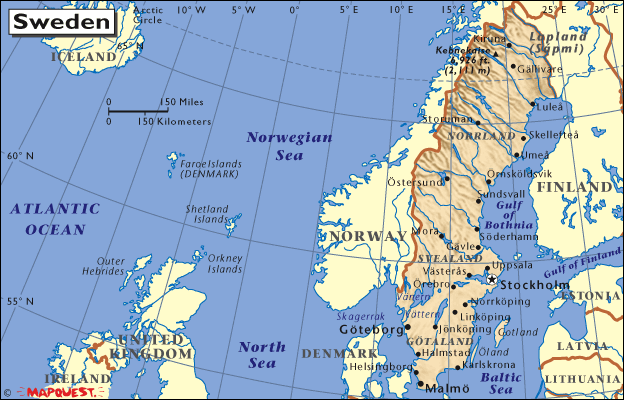
Sweden, of all places, went for government funding of private school attendance in 1992. The quasi-market system has proven very popular, so much so that even the teacher unions don’t complain about it.

Perhaps next they will go really crazy and outsource their bus services, to the delight of Greg and Andy.