The Upward Surge of Mankind?

October 30, 2008

(Guest Post by Matthew Ladner)

Florida tripled the number of Hispanic and African American students passing one or more AP exams with a program that included a financial incentive for schools and teachers.

Meanwhile, C. Kirabo Jackson finds positive results for a similar Texas pilot program in Education Next:

According to my assessment, the incentives produce meaningful increases in participation in the AP program and improvements in other critical education outcomes. Establishment of APIP results in a 30 percent increase in the number of students scoring above 1100 on the SAT or above 24 on the ACT, and an 8 percent increase in the number of students at a high school who enroll in a college or university in Texas. My evidence suggests that these outcomes are likely the result of stronger encouragement from teachers and guidance counselors to enroll in AP courses, better information provided to students, and changes in teacher and peer norms.

Gordon Gekko for Secretary of Education? I can see the confirmation hearing speech in my head:

The point is, ladies and gentleman, that greed — for lack of a better word — is good.

Greed is right.

Greed works.

Greed clarifies, cuts through, and captures the essence of the evolutionary spirit.

Greed, in all of its forms — greed for life, for money, for love, knowledge — has marked the upward surge of mankind.

And greed — you mark my words — will not only save public education, but that other malfunctioning corporation called the USA.

Just kidding, but I will say this: we need to continue experimenting with programs like this. They certainly seem to beat throwing money at schools in the hope that they will improve.


Even I Agree – This Is a Bribe

October 22, 2008

(Guest post by Greg Forster)

Last month I got into a little back-and-forth with Fordham’s Liam Julian after we simultaneously published columns about the practice of financially rewarding students for good performance – mine for and his against.

Well, as a token of goodwill, here’s a form of “performance pay” for students that even I will agree is an impermissible bribe. Baylor has been caught paying students for good SAT scores. The catch: it’s paying them to go back and retake the SAT after they’ve gained admission, so that the statistical profile of incoming freshmen at Baylor will look better.

“I think we goofed on that,” said a spokesman. Gosh, do ya think?

What’s the difference between rewarding student excellence and bribing students? In our exchange last month, Julian tried to outline what he thought was the difference between a legitimate “reward” and an illegitimate “bribe.” I wasn’t buying his definition but offered no alternative of my own (I had been using the word “bribe,” in sarcastic scare quotes, to refer to financial rewards for student performance, so I wasn’t in a good position to make the distinction systematically). I’ll take a crack at it now, and to make things even more fun I’ll add a third category.

I understand a “reward” to be an incentive for a certain activity that arises organically from the nature of the activity itself. An Olympic runner is not “greedy” and “mercenary” for wanting to win the race; victory is the reward for (i.e. the natural fulfillment or fruition of) athletic excellence. Nor is he necessarily greedy for wanting to win a shiny gold medal and stand on the top level of the victor’s podium and thrill to the cheers of the crowd, because the medal and the podium and the cheering are rightly taken as tokens and recognitions of his victory – he can desire them not for their own sake, but as embodiments of the victory. (Of course he may also desire them for their own sake, to gratify his vanity, which is wrong – but that is his fault, not theirs. They remain the natural and proper “rewards” of his excellence even if he doesn’t desire them as such.)

Note that while we usually use the word “reward” only in the context of good behavior, in this sense a “reward” can attach just as easily to bad behavior as to good. For example, those who behave greedily sometimes end up making money as a result, but we don’t call this a “bribe” as such. It’s just the natrual result of his behavior. This is what the New Testament means when it repeatedly emphasizes that those who sin “have already recieved their reward.”

On the other hand, we can provide incentives for behavior that do not arise organically from the nature of the behavior itself. Here I see two categories.

If the act of providing the incentive does not change the nature of the behavior itself, we call that simply “pay.” Managing a business, or laying pipe, or providing heath care, or teaching (or blogging about education reform) is not a different activity simply because one recieves a salary to do it, which is why the salary is called “pay” rather than a bribe. And note that, just as with “rewards” for bad behavior, there is also “pay” for bad behavior; we don’t speak of mobsters “bribing” hit men to kill people.

Whereas if providing the incentive changes the nature of the activity, that incentive is a bribe. Signing a contract with a vendor, supporting a change to government policy, or (in the Baylor case) retaking the SAT becomes a different kind of activity when you’re doing it for money as opposed to when you’re doing it for the right reasons. The corporate officer who steers contracts to a vendor who is giving him kickbacks is not engaged in business for his company, but rather defrauding it. The politician who supports a bill because he’s getting paid under the table is not serving his constituents, but oppressing and exploiting them. And the Baylor student who retakes the SAT because the school pays him is not seeking educational excellence, but collaborating in fraud.

As C.S. Lewis once put it, a man who marries a woman for money is mercenary, but a man who marries a woman because he loves her is not, even though in both cases he is “getting what he wants” by marrying her; marriage is the natural fulfilment of love but it is not the natural fulfilment of acquisitiveness, and marrying someone out of acquisitiveness changes the nature of the act (or so some of us believe).

(One potential weakness of my definition of a “bribe” is that the word implies moral turpitude, and it’s concievable there may be incentives for an activity that change the nature of the activity without creating moral turpitude. I can’t think of any off the top of my head, though. But if there are any such incentives, we would need a different word for them.)

The question before us, then, is whether paying students to learn changes the nature of the activity of learning. I think the answer is no, for the reasons I stated in my Pajamas Media column:

These days, if a child asks why he should care about doing well in school, what kind of answer does he get? He gets the same answer from every source: from parents, teachers, and school administrators; from movies and TV shows; from public service announcements, social service programs, and do-gooder philanthropies; from celebrities, athletes, and actors; from supporters and opponents of education reform; from everybody.

The answer is always some version of: you need to do well in school in order to have prosperity later in life.

Well, if you scrape away the sanctimony, what is this but a “bribe” on a colossal scale? Why is it vulgar and horrible to tell kids that if they pass their APs they’ll get a $500 check, but noble and uplifting to tell kids that if they pass their APs they’ll be able to get a better job five years from now?

Let’s quit kidding ourselves that it’s somehow shocking that somebody would come up with the idea of paying students to do well in school. For at least a decade, money is more or less the only motive we’ve been offering students to do well in school. We’ve just been insisting that the payoff has to come later in life. But morally, the timeline doesn’t make a difference. If it’s OK to pay someone five years from now to do something today, then it’s OK to pay him today, too.

If learning isn’t learning when the student is motivated by his own material well-being, then there probably is no such thing as learning and never has been.

Not that I think that’s the only motive students have, or should have:

Now, as it happens, I would prefer that the cash motive not be the only reason we offer kids to do well in school. I think our culture has been remiss in emphasizing education as an opportunity to become a better person, both morally (through character formation, a concern that the government school system seems to have largely dropped or subordinated, though private schools make it a top concern) and developmentally (because those who learn more and develop their capacities more fully have richer, more blessed lives).

But I also think that denying the presence of a strong financial motive in education is a fool’s errand. Kids will always care about how their education impacts their material well-being. And so they should — looking after one’s own material well-being is a good and natural concern.

Moreover, kids aren’t fully able to appreciate the moral and developmental motives for education until well after their education is complete. The 30-year-old, looking back, may well say, “If I hadn’t worked hard in school and had such great teachers, my personal character and my capacity for a fully human life would have been infinitely poorer.” But try explaining that to a ten-year-old.

Concern for one’s own material well-being is one of the natural motives for education, always has been, and always will be. Admitting this doesn’t negate the other motives.


Memo to Gadfly: History Failure Is a Historical Problem

October 21, 2008

“Okay, Mr. Hancock, if you’re so smart, how many of the freedoms protected in the Magna Carta can YOU name?”

(Guest post by Greg Forster)

The new Gadfly includes a guest editorial lamenting that our students don’t know civics, history, geography, etc. The editorial claims social studies is being “squeezed out” by accountability programs and that we should be “reinserting history and related subjects back into the curriculum.”

All this assumes that the failure of public schools to teach social studies effectively and the resulting colossal student ignorance of civics is a new phenomenon. Otherwise, the claim that social studies is being “squeezed out” and the call to “reinsert” it would make no sense.

But in fact this is not a new phenomenon. The catastrophic failure of social studies education in public schools is a subject with a long history. So what does that do to the story that social studies is being “squeezed out”?

Let me be clear: if I thought it were true that social studies was being squeezed out, but I also thought this would result in a change to our 70% national graduation rate (50% urban) and rampant illiteracy and innumeracy even among those who “graudate,” I would consider that a price well worth paying – and I say that as a social scientist. But the evidence that social studies is being squeezed out is not in fact convincing.


PJM on Civics Ignorance

October 6, 2008

(Guest post by Greg Forster)

Over the weekend, Pajamas Media carried my column on the centruy-long failure of public schools to teach civics effectively:

On the other hand, just because the school system’s failure has been going on for a long time doesn’t mean it isn’t a failure. And school failure always has consequences.

Just think how much better American life might have been over the past century if we had been a nation of citizens who knew what citizens ought to know, rather than a nation whose schools failed so miserably and so consistently at their jobs. Would fewer people have succumbed to the siren song of isolationism in the 1930s, while Hitler and Stalin built their empires of mass murder and Mao took control of the Chinese revolutionaries? Would the triumph of the civil rights movement have come sooner and with less toil and bloodshed, and left behind fewer of the unresolved problems that still fester in our politics? Would there have been a clearer understanding of the nature of communism, meaning less denial and excuse-making for Soviet and Maoist atrocities, perhaps even leading to an earlier and more complete victory for freedom in the world? Who can say what horrors we might have avoided if our citizens had all along understood the intellectual and historical foundations of liberty?

Moreover, if the failure is so long-term, we can’t attribute it to transitory phenomena like 1960s radicalism. We have to expect it to be rooted in the basic structure of our educational institutions — whatever we’re doing wrong, it’s something we’ve been doing wrong for at least a century.


Civics Ignorance: A Very Long Track Record of Public School Failure

September 17, 2008

(Guest post by Greg Forster)

Around these parts we sometimes discuss the failure of civic education in government schools. Our focus is usually this body of research, consistently showing that private school students have stronger democratic values than public school students. And of course Jay has more recently done some pathbreaking research on how civic values are embodied (or not) in public school names (which seem to have undergone a dramatic change in the past 50 years) and public school mascots (which do not appear to have done so).

But of course most people come at this issue from a different angle, bewailing the results of the breakdown of civic education in government schools – our high school graduates don’t know when the Civil War happened, etc. – without saying much useful about the cause.

Well, in response to a recent article on the subject, yesterday’s Wall Street Journal included an intriguing letter to the editor drawing our attention to a 1943 study of the civic knowledge of 6,000 incoming freshmen at the nation’s top colleges. According to the letter, over half did not know the dates of the Civil War and could not locate St. Louis on a map, and nearly two-thirds mistook Walt Whitman for bandleader Paul Whiteman.


Separated at birth?

The study doesn’t appear to be on the web, but I did find this Chronicle of Higher Education article that cites some more findings from it. Apparently only 6 percent were able to name the original 13 colonies. The article also cites a 1917 study that found widespread ignorance of historical items that history teachers said “every student should know” at all levels from elementary school to college.

(Digression: The 1943 study was conducted by historian Allan Nevins of Columbia. While searching for it online, I stumbled across the fact that Nevins is widely credited as the founder of the field of oral history, having been the first to systematically seek out and record on tape, for the use of future scholars, the recollections of persons who had witnessed events of historical significance. Fascinating! Don’t say you never learned anything from Jay P. Greene’s Blog.)

So it seems that on civics education, as on the subject of reading and math scores, the reason we have an outrageous and unacceptable failure of outcomes is not because our schools have undergone a recent decline but because our schools have a consistent, very-long-term record of shocking underperformance. To quote an author who used to be a leading scholar of the history of education, there was no golden age.

What to make of this? To judge from the Chronicle article, some seem to think that we should find it comforting rather than all the more disturbing to know that the failure of civics education is not new. Clearly it does mean that civic ignorance is not a sign that the Republic is in immediate jeopardy of an existential crisis, and the overheated rhetoric to that effect needs to be toned down. On the other hand, the long-term damage done by civic ignorance is going to be all the worse and all the more difficult to repair. It appears that the failure of public schools to teach civic knowledge and values is not the result of a recent change that might be attributed to transitory influences (such as 1960s radicalism) but a fundamental flaw at the heart of our educational institutions. I find the latter thought more daunting than the former, not less.

But there is hope. As I mentioned at the outset, private schools do a better job of civics education. That gives us a clue as to what that fundamental flaw in our educational institutions is (they’re a government monopoly) and how we can go about setting it right.


Good Schools Don’t Reward Students . . . Except When They Do

September 10, 2008

(Guest post by Greg Forster)

Last week I ran a column on Pajamas Media defending the practice of providing students with tangible rewards, including money, for academic achievement. At almost the same time that went live, Fordham’s latest Gadfly came out with a column by Liam Julian attacking the practice.

In his column, Julian wrote that a “recalcitrant youngster . . . requires strict discipline, not bribes. David Whitman’s fine new book, Sweating the Small Stuff, illumines the wonders such discipline can work.”

To start with, I feel perfectly comfortable juxtaposing Julian’s paean to the stick with my defense of the carrot: “To train students at all, you need to motivate them primarily with something that they understand. That means either ‘bribes’ or punishments for failure. Bribes are the more humane option.” I didn’t intend that to mean that there should be no discipline – of course student misconduct requires punishment – but discipline should not be the motivator for success.

Nor is it, I believe, in the schools profiled by Sweating the Small Stuff. I think that in these schools, the real motivator is promising kids they’ll have a better, more prosperous, more successful life if they get with the program. And, as I argued in my column, promising kids prosperity later in life if they study hard now is not really different, in principle, from giving them tangible rewards now. The only difference is the time lag.

More important, I thought Julian’s remark was a little funny, seeing how the “neo-paternalist” schools praised by Fordham’s Sweating the Small Stuff rely so heavily on providing kids with immediate tangible rewards for success. KIPP schools even give kids a weekly allowance, which is reduced if they don’t behave.

I had planned to write a post this morning making this point to Julian. But it appears that Michelle Rhee, whose plan to establish rewards for success in DC is what set off Julian’s original article, has beaten me to it. On Flypaper, Julian writes:

I’m told that Michelle Rhee, who moments ago wrapped up a “Reporter Roundtable” here at the Fordham offices (I knew I noticed a soft glow emanating from our conference room), defended her plan to pay students for right behavior by pulling out the KIPP Card.

Julian is not impressed:

First, let’s make the obvious distinction between KIPP dollars and American dollars, the former being valid tender only at KIPP-operated enterprises that stock wholesome inventory and the latter easily traded for 64-ounce buckets of cola and pornographic magazines. To be clear: There is a not insignificant difference between rewarding 12-year-olds with school supplies and cutting them each month a $100 check (as Rhee’s plan would do), which they can spend on whatever savory or unsavory products or activities they please.

But KIPP dollars are good for more than “school supplies.” For example, kids don’t get to go on big school trips to fun destinations – trips the kids really want to go on – if they haven’t got enough money to pay for it. So Julian isn’t quite playing fair here – KIPP does reward students with things they want.

And that’s not even the real problem. The real problem is that Julian is tacitly conceding the main point he defended in his original article: that kids need discipline, not bribes. Now, apparently, the new line is that it’s perfectly fine to provide kids with tangible rewards for success as long as you do it in the right way.

Well . . . OK then! So much for the position that all these kids really need is a good hard smack of “discipline.” Turns out they need tangible rewards, too. Julian just objects to what kind of reward Rhee wants to give them. That’s a carrot of another color.

Sure enough, Julian goes on to insist that some tangible rewards are “bribes” and others are not:

Second, Rhee’s plan is bribery and KIPP’s is not. To be clear: Rhee’s plan is engineered such that D.C. pupils who habitually miss class and refuse to do their work may, encouraged by offers of payment, deign to act as they already should. At a KIPP school, a consistent truant who balked at books wouldn’t be paid, wouldn’t be bribed—he’d be disciplined and maybe expelled. KIPP uses its KIPP Dollars as rewards for the good behavior that is already expected, not as an incentive to generate such behavior that wouldn’t otherwise be present. KIPP Dollars are simply one reminder among many to pupils that they shouldn’t act out, that they should be conscientious and decorous.

So rewards are not bribes when they are used to reward good behavior, but they’re bribes when they are used to reward the absence of bad behavior? I’m afraid Julian is simply manipulating the definitions of words in order to bring his condemnation of “bribes” into conformity with his praise of “neo-paternalism.” But you can’t redefine your way out of a flat contradiction. Obviously KIPP schools (and not only them) provide tangible rewards as a motivator. If this is OK with Julian, he should stop talking about “bribes” as though he had some kind of principled, across-the-board case to make against motivating students with rewards, and instead frame his case in terms of what kinds of rewards are acceptable in what kinds of situations.

Moreover, in a public school system where the kids have not chosen to be there, you don’t have the option of simply expelling everyone who doesn’t fall right into line. Obviously this is yet another argument for universal vouchers (if more arguments were needed), and someday when all students can choose where to go to school, schools (including government schools) will be able to demand more from the students who go there. But until that day comes, Rhee has to work with the system she’s got. Telling her to just do things the way KIPP does them is not a serious option for public schools.

Let me put that another way. In his original article, Julian said that rewarding students for showing up and behaving themselves is inappropriate because school attendance is supposed to be compulsory. Now he’s praising KIPP schools for expelling students if they don’t show up and behave themselves. Well, does he think public schools should start doing that? If so, then attendance at public school would no longer be compulsory, would it?

Does Julian really think that our approach to kids who don’t currently want to show up and behave themselves should be to tell them to stop showing up? If not, what does he propose to do to change their motivation, if not rewarding them for changing their behavior?

What this all really comes down to is the difference between coercion and choice. You can change people’s behavior by offering them something they want in return for doing what you want, or else by brute force. In terms of both effectiveness and ethics, rewards beat brute force eleven times out of ten.


PJM on Cash for Test Scores

September 4, 2008

(Guest post by Greg Forster)

This morning, Pajamas Media carries my column on schools giving out cash or other tangible prizes to reward academic achievement:

These days, if a child asks why he should care about doing well in school, what kind of answer does he get? He gets the same answer from every source: from parents, teachers, and school administrators; from movies and TV shows; from public service announcements, social service programs, and do-gooder philanthropies; from celebrities, athletes, and actors; from supporters and opponents of education reform; from everybody.

The answer is always some version of: you need to do well in school in order to have prosperity later in life.

Well, if you scrape away the sanctimony, what is this but a “bribe” on a colossal scale?

The practice of tangibly rewarding educational success is the subject of a forthcoming article in Education Next, which is a top scholarly journal, as we all know.


The Meta-List: An Incomplete List of Complete Lists

August 27, 2008

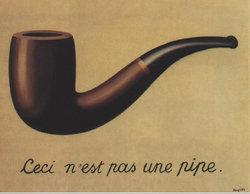
“The Treason of Images,” Rene Magritte, 1928-29 (“This is not a pipe.”)

(Guest post by Greg Forster)

Jay posted two “complete lists” of voucher research this week, and a number of people seem to have found them helpful. Jay and I have both spent a lot of time circulating these lists for years (they change over time, of course, as new research gets done). We keep on thinking we’ve circulated these lists so much that there can’t be much use in circulating them further, yet we keep on finding more people who say, “Wow, I’ve never seen anything like this before, this is really helpful!”

Well, if people found those two lists helpful, maybe they’d like to see some of the other lists that have been compiled. So here’s a meta-list: a list of complete lists of research.

Of course, this is not a complete list of the complete lists. If anyone wants to add more in the comment section, that will help make this page even more useful. And I’ll come back and update the list as needed, so that this page will remain a useful resource for people looking for all the research on vouchers.

Though no doubt others will think that my list of complete lists isn’t nearly complete enough. I hope they’ll compile their own lists of complete lists – the more the merrier. And when there are enough lists of complete lists out there, we’ll need to make a list of them, so that people can keep track of them all . . .

Of course, these lists are all “complete to my knowledge.” There may always be a study lurking out there that hasn’t been noticed – although on the voucher issue that’s a somewhat more remote possibility than it is with other issues.

Last year I made an effort to summarize all the research on all the issues relating to vouchers in this study. The sections covering random-assignment studies of voucher participants and studies of how vouchers affect public schools are now out of date, but the report will point you to a bunch of other studies on issues that don’t have enough of a body of research – or have too much of a body of research – to generate a “complete list.” For example, you’ll find a discussion of the evidence on questions like the fiscal impact of voucher programs, and whether vouchers provide all students with access to schooling.

On those last two subjects – fiscal impacts and whether the private school sector provides broad, inclusive access to schooling for all students – the Friedman Foundation offers handy guides (here and here) and references to the research issues (here and here).

And finally, here is a meta-list that will point you to a bunch of complete lists of research on issues related to vouchers. Personally, I’ve found this resource to be the most helpful of all.

NOTE: This post is edited as needed to keep it up to date.


Che Studies

August 17, 2008

The Arizona Republic’s Doug MacEachern has a column today on the Raza Studies program in Tucson, Arizona.  Raza Studies is part of their Ethnic Studies program in Tucson public high schools emphasizing Latino history and pride.  But the particular way in which Tucson’s program does this has raised some critical scrutiny.  MacEachern writes:

The ethnic-studies directors make a great many claims that teeter over into the wrong side of truth.  They claim not to “teach” communism, socialism or Marxism in their classes. But they lionize Marxist revolutionaries like “Che” Guevara; they all but worship Marxist education theorist Paolo Friere; and they have developed entire lesson plans celebrating modern Marxists like Subcomandante Marcos, the southern Mexican Zapatista who considers himself a “postmodern Che.” But they don’t “teach” the stuff.

The directors of the program “humbly and respectfully welcome the scrutiny and spotlight” their program has attracted, but then denounce “the tyrannical and fascist perspectives that are held and espoused by our adversaries.”

To defend their program, the directors have produced what one local paper called nine “cohort studies,” which the school district claims show that Raza Studies has a positive effect on the high school graduation rate and state achievement test scores of the students who elect to participate in the program.  MacEachern sent the “studies” to me for my comment.  They were actually just a few bar graphs making simple comparisons between the outcomes of students who did and did not choose to participate in Raza Studies at some (but not all) of Tuscon’s high schools.  There is no way to know from a few bar graphs whether Raza Studies helped, hurt, or had no effect on student achievement since the self-selected group of students who chose to take Raza Studies may have already been higher achieving at the beginning.  A few bar graphs does not an evaluation — or nine cohort studies —  make.


The ALA Double-Standard?

August 11, 2008

Last week I had a post observing that high school reading lists were much less likely to contain feminist critiques if those critiques were of non-Western societies, such as Ayaan Hirsi Ali’s Infidel

Later last week, the Wall Street Journal reported that Random House had cancelled the imminent publication of a book that it had under contract that was a fictionalized history of one of Mohammed’s wives.  Random House engaged in this self-censorship out of “fear of a possible terrorist threat from extremist Muslims.”

Once again we see a double standard in the treatment of non-Western subjects.  Where is the American Library Association (ALA) to denounce this self-censorship?  The ALA rightly advocates against efforts to restrict the kinds of books that are available and maintains a list of the most frequently “challenged” books.  They preface that list with a quotation from Judy Blume: “[I]t’s not just the books under fire now that worry me. It is the books that will never be written. The books that will never be read. And all due to the fear of censorship. As always, young readers will be the real losers.”

The ALA saw the need to issue a statement to denounce censorship in the wake of the 9/11 attacks.  When will they release a statement denouncing Random House’s decision not to publish a book that they had deemed worthy of a $100,000 contract because they were bullied by threats of violence?