Teasing Out Freedom from Responsibility

June 19, 2009

(Guest Post by Matthew Ladner)

I have a new study coming out from the Goldwater Institute called Freedom from Responsibility: A Survey of Civic Knowledge Among Arizona High School Students. You dear reader get a special sneak-peak!

This study employs a straightforward methodology: we designed a telephone survey instrument to test civic knowledge based upon the United States Citizenship and Immigration Services (USCIS) exam items. The USCIS administers a test to all immigrants applying for citizenship and makes the questions public.

USCIS officials choose 10 questions out of the item bank of 100 questions and give them as a citizenship exam. In order to pass, the applicant for citizenship must answer six out of the 10 questions correctly. The questions are not multiple choice, instead requiring applicants to supply an answer. When they ask “Who wrote the Declaration of Independence” the applicant has to answer “Thomas Jefferson” in order to get the question correct. 

Recently, the USCIS had 6,000 citizenship applicants pilot a newer version of this test. The agency reported a 92.4 percent passing rate for the test among citizenship applicants on the first try. I did not expect Arizona high school students to do that well of course, given that those seeking citizenship have had the opportunity to prepare for the test. On the other hand, Arizona high school students have some advantages of their own: multiple courses in American history and social studies, hopefully exposure to American history outside of school, etc.

I randomly selected 10 of the USCIS questions and included them in a survey, curious to see how many high school students would pass the test required of immigrants.

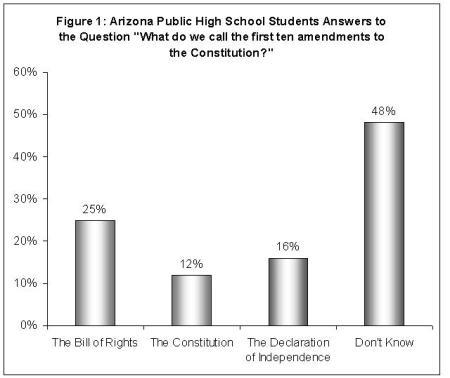
civics1Here’s your free sample: One of the questions was “What do we call the first ten amendments to the Constitution?” How many high school students attending public schools answered correctly?

“I don’t know” beat “the Bill of Rights” by almost a two to one margin, and 75% of students got the question wrong.

Notice also that 12% of Arizona students thought that the first ten amendments to the Constitution were called “The Constitution.”

Phoenix, we have a problem…


School Name Trend Reverses?

June 2, 2009

As Brian Kisida, Jonathan Butcher, and I documented, there has been a dramatic decline over the last several decades in the naming of schools after presidents, in particular, and people, in general.  Instead, schools are increasingly receiving names that sound more like herbal teas, day spas, or nature shows than our nation’s founders.  It’s gotten to the point where there are more schools in Florida named after manatees, the lovable sea cow, than George Washington.  In Arizona there are more schools named after roadrunners (beep-beep!) than Thomas Jefferson.  And there are plenty of schools that sound like Whispering Hills, Hawk’s Bluff, Deer’s Leap, etc….

But take heart, fans of school names with a civic purpose, the trend away from naming schools after presidents may be reversing.  According to Powerline, “St. Paul’s Webster Magnet Elementary School changed its name last month to the Barack and Michelle Obama Service Learning Elementary.”

As David Shribman writes on RealClear Politics, erasing the name Webster from the school marks a real loss:

“There is no trace at all of Webster in the Obama Service Learning Elementary school today, not even a picture of Webster, who may have been the subject of more formal portraits of any man of his time, if not of all American history. Indeed, in the period leading up to the vote on the name change, the principal of the school, Lori Simon, actually had to figure out for whom the school was named originally.

Talk about a missed teaching moment. Webster was the greatest orator in the age of great oratory; some of his words remain in the American memory, even in this ahistorical age. He was probably the most eminent Supreme Court lawyer in American history, having argued 249 cases before the court, including several of the landmark cases of the early 19th century that shaped constitutional law in the United States for generations. And he was one of the greatest secretaries of state ever (and the first to serve non-consecutive terms, one under William Henry Harrison and John Tyler, another under Millard Fillmore).”

Of course, school names should reflect a community’s values and as those values shift, so too should school names.  But couldn’t they have found a Gopher Valley school somewhere to rename?


Democratic Control of Schools

April 26, 2009

Yesterday the New York Times profiled a school district in which the democratically elected school board is dominated by a group that places its financial interests ahead of the educational interests of children in the district.  And that group easily wins school board elections because they are well-organized, have cohesive interests, and turn-out to vote in much higher numbers than parents of children in the schools.

No, the NYT hasn’t suddenly decided to publicize the money-grabbing, electoral bullying of teacher unions in large numbers of school districts all around the country.  Instead the NYT is concerned about the money-grabbing, electoral bullying of a community of Orthodox Jews in Rockland County, NY.

Well, the NYT didn’t exactly describe the Orthodox Jews as money-grabbing: “Many of the Orthodox here and elsewhere feel crushed by the weight of high school taxes and private school tuition.”

The problem, as the NYT piece suggests, is the sense that schools ought be controlled by the families that send their children to those schools: “But increasingly, others are chafing at the idea that people who don’t send their children to the public schools are making the decisions for those from very different cultures who do.”

I have to say that I am sympathetic to this concern.  There are problems with control over schools being located outside of the families whose children attend those schools.  But, unlike the NYT, I don’t restrict my concern to instances involving Orthodox Jews. 

It concerns me that President Obama, who has never sent his children to public schools, and Arne Duncan, who intentionally avoided placing his children in DC public schools, are making decisions to compel children to return to D.C. public schools. 

It concerns me that teacher unions dominate school board elections all over the country, placing their financial interests ahead of the educational interests of children.  In many urban school districts disproportionate numbers of teacher union members also don’t send their own children to the public schools.

The obvious solution is to increase control over schools by the families that attend them by giving those families vouchers.  Empowered with vouchers, schools will be responsive to the interests of current and prospective students rather than the interests of people whose children do not attend those schools is order to attract and retain the revenue those vouchers bring.

Of course, the general regulatory framework governing schools could still be under democratic control, including non-parents.  But let’s restrict the general public’s involvement in controlling schools  to the broad regulatory issues that affect the public’s interests as opposed to the operational details of individual schools.


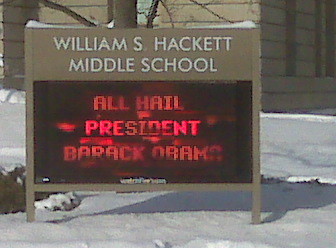
All Hail!

January 29, 2009

all-hail

(Guest post by Greg Forster)

I guess they heard how much money is going to be thrown at schools in the stimulus.

Hat tip to Jim Geraghty, who quips, “I would have preferred a zombie warning.”


Excavating the Little Rock

January 28, 2009

the-little-rock

HT Wall Street Journal

(Guest post by Greg Forster)

Continuing the Arkasas theme, the Wall Street Journal has a fascinating story today about the little rock for which Little Rock was named.

And continuing the theme of government spending, the story notes that $650,000 is about to be spent to excavate the remains of the original little rock for public display. $350,000 of the money was privately raised, the city is kicking in $100,000 from bonds, and the county is kicking in $200,000.

My more libertarian-leaning friends may scoff at that, but I’m for it. Even Adam Smith insisted that it’s important for government to spend money to “maintain the dignity of the state.” He meant all the lavish pomp that surrounds the king and Parliament, but this is the American equivalent of that – it’s affirming the role of our shared past (even in the form of a rock we dug up out of the mud of the Arkansas River) in the foundations of our nationhood.

UPDATE: Of course, it’s not my money, so it’s easy for me to support spending it.


School Voucher Mythbusters

December 17, 2008

mythbusters_collection3

(Guest post by Greg Forster)

A while back, I posted this to help people find comprehensive lists of the research on various subjects related to school vouchers. It’s a list of lists – in case you’re looking for a list of all the available research on whether vouchers improve education for the kids who use them, or whether they improve public schools, and so forth. Some of the lists are more scholarly and contain a lot of technical information, while some are presented in a more easily accessible format.

Well, here’s a big update on the list-of-lists front: the Friedman Foundation has released a set of “myth buster” guides to the research on the six most common school choice myths. For each myth they’ve provided a brief, handy reference sheet and a slightly longer, more detailed guide to the research. Even the detailed version of each myth buster is still less technical than the other lists on my “meta-list” page, compiled by Jay and other scholars, but it does go over the most important technical issues (how do we distinguish the impact of vouchers from the impact of other factors like family influence?) and provides the references you’ll need to dig further if you wish.


Myth: Vouchers hurt public schools and take the best and brightest.

Research: Short version, detailed version.


Myth: Private schools aren’t really better than public schools.

Research: Short version, detailed version.


Myth: Vouchers will lead to increased segregation.

Research: Short version, detailed version.


Myth: Private schools are hostile to tolerance and democratic values.

Research: Short version, detailed version.


Myth: Vouchers are costly and drain money from public schools.

Research: Short version, detailed version.


Myth: Private schools exclude difficult students.

Research: Short version, detailed version.


Take note that these are true comprehensive lists, including all high-quality studies on each of these questions. I’ve noticed that it’s always voucher supporters who are willing to discuss all the evidence, while voucher opponents typically cherry-pick the evidence, mischaracterize the evidence they’ve cherry-picked, and then falsely accuse voucher supporters of cherry-picking evidence.

So I would say Jay’s theory about why school vouchers keep winning against impossible odds is well supported by the empirical evidence – although in this case I haven’t compiled a comprehensive list.

What stronger breastplate than a heart untainted!
Thrice is he armed that hath his quarrel just,
And he but naked, though lock’d up in steel
Whose conscience with injustice is corrupted.

Henry VI, Part II, Act 3, Scene 2


PJM on Colleges – and PJM Column Authors – Who Lack the Guts to Punish Cheating

December 3, 2008

(Guest post by Greg Forster)

You may have heard about the Texas prof who was fired for publicly disclosing the names of students he caught cheating. Pajamas Media carries a somewhat confessional column today in which I discuss the role of the Internet (which, contrary to popular opinion, makes cheating harder rather than easier) and the rise of educational lawsuits (which colleges have responded to by abdicating their traditional disciplinary role), but also reflect, without satisfaction, upon my own experience dealing with a cheater:

The fear of lawsuits only compounds the difficulty of what is already a difficult decision. Even with the strongest possible intellectual conviction that it’s the right thing to do, actually imposing a punishment on a fellow human being takes a certain amount of moral courage. It takes some guts.

The isolation of the teacher as the lone defender of honesty in the classroom only makes it much more difficult to do the difficult but necessary thing when the time comes. And this, again, is something I can testify about from personal experience.

I regret to say that when I confronted my cheater, I chickened out.

What I ended up doing in the end, instead of what I had resolved to do and then didn’t have the courage to do, actually might be a good model for how to deal with a cheater. Of course, I’d rather have discovered it through intelligence rather than cowardice. As C.S. Lewis says, only fools learn by experience, but at least they do learn.


Dallas ISD Caught Faking SS Numbers – And Keeps Doing It

November 14, 2008

scot_free_mug

HT Scot Free

(Guest post by Greg Forster)

The Dallas Morning News is reporting that Dallas ISD was caught making up Social Security numbers for illegal immigrants in order to get them on the payroll quickly, especially as bilingual ed teachers.

Specifically, they were caught in 2004. And told by the state that it was illegal. And naughty. And they should stop.

And they’re still doing it right now.

But remember, public schools are transparent and accountable to the community, while private schools are unregulated and dangerous, and don’t have strong civic values!

Like most websites, the Dallas Morning News site automatically provides links to related stories. Here’s what comes up as related to this one:

“Unused Workbooks Are Tossed Out at Dallas School, Violating Policy”

“Dallas ISD Announces $64M Budget Shortfall”

Maybe they could make up that shortfall if they hired some of the geniuses here in Wisconsin who invested all the school funds in shady securities. None of them is going to face any kind of disciplinary or legal ramifications for their malfeasance with public funds, so there’ll be no smudges on those resumes that might make it hard for another school system to hire them and benefit from their services.


More Quantification of Greatness

November 12, 2008

(Guest post by Greg Forster)

I was so excited by my effort at quantifying greatness yesterday – well, okay, I was testing Alex Beam’s assertion that Great Books tend to be prohibitively long – anyway, I was so excited I couldn’t resist counting the pages in the Great Books I had at home to add to the data set I acquired in my office yesterday.

I had thought that the books at home would be shorter since I keep some of them there for regular reading, and the ones I read regularly tend to be shorter (for obvious reasons). I forgot, however, that some of them I keep there simply because I don’t read them very often at all, and those books tend to be longer (for obvious reasons). The books in my office represent the middle of the spectrum in terms of how often I read them.

Anyway, here’s what I came up with at home. Remember, our test case is Beam’s book, a history of the Great Books movement that claims Great Books are too long to be easily accessible and that clocks in at 245 pages:

Machiavelli, The Prince: 78 pages

Havel, The Power of the Powerless: 87 pages

Lewis, Mere Christianity: 113 pages

Mill, On Liberty: 113 pages

Bunyan, The Pilgrim’s Progress*: 154 pages

Orwell, 1984: 240 pages

Chesteron, The Everlasting Man: 254 pages

Aristotle, Rhetoric: 257 pages

Dante, Inferno: 260 pages

Swift, Gulliver’s Travels: 293 pages

Augustine, Confessions: 305 pages

Pascal, Reflections: 329 pages

Marsilius of Padua, Defender of the Peace: 432 pages

Kant, Critique of Pure Reason: 628 pages

Smith, The Wealth of Nations: 1,028 pages

*I include only the original Pilgrim’s Progress, not the “second part” that he wrote years later.

Again, Beam is clearly on the shorter side of the halfway mark, but the original finding is confirmed: the broad generalization that Great Books are prohibitively long has been falsified.

Moreover, the distribution of page lengths isn’t a bell curve. It’s clustered – and Beam’s book is right smack dab in the biggest cluster:

great-book-page-lengths

Coming next: a comprehensive set of metrics that quantifies all the qualities that make a book “great,” thus allowing greatness to be expressed mathematically – just like Dr. J. Evans Prichard, Ph.D. did for poetry in Dead Poets Society.


The Misunderstood Greatness of “Great” Books

November 11, 2008

great_books

(Guest post by Greg Forster)

Yesterday’s Wall Street Journal carried a review of Alex Beam’s new history of the great books movement, A Great Idea at the Time. The reviewer, Robert Landers, approvingly quotes Beam’s statement that he wanted his history of the GB movement to be “brief, engaging, and undidactic . . . as different from the ponderous and forbidding Great Books as it could be.”

The GB movement has touched all levels of post-primary education – secondary, collegiate, and “continuing” – and it has come in for a lot of criticism, some of it justified, particularly as regards the pomposity and the (really surprising) intellectual vacuity of Mortimer Adler. Much that was written about the Great Books by some of their most prominent self-appointed champions was indeed prolix, unengaging, and didactic.

With some shame, I confess that in my excitement about great ideas during my intellectual youth, I was suckered into paying $50 for Adler’s useless cinder block of a book, the “syntopicon.” Adler’s ambition was to create a reference that would point you to everything that the great thinkers had ever thought about each of a hundred “great ideas.” Alas, the real content of the Great Books failed to line up with Adler’s preconcieved notions about what constitues a great idea, and Adler failed to realize this; consequently the book is as useless as it is long. Fortunately, thanks to the miracle of the Internet, I was able to find another sucker willing to pay me $50 to take the embarrassing thing off my hands.

But anyone who thinks the Great Books themselves are prolix, unengaging, and didactic has obviously never read one – or if he has, all the more shame on him that he didn’t pay attention to what he read.

Indeed, the greatness of Great Books consists precisely in the authors’ gift for communicating large ideas in a clear, easily understood, engaging, and undidactic way so that everyone – everyone – can benefit from them. People think that the greatness of Great Books consists in the greatness of the ideas, but this is false. Any fool can write a book about great ideas, as Mortimer Adler proved so conclusively. What takes greatness is to write a book about a great idea that makes those ideas accissible and exciting to all readers.

The issue here really goes to the heart of how we understand education when it comes to ideas as opposed to skills (like reading and math). What is the best way for people who are not themselves great philosophers to learn about great ideas? For a long time the nation’s educators have set themselves up as a parasitical priesthood class, arguing that the ordinary person lacks the capacity to recieve these things directly from the sources; they need priests to interpret for them. The GB movement argued that the great philosophers themselves were much better teachers of ordinary people than the educational priests – that is precisely what makes them so great.

C.S. Lewis – who wrote extensively about the purpose, methods, and philosophy of education – put it very concisely in an introductory essay he wrote to be included in a new edition of an old book (Athanasius’s On the Incarnation), which was subsequently published separately under the title “On the Reading of Old Books”:

I have found as a tutor in English Literature that if the average student wants to find out something about Platonism, the very last thing he thinks of doing is to take a translation of Plato off the library shelf and read the Symposium. He would rather read some dreary modern book ten times as long, all about “isms” and influences and only once in twelve pages telling him what Plato actually said. The error is rather an amiable one, for it springs from humility. The student is half afraid to meet one of the great philosophers face to face. He feels himself inadequate and thinks he will not understand him.

But if he only knew, the great man, just because of his greatness, is much more intelligible than his modern commentator. The simplest student will be able to understand, if not all, yet a very great deal of what Plato said; but hardly anyone can understand some modern books on Platonism.

It has always therefore been one of my main endeavours as a teacher to persuade the young that firsthand knowledge is not only more worth acquiring than secondhand knowledge, but is usually much easier and more delightful to acquire.

The whole essay is well worth reading for anyone who wants to think about how great ideas are communicated to ordinary people who want to know about them.

And for those of a more quantitative bent, I can’t resist examining the one quantitative claim implied by Beam’s comment – that his book, unlike the Great Books, is “brief.”

The Journal lists Beam’s book at 245 pages. I went to my office shelf and took down all the books that could be considered Great, and checked the page numbers – excluding introductions, interpretive essays, appendixes and the like (some of which occupy hundreds of pages in the volumes I have). Where I had multiple editions I picked the edition that I used regularly. I suspect the selection may be biased toward longer works because the books I keep at work as opposed to what I keep at home for regular reading are probably longer. One could argue that the selection is biased in the other direction because some books are so long that I don’t even bother to own a hard copy, and access them electronically (e.g. Aquinas’s Summa Theologica and Calvin’s Institutes). But I would argue that those longer works are not really Great Books at all, but reference works. Aquinas and Calvin never meant for anyone to sit down and read their works cover to cover; the idea was to provide a useful reference so that if you need help with some specific problem, you know where to look it up. (They’re kind of like Adler’s syntopicon that way, except they’re actually useful.)

Here’s what I came up with:

Plato, Apology of Socrates: 21 pages

Locke, A Letter Concerning Toleration: 49 pages

Rousseau, Discourse on the Origin of Inequality: 97 pages

Rousseau, The Social Contract: 144 pages

Locke, The Reasonableness of Christianity: 195 pages

Locke, Two Treatises of Government: 240 pages

Treatment case: Alex Beam, A Great Idea at the Time: 245 pages

Aristotle, Ethics: 276 pages

Niebuhr, Moral Man and Immoral Society: 285 pages

Burke, Reflections on the Revolution in France: 292 pages

Plato, Republic: 300 pages

Aristotle, Politics: 425 pages

Rousseau, Emile or On Education: 447 pages

Hobbes, Leviathan: 482 pages

Hamilton, Madison & Jay, The Federalist Papers: 494 pages

Locke, Essay Concerning Human Understanding: 678 pages

Tocqueville, Democracy in America: 705 pages

Montesquieu, The Spirit of the Laws: 722 pages

Augustine, The City of God: 1,086 pages

So it does seem fair to say that Beam’s book is on the shorter end of the distribution – but the generalization that Great Books are not “brief” is patently false. And that’s before we even get into the qualitative dimension; the Apology is more or less the Original Great Book (the educational equivalent of an OG, if you will) and in length it barely rises to the level of a pamphlet.

Bottom line: before you complain about the GB movement, try picking up a Great Book and reading it.

UPDATE: See additional data and discussion in my follow-up post.