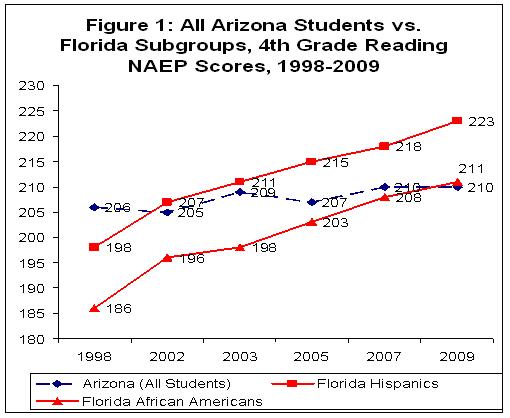
Florida Crushes the Ball on 2009 NAEP Reading

March 24, 2010

(Guest Post by Matthew Ladner)

The NAEP released reading scores for the 2009 Reading exams for both 4th and 8th grade. Florida once again crushed the ball in improving student performance. While the nation’s  4th grade reading scores remained flat, Florida’s scores surged ahead.

In 2007, Florida’s Hispanic students outscored 15 statewide averages for all students on 4th grade reading. Two years later, Florida Hispanics tied or outscored 30 statewide averages. Florida’s Hispanics scored 13 points higher than the statewide average for all students in Arizona in 2009, over a grade level worth of learning (10 points roughly equaling a grade level’s worth of learning).

Arizona had company. Florida’s Hispanic students also outscored or tied the statewide averages for all students in Alabama, Alaska, Arkansas, California, Georgia, Hawaii, Idaho, Illinois, Indiana, Iowa, Louisiana, Michigan, Minnesota, Mississippi, Nebraska, Nevada, New Mexico, North Carolina, Oklahoma, Oregon, Rhode Island, South Carolina, South Dakota, Tennessee, Texas, Utah, Washington, Wisconsin and Wyoming.

Florida’s African American students also beat the statewide average for all students in Arizona by a nose. Statistically speaking, this is a tie, but extraordinary nevertheless. In 1998, the average Arizona student scored two grade levels higher than the average Florida African American. Florida’s African American students outscored or tied the statewide scores for eight states: Alaska, Arizona, California, Hawaii, Louisiana, Mississippi, Nevada and New Mexico.

Florida’s success in improving academic achievement for disadvantaged students should inspire the rest of the nation to action.  Importantly, Florida’s reading scores also improved markedly for 8th graders, including very large gains among all the disadvantaged student subgroups, including Hispanics, African Americans, students with disabilities and ELL students. More on that later.

Congratulations to Florida students, teachers, school leaders and policymakers. Florida serves as a beacon to the rest of the nation, and should inspire us all to even greater reform efforts. I’ve said it before, and I’ll say it again now. When it comes to education reform…I’LL HAVE WHAT FLORIDA IS HAVING!

UPDATE: I left West Virginia off of the list of states which Florida’s Hispanic students outscore. West Virginia’s score for all students was 215, Florida’s Hispanics scored 223. So, make that 31 states for Florida Hispanic students!


2009 NAEP Reading Scores Released Tomorrow

March 23, 2010

(Guest Post by Matthew Ladner)

Tune in here tomorrow for news and analysis.


Jay Interviewed on National Standards

March 17, 2010

(Guest Post by Matthew Ladner)

Jay was interviewed on EducationNews today on National Standards. Strangely enough, the talk quickly turned to movies and awesomely bad pop culture! I can’t imagine how that happened…we take ourselves very seriously around here at JPGB, and indulge in such frivolity with only the most profound reluctance.

Btw Jay- where is this week’s LOST post?


National Standards, Welfare Reform and the Dream of the One True Way

March 16, 2010

(Guest Post by Matthew Ladner)

So why not national academic standards?  Many states, after all, have awful standards. Some with decent standards have nevertheless dropped their cut scores to the point of undermining those standards. Surely the states have proven that they cannot be trusted with this responsibility.  A set of high quality national standards could replace this balkanized mess and improve the sorry state of American education.

Actually, not so much.  First however we should consider the scale of the problem with state accountability tests.
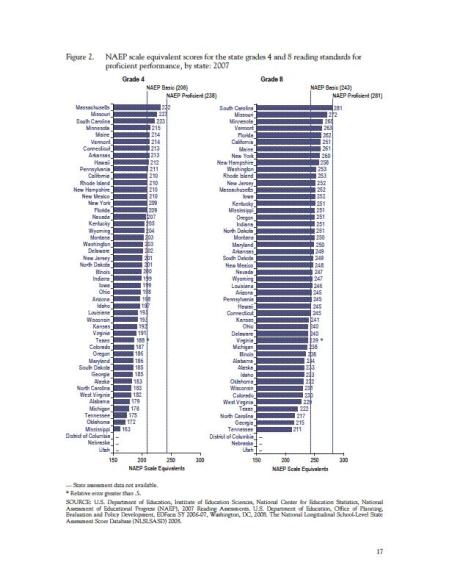
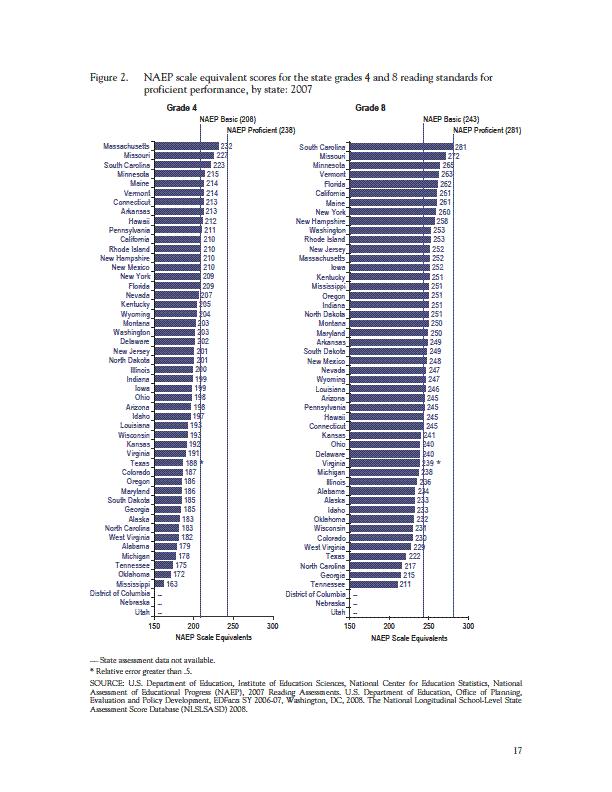
Above is a table from a NAEP study which used an equating procedure to determine where the “proficiency threshold” for each state’s exam would compare to the NAEP 4th and 8th grade reading exam. As you see, many states have proficiency cut scores which would merit a child a “below basic” score on NAEP. No state makes the equivalent of proficient on a 4th grade reading test equivalent to the 4th grade NAEP, and only one state does so on the 8th grade exam.

In Mississippi, one can “pass” the 4th grade reading test with a score which is 25% lower than “Basic” on NAEP, never mind proficient. This is a c*r*u*e*l j*o*k*e to play on children.

American welfare policy provides an insight into why it is not however a good idea to have the federal government take this over. Political scientists have established a strong relationship between shifts in public opinion and trends in federal spending. When the public decides they want more of something, like defense spending, they get it. Two exceptions had been foreign aid and welfare (AFDC). This spending endured despite widespread public hostility as a result of a Burkean elite consensus that this spending had to go on despite the fact that the people providing the funds, by large margins, didn’t want the money spent.

Much ink was spilled back in the late 20th century regarding whether the American public ought to have hated welfare as much as they did. Welfare queens- myth or reality…etc. etc. etc. Ultimately, this didn’t matter other than as a justifying myth to those who wanted elites to continue to ignore public opinion on the subject. America had a welfare program run out of Washington, and lacked a consensus about what to do about it, even after it was widely viewed as a failure.

Eventually an elite consensus formed around the notion that in the long run, welfare was cruel to the recipients, creating a powerful disincentive to work and develop job skills. This new consensus could be seen as early as the late 1980s, but for the most part, the national welfare Gosplan went on as usual, with minor tinkering at the edges.

Given the lack of a national consensus on what to do about AFDC, the Republican Congress and President Clinton eventually agreed to devolve welfare to the states. Different states tried different approaches, but by and large in did not prove terribly difficult for states to reach a consensus about how to deal with the issue. Nor did it prove difficult for the states to (mostly) do a better job than the federal government. The Personal Responsibility Act of 1996 is widely viewed as having been a rare social policy success.

In K-12, the long-term increase in the role of the federal government has coincided with a long-term collapse in the productivity of American K-12 spending. Federal involvement did not drive this collapse, but did contribute to it, and certainly did not prevent it. Secretary of Education Rod Paige lamented the billions spent on Title I with next to nothing to show for in terms of improved academic performance at the start of the George W. Bush administration. Sadly, not much has changed in terms of performance, but spending continued to rise.

Why not national testing? Given that there is no national consensus on what constitutes a high quality education, there is no prospect for an enduring national consensus on high quality standards. In fact, it seems fairly obvious to me from the figure above that there is a national consensus for LOW QUALITY ACADEMIC STANDARDS AND TESTS.

The danger in creating “common core standards” and then forcing states to adopt them through NCLB is that when they get dummied down, and they will, they drag the entire nation with them. Despite the fact that the status-quo is awful, it could be worse: we could have the entire country saddled with bad standards and tests.

Federalism has not been a cure for K-12 because all states have essentially the same problem: large politically powerful special interest groups in every state who prefer the status-quo. In recent years, however, we have not lacked for “labs of reform” out in the states. Jeb Bush’s reforms in Florida have significantly improved academic outcomes for disadvantaged children. The NAEP needle seems to be moving in the right direction in Washington DC. Massachusetts is proud of its standards led reforms and highest overall NAEP scores. Indiana has a reform-minded governor and schools chief determined to learn the lessons from these examples, and to take the next steps.

To be sure, these examples are few and far between, but they do exist. Just as Tommy Thompson led the way on welfare reform by seeking federal waivers from a federal “one true way” on AFDC, those few states that have departed from the “throw more money at schools and wring our hands” consensus fostered by the teachers union have shown progress as well.

It is however NOT likely to be the case that there will be any sort of sustainable national consensus on using high quality standards or tests in Washington DC. The same political forces which dummied down most of the state tests will eventually, if not from the start, dummy down a national effort. The genius of federalism is that a state consensus can be developed much easier in a state than in the nation as a whole. As more states enjoy success, we can expect other states to copy their practices through the normal process of policy diffusion. This process is already under way.

We could however suspend the laws of political dynamics. We could skillfully impose strong tests and standards on states against their wills, and resist their efforts indefinitely to undermine such tests until such time as the public grew to accept, love and defend them from special interest attack. Riiiight. It is also worth noting that while a DC elite consensus fended off AFDC from the public will for decades, they *ahem* got it WRONG…

Sorry kids, but the road to K-12 reform is a long, hard slog that primarily leads through 50 state capitols. We already have a national test for gauging the effectiveness of  state K-12: NAEP. The only reason that NAEP wasn’t dummied down is because no one’s school label or job performance hangs on the results. It is hard enough to maintain a consensus for decent standards in a handful of states. The chance that it will happen at the national level is vanishingly small and the danger of such an attempt very real.

Building Rock Star Teachers

March 7, 2010

(Guest Post by Matthew Ladner)

Elizabeth Green of Gotham Schools turns in a very important article on building rock star teachers in New York Times Magazine.

I am having the same reaction to this article that I had to roller bags: why did it take so long? After all, we only spend hundreds of millions if not billions of dollars a year on Colleges of Education, and, well, what exactly have they been doing for the last 50 years?

Next reaction, this article hints at what may be a growing trend for Teach for America to work with universities to revamp their Ed Schools. It’s not mentioned in the article, but this process is underway at Arizona State University and the article mentions others.  Given that traditional certification shows no relation to student learning gains and many states are getting a large percentage of their new teachers through alternative routes, the handwriting is on the wall for Colleges of Education: improve or else.


George Will on Perpetual Adolesence

March 4, 2010

(Guest Post by Matthew Ladner)

Related to this previous conversation, George Will weighs in on the modern “living in Mom’s basement” Peter Man American male.

Oi vey


Tom Carroll predicts RTTT Winners

March 2, 2010

(Guest Post by Matthew Ladner)

Tom Carroll went insane and read all 41 Race to the Top applications. His loss is your gain. He predicts Round 1 winners, a lump of possible Round 2 winners, and some clear losers here.


The AEA’s Nose is Growing

February 25, 2010

(Guest Post by Matthew Ladner)

Last week I had the opportunity to discuss Florida’s education reforms on the Arizona PBS public affairs program Horizon with Arizona Education Association President John Wright. We were discussing Florida’s Nation’s Report Scores and I was surprised to hear John make the following claim:

The steepest increases that Florida saw in both reading and math scores were between 1994 and 2002- before most of these reforms took place.

There are a few problems with this statement. First, the Florida legislature enacted most of the reforms in 1999, which falls between 1994 and 2002. The Nation’s Report Card gives tests both 4th grade reading and math and 8th grade reading and math. Florida students however did not take a Nation’s Report Card tests in 4th Grade Math, 8th Grade Math or 8th Grade Reading in 1994.

Florida’s 4th graders did take a test in reading in 1994. Between 1994 and 1998 (the last test given before the reforms) Florida’s reading scores increased by 2 points. After the reforms, Florida’s scores increased by 18 points. A ten-point gain approximately equals a grade level’s worth of learning.

I thought perhaps John had his dates mixed up, but there was something to his assertion on trends, but not so much. Going back as far as possible into the 1990s for each subject, the average gain during the pre-reform 1990s equaled 4 points. Post-reform, the average gain has been 20 points. I you calculate per year gains, the post reform period does almost three times better than the pre-reform years.

John also claimed that Arizona’s K-12 budget cuts were “pulling the rug from beneath the teacher’s feet.” The 2008 Superintendent’s Financial Report however reveals the total revenue per pupil to be $9707 per pupil while the 2009 Superintendent’s Financial Report reveals the latest figure at $9,424 per pupil: a whopping $283 per pupil decline.

The AEA has a budget several times larger than the GI, so it ought to be able to avoid outsourcing his research function to golf hecklers who don’t have their facts straight.


Izumi and Clemens: Emulate Canadian K-12, not health care

February 23, 2010

(Guest Post by Matthew Ladner)

Sounds like a good idea to me. After all, the Canadians were the first ones nerdy enough to wed Ayn Rand inspired lyrics to epic drum solos. Oh, plus they spend much less than we do per pupil, get much better results, don’t have a central national education bureaucracy, and have lots of parental choice. Izumi and Clemens could have added that the Canadians get these superior education results despite a national per capita income that would land them among the least wealthy American states, roughly equal to that of Alabama on a PPP basis.

Beauty, eh?


Fordham Foundation on K-12 Economic Segregation

February 18, 2010

(Guest Post by Matthew Ladner)

Fordham has a new study on what they call “private public schools” aka schools that serve hardly any low-income children. Personally I prefer the term Economic Segregation Academies.

Yes kids, calm down, they have data for specific metro areas available online.  So much for the common school myth.