(Guest Post by Matthew Ladner)
Watch this, like right now. Don’t wait, do it now.
(Guest Post by Matthew Ladner)
Watch this, like right now. Don’t wait, do it now.
 15 Comments |
  politics | Tagged: Rand Paul |
  Permalink
 Posted by matthewladner

(Guest Post by Matthew Ladner)
The 2011 legislative sessions set a new standard for K-12 reform, can 2012 hope to compare? The logical response would be something along the lines of “not bloody likely.” The electoral calendar, the fact that many of the reform states are likely to be distracted by policy implementation, and the fact that the molasses states and likely to stay in their torpor all point to a diminished of expectations for next year.
Taking a step back from questions of the pace of reform, it makes for good bloggy fun to speculate where large breakthroughs might occur.
Looking regionally, Big 10 country clearly led the way last year. Indiana engaged in incredible soup to nuts reform, with big reform undertakings in Ohio, Wisconsin and even (gasp) Illinois with tenure reform. The Minnesota legislature passed transformative reforms, but settled for some incremental steps this year. Big things are under discussion in Michigan. Iowa is discussing reform, while Pennsylvania seems to be searching for their sea legs, which I expect them to find.
By comparison to the Big Ten, the South seems stuck in neutral, outside of Florida, Louisiana and Oklahoma. Texas and North Carolina used to be reform leaders, but they faded after plucking the low-hanging fruit of reform (standardized testing). North Carolina shows some signs of rousing. Tennessee has entered into a serious discussion about reform. Reform is on like Donkey Kong in Oklahoma- special needs vouchers followed by school grading and 3rd grade retention and a tuition tax credit program.
The Northeast features some interesting dynamics in Maine, and fascinating struggle between Democrats for Education Reform and the AFT in New York. Lots of small rural schools in the northeast will eventually benefit from digital learning.
When you look out West, you see a clueless giant surrounded by more nimble neighbors. All three states bordering California-Arizona, Nevada and Oregon -have taken steps to enact reform. Yes- even Oregon! Governors Sandoval of Nevada and Martinez of New Mexico have brought a new energy to reform discussions in their states. Arizona, Utah and New Mexico have adopted A-F school grading, with Utah also passing a far-reaching digital learning bill.
Florida enacted comprehensive reform in 1999. Indiana did it in 2011. Which states will be next? I could tell you, but then I might have to kill you. Feel free to speculate in the comments section.
12 Comments | Digital Learning, personal tax credits/deductions, school accountability | Tagged: education reform | Permalink
Posted by matthewladner
 (Guest Post by Matthew Ladner)
Utah state Rep. John Dougall has announced plans to introduce legislation to fund student education through a system of education savings accounts rather than through a system of payments to districts.
From the Salt Lake Tribune:
The plan would be unique in the United States and, just like initiatives from the Utah Legislature on public employee pension reform and Medicaid reform, could become a model for other states, its supporters boast.
For example, one parent of a Highland High School student contacted me recently to complain that his straight-A student wanted to take an AP European history class that is not offered by Highland, but is offered by Skyline, which is in a different school district. The request to remain a full-time student in the Salt Lake District’s Highland High but take that one class in the Granite District’s Skyline High was denied, mostly for reasons of state funding of the school districts, although the Skyline administration said the class was full anyway.
Dougall says his legislation would solve the problem for that student.
He said the student would not be tied to one particular school. He or she could take, say, four classes at Highland, and pay Highland out of the student account for those four classes, then take two at Skyline, paying the money to Skyline from the account, then take a class at applied technology school and pay that school out of the account. The student could move between school districts while utilizing his or her schedule and could also use the money for charter schools or online instruction.
The plan would put into the student’s account nearly $6,000 a year under the assumption a typical high school class costs a school district about $700. The account would cover up to eight classes per year, with the ability of rolling the money over to the next year if the entire $6,000 was not spent.
Under Dougall’s vision, if the student didn’t spend all the money in the account during his or her four high school years, that student could use the left-over funds toward college.
Educators say that, conceptually, the plan is intriguing, but myriad details would need to be worked out.
Dougall’s proposal would profoundly empower parents, increase parental involvement, require careful consideration of opportunity costs, and spur education innovation. It builds upon previous steps taken to fund digital learning on a per course basis in Utah.
Let’s see how the discussion unfolds-these types of very far-reaching steps represent precisely the conversation and debate that we should be having.
4 Comments | Education Savings Accounts | Tagged: customized learning, Education Savings Accounts, education savings accounts Utah, John Dougall | Permalink
Posted by matthewladner
 (Guest Post by Matthew Ladner)
The Arizona School Boards Association had their annual law conference last week, and had William Mathis from the Think Tank Review Project present on “Are Things as Sunny as They Seem in Florida?”
I went first, and presented charts like this, showing the vast improvement in Florida’s 3rd grade reading scores:
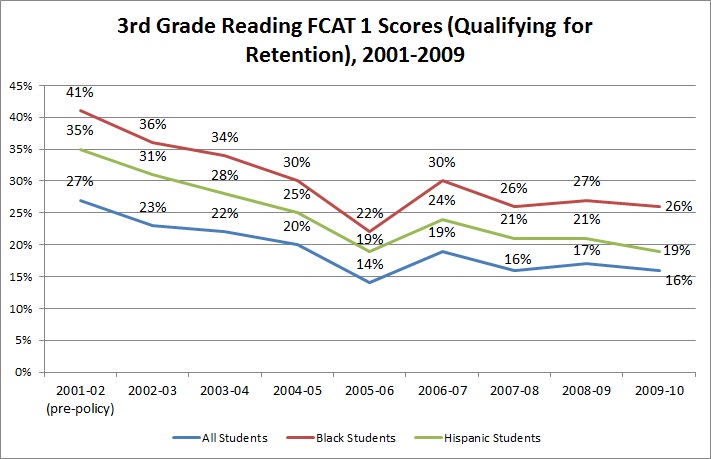
I have repeatedly asked the Think Tank Review Project people to explain why Florida’s 4th Grade NAEP scores continued to rise in 2007 and 2009 even as 3rd grade retention fell substantially. Or for that matter, why their 3rd grade scores have improved so strongly. Dr. Mathis made no attempt to address the issue.
I also presented charts like these:

Now, call me crazy, but when you are the state called “Arizona” in above chart, you might want to make a careful study of what the other state did to get their English Language Learners to read. This phenomenon of course is not limited to ELL. Another chart I used showed the combined learning gains on all four NAEP tests for children with disabilities for the entire period we have data from all 50 states (2003-2009).

Just in case you are squinting that’s Florida in red with a gain of 69 points and Arizona in green with a decline of two points.
Dr. Mathis proceeded with his presentation unperturbed. He complained about the 3rd grade retention policy without any effort to explain why Florida’s 3rd grade scores had so profoundly improved, and why Florida’s 4th grade NAEP scores continue to increase even as retention rates have significantly declined.
To give Dr. Mathis’ presentation the fairest possible reading, I would say that he was trying to make the following points: that correlation is not causation, and that to use the terminology of Campbell and Stanley, I had not “controlled for history.” That is to say, there could be other possible explanations for Florida’s gains other than the reforms.

Now it is of course the case that correlation can lead us very much astray, and it is the case that “history” has a nasty habit of bedevilling our theories of causality. As I have noted in the past, however, the Florida reforms unfolded in the real world, rather than in a random assignment study. A great many things unfolded all at once. This is called “life” and there is nothing to be done about this but to gather as much data as possible to draw the best informed decisions we can.
Both Chatteriji and Mathis ignored the Education Next piece in which Dan Lips and I examined other possible explanations for Florida’s gains. Huge spending increases (nope), decline in the percentage of low-income or minority students (nope-increases in both), preschool voucher program (nope- students too young to have aged into the NAEP sample) and class size amendment (nope- implemented very slowly, gains already well under way, formal evaluations negative) and retention law (scores continued to rise even as retention fell). This sort of information might be unhelpful if you are simply trying to get the idea in that something other than a set of hated reforms drove the gains.
Mathis however posited other types of “history” and noted other ways that the world had changed after 1998. On his list of other parts of uncontrolled “history” with regards to Florida’s gains were Harry Potter books (kids reading more fiction) and the more widespread availability of personal computers at home.
Sadly, the format of the panel did not provide time for rebuttal. We had two other people on with us, and took questions from the audience. Had there been such time, however, I would have noted that while Arizona may seem backwards to outsiders (Dr. Mathis lives in Colorado) that we do in fact have Harry Potter books and even personal computers in our humble little patch of cactus. In fact, I am rather confident that Harry Potter books and personal computers became increasingly pervasive in all 50 states.
You never know, Harry Potter books could have powerful educational properties that only manifest themselves on massive peninsulas with high rates of humidity and large concentrations of alligators. The children of Arizona, landlocked in an arid climate, and with not much more in the large lizard department than the occasional Gila monster, may have been left behind. I can’t prove that this isn’t the cause after all.
Nevertheless I’m going to stick with my theory that Governor Bush’s success in implementing a varied and comprehensive set of K-12 reforms in 1999 served as the driver for the large increases in academic attainment seen in Florida’s NAEP scores since 1998. Dr. Mathis and his compatriots can continue to play their stategic nihlism game if they wish, ignoring the problems with their arguments and the studies most on point for the subject at hand (like the regression discontinuity studies of Florida’s retention policy).
Until they put forward a plausible explanation for Florida’s gains, I cannot for the life of me find any reason to take them seriously.
8 Comments | research reports | Tagged: Florida K-12 education, NEPC, Think Tank Review Project, William Mathis | Permalink
Posted by matthewladner
 (Guest Post by Matthew Ladner)
We interrupt your regularly scheduled education policy wonk nerdapalooza to bring you this update on college football!
A few years ago the Big 10 conference succeeded in pulling in a lot of money with a Big 10 Network, and then announced that they would add a 12th member (they had operated with 11 members since Penn State joined the fold in the early 1990s).
This set off the first College Football Missile Crisis. The Big 10 has long yearned for Notre Dame, and also dreamed of adding the 24 million television sets in Texas. Rejected by Notre Dame and Texas, the Big 10 added Nebraska.
During this first College Football Missile Crisis, the Pac-10 made a huge play for Texas as well, offering to add the Colorado, Texas, Texas Tech, Texas A&M, Oklahoma and Oklahoma State to form the first 16 team super conference.
Larry Scott, the PAC-10 commissioner, crafted a shrewd offer for the University of Texas. The inclusion of Texas Tech would lessen political issues, and constituted a sweetener that the Big 10 would be unwilling to match (all Big 10 schools were AAU members until Nebraska got the boot last year- quelle horreur!)
Furthermore, by including a bunch of neighboring schools of Big 12 and the Arizona schools, Texas and Oklahoma would basically have their own mini-conference to minimize travel. One trip to the West Coast per year (So-Cal, No-Cal, Oregon or Washington) plus a trip to Arizona every year (bring your golf clubs) and then a bunch of places you are already familiar with. Scott’s plans brought in major media markets in Texas and Colorado for the PAC 16 network to exploit, and gave the network a supply of games in the Central Time Zone (the East Coast tends to be asleep by the time a Pac-10 night game hits the air).
Three problems arose with this plan. First, Baylor summoned up the blood in an attempt to get the Texas legislature to quash it. Second, the Aggies decided that they didn’t want to join the PAC-X, and began to make noises about joining the Southeastern Conference. Finally, Texas decided that the same reason that the PAC 10 wanted them was the same reason they didn’t want to go: they would contribute more than took out. Instead, Texas athletic director DeLoss Dodds extracted an agreement to allow individual schools to create their own networks and sell their 3rd tier rights from the Big 12. Sensibly, Scott decided not to match this offer.
Colorado, not taking any chances with Baylor’s political machinations, quickly accepted an offer from the PAC 10, the PAC 10 also brought on The University of Utah to create the PAC 12. Fox and ESPN actually increased the total amount of money going to the Big 12 despite having lost Colorado and Nebraska (fragmentation of the television market has networks paying a heavy premium for live sporting events these days) and the College Football Missile Crisis drew to a close well short of Armageddon.
…or so it seemed last year.
ESPN partnered with the University of Texas to create the Longhorn Network, pledging a minimum of $300 million dollars over a long period of time for what amounts to 3rd tier rights (out of conference road kill football game, basketball games the networks don’t want, and Olympic sports). Despite the fact that the average payout to Big 12 teams had just doubled, the wailing and gnashing of teeth began. It all reminds me of this:
Now, this is the part of the story where the Aggies dive off the deep end. During the First College Football Missile Crisis, elements of the Texas A&M Board of Regents, including an a former University of Alabama football coach (seriously) banged on pots for the Aggies to join the SEC. This ignited a fan rebellion which was only put down with difficulty, and which was reignited by envy of the Longhorn Network.
So shortly after signing long-term agreements with Fox and ESPN, the Aggie brain trust started pounding on the door of the SEC, which just so happens to be entirely tolerant of members selling their 3rd tier rights. In fact, six out of the top 10 schools in generating 3rd tier rights revenue are….wait for it…..SEC schools. I’m willing to bet that they are all chomping at the bit to benchmark their inventory against the Longhorn Network as soon as their current contracts expire. If they aren’t, they need to fire their athletic directors.
Last week or so A&M sent a letter to the Big 12 announcing an exit date contingent upon their acceptance in another conference. Yesterday, the SEC Presidents met in Atlanta and unanimously voted to accept A&M’s application to join the SEC, contingent upon each of the Big 12 schools signing a waiver of any right to sue the SEC conference.
Imagine a state legislature passing a voucher law contingent upon the teacher unions signing a legal document pledging not to file suit against it in court. Some of the universities have contingency plans, and some do not. Most notably, Baylor, Iowa State, Kansas and Kansas state face an uncertain future if the Big 12 expires. You may remember the current President of Baylor University:

Yes, that Ken Starr! The possibility of Starr going on a fishing expedition discovery process seems to have deterred the SEC. Say what you will about the Whitewater fiasco, but there can be little doubt regarding Starr’s ability to exact vindictive revenge if provoked. Sure, the SEC wants A&M, but only if A&M falls into their lap. It reminds me of how Fred Thompson “wanted” the Presidency: he’ll take it as long as he doesn’t have to work for it. Otherwise they are good with being a movie star with a stunning young wife the most successful athletic conference in the country.
Facing a conference abyss, rumor has it tonight that Baylor and some of the other smaller Big 12 schools aren’t going to sign a waiver unless the University of Oklahoma decides to stick with the Big 12 conference. Oklahoma, quite understandably, still seems interested in joining the PAC-1X conference. No one really seems to care whether the Aggies take their inferiority complex/delusions of grandeur over to the SEC for a weekly dose of gridiron humiliation: put some popcorn in the microwave and pull up a chair! The schools without good options just don’t want the conference to implode.
I will say this in defense of the Aggies: the Pac 1X would be an odd fit for them:
As a Texas fan, my main concern with the Aggies going to the SEC is the exposure the other teams will get as they turn A&M into their doormat, and begin some of those extra special SEC style recruiting tactics, like showing up with a dufflebag stuffed with $200,000 cash money. Given that the Big 10 has a research consortium that seems to bring in an extra $200m-$300m a year in research dollars, much of which is agriculture related, the obsession on the Texas A&M board of regents with joining the SEC tells us what we need to know about them: they are making decisions like t-shirt wearing football fans rather than as regents.
The Texas athletic department has been trying very hard to have their cake and eat it too. They want their network, and to be a part of a conference. They have also revealed some control freak tendencies. An astute Longhorns sports blogger noted that college football is supposed to be about fun and the Big 12-2 or 3 and counting is simply not much fun. Personally, I’ll be hoping that Texas joins a PAC 16- that would be the most fun. If I were a regent charged with enhancing the academic prestige of my university, I would favor the Big 10. Longhorn fan would much rather be sitting on the beach in So-Cal than freezing in the snow in Ann Arbor, but tooooo bad. The Big 10 research consortium would exceed the loss of the Longhorn Network many times over.
What they have actually been trying to do is to keep something called the Big 12 together: its local and allows them to operate their own network. Texas operates as an independent with a conference, getting the best of both worlds. It looks to be a bridge too far. Dodds wonders why the maples can’t be happy in his shade, but it sure looks like they can’t. Another possibility is an alliance of independents. Texas scheduled both Notre Dame and BYU (a new independent) and they scheduled each other last year. Hmmmmm.
If the Texas third tier rights are worth $300m, the bean counters in the Texas athletic department are surely curious about what their 1st and 2nd teach rights would fetch. Whatever decision they make, I hope they will make it enjoyable for the fans and wildly profitable for the university, in that order.
Let’s see what happens next…
6 Comments | college sports | Tagged: Baylor University, Big 12, College football realignment, DeLoss Dodds, Ken Starr, SEC expansion, Texas A&M SEC, University of Texas | Permalink
Posted by matthewladner

(Guest Post by Matthew Ladner)
New Schools has a new series of videos about education entrepreneurs:
and…
Leave a Comment » | charter schools | Tagged: education entrepreneurs, New Schools | Permalink
Posted by matthewladner
 (Guest Post by Matthew Ladner)
A careful analysis of test score gains by David Figlio of Northwestern University has found a modest but statistically significant gains for Florida tax credit students. The data in this study are messy, and Dr. Figlio admirably goes about sorting through the various issues in an even-handed fashion.
Figlio employs a regression discontinuity design to analyze the data, and his finding of a small but statistically significant academic gain fits quite comfortably with the larger random assignment literature, which find small year to year gains which accumulate over time.
One of the under-appreciated features of the random assignment literature: the studies usually fall apart after three or four years due to attrition in the control group. Our window into the academic benefits of choice is therefore limited. Figlio’s employment of a different analytical technique provides confirms previous findings, and may (?) open the door to longer term assessment. The challenges with the data described in this paper, however, suggest that it may not be easy.
Money quote from the study, with a definite echo of previous random assignment studies:
These differences, while not large in magnitude, are larger and more statistically significant than in the past year’s results, suggesting that successive cohorts of participating students may be gaining ground over time.
So, the Step Up for Students program has now been found to help improve public school results, help improve participant academic gains, generates high levels of parental satisfaction. Sounds like a rock solid justification for expansion to me.
7 Comments | research reports, tax-credit scholarships | Tagged: David Figlio, school choice research, Step Up for Students, Step Up for Students Tax Credit program, tuition tax credits | Permalink
Posted by matthewladner
 (Guest Post by Matthew Ladner)
The Innosight Institute has published The Rise of K-12 Blended Learning, which included this very helpful microscope slide on the primordial soup of new school models. The vast majority of these will probably fail, but some of them have already shown real promise.
Jay and Greg and I were all just at the SPN conference and discussed the need to see some of these school models “jump species” into the private school sector in a workshop sponsored by the Friedman Foundation.

Leave a Comment » | online learning | Tagged: Innosight Institute, the Rise of K-12 blended learning | Permalink
Posted by matthewladner

(Guest Post by Matthew Ladner)
C-SPAN brought in Diane Ravitch to interview/debate Steven Brill. Check it out.
Too much Ravitch nonsense to refute, but her talking points about the PISA tests are just too simple-minded for words. So if you look at only the very wealthiest schools in America, they outscore the national average in Finland and South Korea.
Riiiiiiiiiiiiight
No mention of how the very wealthiest schools in America compare to the very wealthiest schools in Finland and South Korea, or that our African-American kids score closer to the average score in Mexico than that in Finland.
Ravitch goes into her absurd poverty litany as if they don’t have poverty in other countries. Mexico will be delighted to learn that their poverty problem has disappeared! I wonder how much we spend per pupil here in America compared to other countries. Oh wait, they keep track of that sort of thing.
Brill says Ravitch’s attempts at spin remind him of Thank You for Smoking. That’s not fair. Nick Taylor was at least good for a laugh.

6 Comments | charter schools | Tagged: Class Warfare, Diane Ravitch, Steven Brill | Permalink
Posted by matthewladner

(Guest Post by Matthew Ladner)
Matt Ridley’s The Rational Optimist powerfully makes the case that market exchange is the driving force of human progress. Starting his argument in the far gone reaches of prehistory, Ridley builds a persuasive case that so long as people are out there developing new products and services, grinding on problems, that the human condition continues to improve. Government can certainly do things to speed things along (by perserving property rights) or slow things down in a variety of idiotic ways, but progress has proven to be robust in liberal market based societies. For instance, despite the collapse of a market bubble, horrible policy decisions by the Federal Reserve, Hoover starting a global trade war, too many policy mistakes by the Roosevelt administration to count and the onset of a World War, the average American was still better off in material terms in 1939 than they had been in 1929.
The reason why was simple- through all of the turmoil, there were still people out to make a buck grinding on problems. Technology continued to evolve and improve despite bipartisan political blunders of truly epic scale. Along the way, Ridley helpfully demolishes the conservative meta-narrative of decline from an imagined lost golden age. We live in an age of wonders compared to that of our ancestors. The problems we face are largely either overblown (global warming) or else getting substantially better at an unprecedented pace (global poverty).
Ridley’s journey through history and prehistory imparts a perspective on our struggles over education reform. Progress occurs in unpredictable ways and at its own pace. The key in the long run is to have a large group of people grinding away on a problem. Along the way, there are innumerable failures and false starts, but as long as people are out there trying to build a better product, sooner or later, they succeed and establish the next baseline for the next innovation.
In a primordial JPGB post in 2008, I wrote:
Our students need a market for K-12 schools. The market mechanism rewards success and either improves or eliminates failure. This has been sorely lacking in the past, and will be increasingly beneficial in the future. The biggest winners will be those suffering most under the status-quo.
New technologies and practices, self-paced instruction and data-based merit pay for instructors, may hold enormous promise. Before the current era of choice based reforms, they didn’t fit the 19th Century/unionized model of schooling, so they weren’t seriously attempted. Bypassing bureaucracy, a new generation has begun to offer their innovative schools directly to parents. Some have already succeeded brilliantly. Some states have been much keener than others to allow this process. Expect the laggards to fall in line eventually. We can hardly continue to cower in fear that someone somewhere might open a bad school when, in reality, we are surrounded by them now.
A market system will embrace and replicate reforms which work, and discard those that fail to produce. A top-down political system has failed to perform this task. Where bureaucrats and politicians have failed miserably, however, a market of parents pursuing the interests of their children will succeed in driving progress.
This process is underway but it is proceeding at a maddeningly gradual pace, from the perspective of an individual lifetime. Some problems take more than a lifetime to solve. Consider the struggle to end slavery and provide equal rights for African Americans. Lyndon Johnson’s signature on the Civil Rights Act came at the cost of hundreds of thousands of lives sacrificed over a period of centuries.
Milton Friedman, the originator of harnessing the power of markets to improve education, lived to see only the faint outline of his vision come into practice. Incremental victories such as lifting charter school caps and creating new voucher and tax credit programs are hard fought and to be celebrated, but in the long run the important thing is that we now have people working on new school models and the delivery mechanisms to allow educators to build them and parents to choose them for their children.
It took the charter school movement 20 years to come up with the idea of hybrid education. It’s no accident that it happened out among the charters. Both districts and pre-existing private schools suffer from far too much “that’s not how we do things around here” inertia. Jay covered this quite well-philanthropists should build new, don’t reform old.Hybrid learning may prove to be the next big thing, or something else might. As long as people are trying to build a better mousetrap and have the means to get it into the market, our future will be brighter than our present.
14 Comments | charter schools, Digital Learning | Tagged: Matt Ridley, The Rational Optimist | Permalink
Posted by matthewladner

 Jay P. Greene's Blog