Learning from our mistakes in expanding parental choice

January 21, 2015

(Guest Post by Matthew Ladner)

The Kisida, Wolf and Rhinesmith survey of attitudes of private school leaders in Florida, Indiana and Louisiana released today by AEI has a ton of important information. I commend the authors for releasing it, as the data gathered reveals the cost of attempting to regulate private schools participating in private choice programs.

In particular, the evidence seems to point in the direction of requiring schools to give a test tied to the state curriculum, requiring a great deal of paperwork, and only making low-income students from the lowest performing school eligible represents creates a powerful incentive for schools not to participate. In other words, Louisiana should examine the results of this study carefully and make some significant adjustments if they would like more of the 70 percent of private schools that chose not to participate to make seats available. Let’s just go ahead and put it on the table that the 30 percent of participating schools likely have financially desperate organizations over-represented, and the 70% of non-participants probably have higher percentages of stable organizations and high quality seats.

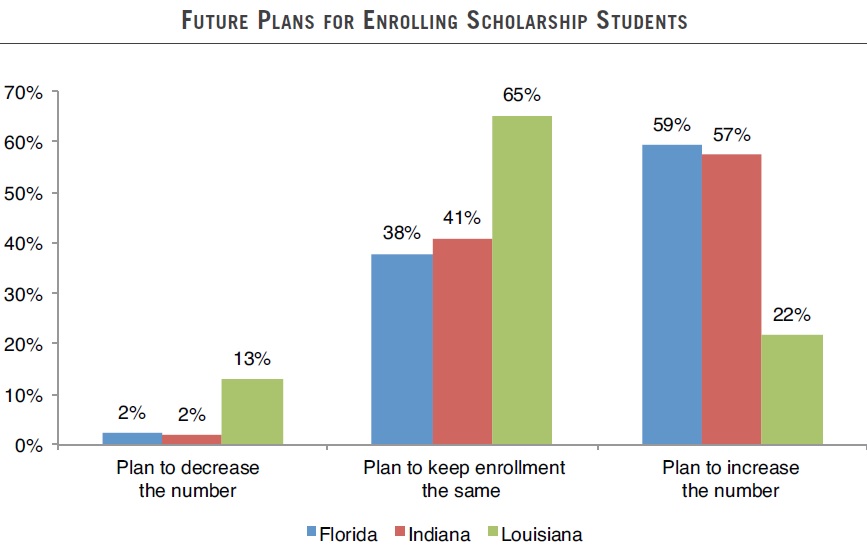
One of the charts deals with schools already participating in the choice- notice the enthusiasm for increasing participation in reasonably regulated Florida as opposed to the disinterest in Louisiana. A net 55% of Florida participating schools plan to increase participation, against 8% in Louisiana.
 

FL IN La 1


Florida does make provision for standardized testing, but allows schools to choose their own test. Florida law has an ongoing third-party academic evaluation of the trends in scores for the program. Indiana also mandates state testing, but had effectively done so years before the creation of the choice program. Every state has varying levels of regulation and laws that apply to private schools irrespective of whether or not they have a choice program, meaning that the impact of a heavy-handed will vary from state to state based on this and other factors.

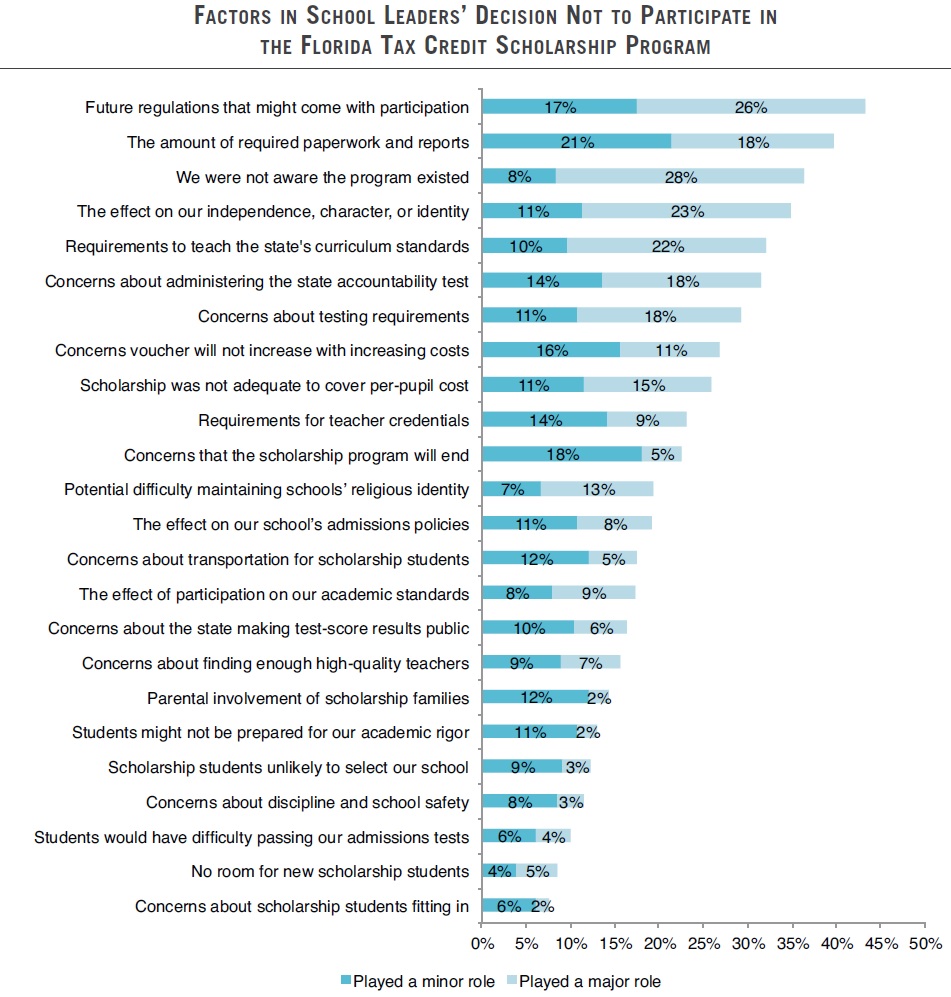
The authors also surveyed non-participating schools. Let’s look at the gory details from Florida and Louisiana. First Florida:
FL Private schools 1

Take a look at the fourth item down from the top. Ok- now Louisiana:
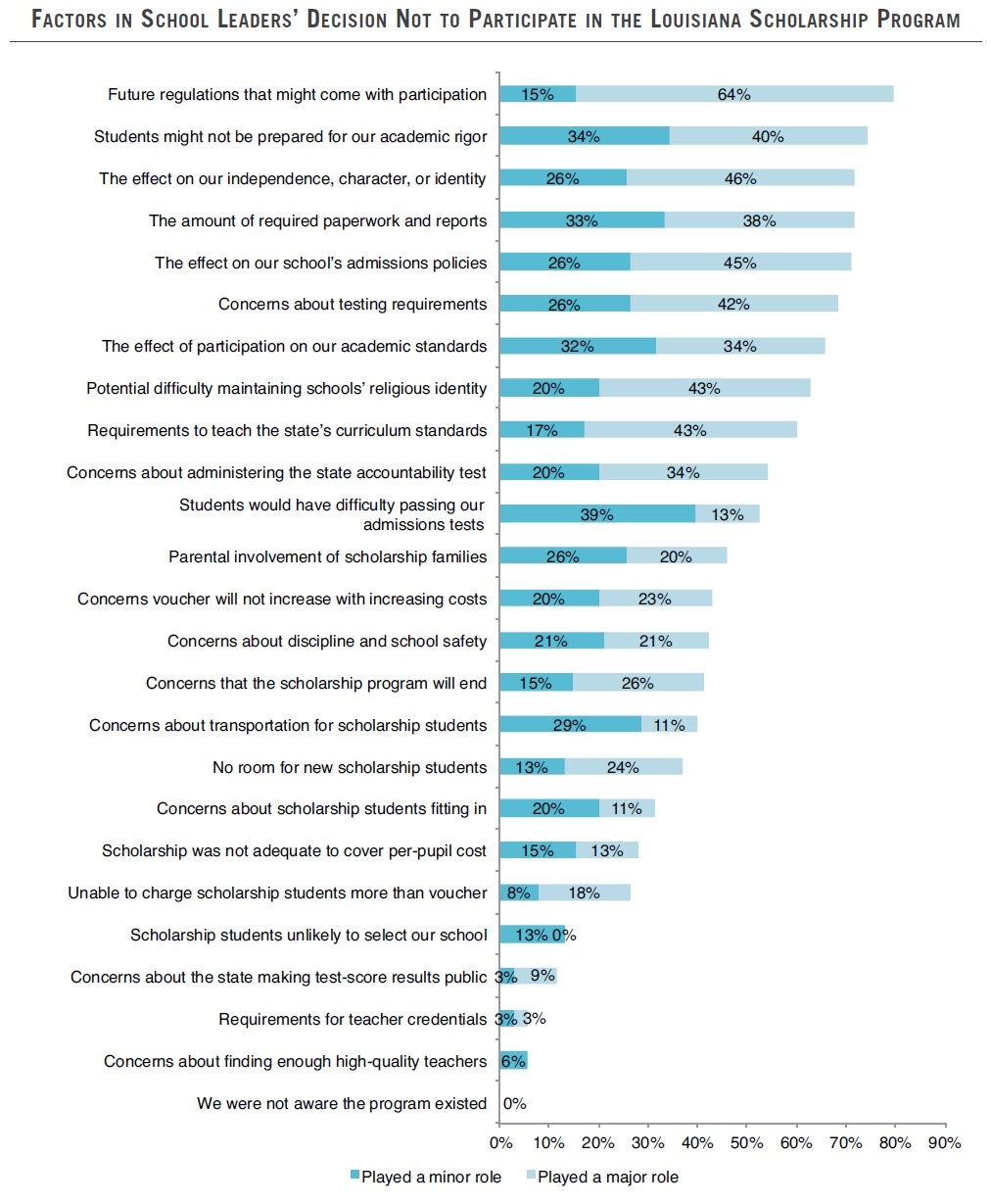
La private schools 1


So 23 percent of Florida non-participating schools said that concerns about independence, character and identify played a major role in their decision to keep out of the program, whereas 46% of Louisiana schools said it played a major role. Eleven percent of Florida schools said it played a minor role, whereas an additional 26% of Louisiana schools said the same. Overall 72% of Louisiana non-participants expressed concerns about their independence under the program.

Notice the first item as well- Florida private school leaders seem relatively confident that Florida lawmakers won’t go off the deep end in the future. Louisiana private school leaders seem to think that their lawmakers have already gone off the deep end. Most Florida private schools participate in the choice program, and seem anxious to provide more seats for low-income students. Many Louisiana private school leaders meanwhile have (understandably) adopted the stance of “thanks but no thanks.”

We create these programs in order to expand opportunities for students. Policymakers must carefully balance the public’s interest in academic transparency with the interest in private schools in maintaining their distinctive character and independence. Opinions of this subject are diverse, but far too many in my view have been consumed with a simplistic notion that giving the state’s (often subpar) test somehow equates with “accountability.” The word means being held responsible, but there is a whole bunch of state testing going on, but precious few being held responsible for much. Private schools already commonly use tests like the Stanford 10 and Iowa Test of Basic Skills and I’ve yet to see anyone make a convincing case that these tests won’t do just fine in providing transparency without saddling private schools with a state mandated curriculum.

Just as a quick thought experiment, suppose every state in the union ditched their state test (some of which are decent and some of which may as well be He-Man and the Masters of the Universe coloring books) and replaced it with one of the national norm tests. How would “accountability” be diminished? If you have a coherent answer please leave it in the comments. If you have an undying irrational attachment to the eternal beauty and truth of state tests uber alles, don’t bother unless you can explain why.

I know a few of the decision makers in Louisiana, and can attest that the road to this hell was paved with good intentions. No one woke up in the morning, stretched and yawned, and said “I want to create a choice program for disadvantaged kids that 70% of the private schools in the state won’t touch with a ten-foot pole.” That is not at all what happened, but the end result has been the same.

You live and learn- it is time to learn.


Netherlanders over alle, of bijna alle

January 21, 2015

(Guest Post by Matthew Ladner)

New Atlantic piece on education in the Netherlands, where teachers call the shots, anyone can open a school, parents have choice, and religion is treated with neutrality rather than viewed as a public menace. Any guesses on what teacher job satisfaction looks like in the Netherlands? How about student test scores? How much do they spend per pupil compared to us?

What is that Mr. DNA OECD? You can answer some of these question? Why yes, please do!


An interesting NYT column that would have been better titled “Stop Trying to Impose Good Ideas from the States on Everyone from Washington”

January 12, 2015

(Guest Post by Matthew Ladner)

Read it for yourself and see what you think. I’m struck by two things- first the assumption that it takes additional state funding to pull off reform at the state level. I think that the handwriting is on the wall that the types of reform states and the feds will need to focus on now and going forward. The focus will need to be on the “how do we get a bigger bang for the bucks we are already spending” rather than “now, NOW we are smart enough to know how to spend this new money much better than that frozen in place money, so give us more.”

The writer makes an interesting point about partisan control and policy diffusion, but failed to note that one party is in control of a much larger number of states than the other party- mostly due to one party blowing up the lab on health care btw. Given the type of reform needed (those that make better use of existing resources) and the philosophical leanings of the party in control of a large number of states, I’m expecting to see a healthy amount of policy diffusion.


Florida Court Dismisses ESA Suit, FEA opts not to appeal

January 8, 2015

(Guest Post by Matthew Ladner)

One of the Florida choice lawsuits is over, specifically this one. Chalk up another school choice victory for our man Clint Bolick.


National Freedom Museum High School Essay Contest

January 7, 2015

(Guest Post by Matthew Ladner)

Change does not roll in on the wheels of inevitability, but comes through continuous struggle. And so we must straighten our backs and work for our freedom.

-Martin Luther King Jr.

This year marks the 50th anniversary of the Selma march. The National Liberty Museum is sponsoring an essay contest for high school students in response. The topic:

“The movie Selma tells the story of how Martin Luther King, Jr. and others peacefully protested to advance voting rights. What do you think needs to be done today to protect individual freedom and self-determination? What are you doing or will you do to peacefully advance those rights?”

The contest is open to students aged 14-18 in public, private and home school programs. Details about the prizes and contest requirements can be found here.


Arizona Governor Doug Ducey calls for expansive parental choice in inaugural address

January 5, 2015

(Guest Post by Matthew Ladner)

“It will be a first principle of my agenda that schools and choices available to affluent parents must be open to all parents, whatever their means, wherever they live, period.”


Burke and Bedrick Discuss the Next Step for School Choice in National Affairs

January 2, 2015

(Guest Post by Matthew Ladner)

Jason Bedrick and Lindsey Burke take to the pages of National Affairs to discuss Education Savings Accounts in a very informative article. I share the author’s interest in a tax credit funded ESA model. In fact I hope that some of our preexisting tax credit programs will move to an account model. Enthusiasts such as myself however will eventually need to address the limits to scale soon to appear in the largest tax credit program- but quite frankly this is the type of problem you want to have, and it may not prove insurmountable.

Lindsey and Jason earn the first BOOOOOOOOOOOOOOOOOOOOOOOOOM of 2015.


Oklahoma Drama Full of Sound and Fury but ends in a whimper

December 28, 2014

(Guest Post by Matthew Ladner)

One bit of 2014 business to address: Oklahoma got their NCLB waiver back after their universities certified their previous standards and tests (which compared relatively well to NAEP) as college and career ready. Note that the story includes the nugget that 40% of Oklahoma college students require remedial education despite those highly thought of standards and tests. Paging Dr. Loveless, Dr. Hanushek! It’s possible that it would have been even worse without good standards and tests but to borrow a line from Sol Stern, good standards and tests are not enough.

On the process issue conditional waivers exceed the authority of the United States Secretary of Education and constitute a piece in a larger mosaic of an attempt to rule by administrative fiat. Unlike the Hotel California, however, you can both check out and leave the CC either without penalty (Oklahoma) after jumping through a hoop. Alternatively states can call Secretary Duncan’s bluff and simply drop their NCLB waiver because the consequences just aren’t that big of a deal (Washington- still no waiver riots on the streets of Seattle). It might at some point occur to someone in Washington or some future waiver-dropping state to file suit over conditional waivers.

It appears that the Secretary has been bluffing with a weak waiver hand, smiling to himself as states all-too-eagerly fold. States wishing to leave the CC however should give some thought as to what they would like to get out of their state testing system rather than adopting a “shoot-ready-aim” approach. My Little Pony connect-a-dot tests may not merit the approval of state university systems, and unlike Oklahoma not all states have decent systems to fall back on. The exit door however is clearly open.


My prayers have been answered…Alamo Drafthouse to Open in AZ in 2015!!!!!!!!!!!

December 24, 2014

(Guest Post by Matthew Ladner)

Oh yes!!!! Best thing to happen to the Valley since the invention of the air conditioner. Now if we could get a Chuy’s I could die happy. Plus tickets for the Interview are on sale at the Austin locations starting tomorrow.


Cuomo to UFT: Come thou no more for ransom, you will have none I swear but these my joints

December 19, 2014

(Guest Post by Matthew Ladner)

Andrew Cuomo prepares to go to war with NY edu-reactionaries.  Governor Cuomo is not taking this course because he has been tricked into it by right winger or corporate interests (they Governor banned fracking earlier this week) but rather because his own sense of justice demands it.