The Unbearable Lightness of Being Barack Obama

May 21, 2015

(Guest Post by Matthew Ladner)

So my favorite part of the entire Georgetown poverty discussion was when the American Enterprise Institute’s Arthur Brooks- alone against the President of the United States, a leading public intellectual/academic and a moderator sympathetic to their point of view- nevertheless took their best shot and then put them on the canvass.

President Obama laid out an indictment about a tax-dodge for hedge fund managers, how he had sought to close this loophole in order to tax hedge fund managers at the normal rate, and that he had planned to invest the additional revenue in high-return fashion to advantage poor children. Sounds pretty damning, unless you can think. Arthur Brooks can think:

MR. BROOKS:  Yes, sure.  Fine.  These are show issues.  Corporate jets are show issues.  Carried interest is a show issue.  The real issue?  Middle-class entitlements — 70 percent of the federal budget.  That’s where the real money is.  And the truth of the matter is until we can take that on — if we want to make progress, if the left and right want to make progress politically as they put together budgets, they’re going to have to make progress on that. 

Now, if we want to create — if we want to increase taxes on carried interest, I mean, that’s fine for me — not that I can speak for everybody, certainly not everybody on the Republican side. 

So if we want to make progress, I think let’s decide that we have a preference — I mean, let’s have a rumble over how much money we’re spending on public goods for poor people, for sure.  And Republicans should say, I want to spend money on programs for the poor, but I think these ones are counterproductive and I think these ones are ineffective, and Democrats should say, no they’re not, we’ve never done them right and they’ve always been underfunded.  I want to have that competition of ideas.  That’s really productive.

But we can’t even get to that when politicians on the left and the right are conspiring to not touch middle-class entitlements, because we’re looking at it in terms of the right saying all the money is gone on this, and the left saying all we need is a lot more money on top of these things — when most people who are looking at it realize that this is an unsustainable path.  It’s an unsustainable path for lots of things, not just programs for the poor.  We can’t adequately fund our military. 

I think you and I would have a tremendous amount of agreement about the misguided notion of the sequester, for lots of reasons, because we can’t spend money on purpose.  And that’s what we need to do.  And when we’re on an automatic path to spend tons of money in entitlements that are leading us to fiscal unsustainability, we can’t get to these progressive conversations where conservatives and liberals really disagree and can work together, potentially, to help poor people and defend our nation.

I’m forming the Arthur Brooks fan club over here by the way. Obama, Putnam and Dionne are no match for him.


The Cowboy Sons of George P. Mitchell vs. Saudi Sheik Update

May 20, 2015

(Guest Post by Matthew Ladner)

HT Mark Perry. From FuelFix:

HOUSTON — Pumping a barrel of oil out of the Eagle Ford Shale could get $10 to $15 cheaper by summer 2016 as service companies cut costs and operators tune up their wells, analysts say.

The oil slump hasn’t stopped producers in the South Texas play from getting better at targeting oil-rich rock in lateral sections of their horizontal wells, speeding up their pressure pumping systems and adopting better technologies for bringing wells into production.

Those efforts could help lift wells’ initial production rates by an average 33 percent in the Eagle Ford, even as service companies cut prices for drilling tools, proppant and rigs by an average 16 percent this year, Wood Mackenzie analysts said at a meeting with journalists last week.

Those two factors could bring the Eagle Ford’s breakeven oil price down from $56 to as low as $41 a barrel by June next year, putting millions more barrels within reach for producers. Similar trends are emerging in the Bakken Shale in North Dakota and the Permian Basin in West Texas.

“The death of the unconventional business has been greatly exaggerated,” Wood Mackenzie analyst Cody Rice said. “Operators can still make money in the best portions of the best plays in the lower 48.”

Do you really think you have a chance against us, Mr. Cowboy?


The Importance of Being < Earnest

May 15, 2015

(Guest Post by Matthew Ladner)

HT to Jon Gabriel for alerting us to an interview on Morning Joe in which Josh Earnest addressed President Obama’s hand-wringing over the non-existent crisis of kids going to private schools. See the video here. Joe basically asks Earnest why the President would be critical of people for sending their kids to private schools when, er, he is a private school graduate and sends his daughters to private schools.

EARNEST: His point is that even if you send your kids to private school, we all have an interest in making sure we have good high quality public schools available to everybody. It’s not that far from the White House that we do have some of the best public schools in the country over in Fairfax County, Virginia.

That is an example. That is also a more wealthy than average county in the country. That is an example of a society of a community that has invested in a common good for the benefit of their community and that’s the kind of thing that we need to see all across the country. Whether that is something as simple as investing in our national parks or local parks or public schools or making sure that every single American has access to quality health insurance.

Ok, so if I am following Earnest here, the President supports public funding for K-12 along with 99% of the rest of us. I have not noticed any movement out to exempt people who send their kids to private schools from paying state and local taxes for the rest of their lives. Did Guam pass a law like that while I wasn’t looking, with it poised to spread across the country like wildfire? Did I miss that somehow?

Schools can’t run without money. It however strikes me as incredible to suggest, as the President did, that the magic high-impact dollars would be on the way to save poor children if only we could overcome our “cynicism” inspired by decades of increased spending with precious little to show for it nefarious right-wingers.

People have honest and deeply felt disagreements about how much we should be spending on public education. If you want to champion the interest of poor children in the K-12 system, you must be willing to ruthlessly pursue efforts to extract the maximum possible amount of value from each dollar invested. Bill Clinton was fond of a certain Einstein quote about the definition of insanity, and it certainly applies here.

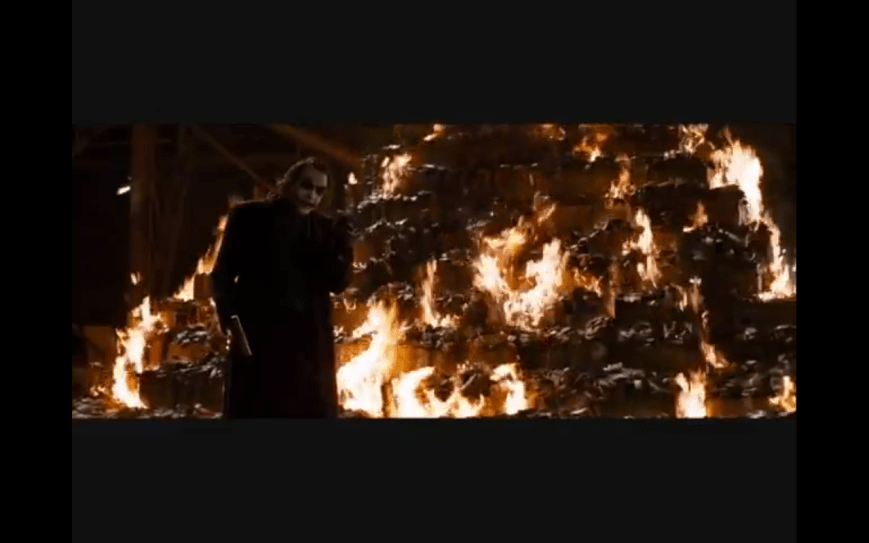
Don’t worry my skeptical friend, the dollars in your pocket are magic fireproof dollars- test it out!


President Obama is Entitled to His Own Opinion but Not His Own Facts on Poverty and Education

May 13, 2015

(Guest Post by Matthew Ladner)

It is a shame that the only thing that seemed to draw headlines from a recent panel discussion on poverty including President Obama was a silly throw away line about Fox News. The entire discussion, which included Robert Putnam and AEI’s Arthur Brooks deeply deserves your time. The event transcript can be found here.

Go read it. Like now. All four participants had very interesting things to say, far more than can be reflected upon in a blog post.

So this quote from President Obama got my attention:

Now, part of what’s happened is that — and this is where Arthur and I would probably have some disagreements.  We don’t dispute that the free market is the greatest producer of wealth in history — it has lifted billions of people out of poverty.  We believe in property rights, rule of law, so forth.  But there has always been trends in the market in which concentrations of wealth can lead to some being left behind.  And what’s happened in our economy is that those who are doing better and better — more skilled, more educated, luckier, having greater advantages
— are withdrawing from sort of the commons — kids start going to private schools; kids start working out at private clubs instead of the public parks.  An anti-government ideology then disinvests from those common goods and those things that draw us together.  And that, in part, contributes to the fact that there’s less opportunity for our kids, all of our kids.

Now, that’s not inevitable.  A free market is perfectly compatible with also us making investment in good public schools, public universities; investments in public parks; investments in a whole bunch — public infrastructure that grows our economy and spreads it around.  But that’s, in part, what’s been under attack for the last 30 years.  And so, in some ways, rather than soften the edges of the market, we’ve turbocharged it.  And we have not been willing, I think, to make some of those common investments so that everybody can play a part in getting opportunity.

This is an interesting quote on multiple levels- the first of which being that it has factual assertions that are demonstrably false. Let’s start with the strongly implied notion that we have disinvested from public schools. Our friends at the Heritage Foundation have a delightfully on point chart addressing what actually happened:


Now I could just as easily show a chart of inflation adjusted public school spending per pupil rising ever higher, but this chart qualifies as more interesting in my book as it shows what was done with the money. In short, we bombed districts with additional money and they used it to hire vast numbers of school employees especially non-teachers. These numbers come right out of the National Center for Education Statistics Digest of Education Statistics, and they demonstrate conclusively that President Obama was wildly off base when discussing the commitment of the American taxpayers to public education.

What about this idea of “kids start going to private schools” assertion? Let’s just for the sake of jovial discussion overlook the fact that President Obama himself attended private schools, and sends his daughters to one of the most exclusive private schools in the country. Again this notion is demonstrably false: private school attendance rates have been falling over time. Ironically the sort of class based segregation that all three participants acknowledge is indeed going on, but it is largely going on within the public school system itself through a system of highly economically segregated district schools- aka the leafy suburbs.

Later the President says “I think it is important for us at the outset to acknowledge if, in fact, we are going to find common ground, then we also have to acknowledge that there are certain investments we are willing to make as a society, as a whole, in public schools and public universities.” With regards to K-12 however the President has constructed an argument on a demonstrably false premise: while the ability of the country to go on making the same level of investment in public education in the future may be in doubt, there can be no doubt regarding the massive increase in resources devoted to public education in recent decades.

Bob Putnam joins with the President on the trends in public school spending:

For most of the 20th century, all Americans of all walks of life thought that part of getting a good education was getting soft skills — not just reading, writing, arithmetic, but cooperation and teamwork, and so on.  And part of that was that everybody in the country got free access to extracurricular activities — band and football, and music and so on.  But beginning about 20 years ago, the view developed — which is really, really deeply evil — that that’s just a frill. 

And so we disinvested, and we said if you want to take part in football here, or you want to take part in music, you’ve got to pay for it.  And of course, what that means is that poor people can’t pay for it.  It’s a big deal — $1,600 on average for two kids in a family.  Well, $1,600 to play football, or play in the band, or French club or whatever — it’s not a big deal if your income is $200,000; but if you income is $16,000, who in their right mind is going to be paying 10 percent of their family income?

I’ll interject here to say that the public school system has more than enough money to pay for football helmets for poor children but that in some cases they may have placed a much higher priority on other spending. Like for instance, bloating out their non-teaching employment (see Figure 1 above).  When staffing growth increased at a rate more than 10 times greater than enrollment growth, it is hard to think anything else. Are there kids priced out of extracurricular activities in American public schools? I’m confident there have been. Is it because the public has disinvested in public education? Hardly.

Later the President returns to his theme:

If, in fact, the most important thing is character and parents, then it’s okay if we don’t have band and music at school — that’s the argument that you will hear.  It’s okay.  Look, there are immigrant kids who are learning in schools that are much worse, and we’re spending huge amounts in the district and we still get poor outcomes, and so obviously money is not the issue.  And so what you hear is a logic that is used as an excuse to under-invest in those public goods.

And that’s why I think a lot of people are resistant to it and are skeptical of that conversation.  And I guess what I’m saying is that, guarding against cynicism, what we should say is we are going to argue hard for those public investments.  We’re going to argue hard for early childhood education because, by the way, if a young kid — three, four years old — is hearing a lot of words, the science tells us that they’re going to be more likely to succeed at school.  And if they’ve got trained and decently paid teachers in that preschool, then they’re actually going to get — by the time they’re in third grade, they’ll be reading at grade level. 

And those all very concrete policies.  But it requires some money.  We’re going to argue hard for that stuff.  And lo and behold, if we do those things, the values and the character that those kids are learning in a loving environment where they can succeed in school, and they’re being praised, and they can read at grade level, and they’re less likely to drop out, and it turns out that when they’re succeeding at school and they’ve got resources, they’re less likely to get pregnant as teens, and less likely to engage in drugs, and less likely to be involved in the criminal justice system — that is a reinforcement of the values and character that we want. 

And that’s where we, as a society, have the capacity to make a real difference.  But it will cost us some money.  It will cost us some money.  It’s not free.

Where to begin? Let’s start with the fact with the blinding ubiquity of incredibly well-funded schools that are also catastrophically dysfunctional. President Obama attempts to waive this problem away while confidently assuming that the next round of public school spending will produce fantastic gains for disadvantaged students. President Obama for instance seems either blissfully or willfully unaware that random assignment studies of Head Start released by his own administration demonstrate (yet again) academic fade out before 3rd grade. The bigger point in my mind is that given the massive investment in public education the greatest opportunity for improvement by far lies in increasing the ROI for the funds we already invest in the system. Any blithe would-be technocrat that effectively wants to write off the current investment as stuck in place while making snake oil salesman style promises regarding the profound efficacy of new spending deserves our profound skepticism.

The unacknowledged elephant in the room- the inescapable fact that the poor have been the primary victims of the failure of the public school system to produce a decent return on investment for the massive increase in public K-12 spending. Several generations of Americans have attended public schools increasingly generously funded and staffed over the decades, and always at globally enviable levels. I’m at a loss to imagine how anyone can blame inter-generational poverty on under investment in public education when such investment can only be described as both substantial and increasing for many decades

If someone would like to explain why I should view this viewpoint as something other than demonstrably shallow and willfully ignorant of the real issues in public education and their equally real consequences, feel free to leave a comment. The problem in my view is not that we have put too little in to public education, but rather that our 19th Century Prussian factory model gave us far too little back in return.

Public education, in short, badly needs an update.


The Kind of Control You Are Attempting…

May 11, 2015

(Guest Post by Matthew Ladner)

Is there much at stake in the fight over academic standards? Studies from no less than Hanushek and Loveless basically show that the standards movement has largely been pushing on a string. There is some evidence that suggests that states that were doing absolutely nothing on testing before NCLB saw above average math gains, but the fact is most states were testing before NCLB, the gains may have been a one time step increase, and evidence linking the quality of standards and/or tests to academic gains is in short supply.

NCLB’s attempt to test the nation’s kids to 100% proficiency (or as Andy Rotherham insists something more like close to it if you read the fine print, which few outside of Andy did) by a date certain ended in tears waivers.

My impression is that the standards movement basically hangs its hat on the Massachusetts experience. Massachusetts has the highest NAEP scores and thus is a good example to study. Massachusetts however introduced a multifaceted reform strategy in the early 1990s, but scholars seem remarkably incurious about which policy changes helped to drive how much improvement. Of course, like the Florida experience, we can never know what policy changes drove aggregate level improvements, but we have a great deal of micro-level evidence on the impact of individual policies. If any of this exists for Massachusetts, I’ve not seen it discussed. Even if we did have a good sense of this based upon a large body of studies, the question of external validity must be considered. Last time I checked MA was one of four states with an average family income for a family of four in the six figures and I’d wager draws an unusually high number of teachers from selective universities.

Why has the standards movement been pushing on a string? No it is not just that states set the test cut scores at incredibly low levels, although they did that:

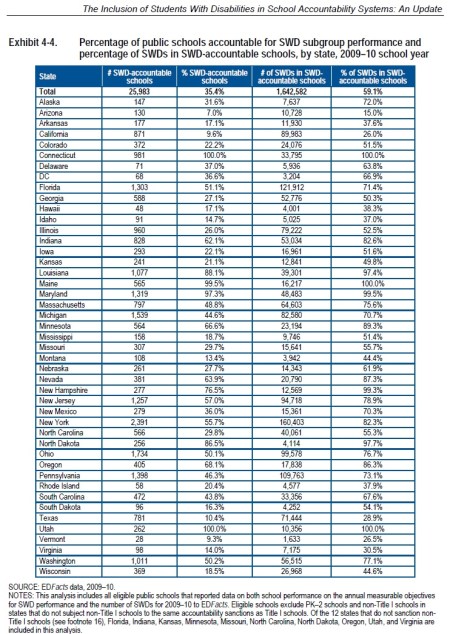
It’s not just that states held a repulsive 35% of schools responsible for the scores of their special education kids scores in 2009-10, although they did just that:

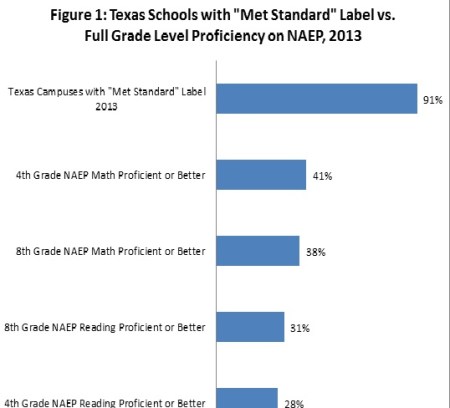
After all of those things and others most states took the further step of obscuring the results behind a set of fuzzy labels, like Texas:

Some states have pulled this off much better than others, and a high quality system of transparency should be every policymakers goal. The idea that the country has meaningful, widespread “accountability” through state testing is a demonstrably simplistic notion. The greatest trick the devil ever pulled was conflating minimal skills testing in math and reading with robust accountability. While this is obviously absurd given a moment or two of reflection, it is also deeply ingrained in people’s thinking that you can do things like show a legislative committee a chart like the one immediately above, only to have a member of that committee berate you a mere few minutes later that private schools “lack accountability.”

Er, lack accountability compared to what? I may have missed it but I’m putting the number of people in Texas having been held responsible for the state’s 28% reading proficiency rate over/under at zero unless you want to blame it on the kids themselves, most of whom have been labeled “proficient” on state tests that the Wall Street Stock Picking Chicken might pass on a good day (see Figure 1).

Well yes, but the Common Core will fix all of this. Except of course it won’t. If you’ve been paying attention, you may have noticed that states all over the place have been adopting their own tests and cut scores and discussing withdrawing all together.  Meet the new boss, same as the old boss?

The current chaos shares an origin with the wrecking of the NCLB-era state tests. It is the same reason your tax dollars get used to pay farmers not to grow food so that you can pay higher grocery bills.  Agribusiness is organized and politically active, while eaters are disorganized and politically inactive.  Organized/active beats disorganized/inactive 99 times out of a 100.

So in theory, the state sets out grade level academic standards, and then tests children against those standards. Schools thereby follow a coherent flow of content such that you do simple addition before complex addition etc. In theory teachers and schools that fail to teach the standards get held accountable. In theory, there is no unauthorized breeding on Jurassic Park, but…

As long as you are going to have academic standards and tests, you ought to fight not to have horribly deceptive systems. You should rather fight for informative tests and clear labels, but with the full knowledge that the dinosaurs on your island will constantly be breaking out of your fences in any number of ways. They may even convince some people in the leafy suburbs that the substitution of one set of standards and tests for another constitutes oppression, er, somehow…how? I’m not entirely sure but…ah…stick it to THE MAN!

Bureaucratic accountability, in short, will always face severe political limitations, and even under the best of circumstances is no substitute for parents possessing an exit option. Even under the best theoretical systems there will always be kids who would be better off somewhere else for both academic and non-academic reasons. Decentralized accountability works best with transparency to inform choices, but centralized accountability without choice will inevitably face the gravity well of regulatory capture.

The level of control you are attempting is not possible.


Begun the First Amendment War Has…

May 5, 2015

Yoda

(Guest Post by Matthew Ladner)

up two-zip, Texas is.


The Rich Get Richer under Tax Credits-Public School Tax Credits that is

May 4, 2015

(Guest Post by Matthew Ladner)

Arizona passed individual scholarship tax credit donations for children to attend private schools, and for public school extracurricular activities, in 1997. Since that time the newspapers have felled many trees and spilled much ink printing columns and letters bewailing the injustice of the private side credits- they are destroying public education, they are going to help rich people send their kids to private school, they are engaged in dark rites to bring Cthulu back into our plane to wreak his horrible revenge on all living things, etc.

This is all nonsense of course– but I think I see now the origin of the “mostly benefiting the rich” narrative- projection. Benefiting the rich far more than the poor is in fact precisely how the public school credit operates. The public school credit goes to support sports, arts, field trips and all of the various things that Jay has been researching lately. The Center for Student Achievement very helpfully crunched the numbers in Arizona Department of Revenue reports and found the following:

So if you are having to squint at your Ipad, the chart has data from both 2005 and 2013, and calculates tax credit revenue by quartile of public school- from the poorest schools (75% and up FRL) to the lowest (< 25% FRL). In 2005, the poorest schools raised a meager $14 per child in tax credit donations, while the wealthiest raised more than 4 times as much at $57 per child.

By 2013, the poorest schools raised a smidge more per student ($16) which is not enough to keep up with inflation. Meanwhile, out in the leafy suburbs, schools collected $96 per pupil. Thus the gap went from $4 for rich kids for every $1 for poor kids, to $6 for rich kids for every $1 for poor kids.

Hmmmm…so the public credit gives to the most to the kids who have the most, gives the least to the kids who have the least.

Well the private school credit might be even worse! Except, it isn’t. All of the corporate scholarship tax credit money is means-tested in Arizona, and some of the individual credit is as well. Even among the individual tax credit money that is not means tested de jure is means tested de facto by the Scholarship Tuition Organizations (STOs). Page 49 of this Arizona Department of Revenue report shows that 70.4% of the original individual tax credit funds (the non-means tested program) go to students with a family income (family of four) of less than $79,000 and 38% of that goes to families making less than $45,000. All of the rest of the money goes to either low/middle income or kids with disabilities.

In fiscal year 2013 STOs raised about $108m from all credits, and we can safely estimate that between 80% to 90% of scholarship funds went to low and middle-income children, which beats not only the stuffing out of the public school credit, but also out of AZ public school system’s spending overall.


Go down or I’ll put you in Expendables 4!


Indiana Allows Greg to Once Again Put Mathews on the Canvass

April 30, 2015

(Guest Post by Matthew Ladner)

Indiana session has ended with both an increase in the size of the tax credit and separately an increase in the voucher program amounts. For those scoring at home:

AR: New special needs voucher

AZ corporate tax credit improvement

AZ expansion of ESA to tribal areas

Indiana- increase in corporate scholarship credit cap

Indiana-increase in voucher amounts

MS New ESA for special needs students

NV New corporate tax credit

TN New ESA for special needs students

Down goes Frazier Mathews!

P.S.


Now I have a Machine Gun Ho Ho Ho

April 27, 2015

(Guest Post by Matthew Ladner)

Must read article in the Financial Times The US Shale Revolution (how it changed the world and why nothing will ever be the same again). The Saudi attempt to wring excess supply from the market is not working in America, in large part because it simply has provided a powerful incentive for efficiency.

Oil producers praying for relief from low prices might take heart from the lost jobs and idled rigs in the US. But the American strengths that made the boom — entrepreneurial culture, depth of knowledge in oil and gas, innovation and supportive capital markets — are now being deployed to keep it alive. Recent history suggests it would be rash to bet against them.

“Look how far we’ve come since 2006,” says Russell Rankin of Statoil. “It’s incredible. So for us to think that we’re through with the technology . . . to say that that’s over is kind of idiotic . . . We’ll always come up with a solution.”

Thus far the U.S. rig count is down but production continues to climb as good ole fashioned American ingenuity extracts more oil from fewer drilling sites.  American drillers have been reportedly putting in new supply but not tapping it yet, waiting for a rebound in prices. Oh and then there is this little problem for OPEC:


Florida ESA expansion receives unanimous House support

April 26, 2015

(Guest Post by Matthew Ladner)

A bill to expand Florida’s Personal Learning Scholarship Accounts eligibility to children with muscular dystrophy and a wider array of the autism spectrum, and to include 3 and 4-year-old children otherwise eligible for special education services passed the Florida House of Representatives without a dissenting vote last week. The bill’s Senate companion also passed without dissent, and a large increase in the appropriation for the program is in the works, although just how large remains to be agreed upon. That increased funding will be needed given that parents have already begun 10,000 applications for next year, which outnumbers current participants by more than 5 to 1.

So far ESA programs have doubled from 2 to 4, with Mississippi and Tennessee joining the family, and we are waiting on word from Montana. The lawmakers in the states with the pre-existing programs have expanded eligibility in both. Bills in a number of other states remain in play. Delightfully, our experiment in ordered K-12 liberty continues to gain momentum.

Let’s see what happens next.