Another Order of Florida Reforms, Please

July 3, 2008

(Guest Post by Matthew Ladner)

In 2007, a family of four needed to earn less than $20,650 to qualify for a free lunch. In Arizona, the median family income for a family of four is over $65,000.

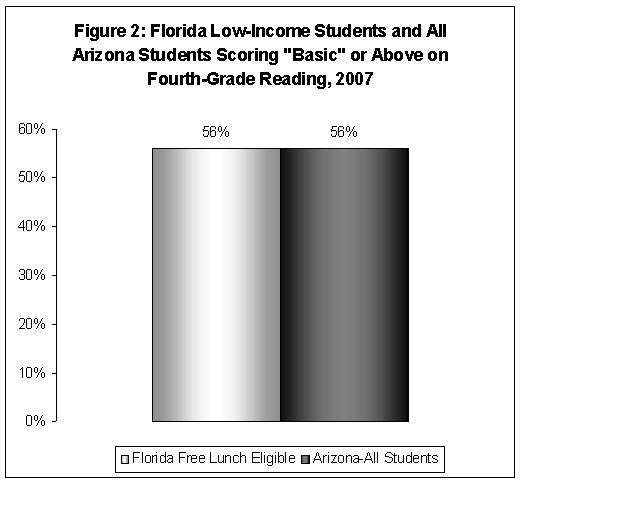
Here’s the surprising news: Low-income students in Florida—namely, those who qualify for free lunches—outperform all students in Arizona. That’s the insight to be gleaned by sifting through the treasure trove of data generated by the National Assessment of Educational Progress (NAEP), known as the Nation’s Report Card.

Figure 1 shows fourth grade reading scores for Florida students whose family income qualifies them for free lunch compared to all students in Arizona.

Figure 2 shows the percentage of Florida’s low-income children scoring basic or above on fourth grade reading and all Arizona students scoring at the same level.

You don’t need to take my word on these scores. You can go to the National Center for Education Statistics website and see them for yourself.

The point here is not to bash the underperformance of Arizona schools. Sadly, they have plenty of company. Rather, these data point to the enormity of the opportunity for improvement which we can and must achieve. Florida has found a way to significantly boost the performance of low-income students. Others should examine how and borrow everything we can.


Fortune Favors the Bold

July 2, 2008

(Guest Post by Matthew Ladner)

The Goldwater Institute released a new study today co-authored by yours truly titled Fortune Favors the Bold: Reforms for Results in K-12 Education.

The study makes the case for robust education reforms rather than incremental tinkering with a fundamentally broken system. Here in Arizona, for example, inflation adjusted spending per capita in the K-12 schools has tripled since 1960, and 44% of our 4th graders in public schools score “below basic” on the NAEP 2007 4th grade reading exam.

The kids are running around with their hair on fire, while we adults wonder whether to use a cup or a bucket of water to put out the flames. It’s time to use the fire hose.

The four reforms proposed:

  • A universal system of choice, either through vouchers or a universal tax credit. Despite having among the nation’s most robust system of private and public school choice, choice programs have simply absorbed about of the third of the increase in the public school population since the charter law passed in 1994. Arizona could enjoy substantial academic and financial benefits from passing a far bolder choice program than anything currently on the books, and we would still be building new public schools.
  • Reforming Public School Governance. Charter schools make up nine out of the top 10 high schools in the greater Phoenix area, and the 10th is a magnet school. Not a single district school cracks the top 10, with charters enormously overrepresented. The lesson is clear: good schools need a district bureaucracy like a fish needs a bicycle. Schools can and should govern themselves, freeing resources for instructional use.
  • Reform of Testing. Standardized testing has jumped the shark in Arizona and elsewhere. We put forward a proposal on how to preserve the transparency and diagnostic value of testing even when states respond to pressure to dummy down their tests.
  • Measure Teacher Effectiveness on a Value Added Basis. William Sanders’ path-breaking work on value added assessment shows that students learn 50% more over a three year period with highly effective teachers compared to those stuck in classes with the bottom 20%. Dr. Sanders finds that variation attributable to teacher performance is 10 to 20 times greater than that associated with class size. Further, high-quality teachers are too rare and clustered in the leafy suburbs. Value-added measurement serves as a pre-requisite for rational and just treatment of teachers as professionals and improving learning for children.
  • Jeb Bush put in what seemed like a radical set of reforms in Florida in 1999, and they have paid huge dividends. The time has come not only for other states to emulate Florida, but to reach further, and do more. Fortune favors the bold and American education reform dithers between being misguided, pointless, and too timid.


DFP to Michigan: Where is the Outrage?

June 26, 2008

(Guest Post by Matthew Ladner)

Detroit Free Press Columnist Rochelle Riley is as mad as hell, and she’s not going to take it anymore regarding the Detroit Public Schools. Money quote:

My question — where is the outrage? — wasn’t meant to ask literally why people aren’t outraged, dear readers. It was meant to spur outrage. It was meant to say: Get up! Stand up! These are children, for God’s sake! How can anyone who is an advocate for children in Michigan just watch? If these children were puppies, there would be lines of cars and trucks from across the state to take them to safety.


How Well Aligned Is Kazakhstan to NAEP Standards?

June 25, 2008

(Guest Post by Matthew Ladner)

Recently I appeared on the Horizon public affairs program together with Arizona Superintendent of Public Instruction Tom Horne, to discuss the No Child Left Behind law and our state AIMS test. Superintendent Horne and I have a public disagreement about the relative reliability of NAEP compared to that of the state’s own version of the Terra Nova exam. NAEP finds Arizona consistently below the national average in all subjects and grade levels, while the state’s Terra Nova finds us above the national average in all subjects tested and grade levels. One of these sets of finds is much more consistent with the socio-economic profile of the K-12 population than the other, given that Arizona ranked second to the bottom on Jay and Greg’s Teachability Index study.

During the discussion, Superintendent Horne said the main reason Arizona students perform poorly on the national NAEP test, also known as the Nation’s Report Card, is due to a non-alignment of standards. If, for example, Arizona does not teach the math concepts in fourth grade that appear on the fourth grade math NAEP, one could expect lower average grades.

The explanation seems quite plausible, and doubtlessly there are some states that have better aligned their standards to NAEP than others. But how big a deal is this, in terms of Arizona’s performance? A study by the American Institute of Research shows probably not much.

The study compared international science scores for eighth graders to eighth grade NAEP science scores through an equating proceedure. Singapore came in first, with 55 percent of students ranked as “proficient” or above. Massachusetts was the highest-performing U.S. state, with 41 percent proficient. Just 20 percent of Arizona eighth grades ranked proficient.

Alignment error ought to be much greater between nations than between American states. Perhaps, for example, Norway chooses not to teach science until 9th grade. One would be hard pressed to buy into the notion that countries such as Singapore, Korea, Estonia, Hungary, and Slovakia simply have national standards more closely aligned to the American NAEP test than Arizona.

When we get clobbered in science proficiency by countries like Estonia, we have problems that go much deeper than standards alignment. I could start looking up GDP per capita in Estonia, but that would be cruel. We need to be willing to think outside the box and figure out what other countries are doing right.

Nation (or State) 8th Grade Science Scores

Percent Scoring “Proficient” or Above

Nation (or State) 8th Grade Science Scores

Percent Scoring “Proficient” or Above

Singapore

55

Lithuania

25

Taipei

52

Slovenia

24

South Korea

45

Russia

24

Hong Kong

44

Scotland

24

Japan

42

Belgium

22

Estonia

41

Latvia

21

Massachusetts

41

Malaysia

20

England

38

Arizona

20

Hungary

38

Israel

18

Netherlands

31

Bulgaria

17

Australia

30

Italy

17

Sweden

28

Norway

15

New Zealand

26

Romania

14

Slovakia

26

Serbia

12


Pass the Popcorn: Truck Turner

June 20, 2008

(Guest Post by Matthew Ladner)

I haven’t seen any decent movies lately, so this edition of Pass the Popcorn will be opening up the treasure vault of oldies, along the lines of Flix You Should Netflix. Summer means action movies, and one of the most stunningly entertaining action films in my book: Truck Turner.

The great Isaac Hayes stars as Truck Turner, and obviously anything with Isaac Hayes in it is likely to be awesome. Before getting on the specifics of this, perhaps greatest film ever, a few notes on the genre seem appropriate.

It all started before WWII when a young army Colonel was ordered to move a military caravan from one coast to the other, to see how long it would take. Years later this same Colonel became President Eisenhower, who spearheaded the creation of the Interstate Highway system, inspired by his Oregon-trail like ordeal.

The Interstate Highway system has been great for moving goods and services rapidly across the country, but had the unintended consequence of enabling high levels of racial and economic segregation. With these new big highways in place, it became possible to work in big city X, but live in a leafy suburb. James Q. Wilson’s book Thinking about Crime discusses the profound policy consequences of this fundamental change in American life.

The so called Blaxploitation genre of film arose as white flight played itself out. The movie industry had an infrastructure of inner-city movie theaters across the country which now had a primarily African-American audience. Hollywood responded with action films aimed at African American audiences.

The content of these films are stunning in many ways by today’s standards. Filmed in the early to mid 1970s, the clothes in these films are often stunningly outrageous, like something you might see at a costume party. More broadly, these films are chock full of racial stereotypes.

The term politically incorrect doesn’t begin to describe the casual and frequent use of racial typecasts in these films. There has been much bemoaning of the rise of political correctness, but check out one of these flicks and then see what you think. Watching one of them quickly makes apparent just how much our national character has changed for the better.

I’m just old enough to remember the old Rat Pack era comedians as older men in the 1970s. It would be nothing to see a Don Rickles stand up at a Dean Martin Celebrity Roast and casually engage in ethnic humor (e.g. an Italian and a Polish guy walk into a bar…) By today’s standards, such humor is only successfully trafficked in by comedians such as Dave Chappelle, whose skits are so outrageous in part because they are so rare under current sensibilities.

In any case, Blaxploitation cinema is like a pre-political correctness time capsule, and as such very educational. Blaxploitation films usually focus on the exploits of a superhuman killing machine/babe magnet- a sort of urban James Bond fighting the villains of the inner-city instead of the Soviets or SPECTRE. Speaking of James Bond, Live and Let Die could almost be considered a Blaxploitation film, other than the pasty British super-agent.

Turner, Truck Turner…

Many of the films of this genre I have seen are impossible to enjoy. Shaft is fairly dull, Superfly was unwatchable. Truck Turner however can be considered a part of an almost subgenre of Comedy Blaxploitation, similar to the Comedy Westerns like the War Wagon or North to Alaska. These films are not comedies per se, but instead contain comedic elements, and do not take themselves seriously at all; much like the knowing twinkle Roger Moore had in his eye as his Bond enjoyed one absurd physical and romantic conquest after another.

Truck Turner has a memorable supporting cast including Star Trek’s Nichelle Nichols as a vengeful madam (check out the white satin bell bottoms!), Yaphet Kotto as the villainous Harvard Blue, and Scatman Crothers as Duke, Truck’s wise old mentor who provides guidance through the “Pimp Civil War.”

Words can scarcely describe how outrageous and funny Truck Turner is, so luckily, youtube has the original Truck Turner trailer. Watch the trailer. You’ll laugh, you’ll cry, Truck will forever be a part of you.

IMDB lists a 2008 Truck Turner project as in development. Color me skeptical- you can’t improve upon perfection.


What Does the Red Pill Do If I Don’t Take It?

June 19, 2008


(Guest Post by Matthew Ladner)

The hidden highlight from the Evaluation of the DC Opportunity Scholarship Program: Impacts After Two Years report is buried in the Appendix, pp. E-1 to E-2:

Applying IV analytic methods to the experimental data from the evaluation, we find a statistically significant relationship between enrollment in a private school in year 2 and the following outcomes for groups of students and parents (table E-1):

• Reading achievement for students who applied from non-SINI schools; that is, among students from non-SINI schools, those who were enrolled in private school in year 2 scored 10.73 scale score points higher (ES = .30)^2 than those who were not in private school in year 2.

• Reading achievement for students who applied with relatively higher academic performance; the difference between those who were and were not attending private schools in year 2 was 8.36 scale score points (ES = .24).

• Parents’ perceptions of danger at their child’s school, with those whose children were enrolled in private schools in year 2 reporting 1.53 fewer areas of concern (ES = -.45) than those with children in the public schools.

• Parental satisfaction with schooling, such that, for example, parents are 20 percentage points more likely to give their child’s school a grade of A or B if the child was in a private school in year 2.

• Satisfaction with school for students who applied to the OSP from a SINI school; for example, they were 23 percentage points more likely to give their current school a grade of A or B if it was a private school.

I’m trying to figure out why the impact of actually using the voucher program isn’t actually the focus of this study, and in fact is presented in an appendix. Instead all the “mixed” results are studying the impact of having been offered a scholarship whether the student actually used it or not.

I’m going to walk way out on a limb here and predict that the impact on test scores of being offered but not using a voucher will be indistinguishable from zero. If this were a medical study, we would have a group of patients in a control and experimental group offered a drug, some of them choose not to take it, but we ignore that fact and measure the impact of the drug based on the results of both those who took it and those who didn’t. Holding the pill bottle can’t be presumed to have the same impact as taking the pills.

We’ve all been told that exercise is good for our health. Should we judge the effectiveness of exercise on health outcomes by what happens to those who actually exercise, or by the results for everyone that has been told that it is good for you?

This shortcoming has been corrected in the Appendix, but that is getting very little attention. On page 24 the evaluation reads:

Children in the treatment group who never used the OSP scholarship offered to them, or who did not use the scholarship consistently, could have remained in or transferred to a public charter school or traditional DC public school, or enrolled in a non-OSP-participating private school.

So in the report’s main discussion, the kids actually attending private schools have to make gains big enough to make up for the fact that many “treatment” kids are actually back in DCPS. As it turns out, several subsets of students do make such gains, but that’s not the point. The point is we ought to be primarily concerned with whether actual utilization of the program improves education outcomes and with systemic effects of the program. We should indeed study who actually uses this program, and who chooses not to and the reasons why (very important information), but this sort of analysis seems to belong in the appendix rather than the other way around.

Receiving an offer of a school voucher doesn’t constitute much of an education intervention, and it seems painfully obvious that the discussion around this report is conflating the impact of voucher offers with that of voucher use. The impact of voucher use is clear and positive.


Jurassic Schools

June 16, 2008


(Guest Post by Matthew Ladner)

The ending sequence of Jurassic Park represents one of the great cinematic thrills of the 1990s. For those of you who couldn’t bear to watch, Drs. Grant and Sadler, et al, found themselves running for their lives inside the Jurassic Park compound, followed by a nasty group of foolishly resurrected velociraptors. The raptors had our heroes surrounded, when suddenly a Tyrannosaurus-Rex appeared to chomp one of the raptors, allowing our human protagonists to slip away. The T-Rex and surviving raptor battled it out. After disposing of the raptor, the triumphant T-Rex bellows out a roar so loud that the overhanging “When Dinosaurs Ruled the Earth” banner to dramatically flutters to the floor.

Now, for you incurable skeptics wondering how the T-Rex got into the building, how it approached with such stealth despite being large enough to shake the ground from far away earlier in the film, etc.- just stop it. It’s a popcorn movie, after all. You didn’t even realize you wanted to see T-Rex vs. velociraptors, but Steven Spielberg did and he delivered the goods.

It’s exciting to watch the future of education unfold, made all the more so by an appreciation of just how dysfunctional our schools are in the present. In 2006, a blue-ribbon panel delivered a scathing indictment of the American public education system. The panel, called the New Commission on the Skills of the American Workforce, included a bipartisan mix of the great and good, including two former secretaries of Education and an assortment of other grandees.

“If we continue on our current course, and the number of nations outpacing us in the education race continues to grow at its current rate,” the report states, “the American standard of living will steadily fall relative to those nations, rich and poor, that are doing a better job.”

The commission has come up with a variety of (IMO) ideas of varying quality, some of which sound misguided (expanding pre-school to 3 year olds) and others that sound outlandish but deserve a hearing, with still others falling into the “no-brainer” category (merit pay).

“We’ve squeezed everything we can out of a system that was designed a century ago,” Marc Tucker, vice chairman of the New Commission on the Skills of the American Workforce told the Christian Science Monitor. “We’ve not only put in lots more money and not gotten significantly better results, we’ve also tried every program we can think of and not gotten significantly better results at scale. This is the sign of a system that has reached its limits.”

“I think we’ve tried to do what we can to improve American schools within the current context,” Jack Jennings told the CSM. “Now we need to think much more daringly.”

The Jurassic angle on all of this has been the reaction of the T-Rex of the education policy world: the teacher unions. T-Rex was none too fond of the report.

Antonia Cortese, executive vice president of the American Federation of Teachers told the New York Times that the report contains “some seriously flawed ideas with faddish allure that won’t produce better academic results.” My favorite line, however, came from Reg Weaver, the president of the National Education Association, who urged “caution in calling for drastic changes.”

Hello failed status-quo, meet my pal- the future!

Given the huge percentage of American 4th graders who can’t read, and the large percentage of high-school students dropping out, by all means, let’s be very, very cautious in making any drastic changes.

Don’t get me wrong: caution in making policy changes is a good idea, an underlying principle of conservative thought. Caution in the face of extreme and blaring need for change, however, moves one from the realm of being a conservative to the realm of being a full blown reactionary. The latest NAEP test of reading shows 59 percent of African American and 56 percent of Hispanic 4th graders scoring “below basic” on reading in 2005. Unable to read their texts, huge numbers of these same students will begin to drop out of school within the next five years. We haven’t exactly achieved great return on investment for spending beyond the dreams of avarice for a school administrator from the 1960s.

Unfortunately, the report did not emphasize school choice. It should have. Chubb and Moe had a pretty decent explanation for the failure of public schools: their monopoly on students promotes and enables them to away with it.

Just for fun, go to http://www.greatschools.net and call up a list of every high school within 30 miles of the 85028 zip code. This zip code is in North Central Phoenix. You’ll get a list of 200 high schools from all over the greater Phoenix area. Next rank the schools according to their performance on the Terra Nova reading exams. Charter schools comprise nine of the top ten schools. Rounding out the top ten is a magnet school. In other words, all of the top ten high schools are schools of choice. Not a single traditional district school makes the list despite the existence of plenty of wealthy suburban schools.

This is progress my friends, and we need much, much more of it. Dinosaurs have ruled the education earth for too long.


The Shape of Things to Come

June 11, 2008

(Guest Post by Matthew Ladner)

Recently I described how the primordial soup of a market system could transform education. A new article suggests that this is already well under way.

The article How Do We Transform Our Schools? in Education Next by Clayton M. Christensen and Michael B. Horn has created a big buzz. Christensen and Horn have now released a coauthored a book on the same subject: how technology will fundamentally transform American K-12 education:

That schools have gotten little back from their investment in technology should come as no surprise. Virtually every organization does the same thing schools have done when implementing an innovation. An organization’s natural instinct is to cram the innovation into its existing operating model to sustain what it already does. This is the predictable course, the logical course—and the wrong course.

I had always thought of online learning as interesting, but ultimately only a niche activity. Christensen and Horn, however, maintain that filling niches is exactly how a disruptive technology like online learning advances:

The way to implement an innovation so that it will transform an organization is to implement it disruptively—not by using it to compete against the existing paradigm and serve existing customers, but to let it compete against “non-consumption,” where the alternative is nothing at all.

The essence of the argument is this: a disruptive technology starts off as something which is perceived to be of inferior quality to the dominant practice. It gains a foothold however by satisfying the needs of consumers who otherwise would have gone under served by the dominant technology.

Online learning seems to fit the bill. Distance learning for example is very popular in Alaska, where children might otherwise have to commute vast distances through dangerous weather to attend a traditional school. Homeschoolers have taken to online learning and the authors point out that only about a third of American high schools have Advanced Placement courses. Better, many school administrators are now reasoning, to adopt such courses online than not to offer them at all.

Christensen and Horn describe the progress of online learning to date as being broadly similar to past disruptive technologies. The key moment of transformation comes years after the disruptive technology has filled niches here and there. Through the normal course of incremental improvement, the disruptive technology becomes superior to the dominant technology, and displaces it. Projecting from the limited amount of data available, the authors project 50 percent of K-12 courses will be delivered online by 2019.

 Whoa, I know calculus!

Bill, forget the phone booth, I just downloaded our history report straight to my brain dude!!

Out with the old, and in with the new. In this case however, the “old” is the labor intensive method of teaching students which has gone more or less unchanged since before Socrates. Could we really be on the verge of transforming the basic method of content delivery?

When I first read this article, I was skeptical. It seemed to me that the authors had underestimated the political obstacles standing in the way of such a transformation even if online learning does become recognized as a superior form of learning, which to date, it has not.

And yet…

It isn’t that hard to imagine the day coming when online programs would improve to the point where they were of demonstrably better quality than the tried and only sometimes true methods. Innovators are working on computer based learning programs that will adapt to the individual learning styles of children. Such programs will present information in a variety of ways, figure out which way works best for the individual learner and adapt the presentation accordingly.

Enormous promise also resides in the area of personalized, self-paced learning. Both fast and slower learners often find themselves frustrated by the pace of a course which settles on a class average which doesn’t suit them.

Can you imagine some clever team designing an online course around, say, the work of Milton Friedman and coming up with something better than the average high-school or college economics class? It doesn’t sound implausible to me-I can’t remember the name of the graduate student who taught my Econ 101 course, but he wasn’t Milton Friedman. He didn’t adapt his presentation to my learning style either. Come to think of it, I don’t think he spoke English fluently.

Exactly how such a transformation would play out, none can say. This was one of the lessons of Chris Andersen’s excellent book The Long Tail.  Andersen convincingly made the case that the internet is fundamentally transforming society. The transformation is simply different and more subtle than expected during the height of the dot.com bubble. The change isn’t exactly subtle for newspapers and record labels, which are being pushed aside, or network television, which draws starkly smaller audiences for top programs today than 30 years ago despite a much larger population.

I’m inclined to think that education will remain primarily a social enterprise, but mixed models of classroom and online instruction are already underway. The nonsensical notion of teachers being a “guide on the side” instead of a “sage on the stage” might actually make sense when the content comes primarily through technology.

Can technology deliver learning better and cheaper than today’s schools? NAEP shows that thirty four percent of American 4th graders can’t read. Somewhere close to that percentage of students drop out of high school, and many others graduate in need of remediation. The Colossus has feet of clay.

Politics will doubtlessly play an inhibiting role, but bet on the better mouse trap in the long run.


A Final Salute to a Great Teacher

June 9, 2008

(Guest post by Matthew Ladner)

Greg Patterson, a former state lawmaker and Arizona’s foremost political blogger, delivers a moving final tribute to the teacher who changed his life.

If you were fortunate enough to have a teacher like this, now would be a good time to let them know how much you appreciated their efforts on your behalf.


Standardized Testing Jumps the Shark in AZ

June 4, 2008

(Guest Post by Matthew Ladner)

In an attempt to keep viewers tuning-in after many years on the air, the sitcom Happy Days produced an episode where Fonzie jumped a Great White shark on water-skis. This episode brought the phrase “Jumping the Shark” into the pop-culture lexicon. Jumping the Shark denotes a tipping point in which something becomes absurd and suffers a noticeable decline. Arizona once was a leader in the standards and accountability movement, but those days are long gone. Days ago, Arizona lawmakers dispensed with AIMS as a graduation requirement, making the sad decline of AIMS into farce complete.

The credibility of Arizona’s K-12 testing has suffered the death of a thousand cuts. In 2004, Arizona schools faced a problem in that No Child Left Behind requires schools to be judged by ethnic subgroups, and Hispanic scores were all but certain to force many schools to be ranked failing under federal guidelines.

Instead, the state simply made AIMS much, much easier to pass. Presto-chango, Arizona Hispanic students (and others) were transformed from having been projected to fail the federal standards in almost all subjects at all grade levels in 2005 to passing almost all of them. A study by Peterson and Hess noted that Arizona’s dummy-down was the largest in the country.

Where were you when we needed you Jaws?

Hop on over, the water’s fine!

Around that same time, the Arizona Department of Education recommended replacing the Stanford 9 exam with an Arizona version of the Terra Nova to imbed into AIMS. Happily, the new “Terra Zona” exam found that Arizona students are above the national average in every grade and in every subject tested.

One small problem: the results aren’t the least bit credible. The Arizona Department of Education recently mailed out the latest state report card, and the evidence of the farcical nature of this home-grown exam can be found in ADE’s own booklet.

On the one hand, the ADE touts the above average Terra Nova scores, but in the same booklet, it presents an analysis from the RAND Corporation showing that if you control for student demographics, Arizona’s scores on the Nation’s Report Card are average instead of rock bottom. The Nation’s Report Card- or NAEP- represents the nation’s most highly respected source of K-12 testing data.

The RAND report is entirely credible. Arizona has a far more difficult to educate student body than the national average- with a much higher percentage of low-income students, English language learners and minority students than the national average.

Controlling for demographic factors is a huge step to take. For instance, Arizona has a percentage of children eligible for a free or reduced price lunch more than twice as large as the national average. Our ratio of children who are English Language Learners is almost four times the national average.

If you pretend that Arizona has an ELL population one fourth its actual size, and about half the number of low-income children that we actually have, and some similar heroic assumptions, Arizona’s adjusted scores near the Minnesota middle instead of close to the bottom.

Arizona’s Terra Nova, however, does not control for demographics at all but somehow finds our students above the national average in every single subject without any adjustment whatsoever. If you are willing to buy that, I’ve got a bridge I’d like to sell you in Brooklyn.

Finally, AIMS has suffered what ought to be its final indignity. The legislature passed “AIMS Augmentation” in order to allow 6,000 high school seniors to graduate despite an inability to pass what at most amounts to a test of basic skills.

If you can’t pass a 10th grade level test, the original thinking went, you don’t deserve to graduate. A diploma should mean something. After delaying the graduation requirement several times, the augmentation bill has effectively killed it.

State policymakers should rethink our entire system of testing. Research shows that children who fail to learn to read in the early grades later drop out in huge numbers. Using AIMS as a graduation requirement addresses the problem at the back end. Arizona should look to Florida, which uses testing to require students to repeat grades if they don’t learn to read in the early years. Florida’s 4th grade reading scores used to scrape the bottom with Arizona, but now they greatly exceed us. Florida’s system set kids up to succeed, rather than to fail.

Parents, teachers, administrators and policymakers all require a credible and transparent system of student data. The AIMS/Terra Nova exam is not delivering. ABC eventually cancelled Happy Days and replaced it with another program. Arizona policymakers should do the same with AIMS.