Rock Star Pay for Rock Star Teachers Part Deux

April 29, 2009

(Guest Post by Matthew Ladner)

Last year I was reading the comments section of a newstory online, and came across a comment from a public elementary school teacher. She was complaining that she had 34 students in her classroom.

So let’s do the math. The statewide average spending per pupil in the state: $11,000. Total revenue generated by this classroom = $374,000. Let’s assume the teacher gets a total compensation package of $60,000 including benefits. The question becomes- what did they do with the other $314,000?

Ah, that was what the teacher was really angry about. Her elementary school had 8 teachers in “non-classroom assignments.”

I don’t have a problem with 30 some odd kids in a classroom. It’s been done, and is being done. Remember?


Many insist that the period depicted by this photo constituted the “good ole days” of education. Jay and Greg have felt compelled to dispel the myth of the lost golden age of public education, back in the good ole days, when public schools were far more effective than they are today. The truth, of course, is that NAEP scores for 17 year olds are flat as far back as you can take them.

What has not been flat- public school spending- adjusted for inflation per pupil has steadily increased even while test scores have stagnated, even while Americans have become wealthier and poverty has declined.

Of course, there is no single explanation for this trend, but certainly the national obsession with lowering average class sizes must be viewed to have been an enormously expensive academic failure. Consider the international evidence:


class-size-11

Really big classes in Asia, really small in the United States. However, when it comes to achievement:

class-size-2

The average South Korean seventh-grader scores 21 percent higher than the average American on seventh-grade mathematics, despite having much larger average class sizes. While a variety of factors contribute to the relative deficiency of American public schools, many scholars are beginning to suspect the main factor is the relatively inferior average quality of American teachers.

In How the World’s Best Performing Schools Come Out on Top, the international management consulting firm McKinsey & Company point squarely at teacher quality as a key variable in explaining variation in international academic achievement. In its findings, McKinsey quoted a South Korean policymaker who noted, “The quality of an education system cannot exceed the quality of its teachers.”


McKinsey found that the top-performing school systems around the world recruit their teachers from the top third of each graduating cohort. Moreover, South Korean schools draw from the top 5 percent of college graduates. Larger class sizes create the resources to pay South Korean instructors much higher salaries.


The Organisation of Economic Co-operation and Development measures relative teacher pay by comparing the average salaries of teachers with 15 years of experience with a nation’s gross domestic product (GDP) per capita. A high salary compared with per capita GDP suggests that a country invests more of its financial resources in teachers and suggests a relative prestige of the profession. By definition, the average person in each of these countries will earn a ratio of 1. Figure 3 compares teacher-salary-to-per-capita GDP for the United States and South Korea.
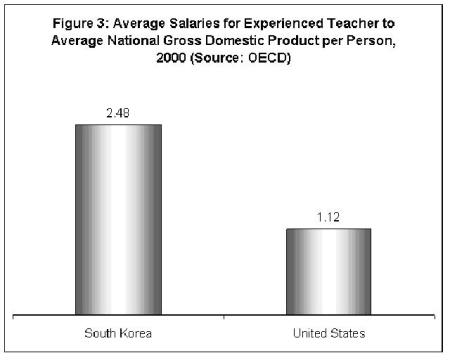
teacher-pay-korea

An experienced South Korean schoolteacher makes a relatively impressive wage compared with teachers in the rest of the world. In South Korea, teaching is an honored profession—not just rhetorically but in compensation as well. In the United States, meanwhile, a teacher with a college degree and 15 years of experience makes a salary relatively close to the average GDP per person. Not surprisingly, there are many qualified applicants for each open teaching position in South Korea.


McKinsey quotes the New Commission on the Skills of the American Workforce to contrast the United States with those countries having more successful education systems: “We are now recruiting our teachers from the bottom third of high-school students going to college…. [I]t is simply not possible for students to graduate [with the skills they will need] unless their teachers have the knowledge and skills we want our children to have.”


Rock Star Pay for Rock Star Teachers!

April 28, 2009

(Guest Post by Matthew Ladner)

The Goldwater Institute released a new study today titled New Millennium Schools: Delivering Six-Figure Teacher Salaries in Return for Outstanding Student Learning Gains. In this report, my coauthors Mark Francis, Greg Stone and I argue that the United States has made a tragic error in emphasizing teacher quantity (through efforts to limit average class size) rather than teacher quality. The growing literature on student learning gains clearly demonstrate that teacher quality trumps the impact of class size variation by a wide margin.

The value added literature has revealed stunning equity issues. We don’t attract enough high ability teachers into the profession, we quickly lose many of those we do to frustration or administration, and we distribute most of the remainder to the leafy suburbs. I don’t have a problem with incentive “combat pay” but let’s face it: it is not enough to simply redistribute the limited number of high quality teachers. We need to attract many more of them.

After exploring foreign and domestic examples of systems that make the opposite choice, we propose a solution: a school model which not only employs value added assessment to identify high achieving teachers, but also splits the additional revenue for students after the 20th with the teacher. We propose a 2/3 teacher, 1/3 school split for the 21st student and beyond. This works out to a $5,200 bonus per child.

With this split, our school delivers a six figure teacher salary at 32 students based upon Arizona’s relatively modest funding for charter schools. A class size of 32 students is hardly outside of the historical practice for American public schools, or even the current practice entirely.

There are many practical issues to consider, and variations on the basic model, so please read the study. I’ll write more about the study in the coming days, but the most important point is this: there is plenty of money in the public school system to treat teachers like true professionals and reward them for excellence.

UPDATE: Education Week’s Stephen Sawchuck points out that principals already covertly increase class sizes for additional pay.


WaPo: Why deny D.C. children what special-needs students get?

April 28, 2009

(Guest Post by Matthew Ladner)

The Washington Post editorial page weighs in again on choice, this time in the context of the Forest Grove vs. T.A. case pending before the United States Supreme Court.

The WaPo raises an interesting question: if special needs students have a right to a private school remedy in cases where the public schools have failed to provide an appropriate education, why shouldn’t other children poorly served by public schools enjoy the same right? Kids like those attending DC public schools. A strong case can be made that public schools have horrendous track record in educating both inner city children and children with disabilities.

Of course you wouldn’t want to clog the courts with lawsuits like the special needs law created.  A voucher program with a voucher amount less than the total spending per pupil would be far more equitable and efficient.


Michael Oher Drafted by the Ravens

April 26, 2009

(Guest Post by Matthew Ladner)

Michael Lewis is busy typing a new afterword for The Blind Side as we speak, as Michael Oher was selected with the 21st pick in the NFL draft by the Baltimore Ravens. Congrats to Michael and his heroic family.

One of the earliest posts I wrote here on JPGB was about Michael. As we celebrate Oher’s incredible good fortune at overcoming incredible odds to get where he is today, I cannot help but to recall Lewis’ chilling words from the book:

Michael Oher was in possession of what had to be among the more conspicuous athletic gifts…and yet, without outside intervention even his talent would likely have been thrown away…If Michael Oher’s talent could be missed, whose couldn’t? Those poor black kids [in the inner-city] were like left tackles: people whose values were hidden in plain sight…Pity the kid inside Hurt Village [in Memphis] who was born to play the piano, or manage people, or trade bonds.

Think of this quote the next time someone urges you to be “patient” when it comes to education reform.  A mind is indeed a terrible thing to waste, or to never develop.


How much do Arizona Public Schools Actually Spend?

April 24, 2009

(Guest Post by Matthew Ladner)

Watch your favorite bearded libertarian edu-nerd (okay maybe third favorite) debate how much Arizona really spends in public schools:


Questions for Leo-The Final Chapter

April 23, 2009

(Guest Post by Matthew Ladner)

In my final question for Leo, I ask: Leo, do your puppets have Taco Flavored Kisses?


Lieberman and Collins: Save the 200 victims of the Friday Night Massacre

April 23, 2009

(Guest Post by Matthew Ladner)

In a bipartisan appeal, Senators Joe Lieberman and Susan Collins wrote a letter to Secretary Duncan asking him to reverse the Departments decision to rescind Opportunity Scholarships to 200 DC school children (HT Whitney Tilson).

The letter reads:

Dear Secretary Duncan,

We are following up on our letter dated March 17, 2009, asking that you refrain from making any administrative rules  or policies that would disrupt the D.C. Opportunity Scholarship Program (OSP) or prevent the grantee from accepting applications and students for the 2009-2010 school year. Prior to a response to our inquiry, we were disappointed to learn that you subsequently made the choice not to allow new students to enroll in the program.

By preventing new scholarships from being awarded, you are effectively ending a program before Congress has had the opportunity to consider reauthorizing it. Therefore, we respectfully request that you consider reversing your decision.

As we noted in our letter to you, the future of the OSP is presently under consideration by the Senate Committee on Homeland Security and Governmental Affairs. We will be holding hearings on the program in May, and Majority Leader Reid  has promised floor time to consider a reauthorization proposal. We respectfully request that you refrain from implementing significant changes to the program until we have an opportunity to review the program’s results, hold  public hearings, and have a thoughtful debate about the future of the program.

Your recent decision to suspend the program for new entrants will hurt families who are searching for other options for their children. We understand that many of these parents had been notified that they would, in fact, receive scholarships for their children. Now that the DC Public School’s out of boundary process has been completed and the majority of public charter school deadlines have passed for the 2009-2010 school year, the suspension decision will leave these families with little or no opportunity to explore viable alternatives.

We will continue to support the D.C. Public School System in its efforts to improve outcomes for all students. However, in the interim, we must continue to provide options such as the OSP and provide families real choices in ensuring access to a quality education for their children.

We thank you for your immediate attention to this matter.

Sincerely,

Joseph I. Lieberman

Susan M. Collins


Democrats for Education Reform and BAEO Weigh In

April 23, 2009

(Guest Post by Matthew Ladner)

Will Democrats live up to their ideals when it comes time to reauthorize DC Opportunity Scholarships, or shamefully repudiate those ideals with their actions? With a series of damning indictments piling up, none have been more accurate or pointed that this one by George Will:

As the president and his party’s legislators are forcing minority children back into public schools, the doors of which would never be darkened by the president’s or legislators’ children, remember this: We have seen a version of this shabby act before. One reason conservatism came to power in the 1980s was that in the 1970s liberals advertised their hypocrisy by supporting forced busing of other people’s children to schools the liberals’ children did not attend.

I predicted that a growing number of Democrats would not stand for this outrage, and today I am happy to say that the list is growing. Linked here is a letter sent by the chairmen of Democrats for Education Reform and the Black Alliance for Educational Options to Secretary Arne Duncan. As you’ll see, Kevin Chavous and Howard Fuller also address the subject of hypocrisy:

The one thing we know about both of you is that neither of you are hypocrites. But, by being unwilling to take a strong stand for these children and their families you are allowing yourselves to be placed in that category. It pains us to see you and the President being attacked this way. But, to be truthful it pains us more to see these children being denied the educational opportunity that the Opportunity Scholarship Program affords them.

If it has feathers, walks like a duck and quacks like a duck, chances are it’s a duck.

It’s still not too late for Obama and Duncan to redeem themselves. If however they choose to repeat the shameful practice of busing for other people’s children with choice for me but not for thee I believe they will find a growing number of Democrats actively opposing them on behalf of these children.

(edited for typos)


Dan Lips and Lindsey Burke = Will Muschamp

April 22, 2009

(Guest Post by Matthew Ladner)

So the University of Texas has a defensive coordinator named Will Muschamp. Muschamp is known as “Coach Boom” because a clip of him reacting to a big hit went viral on youtube. Going nuts after one of his players delivered a bone crunching hit, Muschamp ran out on to the field happily screaming “BOOM!!!!!!!!!!!!” in a voice louder than I would have ever expected humanly possible, with the possible exception of the Ladner children
 
Texas fans now happily yell “BOOM!” from the stands when they see a big hit.
 
This is the reaction I had when I read Dan Lips and Lindsey Burke in the NRO today. The lines from President Obama’s open letter to his daughters is priceless. I take that back. They are beyond priceless:

“In the end, girls, that’s why I ran for President: because of what I want for you and for every child in this nation. I want all our children to go to schools worthy of their potential – schools that challenge them, inspire them, and instill in them a sense of wonder about the world around them. I want them to have the chance to go to college – even if their parents aren’t rich.”

BOOM!!!!!!!!!!!!!!!!!!


Charles Murray responds to Greg

April 22, 2009

(Guest Post by Matthew Ladner)

Charles Murray responds to Greg’s critique of his Kristol lecture on NRO. Murray writes:

Good Public Discourse   [Charles Murray]


Here’s a novel experience. Kathryn Lopez called my attention to Greg Forster’s critique of my Kristol lecture here, wondering if I might want to respond. So I read it. And then read it again. And then thought about it some more. And here’s the novel part: I have nothing to say except, “Well, okay, I take your point.” What he pointed out as weaknesses were weaknesses. On his most important objection, that I failed to mention that activities don’t provide deep satisfactions if they’re morally wrong, he even correctly anticipates my response: I took it for granted. But I shouldn’t have. 

Why am I even bothering to post about it? Because we really, really need a change in tone when we’re discussing difficult issues (and need it every bit as much on the Right as on the Left). Forster’s essay is a model: Based on a minutely close reading of the thing-being-critiqued, refusing to personalize the argument in any way, and, dammit, acute.