Can Meg Whitman Save California?

June 17, 2009

(Guest Post by Matthew Ladner)

Fortune posed the question back in March and matters have only grown more desperate since. California voters (quite rightly in my view) rejected the Governator’s tax increase initiatives, raising the spectre of default and rumors of a federal bailout.

Living in Arizona, within California’s cultural and economic sphere of influence, you meet California refugees all the time. My colleague at the Goldwater Institute, Clint Bolick, quips that Arizona desperately needs to build a border fence-on our Western border rather than our southern border.

Business Week wonders aloud whether the American economy can recover without California righting its’ economic ship. California had a pretty rotten 1990s overall, with poverty rates significantly higher in 2000 than in 1990. It seems on track to have another rotten decade in the Oughts. The beatings will continue until morale improves.

Forbes recently created a list of the top 10 cities for economic recovery, and the 10 worst cities for economic recovery. Four of the best cities were in Texas. Five of the worst were in California. The country could benefit greatly from a reformed California economy rediscovering the vibrancy of the past.  As it is, California is an economic mess.

California is also dragging the nation down educationally. With 1 in 8 of America’s public school students attending California’s terribly underperforming public schools, we have little chance of climbing the international league tables with California performing so poorly.

The public sector unions speak with a loud voice in Democratic Party primaries, and the Democrats have huge majorities in the legislature. Perhaps California’s public sector unions are following the UAW model: suck the blood out of your host and then seek a federal bailout.

I am a confirmed Californiaphobe, but if the question is: can Meg Whitman save California, my only response can be: I certainly hope so.


New Blog Alert

June 17, 2009

(Guest Post by Matthew Ladner)

John Stossel has lauched a blog. It’s going into my google reader.


McGuire on Unions and Urban Students

June 16, 2009

(Guest Post by Matthew Ladner)

 MaryEllen McGuire of the New America Foundation takes on the unions for dealing out the least experienced teachers to the neediest children in U.S. News and World Report:

Teachers with the least experience are educating the most disadvantaged students in the highest poverty, most challenging schools. Low-income kids are being “triaged” not by experienced teachers, but by those with fewer than three years of teaching to go on.

Does it matter? Absolutely. According to the research, teacher experience is at least a partial predictor of success in the classroom and, at present, one of the only approximations for teacher quality widely available. Experienced teachers tend to have better classroom management skills and a stronger command of curricular materials. Novice teachers on the other hand struggle during their initial years in any classroom.

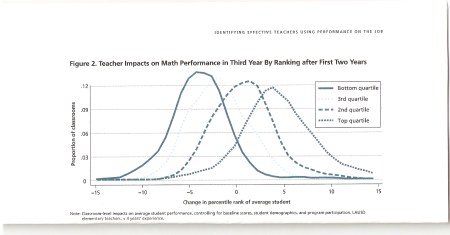
McGuire’s point is valid, but of course we should not be content to use experience as an approximation for teacher quality. There are both outstanding young teachers and truly awful experienced teachers, as you might recall from the Son of Super Chart:

scan0001

The Son of Super Chart broadly  backs up McGuire-the curve for 1st year teachers is centered on -5, and the curve for 3rd year teachers on 5.  All else being equal matching inexperienced teachers with high needs kids is an abominable practice.

Of course, all else need not be equal, which is why Teach for America works well.

McGuire proposes solutions:

Once we can wrap our heads around the true extent of the problem we can start taking down the second obstacle: figuring out a way to entice more experienced teachers to teach in high need schools. This will require a long-term commitment to systemic reform including investing in low-poverty schools to make them more attractive teaching placements and funding incentives to initially attract experienced and, we hope, higher quality teachers to low-income schools.

Will this require dollars beyond what we have? Not necessarily.

Federal law already provides schools with money to pay for this. It’s just that the funds typically go to reduce class sizes or provide professional development for teachers instead – strategies that have mixed results. Some of these funds should be redirected to pay for incentives drawing teachers into high-poverty schools. This is also a great use of stimulus money.

I’m glad to see to someone from the New America Foundation describe the results of class size reduction as “mixed.” Wow- you are half way there. The real word you are looking for however is “c*a*t*a*s*t*r*o*p*h*i*c” and the issue goes much deeper than the distribution of experienced teachers. On average, American colleges of education are recruiting from the bottom third of American college students based on admission scores. 

Reading between the lines, the world is precisely as the unions want it to be: an emphasis on class size and seniority over teacher quality or equity. The system is also perfectly designed to deliver the most needy students low-quality teachers.

John Rawls is surely spinning in his grave.

UPDATE/CORRECTION

I loaded the wrong Brookings study Super Chart! The correct Super Chart! is from page 28 of the same study and shows a  weaker relationship between experience and student learning gains, with year one teachers with a bell curve centered around -3 and second and third year teachers around zero.


Rock star teacher pay for Rock Star teachers: Part 4

June 11, 2009

(Guest Post by Matthew Ladner)

How do you get rock star teachers? Offer rock star wages of course! I coauthored a study for the Goldwater Institute laying out a model of achieving $100,000 teacher salaries based on Arizona charter school funding. You can read the previous posts on this here, here and here.

The New York Times features a new charter school that apparently had a similar idea: they are offering teacher salaries of $125k and merit bonuses of up to $25k.

What do you get for that? Well for starters, Kobe Bryant’s former personal trainer as your gym teacher.  “Developed Kobe from 185 lbs. to 225 lbs. of pure muscle over eight years,” his resume says.

The school, named the Equity Project, is located in a rough part of town and will have class sizes of 30 to pay for those rock star teacher salaries.

I don’t know whether the school will be tracking value-added learning gains over time as we recommend in our study.  I hope they will. I for one will be watching with great interest to see how they do over time.


Question for Sara Mead

June 9, 2009

(Guest Post by Matthew Ladner)

I saw a documentary on Napoleon’s Egyptian campaign a few years ago. After a completely nasty setback, Napoleon retreated in defeat back to Cairo, but then ordered a victory parade to be held before fleeing the country entirely.

Watching Fordham’s pre-school event online, I can’t help but think that pre-k advocates are trying to do the same thing with Oklahoma: pretend its a victory, when in fact it looks more like their Waterloo.

I watched the Fordham Foundation pre-school event online yesterday. I was especially taken by Sara Mead’s claim that universal preschool could lead to dynamic changes in K-12, and that disadvantaged kids in Oklahoma’s pre-k program made larger gains than other students.

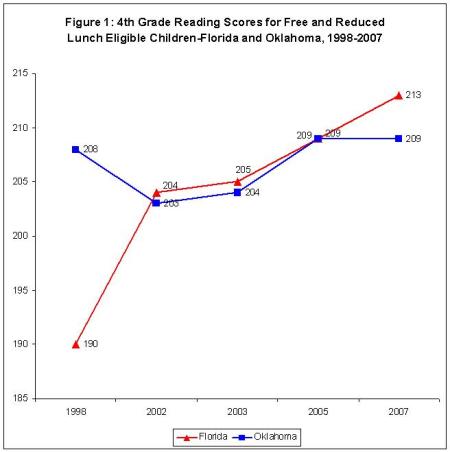
The biggest problem for universal pre-k advocates, in my view, is that the academic gains associated with Pre-K programs fade out. Consider the blue line in the chart below-4th grade NAEP scores from Oklahoma. In 1998, Oklahoma adopted a universal pre-k program.

FL vs. OkI assume that Ms. Mead has a basis to say that disadvantaged children make bigger gains under the Oklahoma pre-k program. The more important question is whether those gains are sustained over time.

Based upon the NAEP scores, Oklahoma’s program looks like a dud, increasing all of one point between 1998 and 2007.

The best one can try to spin out of the Oklahoma situation is scores might have actually dropped in the absence of the program, but now you are really grasping at straws. I seriously doubt that anyone who voted for this program in 1998 could be anything other than disappointed.

The red line, Florida, shows what can be done with a vigorous effort to improve K-12 schools. Florida’s low-income children improved by 23 points between 1998 and 2007.

Florida voters created a universal pre-k program, which was implemented as a voucher, but none of those students had reached the 4th grade by 2007.

Mead would likely argue, and I think she did at the event, that Pre-K and K-12 reform aren’t mutually exclusive, and I agree. It seems fair to ask however: is Pre-K a waste of time as an education improvement strategy? If not, why are the Oklahoma results so dreadfully unimpressive?


Synchronize Your Watches…

June 8, 2009

(Guest Post by Matthew Ladner)

James Sherk and Dan Lips point out that the Obama administration is lowering the amount of transparency for unions even as the Indiana swindle unfolds.

Meanwhile the NEA seems to have shifted its position from “we will take care of this” to “it sucks to be you disabled teachers” back to “we will take care of this.”

Synchronize your watches for 15 minutes and we will see what they say next.


Fifteen Years of Pulp Fiction

June 5, 2009

(Guest Post by Matthew Ladner)

This year marks the 15th anniversary of Pulp Fiction. I can’t believe it either.

Pulp Fiction was a pop-culture phenomenon, not only resurrecting the career of John Travolta, but elevating the careers of several others, especially the brilliant Samuel L. Jackson.

I’ve met people who were repulsed by the grisly violence, foul language and drug use of the film. I’ve encountered others who claim that Resevoir Dogs is a better film (nonsense). Others like the film for the grisly violence, foul language and drug use, but I don’t believe they actually appreciate the film to the fullest.

You see, I believe that despite all of the hipster post-modern lingo, heart stabbing injections, Deliverance references, etc. that Pulp Fiction is actually a film about redemption.

Tarrantino used two main devices to tell this story: a fake Bible quote and non-linear storytelling.

Samuel L. Jackson’s hitman character Jules recites a manufactured version of Ezekiel 25:17 before killing people:

Along the way, Jules experiences what he regards as a miracle and decides to abandon the life of a hit man to “walk the earth” in a way that has echoes of the lillies of the field. Vincent Vega, Jules’ partner in crime ridicules him for choosing to become a bum.

The brilliance of the non-linear story telling is that the viewer knows that Vincent will soon be bleeding to death in a bathtub after being shot multiple times. We don’t know what happens to Jules, but we do know what happens to Vincent. The wages of sin, in other words, are death.

This becomes all the more clear when Ringo attempts to rob Jules in the diner:

Jules is trying real hard to be the shepard, and whatever happens to him, it’s better than what happens to Vincent.

This is how I interpreted Pulp Fiction, and I was relieved to see the Thomas Hibbs offer that the film can be interpreted in this way in his brilliant book Shows About Nothing: Nihlism in Popular Culture from the Exorcist to Seinfeld.

Tarrantino seems to be an unlikely source for a covert religious allegory, but there it is, hidden in plain sight.


Barry Goldwater Jr. on Glen Beck

June 4, 2009

(Guest Post by Matthew Ladner)

Barry Goldwater Jr. is one of the most colorful people I’ve ever been lucky enough to get to know. Barry recently appeared on Glen Beck to discuss the awful state of the Republican Party:

At some point, I’ll have to rant at length about the Big Government Conservative project and the attempt to build a “permanent majority” with money out of your pocket. That was a great electoral strategy for FDR or LBJ, not so much for a right of center coalition.

By the way, how’s that permanent majority thing working out?


Did a “Massachusetts Miracle” actually happen?

June 2, 2009

(Guest Post by Matthew Ladner)

There was fierce posting last week here and at Flypaper on the Massachusetts Miracle and what role the unions did or did not do in thwarting said miracle. The question I’ll raise: does MA’s improvement deserve the title of miracle?

MA has the highest NAEP scores in the country, and they’ve improved in recent years, so they don’t have anything to be ashamed of when it comes to education reform. Superficially, they outshine everyone.

However, MA is also a very wealthy and fairly homogenous state.  NAEP lists their free and reduced lunch eligible students at 28.9% (which is low) and their percentage of Anglo children at 72.9% which is pretty high. Spending per pupil is listed at over $12,000 per pupil.

My favorite education reform state, Florida, spends less and has a far more demographically challenging K-12 demographic profile. And…they’ve made much more progress with difficult to educate students.

FL MA 1

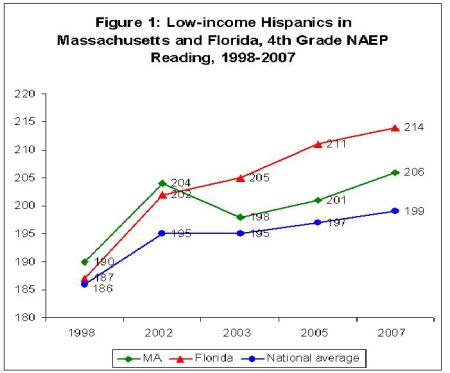
Looking at progress among the most difficult to educate students gives us a good view of which state has made the most progress. This effectively controls for MA being wealthy and pale. Figures 1 and 2 present data from the 4th grade reading exam.

Among free and reduced lunch eligible Hispanics, Florida has made a great deal more progress than MA- 16 point improvement in MA, a 27 point improvement in Florida. 

MA outperforms the national average, but by a mere three points. Florida doubled the improvement of the national average.

The same is true among free and reduced lunch eligible African American students. MA improved by nine points, the national average improved by ten points, and Florida improved by twenty four points.


FL MA 2Again, MA doesn’t have anything to be ashamed of given their highest scores. There are other wealthy and homogenous states that spend a great deal on their public schools- and MA clobbers them. For me, however, when it comes to education reform


Oooooooops!

May 27, 2009

(Guest Post by Matthew Ladner)

One of my favorite scenes from Die Hard is when the evil villain Hans gets found by our hero, John McLain. Hans, dastardly fellow that he is, passes himself off as an American. John gives him a gun to have him help fight the bad guys. John turns his back, and the villain confidently pulls the trigger, only to hear a loud

 **CLICK**

hans

McLain looked at Hans, shocked to be holding what he now knew to be an unloaded gun, and said, if memory serves: “OOOOOOOPS!!!! Do you think I’m f****** stupid Hans?!?”

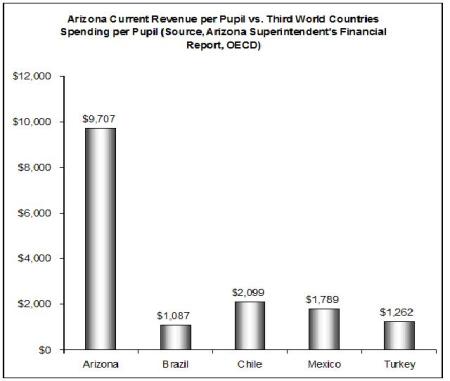
Apparently, an outfit calling itself the “Arizona Economic Council” thinks that Arizonans are stupid. They shot an advertisement in Africa claiming that the looming budget cuts in K-12 threaten to move Arizona to Third World Status.

There is just one little problem with this: objective reality.

The Organization for Economic Cooperation and Development has this pesky habit of actually collecting spending per pupil data. Here is Arizona compared to the Third World Countries:

Third world 1

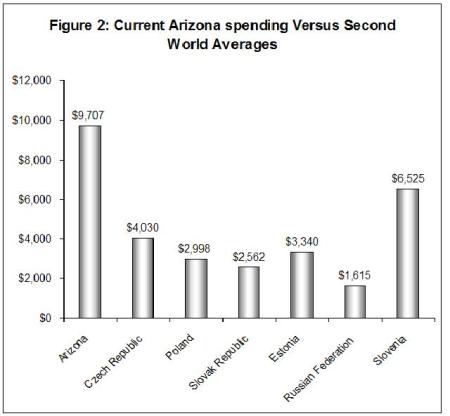
Oooops! Arizona spends five to nine times more than any of them. How does Arizona compare to Second World (former Communist) countries?

Third world 2

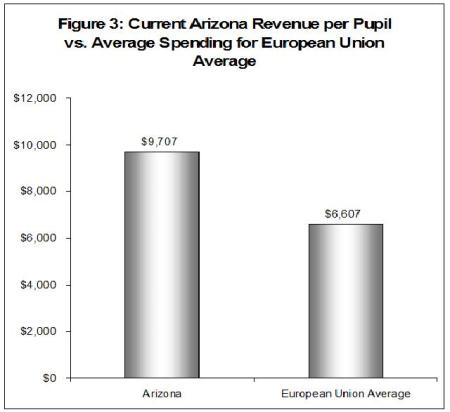
Ooops! All the former communist countries would kill to switch places with Arizona. How does Arizona compare to First World European Countries?

Third world 3

Ooops! Arizona’s figure is 48% higher.

I could dig up comparisons on academic outcomes but that would just be running up the score. Like Hans, the so-called Arizona Economic Council is shooting blanks. And given that they could have looked up these numbers before flying to Africa, I have to say they look pretty stupid.