(Guest post by Greg Forster)
No, I’m not referring to the state’s brand new voucher program. I’ve got a piece in today’s Oklahoman on how the evidence consistently shows school choice works.
(Guest post by Greg Forster)
No, I’m not referring to the state’s brand new voucher program. I’ve got a piece in today’s Oklahoman on how the evidence consistently shows school choice works.
 Leave a Comment » |
  competitive effects, vouchers | Tagged: Greg Forster, Oklahoma, Oklahoman |
  Permalink
 Posted by Greg Forster

(Guest post by Greg Forster)
Molly, if you’re reading this – you still have a choice. You can try to run away from what you know you’re called to do, but Victor Laszlo is right: like Rick Blaine, you’re trying to run away from yourself, and you will never succeed. Or you can rejoin the fight from wherever you are now; the Internet makes it possible to do your part to save the world from any computer station, anywhere.
In case you missed the news, Molly Norris, the cartoonist who came up with the idea for Everybody Draw Mohammed Day, was admonished by the FBI that she needed to erase her identity and go into hiding, and she has done so. As Mark Steyn and others have observed, it appears that the United States law enforcement apparatus is now, effectively, working for the other side. Terrorizing people into abandoning their freedoms is precisely what the enemy is trying to accomplish. Now the FBI is helping them.
This is not the same thing as doing this for a witness in a criminal trial. You send mob informants into hiding because for them, hiding is what they need to do in order to fight the enemy. You can’t testify against the mob if the mob can kill you before you get to the stand. And if they get to you after you take the stand, the next informant won’t testify.
But for people like Norris, not hiding is what they need to do to fight the enemy. If mob informants go into hiding, we win. If Molly Norris goes into hiding, the enemy wins.
Earlier this year, when Norris cancelled her proposed Everybody Draw Mohammed Day out of fear for her life, I expressed my disappointment and she showed up in the comments to ask where all the people who were supposed to be protecting her had gone. It was a very just question! And she was thinking only of politicians and intellectuals, not the police. Who knew, then, that even the police would turn against her?
Yet we can’t give up. We can’t become cowards just becasue the FBI has done so. We are still human beings, and there is no escape from responsibility.
That’s why, in the tradition of Fasi Zaka, I’m proud to nominate Wim Nottroth for this year’s Al Copeland Humanitarian of the Year Award.
The Gates of Vienna blog recounts the story:
Back in the fall of 2004, just after Theo Van Gogh was murdered, an artist named Chris Ripke painted a mural on a Rotterdam street with the text: “Thou Shalt Not Kill”. A scriptural quote, but universally accepted, one would think, and not at all controversial.
Needless to say, local Muslims complained, and the municipality ordered city workers to remove the mural. A video reporter [for a local TV station] named Wim Nottroth stood in front of the mural in an attempt to prevent its removal, but he was arrested by police.
The authorities also ordered all news videos of the operation destroyed, but at least one survived and was uncovered by the diligent detective work of Vlad Tepes.
The mural was on private property. The owner of the property had approved the mural. No laws were violated. But the police destroyed the mural and confiscated all videos of their crime (or so they thought) and erased them.
Four months later, it was revealed that an imam from the mosque that demanded the destruction of the mural was connected to terrorist organizations and inciting his followers to violence. He was deported for being in the country illegally.
Nottroth had been sent to the scene in his capacity as a journalist. His job was to film the police destroying the mural. But as the moment of destruction approached, Nottroth realized that although he was a journalist, he was a human being first. And nobody else was going to do what needed to be done by somebody.
So he went and stood in front of the mural. And he stood there until the police arrested him.
The translation from the Dutch is awkward in some places, but it’s impossible not to hear the courage and integrity behind the awkwardness: “We all do agree to that, don’t we? Thou shalt not kill, we all agree to, isn’t it?…If this goes away there will be more misery than there would be if you leave it.” He couldn’t have been more eloquent if he’d quoted Locke’s Letter Concerning Toleration or Milton’s Aeropagetica.
This exchange encapsulates a lot in a short space:
Nottroth: It should be possible here in a democratic…
Policeman: You rather go stand there.
Nottroth: Well then, I will remain standing here.
Darn straight.
Each and every one of us must be ready to say that at any time, when our duty as human beings calls upon us. For reminding the world that standing for freedom, even against your own government when necessary, is every person’s responsibility, I nominate Wim Nottroth for the 2010 Al Copeland Humanitarian of the Year Award.
7 Comments | Al Copeland Humanitarian Award, politics | Tagged: Al Copeland Humanitarian of the Year Award, Best of Greg, Chris Ripke, Everybody Draw Mohammed Day, Greg Forster, Mark Steyn, Molly Norris, Wim Nottroth | Permalink
Posted by Greg Forster
(Guest post by Greg Forster)
Checker just published a column on the incompetence of government. It’s a little bit weird; there’s not much connection to education policy here, and the piece doesn’t reach any conclusions or advocate any new policies. He just complains that government is really incompetent.

PEREGRUZKA: “OVERLOAD”
To which one can only reply: You’re just discovering this now?
Or is this one of those things like a coworker’s extension number, or your brother’s ZIP code – something you don’t need to know all the time, so you periodically remember it and forget it, remember it again and forget it again?
Like, say, you might remember it when conservatives are doing well in Washington, then forget it when liberals are doing well in Washington, and suddenly remember it again just before a wave election brings the conservatives back?
3 Comments | instructional reform, politics | Tagged: Checker Finn, Greg Forster | Permalink
Posted by Greg Forster

(Guest post by Greg Forster)
It’s taken me a week to think of it, but I have come up with what I believe is the ultimate nominee for the Al Copeland Humanitarian of the Year award this year. Or rather, two nominees.
Yes, the most interesting man in the world is . . . very interesting! I love the ads, but does he really represent the spirit of “The Al”? He certainly has done a lot of things – but what has he actually accomplished?
I propose that the true spirit of “The Al” is what you find inside . . . diapers.
Marion Donovan and Victor Mills’ diapers, to be exact.
Just spend a moment thinking about what life was like during the endless centuries when a diaper was nothing but a piece of cloth – one you had to wash and reuse, because manufactured goods couldn’t yet be made cheap enough for disposability. Contemplate, for a moment (but no longer than that!) how many diapers were changed from the first human beings technologically sophisticated enough to make clothing down through the middle of the twentieth century – and what was involved in changing each and every one of those diapers.
When Martin Luther wanted to illustrate the point that joyfully worshipping God was not a special activity that you did by going to church or performing other “religious works,” but something that had to infuse every single solitary human activity, even the most unpleasant, he was shrewd to choose diaper changing as an example:
Now observe that when … our natural reason … takes a look at married life, she turns up her nose and says, “Alas, must I rock the baby, wash its diapers, make its bed, smell its stench, stay up nights with it, take care of it when it cries, heal its rashes and sores, and on top of that care for my wife, provide for her, labour at my trade, take care of this and take care of that, do this and do that, endure this and endure that, and whatever else of bitterness and drudgery married life involves? What, should I make such a prisoner of myself? O you poor, wretched fellow, have you taken a wife? Fie, fie upon such wretchedness and bitterness! It is better to remain free and lead a peaceful. carefree life; I will become a priest or a nun and compel my children to do likewise.”
He went on to focus on diaper-changing as the representative activity encompassing all these unpleasant duties. Luther knew that by sticking up for the honor of the married estate, he was sticking up for getting poop on your hands. Daily.
But having a family doesn’t mean daily poop-scrubbing anymore.
Born in 1917, Donovan spent much of her childhood hanging around the Ft. Wayne factory run by her father and uncle. They were inventors in their own right – having invented, among other things, an industrial lathe for making automotive gears and gun barrels – and she absorbed their entrepreneurial spirit.
Her first invention was a waterproof diaper cover, made out of a shower curtain, to contain the small leaks that were endemic to diapers in the pre-Donovan era. Rubber baby pants were already on the market, but they weren’t widely used because they caused diaper rash and pinched the skin. The plastic “changing pads” we use today are a distant descendant of Donovan’s innovation.
For good measure, she put snaps on her diaper cover instead of using safety pins, which at the time were the universal fastening technology in the diaper sector. Today we use velcro, but the original quantum leap away from the use of dangerous and labor-intensive pins was Donovan’s.
None of the big manufacturers would even consider marketing her invention, so she went into business for herself. Her product was an overnight success, debuting at Saks Fifth Avenue in 1949. After two years she sold it to one of those super-smart manufacturing companies that had been too dumb to give her the time of day back when it would have counted.

Like any good entrepreneur, she didn’t rest on her laurels but plowed her success into the next innovaiton – this time, disposable diapers. The challenge was significant; she needed to make the interior out of paper (so it would be cheap enough to manufacture in large numbers) but make it durable and absorbant.
She produced what she thought was a workable solution, but once again she couldn’t get the manufacturers interested. They were already working on the same idea – and Victor Mills, a chemical engineer at Proctor & Gamble, had a better solution than hers. (Those are the breaks! “The Al” celebrates the tough life of entrepreneurial struggle.)
In 1956, P&G had acquired a new paper pulp plant, and it asked Mills and his team what they could do with it. Lots of companies were working on disposable diapers, but nobody had solved the problem yet. Mills, a grandfather at the time, had a pretty strongly vested interest in coming up with a solution. And the new plant yeilded just enough durability and absorbancy to solve the problem. Using his grandchild to test the prototypes, Mills developed the disposable diaper that ultimately became Pampers in 1961.
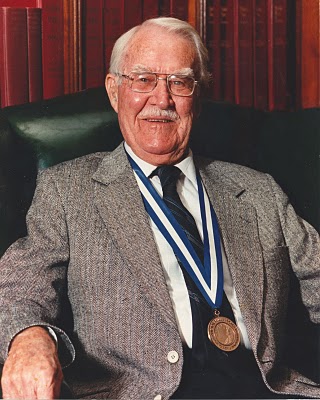
Well earned
So if you have kids, thank Donovan and Mills for their contribution to your well-being – and vote for them for Al Copeland Humanitarians of the Year.
HT Thomas Frey, Women Inventers and Chemical Engineering World for images, Famous Women Inventors and Jon Marmor for info
7 Comments | Al Copeland Humanitarian Award | Tagged: Al Copeland, Al Copeland Humanitarian of the Year Award, Greg Forster, Marion Donovan | Permalink
Posted by Greg Forster

(Guest post by Greg Forster)
Jonah Goldberg lets fly today on NRO with an absolute slam dunk:
And yet when you listen to these endless seminars and interviews on NBC and its various platforms, I never seem to hear Matt Lauer or David Gregory ask “Isn’t the education crisis a failure of liberalism?” After all, liberals insist all social problems can be reduced to root causes. Well, they’ve been in charge of the roots for generations and look at the mess they’ve made. Look at it.
Largely because of the Iraq war, Katrina and Bush’s unpopularity, a host of liberal intellectuals pronounced conservatism to be dead. The decrepit state of American education is a far more sweeping, profound and lasting indictment of the very heart of liberalism and yet the response from everyone is “Let’s give these guys another try!”
HT Jeff Reed @ FEC
6 Comments | money myth, politics | Tagged: Greg Forster, Jonah Goldberg, NRO | Permalink
Posted by Greg Forster

“Facts are stubborn things; and whatever may be our wishes, our inclinations, or the dictates of our passion, they cannot alter the state of facts and evidence.” – John Adams
(Guest post by Greg Forster)
I love Rick Hess for being pissed off that voucher advocates promised the moon and stars back in the 1990s, setting us up for the appearance of disappointment. Inevitably, when we got actual programs enacted, we got tiny, cramped, ridiculously overregulated and sabotaged-by-educrats programs, not the universal vouchers that have defined the gold standard for school choice for fifty years. Unsurprisingly, the modest and heavily limited programs we have enacted have failed to deliver the moon and stars.
Of course I love him for that; we’ve been making much the same point for a while now. Welcome to the party, Rick!
And I love Rick Hess for demanding that we reboot the movement with a focus on “making markets,” on “deregulation and re-invention.” Advocates of school choice to improve public schools have been in hock to the private school status quo for too long. As Milton Friedman said, education is the only thing we still do exactly the same way we did it a hundred years ago. We don’t even know what a good school looks like; we have to set the market free to find out.
Again, welcome to the party!
But Rick doesn’t get the facts right on the question of whether vouchers “work.” He jumbles together respectable scholars (ahem) with breathtakingly shameless professional con artists who happen to have Ivy League credentials (ahem) as though they all had equal credibility. Obviously if you’re going to do that, you can create the appearance of uncertainty no matter how clear the facts are.
Don’t listen to the experts – including me. And don’t listen to experts who decide what’s true – or what’s certain or uncertain – by weighing how many alleged “experts” are on each side.
Find out the facts for yourself. Here’s a fact you can start with: there have been 19 high-quality empirical studies of how school vouchers (and in one case tax-credit scholarships) impact public schools. Of those, 18 find that vouchers improve public schools, one found no visible difference, and none found that vouchers do harm. And that one stray study finding no difference was . . . guess where? In D.C., where the voucher program intentionally insulates public schools from the effects of competition. So even the exception proves the rule.
Vouchers work. Facts are stubborn things. No matter how many “experts” you quote against them.
It’s imperative to look at the high-quality empirical studies and not anecdotes or people’s claims. That’s the only way you can reliably disentangle the impact of vouchers specifically from the impact of hundreds of other factors that affect school performance.
This matters because you can’t reboot the movement with a focus on building markets, as Rick and I both want to do, if you start by ignoring the facts about all the good vouchers have already accomplished. The effect is more likely to be despair and abandonment – if you’ve fought for 20 years and haven’t accomplished anything, why keep fighting?
In the 1950s and 1960s, the clever intellectual elites thought they could reboot America to pursue a new vision of greatness by pooh-poohing and downplaying the importance of all the great things America had accomplished in its past up to that point. They were hoping to inspire the rising generation to aim higher and achive a more glorious society.
What they got instead was a generation of dirty, smelly dopehead dropouts who wouldn’t fight for their country or make any contribution to society. After all, why should they? What good was it?

Anything that produces hippies is a bad thing. (Just ask anyone who’s made fun of “peace, love and understanding” in front of Matt.)
I want the same thing Rick wants. I just want him to see that when he advocates rebooting the movement around liberating real educational markets, the facts are on his side.
8 Comments | vouchers | Permalink
Posted by Greg Forster

“Why Hitler Lost the War”
(Guest post by Greg Forster)
Reviewing Oprah’s segment on Waiting for Superman, Jay Matt [oops] just announced that the war of ideas is over and the unions have lost.
Hmm, where have I heard that before? Oh, yeah, that’s right – I’ve been saying it for a year and a half.
Permission to come aboard, granted!
The unions are primed for a major defeat. If you listen carefully, you can actually hear the voice-over from Mortal Kombat crying out “FINISH HIM!”

What the movement needs now is a fearless, dynamic organizational leader with a smart plan to get a truly universal voucher program (no more watering it down) enacted in a state in the next, say, three years, and who’s determined to spend the next three years doing nothing but putting that plan into action. There are states where that can happen. But it won’t happen unless somebody picks up the ball.
Or am I just waiting for Superman?
3 Comments | charter schools, journalism, money myth, vouchers | Tagged: Greg Forster, Oprah, Waiting for Superman | Permalink
Posted by Greg Forster

(Guest post by Greg Forster)
I had to laugh when I saw this New York Times story. They’ve discovered that the existence of multiple “learning styles” has no sound basis in empirical evidence:
Take the notion that children have specific learning styles, that some are “visual learners” and others are auditory; some are “left-brain” students, others “right-brain.” In a recent review of the relevant research, published in the journal Psychological Science in the Public Interest, a team of psychologists found almost zero support for such ideas. “The contrast between the enormous popularity of the learning-styles approach within education and the lack of credible evidence for its utility is, in our opinion, striking and disturbing,” the researchers concluded.
Wow, those daring journalists at the Times and scientists at Psychological Science in the Public Interest aren’t afraid to buck the conventional wisdom!
Imagine how daring they’d have been if they’d been reading Education Next . . . in 2004?
(Admittedly, the Ed Next article is framed in terms of “multiple intelligences” rather than “learning styles,” but when you come right down to it, “multiple intelligences” was just the fashionable early-aughts buzzword for the same cluster of fallacies that goes by “learning styles.”)
2 Comments | instructional reform, journalism | Tagged: Greg Forster, Joanne Jacobs, learning styles, multiple intelligences, New York Times | Permalink
Posted by Greg Forster

(Guest post by Greg Forster)
Neal notes the connection between Arne Duncan’s now-infamous embrace of Al Sharpton and the president’s continuing his new tradition of broadcasting a back-to-school message to America’s classrooms, coming up later this month.
Duncan didn’t just embrace Sharpton in his personal role as a citizen. He mobilized the U.S. Department of Education to support Sharpton by encouraging employees to attend Sharpton’s anti-Glenn-Beck rally.
Whatever you think of Glenn Beck, Sharpton cut his teeth as a professional purveyor of incitement to murder. During the Crown Heights race riots, with blood running in the streets, he said, “if the Jews want to get it on, tell them to pin their yarmulkes back and come over to my house.” He had to tone it back after the Freddy’s Fashion Mart murders, when people began making connections between Sharpton and the killings that kept following in his wake. But tone it back was all he did; he’s never repented.
Duncan spoke at Sharpton’s rally and urged his employees to attend.
A department spokesperson lamely tried to evade responsibility by saying “This was a back-to-school event.” Really? Here’s a sample of Al Sharpton’s back-to-school message for America’s youth, courtesy of the Washington Examiner:
[Conservatives] think we showed up [to vote for Barack Obama] in 2008 and that we won’t show up again. But we know how to sucker-punch, and we’re coming out again in 2010!
…and do your homework!
This is obviously intimately connected with the presdient’s decision to make it an annual tradition to use America’s government school monopoly to broadcast a message to the nation’s children. Other presidents have done so before, though none has made it an annual tradition. But it was equally wrong whoever did it, and this Duncan/Sharpton rally shows why.
Neal is trying too hard when he strains to describe Obama’s message to students as “politically charged material.” Joanne Jacobs rightly notes, “Last year’s speech raised a lot of fuss, culminating in a big fizzle as Obama told students to work hard in school.” No doubt this year the president will be equally anodyne.
[Update: Neal points out below that it was the accompanying materials sent to schools, not Obama’s message itself, that he described as “politically charged.” Fair enough! I read his post too quickly. Yet it’s worth noting that even those accompanying materials were focused on anointing Obama as a role model rather than pushing an overtly political agenda.]
The connection is rather that politics can’t be hermetically sealed. The president does have some role to play as the representative of the entire nation. But he is never just that; he is also a politician with an agenda. He will always stand for things that many Americans oppose; that’s just the nature of political life. And this president in particular seems to have more of a tendency than most presidents of associating himself with criminals and race-haters.
It doesn’t matter what Obama says. In fact, the less political his message, the worse it is. If Obama’s message really were “politically charged material,” many students would recognize it as such. The more anodyne he is, the more he gets what he really wants – to be anointed as a role model. With all that entails.
It’s wrong enough to have a government monopoly on schooling. To have the government monopoly anoint the president as a role model for our children is a hundred times more wrong. It would be wrong even if the president were relatively uncontroversial, because no president can avoid having many associations to which many parents will reasonably object. With this president – well, words just fail.
4 Comments | civic values | Tagged: Al Sharpton, Arne Duncan, Barack Obama, Greg Forster, Joanne Jacobs, Neal McCluskey | Permalink
Posted by Greg Forster

(Guest post by Greg Forster)
Below, Sandra Stotsky observes that the new national standards demand a reduction in the amount of literature taught in K-12 in order to facilitate more reading of nonfiction.
Stotsky makes a strong case that this demand is equally unnecessary (since schools have already pushed out literature in favor of nonfiction), unjustified (since there are no grounds for the view, being adopted in the name of national standards, that assigning more nonfiction in K-12 English classes will help prepare students to read college textbooks in math, economics, physics, psychology, etc.) and disastrous for real education (because literary and imaginative education is as essential to decent human life as it is neglected by the government school monopoly).
But let’s not overlook a more fundamental point: when we decided to have national standards, nobody told us that it would mean forcing schools to assign less literature. But that’s what’s happening.
Why? Friedrich Hayek outlines it in The Road to Serfdom. Even a small amount of government planning must – must – inevitably either metastasize both quantitatively and qualitatively, or else fail to accomplish its purpose.
Government planning, however small, must metastasize quantitatively. Government gets our consent to plan A. But if A must be planned, that requires control of B. And that requires control of C…
It must also metastasize qualitatively. For government to plan A, government must determine the scheme of values that governs A. This requires not only a mandatory, government-imposed view of the value of A; it requires a mandatory, government-imposed view of the value of everything. In order to plan A you must determine where A stands relative to everything else, and that means government controls not just your view of A but your view of everything.
To the extent that we prevent planning from metastasizing, it fails. To the extent that metastasizes, it succeeds – and we lose our freedom.
Image HT Ukuleleman
3 Comments | instructional reform | Tagged: Greg Forster, national standards, Sandra Stotsky | Permalink
Posted by Greg Forster


 Jay P. Greene's Blog