Pass the Popcorn: The Past Jedi

December 31, 2017

ED3E5D48-903D-4E5F-A622-D8E1009E12C0

(Guest post by Greg Forster)

Start 2018 off right with my review of The Last Jedi over on Hang Together:

Where TFA was about the family, TLJ is about the past. We need the wisdom of the past, but the corruption of the past threatens to destroy us.

Looking forward to hearing what y’all think!

PS Coming soon, Darkest Hour. Go see it while it’s still in theaters, it benefits from the big screen!


2017 in review

December 29, 2017

(Guest Post by Matthew Ladner)

So…let’s start with the good news: despite dire predictions of apocalypse, human civilization is still alive and kicking. No global trade wars broke out, the economy shows signs of life. If you google around a bit you can learn things like that the Trump administration is running at about half of the pace for deportations from the Obama administration peak.

That’s all I have to say about that. Ok I take it back-you should also read this. Keep your fingers crossed.

The early days of 2017 looked like the year might be a complete K-12 dumpster fire as (too) much of ed reform world went into a Patty Hearst level of Stockholm Syndrome. The response to the K-12 version of the polarization trap went in the direction of “Gaghghghghgh!!!! The sky is falling!!!!! Quick make something up about Detroit charter schools!”

It should be obvious now that this was overwrought. As it happens 2017 goes into the books as a mixed year on the choice front, contra the fears of DeVosaphobes. Advances in Illinois, North Carolina and Wisconsin were offset by a setback in Nevada and a cliffhanger in Arizona. The initial drama surrounding the prospect for federal legislation eventually simmered towards an incremental approach sans apocalypse. Kentucky passed a charter school law, but not one likely to produce many charter schools. There are people getting excited for and against the 529 provision, but color me mostly meh. Other provisions of the tax bill may wind up being more significant.

There was a lot of discussion of ESSA plans. I’m not sure why. Perhaps 2018 will see more of the ESSA cottage industry think through the implications of NGO school rating systems. What’s that? Okay I’ll mark my calendar for 2084. Later?!? Fine. Meanwhile approximately 3,650,000 additional Baby Boomers reached the age of 65 in 2017. No one on either side of the aisle in DC seemed to notice. Arguments over inaugural crowd sizes and Russian conspiracy theories took precedence. Excuse me 2018? I’ll have another 3.65m please! Oh and send the check over to the kiddie table.

Perhaps the most encouraging news I heard this year came from the Modern States Project. MSP developed MOOCs and free online textbooks designed to allow students to pass AP/CLEP courses for only the cost of the exam (~$85.) This looks like a straightforward solution to the credit problem, at least in lower level courses and inches the ball closer to free.

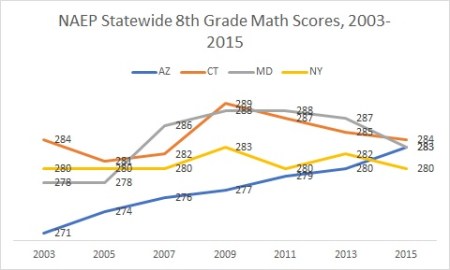
The 2017 NAEP will be released in a few months. Election years don’t usually serve as the setting for broad K-12 reforms, but my money is on Greg beating Mathews yet again.

Let’s see what happens next.


Chicago Mystery Solved?

December 27, 2017

(Guest Post by Matthew Ladner)

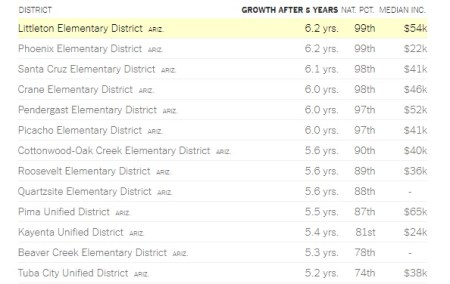
Large scale out-migration of low-income students may help explain Chicago’s apparent status as a value added champ.


“We know why parents want school choice…”

December 20, 2017

(Guest Post by Jason Bedrick)

In Mike Antonucci’s end-of-the-year roundup of quotes by and about teachers’ unions, this one stood out for me:

“We know why parents sometimes embrace these voucher schemes. They move their kids to these programs because they want smaller class size, safer environments and less and more sensible testing. That’s exactly what we want for public schools.” — Joanne McCall, president of the Florida Education Association

Wow, it’s almost as though — contrary to popular opinion among the ed establishment — parents know what’s good for their kids and where to get it!

McCall’s list is amusing for several reasons. First, if the district schools really want smaller class sizes, wouldn’t giving families other options accomplish that goal?

The same goes for safer environments. As Dr. Kevin Currie-Knight and I have explained, school choice not only gives bullied students an escape hatch, it also creates a strong incentive for district schools to take student safety seriously.

As for “less and more sensible testing,” I’m all for that. Would the teachers’ unions take a grand bargain that expanded school choice to all students while reducing top-down regulations on district schools (such allowing districts to decide which nationally norm-referenced test their students will take rather than being forced to administer the state test)?

Most school choice advocates would take that deal in a heartbeat, but I suspect that the people who constantly complain that “private schools aren’t held to the same high standards (that, ahem, we want to eliminate)” wouldn’t be willing to take that deal.

Of course, I hope I’m wrong about that. And the school choice movement will be waiting by the phone in case the unions call.


Yippie kai yay!

December 19, 2017

(Guest Post by Matthew Ladner)


Star Wars: The Last Boomer

December 18, 2017

(Guest Post by Matthew Ladner)

So still no spoilers here, but as a Gen Xer I have to say that the generational overtones between the Boomers and the Millennials in the new Star Wars flick make me chuckle. Luke as an old crazy guy is just…appropriate. That it was the next generation that helped drive him over the edge is…spot on. Where have you gone Master Obi-Wan? Our galaxy turns its’ lonely eyes to you.


This is not going to go the way you think

December 15, 2017

(Guest Post by Matthew Ladner)

Spoiler free review: I loved it, want to see it again. One subplot too many, but still very good. If “there is always a way to blow it up” sums up The Force Awakens, the title of this post summarizes this film. New ranking:

Empire

Last Jedi

New Hope

Rogue One

Return of the Jedi

Revenge

Christmas Special

Phantom

Clones


TUDA districts versus states

December 12, 2017

(Guest Post by Matthew Ladner)

So…Chicago…? Anyone?


The Option to Escape Bullying

December 11, 2017

(Guest Post by Jason Bedrick)

By now you’ve probably seen the heartbreaking video of Keaton Jones detailing the torments he suffers in the lunchroom. As Dr. Kevin Currie-Knight and I explained recently in Education Next, educational choice policies can give kids like Keaton a much-needed escape hatch — and provide schools with a stronger incentive to address bullying.

A Florida mom, Elsi Greciano, explains how school choice saved her daughter:

When my daughter [Maria] finished fifth grade, she begged me not to send her to the neighborhood middle school, because her tormenters would be there. So we enrolled her in an arts magnet. Maria loved the classes and was excited to start over.

But bad things kept happening. One boy groped her. Another humiliated her when she wouldn’t give him her phone number. When a teacher saw a group of boys taunting her in the cafeteria, she sent them to the principal, who suspended them. But then Maria heard the boys were going to beat her up because they got in trouble. She was so upset that she couldn’t sleep.

Sometimes the school tried to help. Sometimes it didn’t. After the cafeteria incident, I emailed the principal, but never heard back. That was the last straw.

We searched for private schools that would be good for Maria, and found One School of the Arts. It had a curriculum like the school we left, but a safe, family atmosphere. We fell in love with it.

We cut all our expenses so we could enroll Maria right away, then got a tax-credit scholarship. Four years later, Maria is in 10th grade and a totally different girl.

She’s confident. She speaks beautifully. She loves to debate in class. At the moment, she’s not sure whether she wants to be a missionary when she grows up, or a fashion designer, or president of the United States.

Fortunately, the Florida legislature is taking steps to ensure that bullied students like Maria and Keaton have other options. Florida already has a tax-credit scholarship program and an education savings account program, but not all students are eligible. The proposed Hope Scholarships would empower families of students who had been bullied or victims of abuse.

Hopefully other states will follow Florida’s lead.


Real Victories + Imaginary Defeats = “Unsettled Law”

December 9, 2017

(Guest Post by Jason Bedrick)

The constitutionality of tax-credit scholarships is in the news again, as Montana’s state supreme court will soon consider the issue. What makes Montana’s case unique is that the roles of the petitioners and respondents is reversed. Usually it’s school choice opponents who sue a state over its choice program. In Montana, the Department of Revenue decided — against the wishes of the legislature — to block tax-credit scholarship recipients from using them at religious schools based on its own squirrelly interpretation of the state constitution. That drew the ire of choice proponents, including the heroes at the Institute for Justice, who sued.

A district court judge ruled in favor of the Institute for Justice, but the state has appealed the decision to the Montana Supreme Court.

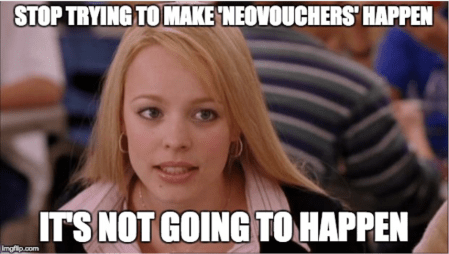
Based on the track record, tax-credit scholarships are very likely to win. But Kevin Welner, a long-time critic of tax-credit scholarships (he calls them “neovouchers,” but no one serious has followed his lead), disagrees:

“If you’re asking if this is an area of unsettled law, the answer is yes,” Welner said. “Generally, the differences that you see are reflective of the blue-red differences we have in this country.”

Is that so? Let’s see what the scorecard shows. First, the victories:

Tax-Credit Scholarship Legal Victories

  • Supreme Court of the United States
  • Alabama
  • Arizona
  • Florida
  • Georgia
  • Illinois
  • New Hampshire

It should be noted that the unanimous decision in Georgia was written by a justice appointed by a Democrat. In Florida and Illinois (not a red state, last I checked), the state supreme courts refused to hear appeals of lower-court victories. Also, before anyone objects “some of these were decided on standing, not the merits!” — there’s very little difference. First, all the decisions but New Hampshire’s explicitly state that tax credits do not constitute public expenditures in their decisions ruling against the plaintiffs’ standing, which is essentially ruling on the merits. Even New Hampshire’s state supreme court (which had a liberal majority) unanimously ruled against standing because the plaintiffs could not demonstrate any harm. Second, there’s functionally no difference between “constitutional” and “may or may not be constitutional on the merits but no one has standing to sue so the program may legally continue.”

Anyway, let’s now look at the losing side of the ledger to see how truly “unsettled” this area of law is:

Tax-Credit Scholarship Legal Defeats

  • None

This looks less like a “red state vs. blue state” divide than a “real state vs. imaginary state” divide.

My question for Welner is: how many states have to follow the U.S. Supreme Court’s lead before he believes the law is “settled”?

Also, a closing word of advice:
Screen Shot 2017-12-09 at 9.39.53 PM.png