Checker’s Case for World Government (and Common Core)

December 13, 2011

In the current issue of the Education Gadfly and on the Education Next blog Checker Finn offers an unusual argument for adoption of K-12 national standards.  He likens opposition to national standards to rooting for the Euro to fail:

If you hope the Euro crashes, that this week’s Brussels summit fails, and that European commerce returns to francs, marks, lira, drachma, and pesetas, you may be one of those rare Americans who also seeks the demise of the Common Core State Standards Initiative in U.S. education.

It’s odd that Checker should pick the Euro as a way to make the case for national standards since the Euro’s difficulties wonderfully illustrate the problems with national standards.  The Euro is in trouble because it was an attempt to impose a common currency on countries that were too diverse in their economic needs and political traditions.  The Euro is too strong of a currency for countries with un-competitive labor forces and undisciplined budget deficits, like Greece, Italy, and Spain.  But if the European Central Bank significantly loosens the currency to bail out these countries, it will create serious inflation problems in countries like Germany and others with more skilled labor forces and reasonable deficits.

The Euro is not in trouble because some people “hope the Euro crashes.”  It’s in trouble because it is a centralized institution that does not fit the diversity of its members.

Similarly, national standards will fail because it is not possible to have a centrally determined set of meaningful standards that can accommodate the legitimate diversity of needs, goals, and values of all of our nation’s school children.  To have an effect national standards inevitably drive the assessments that are used to measure student achievement as well as the methods of instruction that are used to produce that achievement.  “Tight-loose” is just an empty slogan (or part of a drinking game).  In reality standards, assessments, and instruction are closely connected unless they are just irrelevant things.

In a country as large and diverse as ours there is no single, right set of knowledge for all students to possess, no single, best way to assess that knowledge, and no single, best method for teaching it.  The attempt to impose a nationalized system onto this diversity is doomed to fail just as the Euro is doomed to fail in imposing a common currency on such diverse economies and political systems.

The fact that the Euro is in such trouble and creating such political and economic turmoil ought to scare us away from trying to impose a centralized solution on too much diversity.  The Euro crisis is an argument against national standards, unless we are eager to have similar difficulties here.

No one is rooting for those failures, per se.  Some of us just recognize that reality is not created by repeating slogans to each other over catered lunches at DC think tank conferences.  Reality actually exists out there in the world and no matter how many chardonnays I’ve had while listening to the keynote speaker and no matter how many grants the Gates Foundation sprinkles on me and my friends, centrally imposing institutions on too much diversity is doomed to fail.

Of course, there is a way to overcome that diversity and improve the chances for centrally imposed institutions to succeed — force.  If European countries relinquish power to make their own budgets to a central authority, the Euro might work.  Similarly, if individual schools, school districts, and states relinquish power over daily operations to a central authority, the nationalized education movement might succeed.

But achieving that type of centralization in the face of diversity requires an enormous amount of coercion.  People who disagree have to be suppressed, or at least denied the ability to do anything about their dissent.  Local folks no longer get to make the meaningful decisions.  They can just implement the decisions that are centrally made.

This could work but it would be awful.  Some people say they would favor a World Government if only it were possible to do it.  I’m not one of those people.  World Government would be awful because it would require an enormous amount of coercion to overcome local diversity.  To a much lesser degree, a nationalized education system in the US could be done but it would run roughshod over the needs and legitimate interests of many individuals.

But some people are nevertheless attracted to centralized solutions.  I think Tears for Fears has a song that might explain why.


Parenting Advice from Sara Mead

December 12, 2011

Sara Mead takes issue with my recent post that puts misconduct by some McKay schools in perspective.  I noted that those reacting to reports of misconduct by calling for the elimination or heavy regulation of McKay do not similarly react to incidents of misconduct in traditional public schools.  She likens this to a misbehaving child saying “he did it first.”  Sara urges us to be tough parents who don’t accept such weak excuses:

I was a very naughty child. When I was inevitably caught misbehaving, I often tried to justify it by saying “So-and-so (usually my sister or a classmate) did it first!” Not surprisingly, that argument never won the day or kept me from being punished.

I was reminded of this by Jay Greene’s recent blog post about reports of malfeasance and fraud by operators participating in Florida’s McKay Scholarship program for children with disabilities. Jay cites a series of examples of abuses in public school districts–basically a grown-up “he did it first!”–before stating that “existence of misconduct in traditional public schools in no way excuses the misconduct that has been uncovered in the McKay program.”

Glad we agree on that one!

Let’s ignore that I clearly said (in the comment she quoted!) that misconduct by McKay providers is inexcusable.  And let’s ignore that she mis-characterizes my call for perspective.  And let’s ignore my argument that the direct operation of schools by the government or heavy regulation of private providers unfortunately does not eliminate misconduct.

Instead, I would like to offer some parenting advice of my own.  When I was a child I sometimes tried to persist in making an argument, even when the evidence contradicted it.  My parents correctly taught me that when you are wrong, you should admit it.

I was reminded of this when thinking about Sara Mead’s repeated claim that the McKay Scholarship program provides incentives to increase the over-identification of students as disabled.  In 2003 she and Andy Rotherham released a report that made a series of speculative allegations against McKay, including:

special education vouchers may actually exacerbate the over-identification problem by creating  a new  incentive for parents to have children diagnosed with a disability in order to obtain a voucher. In fact, if special education identification led to funding for private school attendance, it would be unusual if this did not create an incentive to participate in special education in many communities, particularly those with low-performing public schools.

And in 2007 Sara Mead repeated the claim:

Offering vouchers to children with disabilities—and only children with disabilities—creates an incentive for parents to seek out a special education diagnosis in order to get a voucher. Anecdotal evidence suggests that some parents seek out diagnoses of learning disabilities or attention deficit hyperactivity disorder (ADHD) to get their children additional help and accommodations on tests. McKay’s offer of a voucher for students with disabilities creates an even stronger incentive for parents to “game the system.” And Florida psychologists who diagnose youngsters with ADHD and other disabilities have told reporters that they see some Florida parents who are seeking these diagnoses just so they can get a McKay voucher.

But in 2009 Marcus Winters and I released an empirical examination of the issue that actually found the opposite.  McKay actually provided incentives to reduce the excessively high rate at which students are identified as disabled.  And in June of this year, the leading quantitative AERA journal, Education Evaluation and Policy Analysis, published our article with this finding.

Nowhere has Sara Mead said that she was mistaken.  And last week Education Sector responded to reports of misconduct in McKay by urging people to read the 2007 report with this (and other) false or unsubstantiated claims.  People shouldn’t persist in repeating false claims.

I hope we can agree on that one.


The Rise of the Zune Monopolists

December 12, 2011

(Guest Post by Jim Stergios)

image002.jpg

Understand, I am not for monopoly when we can help it,” Louis Brandeis said in 1912. “We intend to restore competition. We intend to do away with the conditions that make for monopoly.” (Wikipedia)

Brandeis had some inkling of what hare-brained schemes philanthropists could come up with. Remember the Simple Spelling Board Andrew Carnegie set up in 1906?

The New York Times noted that Carnegie was convinced that “English might be made the world language of the future” and an influence leading to universal peace, but that this role was obstructed by its “contradictory and difficult spelling.”

105 years later, Sam Dillon of The New York Times produced a terrific piece of journalism in a May 2011 Sunday article on the overweening ambitions of the Gates Foundation and its list of DC-based clients, vendors and trade organizations like the National Governors Association; the Chief State School Officers; the Fordham Institute; Achieve, Inc.; as well as the Gates Foundation’s strategy to leverage, really to drive, federal policy in the Obama Administration’s US Department of Education. In the May article, Dillon wrote:

For years, Bill Gates focused his education philanthropy on overhauling large schools and opening small ones. His new strategy is more ambitious: overhauling the nation’s education policies…In some cases, Mr. Gates is creating entirely new advocacy groups…[The Gates Foundation] is bankrolling many of the Washington analysts who interpret education issues for journalists and giving grants to some media organizations.

Dillon continued:

The foundation spent $373 million on education in 2009, the latest year for which its tax returns are available, and devoted $78 million to advocacy — quadruple the amount spent on advocacy in 2005. Over the next five or six years, Mr. Golston said, the foundation expects to pour $3.5 billion more into education, up to 15 percent of it on advocacy…Given the scale and scope of the largess, some worry that the foundation’s assertive philanthropy is squelching independent thought, while others express concerns about transparency.

Yup. The Gates Foundation and the enormous financial interests associated with the Washington education lobby have decided that the U.S., despite its 222-year history to the contrary, needs a nationalized K-12 education system. No matter that the arguments for it are flimsy:

  1. Nations with national curricula do better than ones without on international tests
  2. . Not true.

  3. The national standards raise the bar set by states. For some, for some it’s a wash, and for some it is a step backwards. Prominent researchers and subject experts (Stotsky, Wurman, Milgram, Porter and others) find the standards lacking in comparison to international benchmarks. Basically the Gates folks are setting up a community college readiness set of standards.
  4. The new national standards will give us the ability to craft better tests. No one knows. They are not complete. And we have no idea where proficiency levels will be set, whether they will build off of Massachusetts’ content frame or the frame of other state tests, which are more skills-based.
  5. The new national standards will be serious content-based standards. Uh, no. The fact that one of the Gates Foundation allies, the Council of Chief State School Officers, absorbed the Partnership for 21st Century Skills is more than a whiff of evidence to the contrary.
  6. The new national standards will save money. Implementation of the standards, through textbook purchases and professional developments, as well as technology and other actions necessary to implement the tests will cost tens of billions of dollars. States and localities will pay for 90 percent of this if history is any guide.
  7. The new national standards will improve accountability. The reset of state standards means a loss of longitudinal data on student performance and will take at least half a decade to amass. Again, without the knowledge of where proficiency will be set and what the tests look like, this is fanciful thinking.
  8. The new national standards will help improve teacher quality. Huh? Not sure how they came up with this one. Perhaps it will cure the common cold as well. The fact for Massachusetts is that the new national test and standards will undermine one of the “secret sauces” of the Bay State’s success: the teacher test (MTEL) is aligned with student tests and the standards to ensure that teachers are able to teach the materials required in the state test. We will now have to refight that battle with the unions based on the new national standards – and it will be a tough battle drawing in national lobby groups. That’s going to be hard to win.
  9. The new national standards will drive innovation. Yeesh. I hear this from virtual learning providers all the time. Of course, if you set one set of standards, then your product development is easier and less costly in the short run. But this is the Zune argument (see below) and it’s stupid. Think about this: Most of the countries with national standards (think Finland) are the size of a state in the U.S. and often relatively homogeneous. Instead we are forging standards for 53 million kids from very diverse backgrounds.

We need one set of standards as much as we need one exclusive operating software, one keyboard for the world, and one Zune. You remember the Zune, right?

image004.jpg

Thankfully, because consumers have the freedom to choose the products they buy, it got killed by the iPod. Curtis Cartier of The Seattle Weekly blog noted even this past March that the Zune, Microsoft’s signature paperweight, hasn’t seen a significant upgrade, or really anything in the way of marketing or promotion, in almost two years . . . No, really, they still make the Zune. I know, right? Microsoft bloodhound Mary Jo Foley writes at ZDNet about “Project Ventura,” a music- and video-based service that seems to be exactly what Zune and the Zune Store is, but thankfully, not the Zune.

Ventura, from what my tipsters tell me, is the name of a set of services being developed by Microsoft’s Entertainment and Devices (E&D) unit. These services are focused on music and video discovery and consumption.

Wikipedia notes:

On October 3, 2011, Microsoft announced that it has discontinued all Zune hardware, encouraging users to transition to Windows Phone.

Aw, shucks. And I was waiting for the new and improved Zune. Just holding my breath. And I know we all have such high expectations for Ventura.

Then there is # 9. Experts creating the standards have built off state successes. That’s hardly the case with the Massachusetts standards or the California standards, which were among the best in the country. So, maybe they built off Bob Wise’s West Virginia standards, Gene Wilhoit’s Kentucky standards, Jeb Bush’s Florida, and Checker Finn’s Ohio state standards. These are all people who promote national standards. And their state standards were mediocre and worse. No wonder they look at the community college readiness standards as a step forward.

Make no mistake about it, this is an effort built from the mainframe developed in 1992 by Marc Tucker, then president of the National Center on Education and the Economy, who in his famous 18-page “Dear Hillary” letter called for

a seamless web that literally extends from cradle to grave and is the same system for everyone,” coordinated by “a system of labor market boards at the local, state and federal levels” where curriculum and “job matching” will be handled by counselors “accessing the integrated computer-based program.

Such words may please Bill Gates, given his less than warm view of the liberal arts. The drive to nationalize education is so important to the DC lobbying crowd and the Gates Foundation that they are willing to overlook some “niceties,” such as the fact that it violates provisions in three federal laws (including the original Elementary and Secondary Education Act, the US Department of Education’s 1979 enabling legislation, and No Child Left Behind). Perhaps understanding the rule of law is a 20th-century skill.

Only this time, the DC advocates for this sort of educational lobotomy (which places workforce development above the formation of free citizens) have learned lessons from the past, when national standards efforts died off because they were done in the light of day. As Pioneer’s Jamie Gass noted a year ago in The Providence Journal:

When it comes to the national standards, the line dividing public officials and trade organizations has become so murky that Pioneer Institute recently submitted a Freedom of Information Act request for correspondence between state education officials and organizations like NGA, CCSSO, the Gates Foundation and the Common Core State Standards Initiative. It’s particularly unfortunate that public education is the setting for this circumvention of democracy and the public trust. Even as we teach our children about the sanctity of the Constitution, the Bill of Rights and the Federalist Papers, they watch adults develop ever-more-clever ways to brush aside the principles those documents exemplify.

Those comments are based on experience. A year after Pioneer submitted a basic Freedom of Information Act search of the national standards in Massachusetts we’ve received more delays and stonewalling than any concrete FOIA results.

What I want is a debate on the merits of this effort before we call the game over. And when we have that argument, the national standards folks lose. Consider the fact that in August the American Legislative Exchange Council (ALEC), an association of conservative legislators, debated the merits of model legislation to pull out of the national standards at their quarterly meeting in New Orleans. Given the fact that most state legislatures and legislators are Republican, this is an influential group.

At the last minute, as Kris Amundson of Education Sector noted, Jeb Bush wrote “to the ALEC delegates urging them to table the resolution.”

They did and instead set up a series of sessions debating the issue at the end of November in Scottsdale, Arizona. The debate was open and frank. And as Catherine Gewertz of EdWeek reported, and Lindsey Burke of the Heritage Foundation notes in her blog, the ALEC Education Task Force debated model legislation that would aid states seeking to “exit the national standards project and regain control over what is taught in local schools.”


Arizona Republic Series on Digital Learning

December 12, 2011

(Guest Post by Matthew Ladner)

The Arizona Republic began publishing a multipart series on digital learning here in our humble patch of cactus on Sunday. You can read installments one and two online.

Thus far, here is what I have learned for this series: Arizona is a wild west in terms of regulatory oversight, the main online providers in Arizona earned C grades, pure online learning works for some kids and not for others, Gene Glass dislikes online learning, and some people are uncomfortable with for-profit companies being involved in education.

Perhaps they are pacing themselves by backloading the stuff we didn’t already know into the latter part of the series.

The Wild-West bit is par for the course out here and it may be just as well. It isn’t like an extra bureaucrat or three would be likely to do anything productive. What is needed in my view is a system of 3rd party administered end of course exams. A good portion of the funding should be conditioned on how the student performs on these exams. At the moment, Arizona law provides an incentive for students to sign up for online courses rather than to educate students. The same of course can be said for the traditional districts. The river needs to flow both ways on this, as I have no more interest in funding mere seat time in a brick and mortar than I do academic failure in a digital setting. If someone needs to go first, I nominate the digital providers.

He likes it! Hey Mikey!

At the moment, Arizona has neither end of course exams developed, nor any infrastructure for 3rd party administration of such exams. Neither to my knowledge does anyone else. Time to get cracking on that.

I could write an entire post on how silly it is to implicitly expect for-profit companies to spend more money than they receive. Maybe later in the week. In the meantime, I’ll be curious to see what the Republic has to say next.


Perspective on McKay

December 10, 2011

Ed Week, Ed Sector, and others are picking up on a hyperventilating story from the free weekly Miami New Times about misconduct in Florida’s McKay Scholarship voucher program for disabled students.  The piece is actually a re-hash of a story the New Times ran 5 months ago about private schools participating in McKay that mishandled money, hired incompetent staff, or failed to provide adequate services.

The stories were embarrassing, but the reaction by the New Times and others has been completely lacking in perspective.  Organizations receiving government funds are unfortunately even more prone to misconduct than typical organizations.  This is also true of public schools.  For example in the Detroit Public Schools we see:

 Five Detroit Public Schools employees have been charged with embezzlement in an ongoing probe into the “culture of corruption” that took hold in the state’s largest district, a prosecutor said Wednesday….

A series of audits into district finances have been ordered. Two separate audits announced last week revealed the district has been paying $2.1 million per year for health coverage for ineligible dependents, and bought 160 unused BlackBerries and 11 motorcycles.

“It has been said that the accomplice to corruption is frequently our own indifference, and I agree wholeheartedly with that,” Worthy told reporters in announcing the charges.

“My office was not surprised about the culture of corruption that we’ve been seeing in the past in the Detroit Public Schools system,” she said. “What did surprise even us, though … is how rampant, how overt and how conspicuous and downright bold-faced the corruption is, allegedly, in some of the cases that we’ve been looking at.”

And from Springfield, MA public schools we learn:

A 13-month audit recently concluded at Putnam Vocational Technical High School found that some employees abused a student association checking account that operated independently from the city and school system in apparent violation of Massachusetts law.

McCaskill was in charge of that unauthorized account, which averaged about $200,000 annually in transactions since late 2005, but was managed with a manual ledger that never matched bank statements, according to the report from Springfield’s Office of Internal Audit….

“There is no excuse for the disgraceful, dishonest practices that appeared to have run rampant among a group of employees at the school for several years,” Ingram also wrote in a post on his official blog.

And right in the backyard of the Miami New Times we find the mysterious absence of $3.8 million from the Broward County teacher union accounts, the prior head of the Broward teacher union in jail for soliciting sex from a minor, and the former head of the Miami-Dade County teacher union in jail for corruption and embezzlement.

And while the New Times was repeating the complaints of Miami-Dade superintendent  Alberto Carvalho about McKay, they somehow failed to mention Carvalho’s own history of manipulating newspaper coverage through a reporter with whom he was reportedly having an affair.

But these are just selected anecdotes.  In a systematic study of scandals in public and private schools, Greg Forster and Matthew Carr found that misconduct was actually slightly more likely in regulated public schools than in largely unregulated private schools.  That is, some amount of scandal is unfortunately unstoppable and increasing regulation or government operation of schools is unlikely to eliminate the problem.

Of course, the existence of misconduct in traditional public schools in no way excuses the misconduct that has been uncovered in the McKay program.  But then again no one calls for the public school system to be shut down as a result of these scandals like folks are calling for an end to McKay.  And Diane Ravitch, in her typical, scholarly fashion, responds to the McKay reports by tweeting “Legalized child abuse in Florida?”, but appears to have no reaction to similar reports from traditional public schools.

My point is that the reaction to reports of misconduct in the McKay program are lacking perspective.  Yes, abuses need to be stopped.  And the regulations on the books, if enforced, could keep those abuses to a minimum.  As former Senator John McKay told a Florida newspaper in response to calls for more regulation:

Kriseman suggested nine issues to increase accountability, including mandatory site inspections of facilities. He said the Department of Education should review and sign off on personnel criminal background checks in facilities seeking to receive McKay dollars. And teachers in a school accepting McKay dollars should have a state teaching certificate.

Former State Senate President John McKay — who created the law — agrees. McKay listened to Kriseman’s full list of suggestions.

“A number of his suggestions are quite positive,” McKay said. “Many of the things he’s asking for are already in the statute.”

McKay suggested asking officials with the Department of Education to enforce the law.

“It’s nice to have words in a statute,” McKay said. “Unless someone does something, it’s kind of meaningless.”

And of course, all of these criticisms of McKay fail to mention the proven positive effects of the program.  It improves student achievement for disabled students, reduces the rate of new identification of disabilities, increases the chances that students will receive needed services, and is overwhelmingly loved by parents.  I wish we could say the same about all traditional public schools, including those riddled with misconduct.


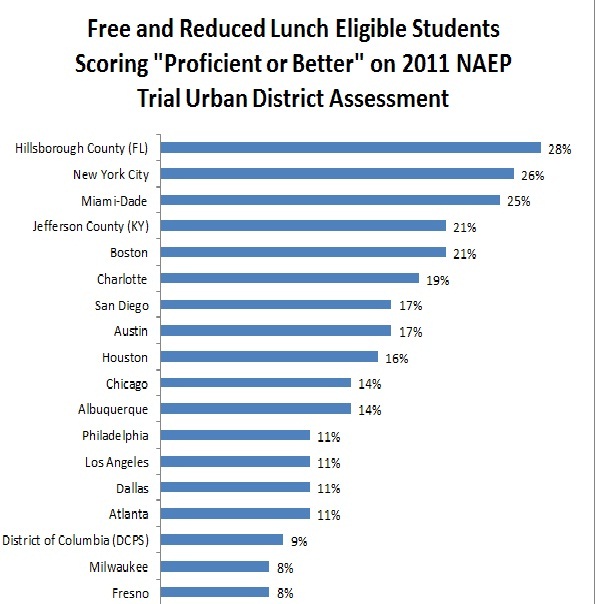
2011 Trial Urban NAEP-Which Districts to Avoid When Reincarnated as a Poor Child…

December 9, 2011

(Guest Post by Matthew Ladner)

…if you want to learn how to read. In the great reincarnation to come, you want to request Tampa, New York City or Miami. You are three or more times more likely to learn to read at a high level than in Fresno. DC has improved but is still horrible.

I haven’t read the appendix about the inclusion/exclusion rates but the burden of proof lies on Kentucky rather than the other way around on that Jefferson County number. Tied with Boston? Color me skeptical.

Everyone in Wisconsin ought to be horrified by the abomination that is the Milwaukee Public Schools. These awful results make me all the more grateful that kids have the possibility of choosing a charter or private school, and the results may have been even worse in the past (can’t track them very far back) but it is time for something far more drastic.

There should be no bullets left in the gun when it comes to Milwaukee. Policymakers should correct the bad joke of an accountability system the state has employed for starters. Lawmakers expanded appropriately expanded choice last year (can’t get too many lifeboats for that sinking ship) but ought to consider a different governance structure as well.

Meh results from former reform luminaries North Carolina and Texas. The low-hanging fruit has been picked off the tree.

Discuss amongst yourselves…


The Incredible Hulk on Digital Learning

December 8, 2011

(Guest Post by Matthew Ladner)

It turns out that after a full day of smashing supervillians, the Hulk loves to kick back and rap about technology based learning. Who knew?


The Feds and Data

December 6, 2011


Look out! The feds have come to collect you!

(Guest post by Greg Forster)

 Today’s NYT features an op-ed by stand-up guy Rick Hess and pathetically failed charter school founder Linda Darling-Hammond, bemoaning federal micromanagement of schools and also suggesting four things the federal government should be doing in education. Neal replies with a step-by-step critique of the four suggestions. I’m with Neal on most of the issues, but I think Neal underestimates the legitimacy and usefulness of federal data collection.

Neal is correct that much of what Hess and Darling-Hammond ask for under the rubric of “transparency” is unrealistic. But he also writes: “There is precious little evidence Washington can force real transparency. NCLB is exhibit A.” However, he only goes on to discuss the AYP reports. NCLB also required, for the first time, every state to administer the NAEP. That was a huge transformative change. All those state-by-state comparisons everyone has been doing for the last decade, which pop up ubiquitously in education dialogue and have created a lot of real pressure for reform, come directly out of NCLB’s requirement that every state do NAEP.

Neal himself, in the same post, cites a national analysis of NAEP data to argue that NCLB hasn’t lifted scores. I agree! But it was only NCLB’s requirement that every state do NAEP that allowed Neal, myself, and others to know that.

Neal and I have already tangoed on the federalism question enough times before. Short version: I’d prefer to get the feds completely out of education, but since we can’t have that, I’m content to have them ask for basic data collection in return for the funding rather than have them not ask.

Neal is also largely right on the second point in the Hess/Darling-Hammond article; test score disparities shouldn’t be made into civil rights cases. But there are other, more legitimate ways to get at federal civil rights issues. For example, I believe that special education systems that systematically create false diagnoses are a legitimate federal civil rights issue, and if the feds were interested it would be relatively straightforward to create simple auditing systems that would discourage these abuses.

And on the last two items, Neal is bang on. Except insofar as data collection counts as research (see above), government shouldn’t fund studies. It should fund . . . data collection that allows the rest of us to do studies! And the whole competitive grant thing – well, setting up Arne Duncan, Suuuuuuuuuuuuper Geeeeeeeeeeeeenius as a one-man national legislature is just not good mojo.


Liberty for Me But Not for Thee

December 6, 2011

I’ve been chatting with some students about how exceptionally rare liberty is.  In all of human history there has been wide-spread respect for liberty in only a small portion of the globe for a brief stretch of time.  The problem isn’t that people lack desire for their own liberty.  The problem is that people are not usually inclined to extend liberty to others when they have the power to get what they want and constrain what others want.  That is, respect for the liberty of others is not natural or automatic.  It takes some sort of miracle for people to resist the corrupting temptation of power to protect their own autonomy while denying it to others.

George Washington performed one of these miracles to establish the foundations of liberty.  Faced with the opportunity to become dictator for life, he voluntarily relinquished power.  Keeping that power would have allowed him to best protect his own autonomy while promoting his own vision of “the good” for others.  Instead he put at risk his own autonomy and denied the natural inclination to impose on others by voluntarily leaving office.

If this seems routine to us today, try to name others who voluntarily walked away from total power.  Napoleon couldn’t resist the temptations of absolute power.  He’s reported to have declared with disgust as he was being dragged away to Elba that they thought he would be another Washington.  But Napoleon was no Washington and almost no one else is either.

Remember that Hitler was democratically elected.  The Iranian revolution began democratically.  The Arab Spring is quickly turning into an Arab Winter, with parties opposed to liberty and tolerance winning elections.  It is quite common to see a country’s first, free democratic election turn into its last.

Even the English respect for liberty was not derived from leaders voluntarily relinquishing power.  Financial distress forced limits of power on English monarchs, leading to the gradual growth of respect for liberty.  The current German and Japanese respect for liberty was imposed on them through conquest.

The only other major example of a leader voluntarily relinquishing power that I can think of is King Juan Carlos of Spain refusing to be Franco’s dictatorial successor and also putting down an attempted coup.  Of course, Juan Carlos’ example helped change expectations about leaders throughout Latin America, which helped ignite an expansion of liberty.  And the English example planted seeds of liberty in its former colonies.

But other than Juan Carlos and Washington, how many examples could we cite of leaders who truly had the opportunity for absolute power who refused to grab it?  If the desire to extend liberty to others were so natural and common, this sort of thing should happen all of the time.  It doesn’t.  It takes miracle-makers like Washington and Juan Carlos to establish the social expectation so that others tempted to grab power will be prevented from doing so.  That’s why we should study their example and sing the praises of these liberty miracle-makers.


National Standards Shows Cracks

December 5, 2011

Last week the education task force of the American Legislative Exchange Council (ALEC) endorsed measures urging states to oppose adoption and implementation of the federally “incentivized” Common Core standards.  According to Catherine Gewertz at Ed Week:

A package of model legislation opposing the common standards gained ground yesterday at the American Legislative Exchange Council.

The organization’s education task force approved the package, we learned from a couple of folks who attended those sessions of ALEC’s meeting this week in Scottsdale, Ariz.

Gewertz added that the measures do not become official ALEC policy until they are approved by the board of directors.  A similar proposal was proposed last summer by members of the education task force but was tabled until the recent meeting.  Allies of Jeb Bush and the long, gilded arm of the Gates Foundation pulled out the stops to block the measure and may yet succeed at the board level.

I fear that even if the measure is approved by ALEC’s board, the battle over adoption may effectively be finished.  An effort to repeal Common Core standards in Alabama failed despite the fact that the governor proposed the repeal and votes on the state board of education.   If you can’t repeal national standards in Alabama under such favorable conditions, it may be very hard to repeal it in any of the other 40-some states that have signed on.

But just because the adoption debate is winding down doesn’t mean the national standards war is over.  Far from it.  So far states have done the costless and non-constraining step of adopting a set of standards.  Once the nationalizers try to make the standards concrete and binding by incorporating them into newly designed high-stakes testing, we are likely to see a lot more resistance.  And adopting those new tests, revising teacher training, professional development, and textbooks to fit the national standards and testing will require considerable effort and expense — causing more states to rethink their initial support for Common Core.

The ALEC anti-Common Core measure will be important for mobilizing opposition as those next hurdles have to be jumped.  Even if the nationalization effort successfully runs this gauntlet, which they may do, the probability that national standards and assessments will actually produce the end goal — significantly improved student achievement over the long term — is near zero.  If nationally setting goals and ordering progress toward those goals were the path to success, the Soviet Gosplans would have produced their economic triumph over the West.  We all know how well that turned out.