(Guest post by Greg Forster)
Fordham desperately wants you to believe that they want “transparency, not accountability” from the feds. Don’t believe a word of it. It’s true only if you define “accountability” as “school-level accountability.”
Fordham’s idea is that the feds get unlimited and unaccountable power to decide what schools should be doing, and then the states are in charge of holding schools accountable for doing what the feds have decreed they should do. It’s “tight-loose”!
The executive summary of the Fordham report – which is the only part of it most people will bother reading, and the Fordham folks know it – mouths just the right reassuring weasel-words to throw you off the scent:
Transparency in lieu of accountability. Results-based accountability throughout the education system is vital, but it cannot be successfully imposed or enforced from Washington. Indeed, the No Child Left Behind experience has shown federal “accountability” in this realm to be a charade. The federal government can’t force states and districts to turn around failing schools or offer students better options. What Uncle Sam can do is ensure that our education system’s results and finances are transparent to the public, to parents, and to educators.
In a comment on Matt’s post this morning, Mike Petrilli shows up to peddle the same line:
Hi everyone. When you look closely at our proposal (if you can get past the preface, Matt!) you’ll see that we’re all advocating more or less the same thing: Mandate “transparency” but not accountability. We can quibble about the details.
That’s pretty hard to believe given that up through the day before yesterday, Fordham was stumping for the federal-government sponsored initiative to create national standards, national curriculum, and national assessments.
And, in fact, you don’t even have to get very far into the main body of the Fordham report (which few will read) before you see how empty these gestures are.
The report considers ten policy questions, giving “the reform realism position” on each one. Question one is: “Should states be required to adopt academic standards tied to college and career readiness (such as the Common Core)?”
Jay has already pointed out that “college and career readiness” is an empty phrase. It’s a blank check that the feds can fill in later.
But let’s set that aside. What is Fordham’s position on the use of federal government power to define what schools should be held accountable for doing?
As a condition of receiving federal Title I funds, require states to adopt the Common Core standards in reading and math, OR to demonstrate that their existing standards are just as rigorous as the Common Core. Standards developed apart from the Common Core initiative would be peer reviewed at the federal level by a panel of state officials and content-matter experts; the panel itself (not the secretary of education) would have the authority to determine whether a state’s standards are rigorous enough.
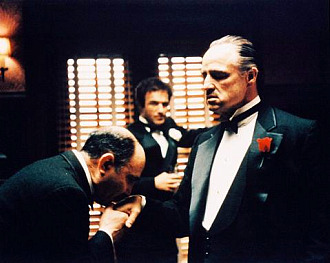
So adopting Common Core is just about as “voluntary” for the states as signing Johnny Fontane was for Jack Woltz.

Governor Walker the morning after Wisconsin opts out of Common Core
How naive do these people think we are?

 Jay P. Greene's Blog
More important than standards is the bit in the new Fordham report on assessments. Assessments are the thing that drive what schools are likely to do and the Fordham vision is to have that nationally imposed unless a state can prove to a death panel (I mean expert panel) that its alternative assessment is at least as good.
They write:
“As a condition of receipt of Title I funds, require states to set achievement standards
such that students will be college- and career-ready by the time they graduate from high school.
Require states to back-map achievement standards down to at least third grade, so that passing the
state assessment in each grade indicates that a student is on track to graduate from twelfth grade ready
for college or a career. States that opt out of the state assessment consortia funded by Race to the
Top (RTT) would have their standards peer reviewed at the federal level by a panel of state officials
and content-matter experts. The panel itself (not the secretary of education) would have the authority to determine whether a state’s standards are adequately tied to college and career readiness. No
state would be required to adopt achievement standards developed by the Common Core assessment
consortia”
Greg and Jay, I’m really torn. You imply such authoritarian heavy handedness… yet the headings throughout were in a friendly Comic Sans stylized marker font draped in casual highlighter scribbles.
Yes, that threw me off at first as well. But if you examine it closely, a trained eye can spot telltale differences in curvature that indicate those headings are actually in Authoritarian Comic Sans rather than the nearly identical Friendly Comic Sans. You have to watch these things carefully!
Wow, the vitriol! The suspicion! The conspiracy theories! You guys must be rooting for The Donald.
In all seriousness, we’re not trying to pull the wool over anyone’s eyes. We’ve been for national standards and tests forever, mostly because we’re for rigorous standards and tests. We think the Common Core standards came out pretty good (not perfect–pretty good). They put forward high expectations and if kids master them we think they will be ready to take credit-bearing courses in college. (Admittedly, the “career” part of “college and career readiness” is pretty squishy.)
What we’re saying is that if federal taxpayers are going to spend $13 billion or so a year on our public education system, it’s reasonable to ask for something in return. That something, we think, is for states to produce reliable information about how their students are performing (and how much their schools are spending). Thus our recommendation to be fairly prescriptive about the standards and tests–not the content, but the level of rigor.
We wrestled with the “peer review” process and landed in a place that we thought respected states’ rights but also provided some oversight. So the Secretary of Education doesn’t get to make these approval decisions unilaterally. In practice, we suspect that states with serious standards–like Texas and Virginia–would win approval without a problem. Alaska, with its farcical standards, would not.
But yes, Greg, we are focused mostly on stepping away from federally-mandated school-level accountability. As you can tell if you read Flypaper, that has us in hot water with Sandy Kress, among others.
Honest to goodness I don’t want to prescribe what American schools teach all day. I’ve got my son in a Waldorf preschool–it wouldn’t meet anyone’s idea of a “standard” education. But I do want parents and taxpayers to be told the truth about whether their own kids–and the state’s kids–are getting prepared for higher education. To me that’s not an authoritarian request but a reasonable trade-off.
Forgive me if I lost my temper. Let me try to be less vitriolic.
1) Since you’re in favor of national standards and tests – and also a national curriculum – will you agree that the statement “we’re all advocating more or less the same thing” is inaccurate?
2) In what sense do you respect what you describe as “states’ rights” given that each state will totally lose all control over its standards and assessments to politicians from outside that state? From Wisconsin’s point of view, how is it any better for us if the dictator who takes control of our standards and assessments is a panel of politicians from Vermont, New Mexico, Illinois and California rather than DC?
You describe these mysterious and unaccountable panels as “peer review.” When you submit an article to peer review, are you keeping control over whether it gets published, or giving up control?
Personally, if we must surrender control of our standards and assessments, I’d much rather have a single national dictator than a series of mysterious panels. You get more – what’s the word? – transparency. Also more accountability.
For the record, I don’t think it’s a good idea to conceptualize the relationship between state and federal responsibilities in terms of “rights.” Checks and balances would be a much better conceptual framework.
3) How is being “fairly prescriptive about the standards and tests” not being prescriptive about “content”? Especially since Fordham favors a national curriculum?
4) When the average educated reader hears you saying you want “transparency not accountability,” do you think he will walk away with the impression that you do, or do not, want to be “fairly prescriptive about the standards and tests”?
5) “In practice, we suspect that states with serious standards–like Texas and Virginia–would win approval without a problem.” Why? What reason do we have to expect these panels to make decisions on the merits when they face overwhelming incentives to make the decisions politically and no incentives at all to make them on the merits?
I just want to hear you say with a straight face that you think this massive DC bureaucracy and these shadowy review panels, all of which are under political control, are going to make decisions on the merits.
6) What effect do you think it will have on governors who are considering whether or not to support painful educational reforms if their access to Title I funds is beholden to these mysterious political panels drawn from outside their states?
7) How do you reconcile the statements that you want the federal government to be “fairly prescriptive about the standards and tests” and that you “don’t want to prescribe what American schools teach all day”?
8 ) You describe your approach as a “reasonable trade-off.” What is being traded off?
Of course, it’s quite easy to define reasonable sounding “trade offs” with straw alternatives.