Destruction of a Profession in PJM

November 12, 2009

(Guest post by Greg Forster)

This morning, Pajamas Media carries my column on Public Agenda’s study documenting the destruction of a profession:

As D-Day for health care “reform” approaches, we’re hearing a lot of contradictory claims about how things are going in countries where they have socialized medicine. One side says Canadian, British, German, and even (in the more extreme cases) Cuban health care is wonderful. The other side says it’s a catastrophe. All these directly conflicting claims aren’t very helpful to those who might be in doubt about the truth.

Instead of seeking our evidence in far-flung corners of the world, why don’t we look at what’s happened to the one profession we’ve already socialized right here at home? The government school monopoly gives us a great opportunity to examine what happens to a profession when you dragoon it into government service.

A commenter offers a point that I think is valid – it’s hard to disentangle the effects of “socializing” a profession from the effects of “unionizing” it. But how different are those? The head of the health-care worker union SEIU, under a cloud for apparently having approached Rod Blagojevich about a bribe, is nonetheless the top visitor to the White House.


Civic Knowledge Polling Controversy

November 12, 2009

 (Guest Post by Matthew Ladner)

Last summer, I wrote a study for the Goldwater Institute reporting the results of a survey in which we gave 10 questions from the United States citizenship exam to Arizona high school students. The results were terrible, with only about 3.5% of the district students scoring 6 or better correct (passing). A few months later, I replicated the study for the Oklahoma Council of Public Affairs (OCPA) with Oklahoma students, and the results were even worse.

Since then the survey firm I used, Strategic Vision, has come under attack from a group of critics. I believe that it started over a poll from the New Hampshire primary last year. I am in no position to judge the merits of the case involved. Over the past few weeks, the critics have turned their fire on the civics surveys. Strategic Vision’s most aggressive critic claims that someone has replicated the Oklahoma survey and found them far more cognizant of civics than the Strategic Vision reported, concluding that SV simply fabricated the data. Smelling blood, my old friend Leo Casey is waving the bloody shirt. Some are wondering how anyone ever bought into the results in the first place or are feeling buyer’s remorse.

A few comments seem in order.

First, both myself and OCPA are investigating the validity of the survey. We have asked for and received call logs for the surveys, and we are awaiting receipts for the marketing lists employed in the survey. If, it stands to reason, a polling firm were simply fabricating data it seems terribly unlikely that they would pay thousands of dollars for marketing lists. If there has been a fraud, myself, the Goldwater Institute and OCPA were all victims of it.

Regarding the question of “how could anyone have ever believed these results” people should keep an open mind and examine the available evidence.

For the Arizona study, we purchased a poll of both public and private school students. The public results were terrible, but so too were the private school results. If memory serves, 3.5% of the public school students scored six or better and 13.8% of private school students scored six or better. We reported the private results in the study, and essentially characterized them as simultaneously better than the public results and still catastrophic.

If SV were simply manufacturing data, it seems at a minimum odd to make the private school results so terrible.

Second, results from other exams of civic knowledge should be considered. The Intercollegiate Studies Institute has run a series of tests on the civic knowledge of university students. You can look the results of the 2006 study here for both Freshmen and Seniors.

The average score for a freshman at Yale: 69.8%.

Harvard: 67.8%

Princeton: 66%

University of Texas at Austin: 53.8%

University of Michigan: 52.1%

These are all highly to uber selective universities, but strangely enough their students are arriving (and leaving btw-check out the Senior results) profoundly ignorant of American civics. In fact, the Ivy League kids, even the Seniors, score significantly worse than the alleged replication scores (no details provided btw)  in Oklahoma, where the kids supposedly got almost 80 percent correct.

Oklahoma high schools > Ivy League. Things that make you go hmmmmmm…

Next, it is worth considering the differences in testing method. The ISI results were given as multiple choice exams. If they ask you to name the first President of the United States, George Washington is jumping up and down right behind the letter “B.” You’ve really had to have been living on another planet not to get that one right.

The Arizona and Oklahoma surveys, however, emulated the methodology of the United States citizenship exams, directly lifting the questions from INS item bank, and employing their open-answer format. When you are asked “who wrote the Declaration of Independence” it is necessary to answer “Jefferson” without the benefit of four names, one of which is “Thomas Jefferson” literally staring you in the face.

In short, we have no reason to believe that the average high school student to be anywhere near as well-informed as the average student at highly selective universities. As it turns out, students at even highly selective universities know embarrassingly little about civics. Moreover the open answer format of the United States Citizenship Exam represents a higher hurdle of knowledge than a multiple choice exam. You are either carrying around the knowledge of how many Supreme Court Justices there are around in your head, or you aren’t. With a multiple choice exam, you’ve got a shot, but with an open answer format…good luck.

So my request to everyone is to stay calm and give us time to run the traps on this. If I got snookered, I’ll own up to it, but the jury is still out.


True to Her Traditions

November 11, 2009

Yale WWI

(Guest post by Greg Forster)

The monument pictured above is quite large and centrally located on the Yale campus. When you walk into a nearby building, you enter a small atrium of solid marble walls, covered from floor to ceiling with the inscribed names of Yale alumni who have died in military service for their country.

Neither the monument nor the atrium recieve any attention from the people who walk by them every day. Students sometimes take advantage of the monument’s prominent location by taping fliers to it advertising their beer-and-sex parties.

ROTC has been banned from Yale since 1969.

Happy Veterans Day.


Phony Conflict

November 10, 2009

I don’t understand why enthusiasts of curricular or pedagogical reforms feel the need to pick fights with choice supporters.  Are they so starved for attention that they need to create a phony conflict about whether focusing on choice or curriculum is a more effective strategy for school improvement?

I say that this is a phony conflict because there is no necessary tension between expanding choice and competition in education and spreading the adoption of more effective curriculum and pedagogical practices.  In fact, the two strategies should usually complement each other nicely.  Given that the educational establishment is hostile to reforms proposed by backers of Core Knowledge, phonics-based reading instruction, etc…, the best way to expand access of students to these alternative approaches is to allow them to choose charter or voucher schools where they are more likely to find these alternatives.  We can expand access to Core Knowledge by expanding access to choice.

But curriculum reform enthusiasts often seem uncomfortable with choice.  What if people choose the wrong thing?  Wouldn’t it be much better if we just made everyone adopt the right approach?

The problem with this strategy is that it reflects an amazing amount of political naivete.  If someone were in a position to impose a single curriculum and pedagogy, through national testing, standards, and restricted choice, why would they assume that their view of the desirable curriculum would be the one to prevail?   Opponents of Core Knowledge, phonics, etc… are much better positioned politically to control national testing and standards.  Even if the reformers could gain control over those centralized institutions for a period of time, they can’t simply assume that they would remain forever in control.

It’s time for the curriculum people to suppress these periodic inventions of a phony conflict with choice supporters.  The vast majority of choice supporters are sympathetic to the goals of curriculum reformers and we can make much better progress if we work together than if we get drawn into these phony fights.


Pass the Clicker: The Future Lost?

November 6, 2009

flash_forward-10

ABC headquarters the day after Lost goes off the air

(Guest post by Greg Forster)

With Lost coming up on its last season, ABC has been scrambling for a new cash cow. It bet heavily on Flash Forward, a new drama with acting talent coming out of its ears and a premise with potential: everyone in the world blacks out for two minutes and experiences a “flash forward” – an intense, dreamlike vision that appears to be a glimpse of what each of them is going to be doing exactly six months later. And everybody’s visions match – if I saw myself having a conversation with you, you also saw yourself having the exact same conversation with me.

The ratings have been slipping and it’s not looking like Flash Forward is going to be the big cash cow ABC was hoping for. Which is too bad, since after a slow start the show is really finding its legs. (Disclaimer: I haven’t gotten around to watching last night’s episode yet, so if the show stank last night I’m not responsible.)

flash-forward1

They clearly invested a lot in stacking this show with talent. In addition to securing Joseph Fiennes to anchor, they rounded up Courtney Vance (known to the general public as a prosecuting attorney on one of the Law & Order shows, but the fan base for Flash Forward is more likely to remember him as “Jonesy,” the brilliant communications officer who figures out how to track the silent sub in The Hunt for Red October), John Cho (Sulu in the new Star Trek) Sonya Walger (Lost’s Penny), and cameos – with suggestions that more appearances may be on the way – from Firefly’s Gina Torres and The 4400’s Peter Coyote.

0929flash_article

Another Lost alum makes a shocking surprise appearance a few episodes into the season, and it looks like that character is going to be a recurring presence.

The show resembles Lost in that it revolves around the intersection between human drama (the “soap opera” element)and great cosmic issues. FF’s cosmic issue is similar to Lost’s, but more anthropocentric – it’s less about man confronting the larger forces in the unverse and more directly about the question of free will, which has come up on Lost but only as one of several themes. Having seen a glimpse of the future, everyone wants to know: can that “future” be changed? Or is it inevitable?

The biggest difference between Lost and FF is the latter’s stronger emphasis on plot. The heroes believe the “flash forwards” are not a cosmic fluke but are the result of some kind of human action, and are trying to track down who’s responsible and why. And so every episode of FF has suspense, thriller and/or mystery-solving elements; the show makes regular use of cliffhanger and twist endings.

This does give the show some strengths. There have been no boring episodes. And the unfolding of the “mythology” is much more well constructed and proceeds at a steady, satisfying rate. The hero has become the lead investigator because he had a “flash forward” in which he was the lead investigator, and he was standing in front of his giant bulletein board full of clues in the case. He remembers many of the clues he saw in his “flash forward” and begins to track them down in the present – and, lo and behold, they turn out to be valid. The idea is for the explanations behind all the seemingly unrelated and sometimes nonsensical clues to be slowly revealed over the course of the season. This will presumably require the writers to avoid making things up as they go.

It also provides a lot of opportunities for the writers to do clever things with the story. More plot = more opportunities for great storytelling, and the writers don’t disappoint.

Don’t get me wrong, sometimes the script can be dumb – but no dumber than Lost occasionally gets.

That said, as I indicated before, the series did take a few episodes to find its legs. The first few episodes telegraphed various underlying conflicts that were obviously going to unfold over the course of the show, but it allowed them all to simmer too long before they started to produce direct conflict among the characters. For a while, all these great actors just weren’t given enough to do.

That’s all over now, but it appears from the ratings that the show may have missed the chance to find its audience. If you like Lost, you should give this a shot.


Klein vs. Rothstein

November 5, 2009

(Guest Post by Matthew Ladner)

I was struck by Joel Klein’s statement in introducing the latest McKinsey & Company report on the impact of achievement gaps.

Klein stated:

People have said to me ‘Chancellor, we will never fix education in America until we fix poverty in America.’ Now I care about fixing poverty, but those people have got it exactly backwards folks. We are never going to fix poverty in America until we fix education in America, and this report shows that it is entirely doable.

Klein has both his theory of causality and priorities correct. It is perfectly idiotic to wallow around in helplessness claiming that education cannot radically improve in the absence of the vanguard of the proletariat seizing the commanding heights of the American economy and creating the New Jerusalem.

It should be painfully obvious even to the most ardent collectivist that this is never going to happen even if it were true, which as it happens, it isn’t. Welfare programs won’t change the fact that we recruit too few of the right people, and too many of the wrong people into teaching. It won’t change the fact that we distribute the limited supply of high quality teachers as if we are out to get poor inner city children. For that matter, it won’t change the fact we still don’t measure teacher effectiveness, and that when we do, we don’t do much of anything with the information.

Parental choice can be seen very much through this same lense. If you draw the short stick and grow up in an inner city area with terrible schools, why should anyone stand in your way of accessing a different group of educators for the same or less funding?

It is absurd to sit in the wealthiest major nation on the planet and have to listen to people claim that $10,000 a year is not enough to teach children how to read. Anyone who actually cares about the plight of the poor would do well to listen to Klein, not Rothstein.


The Destruction of a Profession

November 4, 2009

Edweekchart1_teachers_three_groups

Public Agenda’s portrait of the teaching profession

(Guest post by Greg Forster)

How would you feel if you found out, the moment you were going into surgery, that 40% of surgeons were “disheartened” about their own work?

How would you feel about it if you had no right to choose your own surgeon?

That’s how parents ought to feel about public schools.

“You don’t want somebody operating on you if they’re resentful about having to do it.” I heard somebody say that last week. It’s as good a case against the current movement toward socialized medicine as I’ve heard anybody make in just fifteen words. The legislation Congress is moving right now already anticipates huge cuts in Medicare reimbursements to doctors. And rest assured that more of the same will be on the way if the bill actually passes.

That’s the way it always goes when you socialize a service. In spite of the lavish promises made to them, the people who provide the service inevitably get the shaft. Well, OK, everybody (except the politicians and bureaucrats) gets the shaft. But the service providers get it first and worst.

The good news is, we still have a chance to avoid destroying the medical profession this way.

The bad news is, a big new teacher survey from Public Agenda shows we’ve already done it to the teaching profession.

The report is bursting at the seams with horrible, horrible data about the state of the teaching profession, and I encourage you to read it for yourself. But here are a few highlihgts.

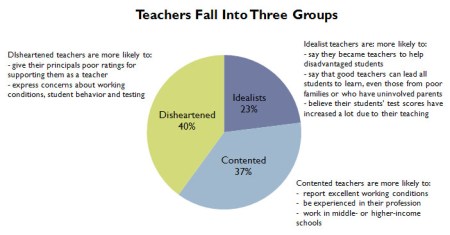
A large plurality of teachers fall into the “disheartened” category:

Members of that group, which accounts for 40 percent of K-12 teachers in the United States, tend to have been teaching longer and are older than the Idealists, and more than half teach in low-income schools. They are more likely to voice high levels of frustration about the school administration, disorder in the classroom, and the undue focus on testing…

A considerable degree of bitterness characterized the Disheartened in comparison to the other groups: Twice as many spoke of likely burnout as did the Contented and Idealists. Only two-fifths strongly agreed that “there is nothing I’d rather be doing” than teaching, compared with nearly two-thirds of the Contented and nearly half of the Idealists.

Think it doesn’t make a difference in the classroom? Think again – a shocking number of disheartened teachers think that teaching makes no difference:

Beliefs about their students and student potential also differed notably, with potentially significant implications for efforts to reshape the profession. A 22-percentage-point difference separated the Idealists and the Disheartened (88 percent to 66 percent) in their faith that good teachers can make a difference in student learning. Idealists strongly believe that teachers shape student effort (75 percent), whereas just 50 percent of the Disheartened believed that. Only one-third of the more disillusioned teachers were very confident in their students’ learning abilities, compared with nearly half among the other groups (48 percent of the Contented and 45 percent of the Idealists).

How do you suppose those attitudes affect their teaching?

“Potentially significant implications for efforts to reshape the profession.” No kidding. More than three quarters of all teachers are either “disheartened” or else “contented” – i.e. not interested in making the system any better than the lousy mediocrity it is now.

Delving through the data tables, here’s another intriguing tidbit I found. Given a choice between “I am able to create high quality lesson plans” and “I am not able to do this as much as I would like because of limited planning time,” the Contented teachers were 30 points more likely than Disheartened teachers to say they could create quality lesson plans (72% v. 52%). No shocker there. But a surprising number of Idealist teachers gave their own lesson plans a negative review – 38% say they can’t create high qualiy lesson plans as much as they’d like, while 60% say they can.

Do you suppose Contented teachers and Idealist teachers have different standards for what counts as a “high quality” lesson plan?

Which kind do you want teaching your kids?

Too bad you don’t get a choice. Government will decide which teacher will build (or destroy) your child’s future.

Unless, of course, you’re one of the ones lucky enough to have a choice.

It’s interesting that Public Agenda only surveyed teachers working in the government monopoly system. You can only find that out by wading deep into the weeds of the methodology section. In the body of the report, they just describe their survey population as “teachers.” Apparently government teachers are the only kind that count.

As it happens, federal survey data show that teachers in private schools are much, much happier with their jobs on a wide variety of measurements. That’s because, according to the same data, they’re free to teach – unlike the government monopoly, private schools give teachers autonomy in the classroom. Of course, they’re only able to do this because they’re also allowed to hold teachers accountable for results. But the much larger satisfaction figures for private school teachers – including much higher satisfaction with their school administrators! – show that this is an accountability model that works.


Everyone Wins in the Wall Street Journal

November 4, 2009

Everybody Wins

(Guest post by Greg Forster)

Today’s Journal has a hard-hitting editorial on Marcus’s new study showing that competition from charters improves regular public schools in NYC.

Opponents of school choice are running out of excuses as evidence continues to roll in about the positive impact of charter schools…State and local policy makers who cave to union demands and block the growth of charters aren’t doing traditional public school students any favors.

And where did you read about it first? Oh yeah.


CBS v. CDC on Swine Flu

November 3, 2009

Dr Horrible

(Guest post by Greg Forster)

Now, I know CBS News is a disreputable tabloid organization – not a highly reliable source of information, like, say, the National Enquirer. But here at JPGB we’ve always said that empirial research should be judged on its own merits, not on the identity of the researcher.

CBS is reporting that states checking up on H1N1 diagnoses have found that only a small (sometimes tiny) portion of those diagnosed by their doctors as having swine flu actually had it. California tested 13,704 cases of people who were told by their doctors that they probably had swine flu and found that only 2% actually had it. Florida tested 8,853 cases and found that only 17% had swine flu. Other states found similar results.

CDC stonewalled CBS’s FOIA requests for the data, saying the state agencies that reported the data didn’t feel confident enough in their accuracy to have them publicly released. Sorry, we’d love to help, but our hands are tied. In the report you can see the CDC spokesman promise that he’ll get those data right to CBS just as soon as the states tell him it’s OK with them to release them.

But when CBS went to the states and asked for the data, they handed them right over.

I can’t imagine why the CDC might feel like it has something to hide. Surely it has nothing to do with the president’s use of swine flu panic as an excuse to claim “emergency powers” to sweep away “bureaucratic obstacles” (formerly known as the rule of law).

Update: OK, admittedly we don’t have all the details here. Maybe there will turn out to be some issue of selection bias at work. But the reason this information isn’t readily available is because of the CDC stonewall. That’s the story here.


California vs. Texas Part Deux

November 2, 2009

(Guest Post by Matthew Ladner)

William Voegeli joins the fun in City Journal.

Money quote:

Bill Watkins, executive director of the Economic Forecast Project at the University of California at Santa Barbara, has calculated that once you adjust for population growth and inflation, the state government spent 26 percent more in 2007–08 than in 1997–98. Back then, “California had teachers. Prisoners were in jail. Health care was provided for those with the least resources.” Today, Watkins asks, “Are the roads 26 percent better? Are schools 26 percent better? What is 26 percent better?”

BOOOOOOOOOM!!!!!!!!!!!!!!!!!!

UPDATE: Great minds think alike as Kotkin brings the pain in Forbes.