Was He Stupid or Lying? Durbin-Blagojevich Edition

June 3, 2009

Durbin

(Guest post by Greg Forster)

A while back, noting Sen. Dick Durbin’s flagrantly false statements about the DC voucher study – he said the study didn’t show voucher students outperformed the control group, which is entirely true except for the fact that it did show voucher students outperforming the control group – Jay asked “is he stupid or lying?”

“Of course,” he added, “when it comes to an Illinois pol, one doesn’t have to choose. He could be both.”

Not long ago, when Sen. Durbin made similarly misleading (though now more carefully weaseled) statements in USA Today, Jay remarked, “I’m beginning to lean toward the lying end.”

The first sign of a good scientist is that he adjusts his theory in response to new data!

Well here’s another new datum to factor into our “stupid or lying” calculus. The AP reports that Durbin offered to help Rod Blagojevich make a deal for Barack Obama’s Senate seat. Take it away, AP (emphasis added):

CHICAGO (AP) – Just two weeks before his arrest on corruption charges, then-Gov. Rod Blagojevich floated a plan to nominate to the U.S. Senate the daughter of his biggest political rival in return for concessions on his pet projects, people familiar with the plan told The Associated Press.
 
Blagojevich told fellow Democratic Sen. Dick Durbin he was thinking of naming Illinois Attorney General Lisa Madigan to the seat vacated when Barack Obama won the presidential election, according to two Durbin aides who spoke on condition of anonymity…
 
The aides said the concessions Blagojevich wanted in return were progress on capital spending projects and a health care bill that were stalled in the Legislature…
 
According to the Senate aides, Durbin was delighted to hear that Blagojevich was thinking of naming Madigan to the seat. He believed she would be a popular figure in Illinois and stood perhaps the best chance of holding the seat against a Republican.
 
Durbin volunteered to call the attorney general or the speaker to get the ball rolling and possibly broker an agreement, the aides said.

When the AP came calling about the story, Durbin’s office offered no comment.

Moe Lane of Red State comments: “This would only be a bombshell if it had been unexpected…Senator Dick Durbin has had since November some very significant corroborating evidence that Governor Rod Blagojevich really was corruptly auctioning off a Senate seat.  This is information that would have been very helpful when it came to the timing of Blagojevich’s impeachment, seating Burris, and/or fixing the entire problem with a special election.  And yet, Durbin did or said nothing. I don’t wonder why.  Then again, I know enough about this story to know that the Senator hadn’t realized that his talks with Blagojevich were being recorded.”

Lane highlights the implication that Durbin knew about Blago’s corruption all along, and kept vital information under his hat during the crisis. And Illinois-based politicians betraying the public trust by keeping vital information out of public circulation during a crisis does seem to be emerging as a meme in the DC voucher story.

But doesn’t it seem more important that AP is reporting Durbin offered to help broker the deal?

Yes, what Durbin offered to help arrange was not a bribe to be paid directly to Blago. It was conessions on Blago’s pet projects, including “capital spending projects.” Yet that’s bad enough, isn’t it? I’m aware that people take alliances and rivalries into account when they make these kinds of appointments. But isn’t it something else entirely to arrange a quid-pro-quo transaction of legislative votes for nominations?

And if you insist that there must be a personal bribe involved before we can say it’s wrong, let me ask you: given what we know about Blago, what kind of odds would you give that he wasn’t going to wet his beak on any of those “capital spending projects”? And doesn’t that make Durbin complicit? Or just how dumb are you willing to say Durbin is?

HT Moe Lane, via Jim Geraghty


Did a “Massachusetts Miracle” actually happen?

June 2, 2009

(Guest Post by Matthew Ladner)

There was fierce posting last week here and at Flypaper on the Massachusetts Miracle and what role the unions did or did not do in thwarting said miracle. The question I’ll raise: does MA’s improvement deserve the title of miracle?

MA has the highest NAEP scores in the country, and they’ve improved in recent years, so they don’t have anything to be ashamed of when it comes to education reform. Superficially, they outshine everyone.

However, MA is also a very wealthy and fairly homogenous state.  NAEP lists their free and reduced lunch eligible students at 28.9% (which is low) and their percentage of Anglo children at 72.9% which is pretty high. Spending per pupil is listed at over $12,000 per pupil.

My favorite education reform state, Florida, spends less and has a far more demographically challenging K-12 demographic profile. And…they’ve made much more progress with difficult to educate students.

FL MA 1

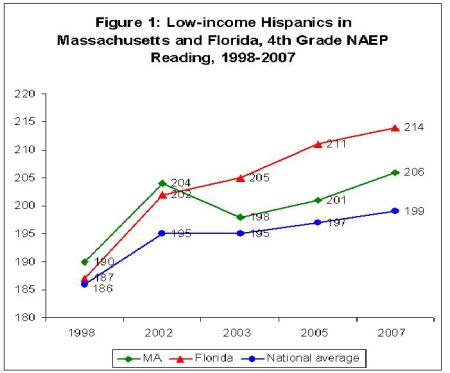
Looking at progress among the most difficult to educate students gives us a good view of which state has made the most progress. This effectively controls for MA being wealthy and pale. Figures 1 and 2 present data from the 4th grade reading exam.

Among free and reduced lunch eligible Hispanics, Florida has made a great deal more progress than MA- 16 point improvement in MA, a 27 point improvement in Florida. 

MA outperforms the national average, but by a mere three points. Florida doubled the improvement of the national average.

The same is true among free and reduced lunch eligible African American students. MA improved by nine points, the national average improved by ten points, and Florida improved by twenty four points.


FL MA 2Again, MA doesn’t have anything to be ashamed of given their highest scores. There are other wealthy and homogenous states that spend a great deal on their public schools- and MA clobbers them. For me, however, when it comes to education reform


School Name Trend Reverses?

June 2, 2009

As Brian Kisida, Jonathan Butcher, and I documented, there has been a dramatic decline over the last several decades in the naming of schools after presidents, in particular, and people, in general.  Instead, schools are increasingly receiving names that sound more like herbal teas, day spas, or nature shows than our nation’s founders.  It’s gotten to the point where there are more schools in Florida named after manatees, the lovable sea cow, than George Washington.  In Arizona there are more schools named after roadrunners (beep-beep!) than Thomas Jefferson.  And there are plenty of schools that sound like Whispering Hills, Hawk’s Bluff, Deer’s Leap, etc….

But take heart, fans of school names with a civic purpose, the trend away from naming schools after presidents may be reversing.  According to Powerline, “St. Paul’s Webster Magnet Elementary School changed its name last month to the Barack and Michelle Obama Service Learning Elementary.”

As David Shribman writes on RealClear Politics, erasing the name Webster from the school marks a real loss:

“There is no trace at all of Webster in the Obama Service Learning Elementary school today, not even a picture of Webster, who may have been the subject of more formal portraits of any man of his time, if not of all American history. Indeed, in the period leading up to the vote on the name change, the principal of the school, Lori Simon, actually had to figure out for whom the school was named originally.

Talk about a missed teaching moment. Webster was the greatest orator in the age of great oratory; some of his words remain in the American memory, even in this ahistorical age. He was probably the most eminent Supreme Court lawyer in American history, having argued 249 cases before the court, including several of the landmark cases of the early 19th century that shaped constitutional law in the United States for generations. And he was one of the greatest secretaries of state ever (and the first to serve non-consecutive terms, one under William Henry Harrison and John Tyler, another under Millard Fillmore).”

Of course, school names should reflect a community’s values and as those values shift, so too should school names.  But couldn’t they have found a Gopher Valley school somewhere to rename?


Duncan Endorses Universal Vouchers (without knowing it)

June 1, 2009

Below is a portion of the transcript from a National Press Club event last week featuring Secretary of Ed, Arne Duncan.

If I am reading Duncan right, the problem with vouchers is that they only serve 1 to 2 percent of the population.  So, the obvious solution he endorses must be universal vouchers.  Right?

MODERATOR:  OK.  What is your position on a potential national education voucher program?   

DUNCAN:  I’ve been very, very clear that I don’t think vouchers work.  They’re not the answer.  Let me explain why.      

Vouchers usually serve 1 to 2 percent of the children in a community.  And I think we as the federal government, we as local governments, or we as school districts, we have to be more ambitious than that.  That’s an absolutely worthy or noble goal.  If a nonprofit or philanthropy wants to provide scholarship money to children, that’s a great, great use of the resources.       

But I don’t want to save 1 or 2 percent of children and let 98, 99 percent drown.  We have to be much more ambitious than that.  We have to expect more.       

And this is why I would argue rather than taking one of these struggling schools, these thousands (inaudible) — rather than taking three kids out of there and putting them in a better school and feeling good and sleeping well at night, I want to turn that school around now and do that for those 400, 500, 800, 1,200 kids in that school and give every child in that school and that community something better, and do it with a real sense of urgency. 


PJM on Free to Teach

June 1, 2009

Free to Teach cover

(Guest post by Greg Forster)

Today Pajamas Media runs my column on why the government school monopoly is bad for teachers:

Everyone knows a monopoly is bad for the people who rely on its services. But monopolies are also bad for the people who work for them. Just like the monopoly’s clients, its employees have few alternatives. If they’re not treated well at work, they can’t go work for a competing employer. That means the monopoly doesn’t have to worry about keeping them happy.

And the education monopoly also locks out parental pressure for better teaching, which is probably a factor in improving working conditions for teachers in private schools. Public schools are government-owned and government-run, so the main pressure on them is political imperatives. The main pressure on private schools is keeping parents happy. Given that parents primarily want better teaching, which of those two options do you think is better for teachers?

A certain recent study is mentioned in the column.


Liberating Learning

June 1, 2009

Liberating Learning by Terry M. Moe: Book Cover

Two decades after writing Politics, Markets, and America’s Schools, Terry Moe and John Chubb have done it again.  With Liberating Learning they’ve written a a compelling account of what is blocking significant improvement in public education and provided strategies for overcoming those obstacles. 

The main obstacle has remained the same across the two books: teachers unions.  Organized special interests in education as in other sectors of public policy shape the policies that are made.  In the case of education the special interests are so large, well-organized, and well-funded that their influence has distorted policy significantly to the benefit of the adults working in schools and against the interests of students and their families.

In their earlier book the solution to union dominance was choice and competition.  Interest groups can control policy but they can’t easily control markets.  But in the new book Moe and Chubb (they flipped the order of the names) acknowledge that unions have been generally successful at using politics to block the creation of effective markets.  Something has to loosen the union stranglehold to allow the markets to develop and prosper.

In Liberating Learning they’ve found what they think will break that logjam: technology.  The increasing use of technology in education will transform the operation of schools and the role of teachers in education.  In general, it will reduce the need for teachers by replacing (at least to some extent) labor with capital.  It will generate tons of data, improving the transparency of schools to the public and policymakers.  And it will decentralize the education workplace, making it harder for unions to organize and control the workforce.

There are clear echoes of Clayton Christensen’s work on disruptive technologies in this new book.  But unlike Christensen, Moe and Chubb focus on the politics of public organizations rather than technology per se.  In fact, if you are looking for detailed descriptions of how technology should be used in education or hard proof of its effectiveness, you won’t find it in Moe and Chubb’s new book.  They are not trying to prove that these technologies are educationally effective or describe best practices, although it is clear that they have some ideas on these topics.  They are trying to describe the political logic of the current stagnation in education and how it might be altered.

The clear writing and tight argument will make Liberating Learning a pleasure to read for education reformers.  We might still wonder whether unions will be able to use politics to block the transformative effect of technology, but the book is sure to provoke a lot of productive discussion and thinking.

(edited for typos)