
(Guest Post by Matthew Ladner)
Public school officials have come to resemble the kids at college football games holding up the sign “Hi Mom! Send More Money!” Public school officials constantly call for additional resources, a call that lawmakers have answered. Nationally, inflation adjusted spending per pupil nearly quadrupled between 1959 and 2004. Unfortunately, there was very little evidence of increased student learning during that period- NAEP scores have been largely flat since the late 1960s despite the increase in funding.
One state, however, has figured out how to utilize the insatiable appetite of schools for additional funding as a carrot to improving student performance.
Florida education reforms not only have improved early childhood literacy, but have also prepared a higher percentage of minority children for college work. Governor Jeb Bush pushed a One Florida Initiative, which sought to replace race based affirmative action with more effective instruction: better preparation rather than lower standards. The results have been impressive.
Working in partnership with the College Board beginning in the year 2000, the One Florida plan sought to increase the academic achievement of Florida’s students, particularly underrepresented in universities. The comprehensive plan included professional development for teachers and counselors and free PSAT exams for students. Florida officials created AP Potential – a web-based tool to identify promising students for AP coursework.
The program relied heavily on incentives, creating an AP Teacher Bonus – $50 for every passing score, up to $2,000. The program also created an incentive for the school, paying the school an additional bonus of $650 per student passing an Advanced Placement exam. Florida officials carefully wrote this bonus into the funding formula so that it went to the school, not to the school district.
The reformers didn’t stop there, however. Florida’s A-Plus reform plan assigns letter grades to schools based upon student performance. The One Florida plan provided an additional school bonus of $500 per student passing an AP exam for schools rated “D” or “F.” The idea was to set high expectations and to reward success.
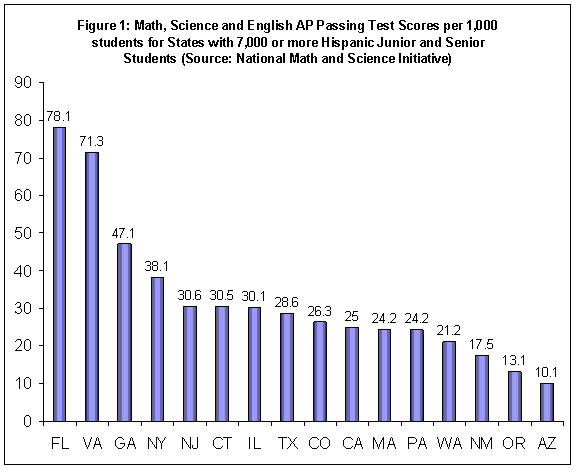
The National Math and Science Initiative recently collected data on the number of students passing AP exams, broken down by ethnicity. Figure 1 presents the number of Hispanic students having passed an AP exam per 1,000 junior and senior Hispanic students. Florida not only leads the nation in Hispanics passing AP exams, they do so at a rate nearly 8 times greater than that of my home state of Arizona.
Do schools respond to incentives? Judge for yourself: between 1999 and 2007, the number of Florida students passing AP tests increased by 154%. Figure 3 below shows that the number of Florida Hispanic and African American students passing an AP exam more than tripled between 1999 and 2007.
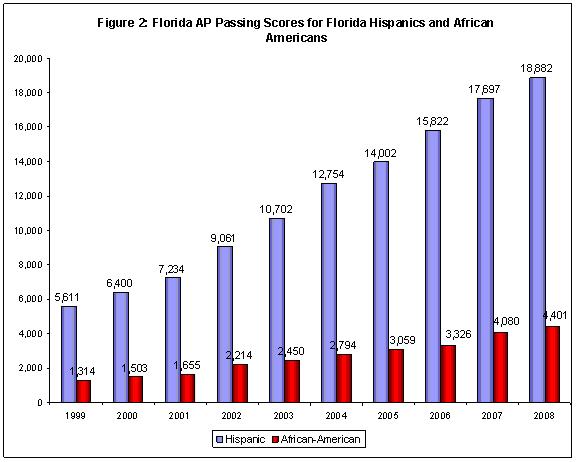
Florida’s education reformers achieved these results for what ultimately amounts to a tiny portion of the Florida K-12 budget. Floridians should not be satisfied with these results, but should be proud of this level of progress- and work to extend it.
The next time the public school establishment calls for additional resources in your state, the question should not only be whether they should get them or not. The question should also be “in return for what?” Pay for performance is an excellent idea for education funding.
In Florida, high-schools get more money the old fashioned way- they earn it.

 Jay P. Greene's Blog

It really sounds like Florida may be on to something here. I have read other examples of students being paid for high scores on the AP exams. There was just recently an article about students in New York city getting paid for high AP scores. The result of that was not as positive as this. More students did take exams, but there was not an increase in higher scores. Perhaps the difference here is that bonus goes to the schools/teacher, causing them to change instruction to get higher acheivement.
Across the country there is a push to expand AP programs. I help high schools register students online for AP exams and almost every school we work has an expaning AP program. I think it is great that more students are being challenged to take these more rigorous classes. The key is to open the classes up to more students without lowering the expectations of the class. In the long run this can be tough to do as less prepared students can slow down the class some. It is very important to try to raise the level of preparation for all students and therefore all more students success in their AP exams.
Mike
Total Registration, LLC, http://www.TotalRegistration.net – Offering an online AP exam registration service for high schools
What a flawed meme. Results are not always indicative of success. Connecting grades with money doesn’t promote good philosophies in regards to education.
We win the battle and lose the war. Teachers and administrators are more likely to make short cuts, juggle numbers, and even cheat, as some data has shown in various sources I’ve read over the past years since NCLB’s enactment.
Most importantly, kids will gain very little joy from being forced into the standardized molds by districts who are hungry for more financial rewards. Is it any wonder kids grow up hating school? Governments and educational institutions should be mindful of the side effects when implementing systems such as these.
Good teaching should be sourced from an authentic desire to better the lives of children. Real learning can only be achieved when students are free to make mistakes and think creatively while learning at their own pace. Of course this is much more difficult to promote, when teachers are under pressure to get students to perform by certain deadlines. So do we settle for results motivated by money?
Bottom line as always in the United States.
“Results are not always indicative of success.”
If you can’t measure success by results, what can you measure it by?
By how much money you spend. That’s how we always measured success before the rise of accountability and choice reforms, and that’s what the mossbacks want to go back to. I can’t imagine why.
I am looking for more information on Florida’s AP success. A recent survey conducted by the DOE (2006 – AP Projections for LEP students and students with disabilities) indicates no increase in AP class participation on test success in the state of Florida.
I would be interested in finding out why this target group of students has not made progress. My daughter has a specific learning disability and the trend is significantly up for this group of students to attend 2 and 4 year colleges.
Thanks
Ms. Cormack-
I don’t have any information on that. I would suggest calling the Florida DoE.
There is something very misleading about these stats. For one thing, there is no distinction between states that barely have 7000+ Hispanics and states that have significant Hispanic populations. South Florida’s Hispanic population is very significant, and this leads to some interesting insights. The biggest change apparent is that many more Hispanics are taking the Spanish AP exam. Now, is this a measure of success for the program talked about here? The answer should be a resounding no. The statistics of the Black population show growth, but keep in mind that the statistics in the second graph is not based on any proportion. The growth could just as easily be associated with the rapid growth of Florida’s population. While one may not have the right to say the Florida plan is a failure, to say that the Florida plan is effective through these stats is misleading.
Fred-
A Spanish AP class wouldn’t be included in Figure 1- it is for Math, Science and English. On your second point, you are correct that the figures are not standardized. The Hispanic and African American K-12 populations did not triple over the last ten years however. Between 1998 and 2005 (latest year available in the common core of data) the African American K-12 population increased by 8% for all grades. The Hispanic population increased by sixty percent for all grades.