States Need Flexibility, Not a Bailout

October 31, 2008

(Guest Post by Dan Lips)

Following Wall Street and Detroit, the nation’s governors have joined the growing line on Capitol Hill—begging Congress to save their states from looming fiscal shortfalls. The National Governors Association sent a letter to Congressional leaders asking states to be included in the next economic stimulus package.

New York Governor David Patterson made the plea in person before the House Ways and Means Committee on Wednesday: “As part of a comprehensive second economic stimulus package, states need direct and immediate fiscal relief.”

But not all governors are looking for a federal handout. South Carolina Gov. Mark Sanford offered Chairman Rangel’s committee a different view—begging Congress not to give states more federal dollars. Instead, he called for greater freedom and flexibility from federal mandates.

In his testimony, Governor Sanford warned that a federal bailout would only fuel further out-of-control state government spending:

Essentially, you’d be transferring taxpayer dollars out of the frying pan – the federal government – and into the fire – the states themselves. I think this stimulus would exacerbate the clearly unsustainable spending trends of states, which has gone up 124 percent over the past 10 years versus federal government spending growth of 83 percent…

…State debt across the country has also increased by 95 percent over the past decade. In fact, on average every American citizen is on the hook for $1,200 more in state debt than we were 10 years ago. There seems to be no consequence, and indeed a reward, for unsustainable spending growth by states. In effect, sending $150 billion more to states would produce another layer of moral hazard – already laid bare at the corporate, individual and federal levels in recent years.

Rather than a bailout, Governor Sanford urged Congress to give state greater freedom and flexibility from government mandates and regulation:

Give us more flexibility. Give us more in the way of control over the dollars we already have and less in the way of costs. Give us more options, not more money with federal strings attached.

Among the costly mandates Governor Sanford referenced was No Child Left Behind. Designed to help improve learning opportunities for students, NCLB comes with a heavy compliance burden. According to the Office of Management and Budget, NCLB increased the annual paperwork required of state and local governments by 6,680,334 hours (or $141 million). That means it would take one person a miserable 762 years to complete just one-year worth of NCLB compliance!

The result of this red tape is that more dollars are consumed by the bureaucracy and less is actually available for use in the classroom.

There is a better approach. Governor Sanford and leaders in other states should call on Congress to adopt policies like the A-PLUS Acts, which would let states opt-out of No Child Left Behind and receive their share of funding in a block grant with less regulation. Doing this would give state and local leaders the freedom and flexibility to use scarce tax dollars on local initiatives to improve opportunities for disadvantaged children.

Giving states more flexibility in how federal funds are used makes more sense than another federal bailout.

Cross posted at The Foundry.

(Edited for typos)


Obama Wins Arkansas!

October 31, 2008

… at least in the mock election held in many Arkansas schools.  According to the Northwest Arkansas Times, “Statewide, Obama won the mock election for Arkansas with 49, 088 votes, compared to 34, 393 for McCain.”  Does this mean anything for Tuesday’s outcome in the state?  I doubt it.  McCain holds a double-digit lead in multiple polls in the state.  But who knows?


Pass the Clicker — Pee Wee’s Playhouse

October 30, 2008

Go ahead and make fun, but the fact is that Pee Wee’s Playhouse was the most imaginative, interesting, and funny program ever to appear on Saturday morning TV (with the obvious exception of Bugs Bunny, which was actually made for movie theaters and only appeared on Saturday morning years later). 

Pee-Wee’s Playhouse (PWP) had a budget per episode that was typical of prime time shows of its era rather than the typical budget of some chintzy, bad-animation 30 minute infomercial for a dumb toy (I’m looking at you, He-Man).  With that budget PWP was able to offer a mix of claymation, animation, puppetry, live-action, and a creative set.  And it had a long list of talented actors.  PWP regulars included Phil Hartman, Laurence Fishburne, and S. Epatha Merkerson (of Law and Order fame).  Special guests included Jimmy Smits and Grace Jones in this so awful it is great Christmas special singling Little Drummer Boy.  You have to see it to believe it:

OK, still don’t believe me that this was the greatest Saturday morning TV show ever?  It won 22 Emmys.  And it had this scene where Cowboy Curtis (Laurence Fishburne) prepares for a date by practicing with Pee Wee pretending to be Miss Yvonne (I know, it’s a stretch):

And who could resist repeat-gags like the secret word, when everyone would have to “scream real loud” whenever it was said.  Like this “time” when the secret word was “time”:

Don’t forget that Tim Burton also launched his directing career with the movie Pee Wee’s Great Adventure and Danny Elfman did the music for both the TV show and movie.

PWP was not bad-good, like the Harlem Globetrotters cartoon or Shazam/Isis.  It was good-good.

(I should add that I had the honor of meeting the actress who played Chairry this summer.  Barrymore never had Chairry on his resume.)


The Upward Surge of Mankind?

October 30, 2008

(Guest Post by Matthew Ladner)

Florida tripled the number of Hispanic and African American students passing one or more AP exams with a program that included a financial incentive for schools and teachers.

Meanwhile, C. Kirabo Jackson finds positive results for a similar Texas pilot program in Education Next:

According to my assessment, the incentives produce meaningful increases in participation in the AP program and improvements in other critical education outcomes. Establishment of APIP results in a 30 percent increase in the number of students scoring above 1100 on the SAT or above 24 on the ACT, and an 8 percent increase in the number of students at a high school who enroll in a college or university in Texas. My evidence suggests that these outcomes are likely the result of stronger encouragement from teachers and guidance counselors to enroll in AP courses, better information provided to students, and changes in teacher and peer norms.

Gordon Gekko for Secretary of Education? I can see the confirmation hearing speech in my head:

The point is, ladies and gentleman, that greed — for lack of a better word — is good.

Greed is right.

Greed works.

Greed clarifies, cuts through, and captures the essence of the evolutionary spirit.

Greed, in all of its forms — greed for life, for money, for love, knowledge — has marked the upward surge of mankind.

And greed — you mark my words — will not only save public education, but that other malfunctioning corporation called the USA.

Just kidding, but I will say this: we need to continue experimenting with programs like this. They certainly seem to beat throwing money at schools in the hope that they will improve.


John J. Miller Smacks Half Sigma

October 29, 2008

National Review columnist John J. Miller smacks a blogger known as “Half Sigma” for “dis”ing special education vouchers.  Half Sigma wrote: “Republicans applaud themselves for doing stuff that the left has been pushing for. We nominated a woman for Vice President. How wonderful of us. The female candidate talks about how she’s going to help “special needs” children, and the so-called conservatives applaud the conservatism of it. How wonderful of us. We are going to fight global warming. How wonderful of us.”

Miller then responds on The Corner: “I love those sneer quotes around “special needs.” Would it be better if we called them “retards”?

But that’s just a style point. The substance itself is vaporous. Sarah Palin — oops! “the female candidate” — is calling for the voucherization of special-education spending. This is a very good idea. It’s modeled on one of Jeb Bush’s best market-oriented reforms in Florida, where McKay Scholarships have gotten kids out of lousy public schools and into good private ones, saving taxpayer dollars in the process. School choice has been an elusive public-policy goal of conservatives for a long time; this is a promising path to securing more of it. I urge you to read NRO’s editorial; also this NRO article by Jay Greeneand my article in the Oct. 20 NRODT.”

Besides, The Notorious JPG and DJ Super-Awesome may give Half Sigma a whooping for not having read the post about how bloggers shouldn’t have rapper names


The Infinte Regress

October 29, 2008

There is no problem to which more education is not the proposed solution.  Teachers aren’t as effective as they should be?  Increase professional development.  Professional development isn’t as effective as it should be?  Increase training for providers of professional development.  Wash.  Rinse.  Repeat.

So, when Mathematica found that intensive mentoring for first year teachers had no effect on those teachers’ practices or their students’ academic achievement, what did folks have to say?  Improve the training of the mentors

Similarly, when Mathematica evaluated a broad range of education technology in schools they found: “Test scores were not significantly higher in classrooms using selected reading and mathematics software products. Test scores in treatment classrooms that were randomly assigned to use products did not differ from test scores in control classrooms by statistically significant margins.”  But, critics of the study said that it “didn’t take into account the critical factors of proper implementation and curriculum integration, professional development for teachers, planning, or infrastructure issues, among others. ”  That is, the results would be better if only we provided more education to teachers and administrators to implement the technology appropriately.  Wash. Rinse. Repeat.

And again when the Department of Education’s evaluation of Reading First showed no advantage for students’ reading achievement, others responded that the schools studied had not properly implemented the program or trained their teachers.

The problem with offering more education as the solution to each failure is that it assumes that the only thing educators are lacking is knowledge of the right thing to do.  If only we bother to tell them, educators are hungry to learn the right thing and implement it well.  But as I’ve argued in the past, educators are also lacking the motivation to learn these techniques and implement them well.

All of these interventions — mentoring, technology, and increased reliance on phonics — may very well be desirable.  But unless we address the incentives that educators have to identify effective practices, learn them, and use them well, no amount of additional education will solve the problem.


Paying the Pension Piper

October 27, 2008

According to an analysis of public (including teacher) pensions by Northern Trust reported in the Washington Post, those pensions lost 14.8% of their value for the year ended September 30.  They have almost certainly lost more during October in line with the continuing drop in stock prices. 

The decline only compounds a serious problem.  Even before this year’s market fall many teacher pension plans were under-funded.  According to the Post, the GAO concluded that 27 out of 65 large public pensions were inadequately funded as of 2006.

The problem, according to pension administrators cited in the article, stems in part from “an increase in pension benefits.”  That is, when the market is doing great and pension funds are flush, state policymakers are tempted to accede to teacher demands to raise benefits.  But when the market drops, the pension benefits cannot be cut.  It’s a one-way street.  Pension benefits may be increased but it is illegal to decrease them.

So, guess who is going to have to pay the pension piper?  Taxpayers.

UPDATE:  Teacher pensions also distort the labor market for teachers by having “spikes” and “valleys” in benefits.  That is, teachers leave a large amount of money on the table if they leave their positions too early and they actually begin to lose pension benefits if they remain in their job too long.  The net effect is to keep some teachers who have lost their fire for teaching in the profession too long and to drive effective and experienced teachers out of the profession too early.  See a great piece on this by my colleagues Bob Costrell and Mike Podgursky in Education Next.


Why Are School Construction Costs So High?

October 27, 2008

I don’t know the answer but I really think this is a topic worth exploring.  And my attention has been focused on the question by a local debate over building a new high school in Fayetteville, AR.

What I do know is that according to the 34th Annual Official Education Construction Report the median new school built in 2007 cost $188 per sq. ft. for elementary schools, $211 per sq. ft. for middle schools, and $175 per sq. ft. for high schools. By comparison, the median cost per square foot to build a three story factory in 2007 ranged from $83 in Winston-Salem to $136 in NY City, with most major metro areas hovering around $100 per square foot.  Schools cost almost double what it costs to build a three-story factory and even more than what it costs to build houses. 

Why does it cost so much?  Part of the answer is that schools are more likely to be mandated to have Project Labor Agreements (PLAs), which require the use of unionized construction workers.  Schools built with PLAs cost about $30 more per square foot according to studies conducted in Connecticut and Massachusetts. 

Some of the higher cost can be attributed to gold-plating in the school building codes.  In Florida, for example, the increase in school building code requirements following Hurricane Andrew added $500,000 to the cost of each elementary school and $2 million for each high school over a decade ago.  Every school was expected to withstand 150 mph winds rather than 121 mph and to double the thickness of the concrete roof to 4 inches.  Of course, it’s always hard to argue against the safety of school buildings, but remember that kids are not in schools when hurricanes hit.  Schools are usually closed a day or two before a hurricane is expected.  It’s true that schools may be used as shelters, but not every school needs to be a shelter.  Requiring that every school meet the highest standard for any building is a way to exploit our concern for kids’ safety to drive school construction costs up.

In addition to the price per square foot, there is also the question of how many square feet we need.  The average new school has between 100 and 158 square feet per student, depending on the grade level.  But state requirements for square footage are increasing based on the argument that “schools need more space than they did 20 years ago.”  That may be, but some states, such as Minnesota, require as many as 200 to 320 sq. ft. per student for small high schools.  The Har-Ber high school that I described in my last post has 198.25 square feet per student.  At about 200 sq. ft. per student we could teach a class of 25 kids in a 5,000 square foot mansion.  And at an average cost of $23,873 per student for new high school construction, we could build that 5,000 square foot mansion for those 25 students for around $600K. 

Not bad.  Now if only we could teach students well-enough so that they could earn their own $600K house.


Palin Backs Special Ed Vouchers

October 24, 2008

In a speech in Pittsburgh today, Governor Palin endorsed the idea of special ed vouchers saying, “In a McCain-Palin administration, we will put the educational choices for special needs children in the right hands — their parents’. Under reforms that I will lead as vice president, the parents and caretakers of children with physical or mental disabilities will be able to send that boy or girl to the school of their choice — public or private.

Under our reforms, federal funding for every special needs child will follow that child. Some states have begun to apply this principle already, as in Florida’s McKay Scholarship program. That program allows for choices and a quality of education that should be available to parents in every state, for every child with special needs.”


Illiterocracy?

October 24, 2008

(Guest Post by Matthew Ladner)

Idiocracy is a silly Mike Judge movie about an average Joe who finds himself shot into the future, where the world has suffered a catastrophic decline in mental ability over time. The protagantist, played by Luke Wilson, finds himself to be a relative super-genius, as the denizens of the future can barely speak a sentence and sit around all day watching mindless television programs. Our hero overcomes adversity to become President.

Every once in awhile, I see something that brings that movie to mind.

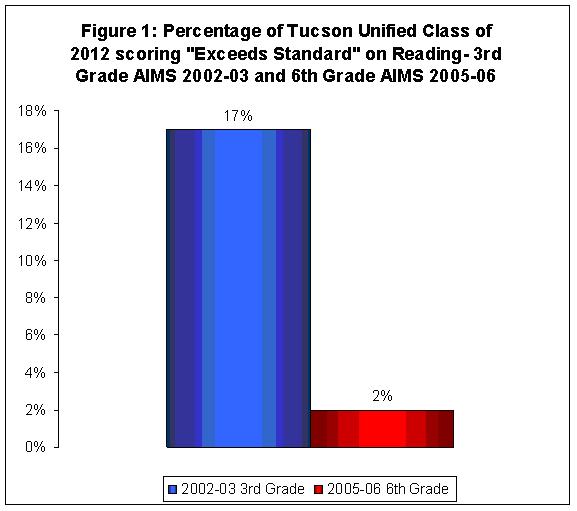
I’ve written about Arizona’s lowering of AIMS cut scores in order to game school accountability. AIMS however has four levels of achievement: Below Standard, Approaches Standard, Meets Standard and Exceeds Standard. The “Meets” category of course has been the focus of lowering cut scores.

Let’s take a look, however, at the more stable category of “Exceeds Standard.” Cut scores have been much more stable at the top. Figure 1 below presents data from the Tucson Unified School District Reading AIMS. The figure presents the percentage of TUSD 3rd and 6th grade scoring “Exceeds Standard” on the Reading AIMS for the Class of 2012.

For those without an abacus on hand, that’s an 88% decline in the percentage of children scoring at the advanced level between 3rd and 6th grade. Strangely, TUSD finds enough money to spend on a “Raza Studies” program in the midst of such catastrophic failure.


Any interest in running for Governor of Arizona?

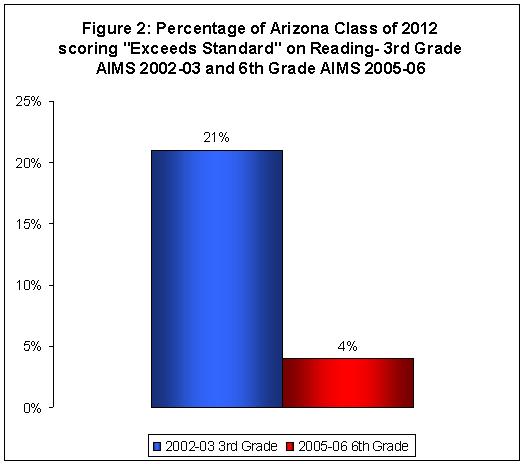
Figure 2 presents the statewide figures for all public schools in Arizona for the Class of 2012 for the same grades and years.

Figure 2 presents an 80% statewide decline. Attendance in a typical Arizona public school seems injurious to the ability to perform high-level reading at grade level, at least according to the state’s own standards and measures.