Pass the Popcorn: City of the Dark Knight (Issue #5)

September 5, 2008

(Guest post by Greg Forster)

Okay, okay, okay, okay, okay.

I saw it for a third time last night and now I just have to post one more City of the Dark Knight before letting this movie go (as promised two weeks ago).

You may not be surprised to hear that after three viewings within three months, the “pencil trick” has lost all its magic (so to speak). As the Joker walks into the room, I’m sitting there thinking, “here comes the pencil trick.” And of course that sucks all the life out of it.

But much more important, every time I see this movie the story of Harvey Dent comes across more fully and more believably. Since Dent has been mostly in the background in my posts on this movie, today we’re going to be all Dent all the time.

Part of the reason the Dent story made less of an impression on me during the first viewing is just my own idiosyncratic way of experiencing movies. I generally don’t “look ahead” mentally while watching a movie. I know lots of people do that, and God bless them. Among regular moviegoers, those who look ahead are probably in the majority. One very dear friend of mine, who has worked in Hollywood full time for about twelve years now, looks ahead so diligently and is so intimately familiar with the conventions of the medium and the imperatives of storytelling that she claims no movie ending has ever surprised her – yet she also claims this has no impact on her enjoyment of movies. (And I guess the latter claim must be true, or she wouldn’t work in Hollywood.)

But that just isn’t how I’m built. It isn’t a conscious decision; I just don’t do it. I experience the movie as it comes. In some ways it’s better, in some it’s worse. Despite my friend’s testimony, I can’t help but think that plot twists and surprises must be much more enjoyable for me than for her. And I have a lot more patience for slow-paced movies like Heat, Unbreakable and Ghost Dog. I’m not sitting there thinking, “come on, come on, get on with it,” because I’m not looking at where we’re going, just at where we are. On the other hand, foreshadowing has to be pretty blatant before I’ll notice it. (One clever little movie, The Opposite of Sex, has the main character – a teenage girl – narrating the movie as it happens, on the pretense that she’s in control of what’s on the screen. In the first scene she’s packing up to run away from home, and she puts her father’s pistol in the backpack. Narration: “Oh, and this part where I take the gun? That’s like, duh, gonna be important later! My English teacher says that’s called foreshadowing.”) And if things happen early in a movie that turn out to have more significance later, I’m slower to catch up.

On second and subsequent viewing, however, you can’t help but look ahead. And when you do that, the Dent narrative comes across much better. The second time, when things happened like Dent saying “you either die a hero or you live long enough to see yourself become the villain,” I noticed them and said, “oh, I see what they’re doing here.” But it was still coming across all in bits and pieces. The third time was the charm – I saw the whole Dent narrative pull together. On the third viewing you’re bearing these things in mind from beginning to end – for example, one of the keys to the Dent narrative is that Dent knew all the time that Wertz and Ramierez – the cops in Gordon’s unit who got Rachel killed and him disfigured – were dirty. I don’t think I realized the full importance of that until the third viewing.

Obviously Chris Nolan was counting on you to look ahead. From the moment you hear the name “Harvey Dent,” you’re supposed to be thinking, “oh, he’s going to become evil.” And given the core audience for this movie, I’m sure that was a very sound decision. The movie is much more economical this way – sound economy being a precondition of artistic achievement.

It also helped that I now understand the Joker’s plan better. (Yes, in spite of his claims, he has a plan.) When he says to Dent “introduce a little anarchy” and hands him a gun, he’s not mainly inviting Dent to go out and kill Maroni – which is what I thought the first time. Obviously he does hope that Dent will go out and kill Maroni, which is why he plants the idea with Dent that killing Rachel was all Maroni’s idea. But what he mainly wants is for Dent to kill him, just as he previously wanted Batman to kill him. That makes the whole scene make a lot more sense.

The Joker tells Dent that the world is controlled by “schemers” who make “plans,” and that everybody organizes their lives around the “plans” even if the plans are horrible. Now let’s look at this from Dent’s persepective. All his career he’s been fighting to clean up Gotham. And what has been his primary obstacle? Not the bad guys, but the system. He has Maroni dead to rights, and Maroni walks. For that matter, years ago he had Wertz and Rameriez dead to rights on corruption and racketeering charges, and they walked, too. And then the system let Gordon set up his own little unit and put these dirty cops to work on Dent’s cases. And even after Gordon and Dent round up a whole city of full of bad guys by taking advantage of the broad racketeering laws, and Dent gets a judge to sign off on it, he still has to go to the mayor and beg for permission to prosecute the cases – over the vocal objections of the police commissioner (Gordon’s predecessor). Examples like this could be multiplied.

After a track record like that, is it any surprise that Dent, lying in that hospital bed, was receptive to the Joker’s message that the legal system’s “schemers” with their “plans” are not essentially different from the mafia’s “schemers” with their “plans”? That the real problem is the futility of trying to do things by “plans” at all?

But – and here I’m sort of half expositing the movie and half speculating to fill in the blanks – Dent is not the Joker. Dent will not become simply an “agent of chaos.” He resents the system because it stands in the way of justice, and he’s still motivated by a desire to see justice done. So when he rejects the system, he doesn’t (at least from his perspective) simply set himself up as prosecutor, judge, jury, and executioner, because that’s not how justice works. Instead, he sets up a new “judge and jury” system of his own, one that will substitute for the real judges and juries who have proven so ineffective (their “plans” are “horrible,” as the Joker puts it). This leaves him to serve simply as prosecutor (he decides whose “cases” will come to the bar) and executioner. And the system he sets up – “chance,” as embodied in the coin toss – is “fair” not only in that it has no favorites but also in that it is not subject to all the other forms of human weakness and corruption. There will be no crazy, arbitrary rewriting of the rules by ideologically blinded judges or by self-serving, scheming politicians and police. How could there be, when chance by definition has no plans?

The temptation to set aside all civilized procedure in the pursuit of justice is a perennial one, inherent in the nature of a human race whose members are each good enough to desire justice yet evil enough not to be able to carry it out without the need for checks and balances. It is partly this temptation that makes Batman so popular in the first place, as this movie clearly understands. (“What gives you the right?” demands the Batman imitator. “What makes you different from me?” The crushing rejoinder “I’m not wearing hockey pants” is good for a laugh, yet the question remains.)

It’s a temptation that must be strictly avoided, because it never ends according to plan, as the Joker knows only too well – that, of course, is why the Joker starts Dent down this road in the first place, because he knows that Dent will end up an agent of injustice rather than of justice. He wanted to do the same with Batman. When Batman throws him from the building, he laughs with glee on the way down because he thinks he’s won. When Batman ropes him and hauls him back up, he says “you really are incorruptible, aren’t you?” That line is his admission of defeat, at least as far as Batman is concerned. But a moment later he drops the hammer: he admits defeat with respect to Batman, but (correctly) claims victory over Harvey Dent.

And in this game, the good guys have to win every time. The bad guys only have to win once.

Unless, of course, the good guys break the rules.


What Does Florida Tell Us About Broader/Bolder?

September 4, 2008

(Guest Post by Matthew Ladner)

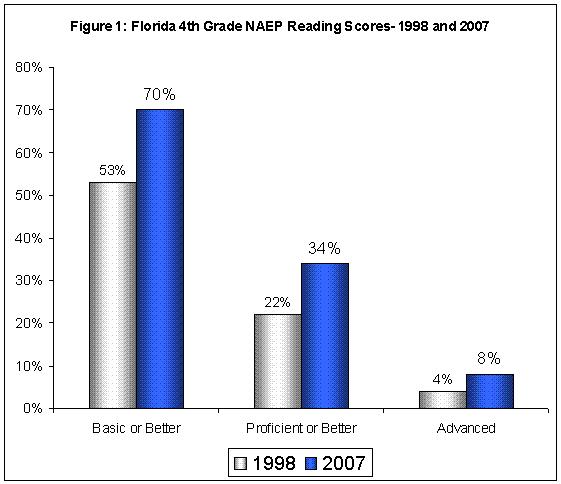
I have several times noted the vast improvement in Florida’s 4th Grade Reading NAEP scores on this blog. Figure 1 below demonstrates just how large that improvement has been between 1998 and 2007. For those who don’t have an excel spreadsheet open, that is  a 32% increase in students scoring Basic or above, a 54% increase in those scoring Proficient or better, and a 100% increase in the percent scoring at the advanced level.

These results make the so-called “Broader and Bolder” approach seem all the more absurd. There hasn’t been any outbreak of “Socialism for the Children” in Republican dominated Florida, but there has been substantial improvement in the percentage of children learning to read.


Lucky thing too, as state budgets are being consumed by out of control Medicaid spending that it taking an increasingly large bite. Society has several other priorities besides K-12 education, such as criminal justice, higher education, transportation and social welfare. Bottom line: there isn’t the money for the Broader and Bolder approach anyway. This is just as well, as the track record on spending increases fueling academic gains stands as a dismal failure.


Given that we can’t spend our way out of our K-12 problems (and it wouldn’t work if we tried) we should instead seek ways to improve the bang we get for our existing bucks. Fortunately, Florida shows that it can be done.


PJM on Cash for Test Scores

September 4, 2008

(Guest post by Greg Forster)

This morning, Pajamas Media carries my column on schools giving out cash or other tangible prizes to reward academic achievement:

These days, if a child asks why he should care about doing well in school, what kind of answer does he get? He gets the same answer from every source: from parents, teachers, and school administrators; from movies and TV shows; from public service announcements, social service programs, and do-gooder philanthropies; from celebrities, athletes, and actors; from supporters and opponents of education reform; from everybody.

The answer is always some version of: you need to do well in school in order to have prosperity later in life.

Well, if you scrape away the sanctimony, what is this but a “bribe” on a colossal scale?

The practice of tangibly rewarding educational success is the subject of a forthcoming article in Education Next, which is a top scholarly journal, as we all know.


Modest Programs Produce Modest Results . . . Duh.

September 3, 2008

HT perfect stranger @ FR

By Greg Forster & Jay Greene

Edwize is touting a new “meta-analysis” by Cecilia Rouse and Lisa Barrow claiming that existing voucher programs produce only modest gains in student learning.

Edwize quotes the National Center for the Study of Privatization in Education (NCSPE), which sponsored the paper and is handling its media push, describing the paper as a “comprehensive review of all the evaluations done on education voucher schemes in the United States.”

But the paper itself says something different: “we present a summary of selected findings…” (emphasis added). Given EdWize’s recent accusations about cherry-picking research, which are repeated in his post on the Rouse/Barrow paper, we thought he’d be more sensitive to the difference between a comprehensive review of the reserach and a review that merely presents selected findings. (By contrast, the reviews we listed here are comprehensive.)

Even more important, the Rouse/Barrow paper provides no information on the criteria they used to decide which voucher experiments, and which analyses of those experiments, to include among the “selected findings” they present, and which to exclude from their review. The paper includes participant effect studies from Milwaukee, Cleveland, DC, and New York City, but does not include very similar studies conducted on programs in Dayton or Charlotte. In New York it includes analyses by Mayer, Howell and Peterson, as well as Krueger and Zhu, but not by Barnard, et al. The paper includes systemic effect analyses from Milwaukee and Florida, but excludes analyses by Howell and Peterson as well as by Greene and Winters.

Clearly this paper is not intended to be, and indeed it does not even profess to be, a comprehensive review.

But even with its odd and unexplained selection of studies to include and exclude, Rouse and Barrow’s paper nevertheless finds generally positive results. They identified 7 statistically significant positive participant effects and 4 significant negative participant effects (all of which come from one study: Belfield’s analysis of Cleveland, which is non-experimental and therefore lower in scientific quality than the studies finding positive results for vouchers). In total, 16 of the 26 point estimates they report for participant effects are positive.

On systemic effects, they report 15 significant positive effects and no significant negative effects. Of the 20 point estimates, 16 are positive.

And yet they conclude that the evidence “is at best mixed.” If this were research on therapies for curing cancer, the mostly positive and often significant findings they identified would never be described as “at best mixed.” We would say they were encouraging at the very least.

Moreover, the paper is not, and doesn’t claim to be, a “meta-analysis.” That term doesn’t even appear anywhere in the paper. It’s really just a research review, as the first sentence of the abstract clearly states (“In this article, we review the empirical evidence on…”). It looks like the term “meta-analysis,” like the phrase “comprehensive review,” was introduced by the NCSPE’s publicity materials.

What’s the difference? A meta-analysis performs an original analysis drawing together the data and/or findings of multiple previous studies, identified by a comprehensive review of the literature. The “conclusions” of a research review are just somebody’s opinion. Meta-analyses vary from simple (counting up the number of studies that find X and the number that find Y) to complex (using statistical methods to aggregate data or compare findings across studies). But what they all have in common is that they present new factual knowledge. A research review produces no new factual knowledge; it just states opinions.

There’s nothing wrong with researchers having opinions, as we have argued many times. It’s essential. But it’s even more essential to maintain a clear distinction between what is a fact and what is somebody’s opinion. Voucher opponents, as the saying goes, are entitled to their own opinions but not their own facts. (Judging by the way they conduct themselves, this may be news to some of them – for example, see Greg Anrig’s claims in the comment thread here.)

By falsely puffing this highly selective research review into a meta-analysis, NCSPE will decieve some people – especially journalists, who these days are often familiar with terms like “meta-analysis” and know what they mean, even if NCSPE doesn’t – into thinking that an original analysis has been performed and new factual knowledge is being contributed, when in fact this is just a repetition of the same statement of opinion that voucher opponents have been offering for years.

(We don’t blame Edwize for repeating NCSPE’s falsehood; there’s no shame in a layman not knowing the proper meaning of the technical terms used by scholars.)

And what about the merits of the opinion itself? The paper’s major claim, that the benefits of existing voucher programs are modest, is exactly what we have been saying for years. For example, in this study one of us wrote that “the benefits of school choice identified by these studies are sometimes moderate in size—not surprising, given that existing school choice programs are restricted to small numbers of students and limited to disadvantaged populations, hindering their ability to create a true marketplace that would produce dramatic innovation.”

And there’s the real rub. Existing programs are modest in size and scope. They are also modest in impact. Thank you, Captain Obvious.

The research review argues that because existing programs have a modest impact, we should be pessimistic about the potential of vouchers to improve education dramatically either for the students who use them or in public schools (although the review does acknowledge the extraordinary consensus in the empirical research showing that vouchers do improve public schools).

But why should we be pessimistic that a dramatic program would have a dramatic impact on grounds that modest programs have a modest impact?

One of us recently offered a “modest proposal” that we try some major pilot programs for the unions’ big-spending B.B. approach and for universal vouchers (as opposed to the modest voucher programs we have now), and see which one works. He wrote: “Better designed and better funded voucher programs could give us a much better look at vouchers’ full effects. Existing programs have vouchers that are worth significantly less than per pupil spending in public schools, have caps on enrollments, and at least partially immunize public schools from the financial effects of competition. If we see positive results from such limited voucher programs, what might happen if we could try broader, bolder ones and carefully studied the results?”

Has Edwize managed to respond to that proposal yet? If he has, we haven’t seen it. Come on – if you’re really as confident as you profess to be that your policies are backed up by the empirical research and ours are not, what are so you afraid of?

And while we’re calling him out, here’s another challenge: in the random-assignment research on vouchers, the point gains identified for vouchers over periods of four years or less are generally either the same size as or larger than the point gains identified over four years for reduced class sizes in the Tennessee STAR experiment. Will Edwize say what he thinks of the relative size of the benefits identified from existing voucher programs and class size reduction in the empirical research?


Lieberman Gives Them Something to Cry About

September 3, 2008

(Guest Post by Matthew Ladner)

Judging from the 96 comments in this Washington Post story, Democrats were more than a little angered by Senator Lieberman’s speech last night. As Francis Urquart would say, Lieberman gave them something to cry about:

Senator Barack Obama is a gifted and eloquent young man who I think can do great things for our country in the years ahead.

But my friends, eloquence is no substitute for a record, not in these tough times for America.

In the — in the Senate, during the three-and-a-half years that Senator Obama’s been a member, he has not reached across party lines to accomplish anything significant, nor has he been willing to take on powerful interest groups in the Democratic Party to get something done. And I just ask you to contrast that with John McCain’s record of independence and bipartisanship.

But let me go one further — and this may make history here at this Republican Convention. Let me contrast Barack Obama’s record to the record of the last Democratic president, Bill Clinton, who stood up to some of those same Democratic interest groups, worked with Republicans, and got some important things done like welfare reform, free trade agreements and a balanced budget.

So translating from politicalese: Obama is not ready to be President, Obama hasn’t accomplished much of anything, Obama isn’t tough enough to take on vested interests in his own party, Obama is no John McCain, nor a Bill Clinton.

There’s an old expression used in Texas politics that says you don’t scratch the king unless you are going to kill the king. In his own calm and dignified way, the Democrat’s 2000 Vice Presidential nominee went for the rhetorical kill last night.

Conventions have become stale, staged events, but you still get some drama here and there.


Toppo: Democrats, Teacher Unions Now Divided on Many Issues

September 3, 2008

(Guest Post by Matthew Ladner)

Greg Toppo provides more evidence that progressives can either have progress, or a Stockholm syndrome relationship with education unions, but they can’t have both.


Lessons for Arkansas

September 2, 2008

The national media has a few pieces that speak to issues being debated in Arkansas (and I’m sure elsewhere).

New School Buildings

Arkansas, like many states, believes that it urgently needs to spend an enormous sum (more than $1 billion in Arkansas) to improve school facilities.  I’m sure that there are schools in Arkansas that are desperately in need of repairs and replacement, but the need for new school facilities is greatly exaggerated.  The obsession with shiny, new buildings is greatest in my hometown of Fayetteville, where folks covet the mansion-like schools that have recently been built in nearby Springdale and Bentonville. 

But Jay Mathews had a column in the Washington Post  yesterday that observed: “Great buildings don’t make great schools. It might be better if we spent our money on principals and teachers who inspire, who don’t take lethargy or resentment for an answer. Put educators like that in the rickety buildings we have, and stand back.”  Mathews wrote a book reviewing the best high schools in the US and “was astonished at how bad some of the buildings were.”  In the end he agreed with the teachers in those excellent schools: “It is not the building, but the teaching, that makes a difference.”

Fayetteville would do well to take some of the $92 million it was considering spending on a new high school (and why it costs so much is a topic for another day), and devote it wisely to teacher and principal salaries.  I emphasize wisely because across-the-board pay raises without changing the current structure will almost certainly make no difference.  Teachers are not under or over-paid.  They are just paid incorrectly because the pay does nothing to attract, reward, or retain excellent teaching. 

District Consolidation

The major education reform strategies championed by former governor Mike Huckabee was the consolidation of smaller school districts.  Outgoing Senator Jim Argue has even floated the idea of consolidating down to 75 county-wide school districts. 

Recently I’ve questioned consildation as a productive reform, suggesting that unless we want our schools to imitate county-wide districts in Los Angeles or Miami, consolidation is not the answer. 

Now the Wall Street Journal reports that Los Angeles is taking steps to break-up their giant school district.

(edited to correct number of counties in AR)


Happy Labor Day

September 1, 2008


These stories are all from the last month:

3rd Union Leader on Leave Amid Financial Inquiry

August 31, LOS ANGELES (AP) — The executive vice president of the Service Employees International Union has stepped aside while accusations that she paid thousands of dollars in union money to a former boyfriend are being investigated, The Los Angeles Times reported Sunday.

The vice president, Annelle Grajeda, is the third major official of the union to be placed on leave in recent months amid accusations of misspending union money.

The Los Angeles Times reported the union’s Los Angeles local paid hundreds of thousands of dollars to companies owned by chapter President Tyler Freeman’s wife and mother-in-law and also spent a lot of money at luxury venues such as the Four Seasons Resort and Morton’s Steak House.

Enforcement agency announces 10 criminal convictions and 8 indictments for July 2008. The U.S. Department of Labor’s Office of Labor-Management Standards (OLMS) today announced its criminal enforcement data for July 2008. During the month, OLMS obtained 10 convictions, eight indictments and court orders of restitution totaling more than $500,000. The office’s totals for fiscal year 2008 (which began on Oct. 1, 2007) now stand at 87 convictions and 112 indictments, with restitution of more than $3 million. Since 2001, OLMS has obtained 889 criminal convictions. The bulk of the cases have involved the embezzlement of union funds.

EDITORIAL: Getting to the bottom of things

Aug 21, 2008 … The trial was hardly under way when former chancellor Roy Johnson was called to the stand to testify. Under oath, he discussed how the head of the Alabama Education Association, Paul Hubbert, and Speaker of the House Seth Hammett came to him to get a job for Schmitz — one of the AEA’s most dependable allies in the House. Johnson testified that the speaker and another legislator found a job and the money to pay for it, and that Schmitz took the job and the money but did no work.

Ex-bookkeeper allegedly embezzled longshore union

The Associated Press

Article Launched: 08/13/2008 08:59:32 AM PDT

LOS ANGELES—An ex-bookkeeper has been indicted for allegedly embezzling $108,000 from the South Los Angeles office of the International Longshoremen and Warehouse Union.

Ex-union secretary in Pa. accused of embezzlement

The Associated Press  Article Last Updated: 08/26/2008 03:38:18 PM EDT

PITTSBURGH—Federal prosecutors in Pittsburgh say a western Pennsylvania woman embezzled more than $87,000 from the United Steelworkers of America.

Prosecutors say between June 2006 and January, 42-year-old Donna Simpson of East McKeesport embezzled the money from a bank account for the Steelworkers Organization for Active Retirees. Prosecutors say Simpson was working as a field secretary for the union at the time and wrote 82 unauthorized checks to herself.

Former Union Secretary Convicted Of Embezzling

August 21, 2008

Two years on probation, with 90 days of those being served under house arrest is the sentence for a Lima woman convicted of taking money from an area union.  Amy Cross pleaded guilty to a charge of embezzling from the Utility Workers Local 308 according to the U.S. Department of Labor.