The Arkansas Lottery Lock Box

September 23, 2008

Arkansas’ Lt. Governor, Bill Halter, has staked his political fortunes on a constitutional amendment creating a state lottery.  Halter has urged adoption of the lottery to increase funds for college scholarships and K-12 teacher bonuses.  All of the money, he emphasizes, will be used to increase education spending: “The bill specified that revenue generated by the lottery would expand, not replace, existing education funding.”

Promising that lottery dollars will be earmarked for increasing education spending is a common strategy to expand political support.  But of course it is impossible to guarantee that lottery proceeds would supplement and not substitute for spending.  Dollars are fungible, so it is always possible that lottery dollars would replace dollars from other sources that would have been used to fund increases.  That is, as long as education spending goes up (as it consistently has in the past), who’s to say whether those increases would not have occurred anyway without the lottery?  The lottery money could just free what would have been spent on education to be spent on something else.  That is, lotteries are basically just general tax increases even if it is claimed that the revenue is targeted for a particular purpose.  (See for example Spindler, 2003)

So, if lotteries are just another tax increase and not a free way to increase education spending, are they a good way to increase taxes?  Well, the tax burden from lotteries falls disproportionately on the poor and disadvantaged.  Supporters of progressive taxation shouldn’t be very interested in lotteries. 

On the other hand, some people enjoy gambling and want lotteries.  Liberty concerns would probably favor permitting gambling.  But a state operated lottery is effectively a local gambling monopoly, which lovers of liberty should dislike.  I guess the question is whether a monopoly is better than a prohibition as far as liberty goes.

However you slice it, the lottery isn’t a great deal.  There is no lock box into which the lottery dollars go to ensure that they increase education spending and cannot substitute for other dollars.  Lotteries are a regressive tax.  And lotteries barely increase liberty because they are operated as local monopolies.  Bill Halter may want to find a new issue to make his political fortune.


Real Longhorn Fans

September 22, 2008

Since Matt started it, already gloating about the defeat of our beloved University of Arkansas Razorbacks by the University of Texas Longhorns in this upcoming Saturday’s football game, I thought I would respond by showing real Longhorn fans giving the Hook ‘Em Horns Sign.


(edited to replace broken link to Yassir and to add the guy from the Breakfast Club)


Progress in Delaware

September 22, 2008

(Guest Post by Matthew Ladner)

Both Eduwonk and Charlie Barone are ga-ga for Delaware’s education reform results, and with good reason. Delaware has high-scoring minority students on NAEP, and have an admirable system of student testing that other states should study carefully.

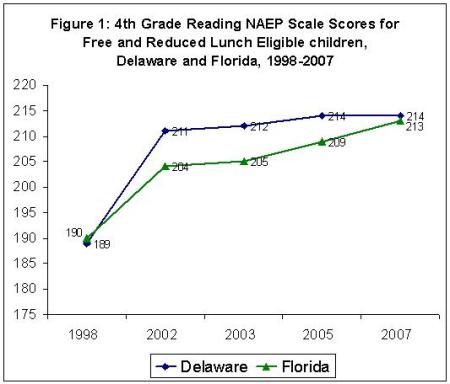
I decided to run Delaware’s numbers against my favorite reform state, Florida, by comparing progress by low-income children on NAEP’s 4th grade reading exam.

And down the stretch they come! It’s Delaware by a nose!

Now, Delaware spends $11,633 per pupil in the public schools in 2006, while Florida was only at $7,759, which is 49% higher. However, these days, you don’t look the progress gift-horse in the mouth, even if it comes at a hefty price.

One could argue that Delaware shows that with the right kind of investment and commitment to standards, that you can improve student achievement without any of that messy school choice business.

Not so fast my friend!

It turns out that Delaware is discretely a haven for parental choice. Delaware has the nation’s 7th ranked charter school law according to the Center for Education Reform, and active inter and intra district choice programs. Add all of those up, and 15.5% of all K-12 students in Delaware are exercising choice through public options.

Delaware also has a large number of students attending private schools, and a little less than 2% home-schooling. Combine those, and you get over 20 percent of students exercising private choice.

If you add it all together, 35.7% of Delaware students are attending schools other than their assigned district school.

It just goes to show- standards and parental choice are two great tastes that taste great together.


I Miss Bill

September 22, 2008

I miss Bill. 

I miss significant expansions in free trade, like with the passage of NAFTA.  Instead, under Bush we’ve had new tariffs on steel, tariffs on underwear, and protectionism on catfish.

I miss welfare reform that encouraged work and discouraged irresponsible behavior.  Instead, under Bush we’ve just had $1 trillion in corporate socialism that simply transfers wealth from taxpayers who didn’t work for or invest with reckless financial institutions to the people who do.  Doing so discourages work and rewards irresponsible behavior.

I miss low inflation and unemployment partially sustained by fiscal restraint.  Instead, under Bush we’ve had runaway government spending with rising inflation and unemployment.

I miss an articulate, well-crafted speech that inspires us to support promising government efforts.  Instead, under Bush… well, you know.

Of course, divided government may have helped shape Clinton’s agenda and deserves some of the credit.  And of course, presidents can’t take full credit or blame for the economy or world events.  And I certainly wouldn’t say I miss everything about him.  But whoever helped shape Bill, whatever credit doesn’t belong to him, and despite his failings, those were good times and he was a good president.


Pass the Popcorn: Point Break

September 18, 2008

Like Trick or Treat Banker Dudes!

(Guest Post by Matthew Ladner)

Number one seed in the west so bad they’re good movies tournament: Point Break.

Point Break is a sublimely absurd action flick starring Keanu Reeves, Patrick Swayze and Gary Busey.

So, Keanu Reeves plays FBI Special Agent Johnny Utah (no, I’m not making that up), a former all Big 10 defensive back who didn’t make the pros due to a knee injury. Gary Busey plays the plantonic ideal of the grizzled-veteran-who’s-upset-to-have-to-train-a-damn-rookie stereotypical cop character.

If you guessed that Johnny Utah’s knee injury reappears at an inopportune moment, you’ve been watching too many bad movies. Give yourself a gold star.

Bank-robbers known as the Ex-Presidents are giving our FBI heroes fits. Barging into banks wearing rubber masks of Nixon, Carter, Reagan etc, the Ex-Presidents have pulled off a series of heists.

Busey notices that one of the ex-Presidents has a tan line, leading Johhny Utah to go undercover as a (real stretch here) surfer to find them out, leading to the following confrontation:

In this scene, Johnny Utah chases Ronald Reagan after a robbery. Unfortunately, this clip starts after Ronald Reagan (Swayze) has used a cigarette lighter and a gas pump as a flamethrower, and has some random song imposed on it. Nevertheless, you will see what has got to be the greatest a pied chase scene ever:

Point Break has Johnny Utah jumping out of a plane without a parachute in a fit of rage and even Ronald Reagan throwing a bulldog in anger, and the authorities killing the lead singer of the Red Hot Chili Peppers.  But most of all, it has the best Keanu-rific line delivered line of all time.

Now, in most Keanu Reeves movies, there is at least one line delivered with laughter inducing awkwardness. One of the brilliant things about The Matrix was that the Wachowski brothers made no effort to suppress the insuppressable, and instead brought on the Keanurific moment on purpose: I KNOW KUNG FU.

Sure, there are other candidates for greatly awful Keanu lines. In Something’s Got to Give for instance, Keanu tells Diane Keaton You smell good. I knew you’d smell good!

Point Break however takes the prize. In the priceless finale Swayze is captured by Johnny Utah, handcuffed on the beach, preventing him from going out to commit surfer suicide on the most bitchin’ wave of all time. Johnny explains:

YOU’RE GOING DOWN!!! IT’S GOTTA BE THAT WAY!!!!!!!!!!!!!!!!!!!!

Swayze then begs Utah into letting him off himself like a true SURFER-ZEN-DOOFUS, crushed by the super tsumami. Johnny’s FBI badge washes away in the tide, roll credits.

But did Swayze actually die? Believe it or not- there is a sequel planned.


Does Joel Klein Matter?

September 18, 2008

(Guest Post by Matthew Ladner)

Literature contains any number examples of the “magic child” myth- the one with mystical abilities that will become a great leader. Paul Atreides, Luke Skywalker and Thomas “Neo” Anderson are recent examples from science fiction, but there are many others.


For some reason, we tend to buy into the messianic myth with school leaders as well.


The oddest thing (to me) about the back and forth we’ve had here and elsewhere about instructional versus incentive based reform seems to center around Joel Klein’s tenure in NYC. I think Klein will ultimately be seen as a fairly inconsequential figure.


Let me hasten to say that I briefly met Klein at a conference a few months ago, and he seemed like a good guy, so this is nothing personal. He seems to have good intentions. Some have lauded his reforms; others have indicted him for making poor instructional choices. It seems perfectly plausible to me that Klein deserves praise for some things and criticism for others.


In my book, however, there are usually only two types of urban superintendents: those that have failed, and those that will fail. Rick Hess’ Spinning Wheels made this case convincingly- school systems cycle through superintendents as pseudo-messiahs as a method for kicking the can down the road. New savior arrives, tries to implement reforms, and receives a pink slip about three years later.


The new-new savior finds a group of half implemented reforms lying around, discards them to put in his or her own new program. Repeat process indefinitely. Longtime teachers learn to ignore the flailing at the top, knowing that “this too shall pass.”


Klein obviously departs from this model. He has a legal rather than an education background, and assumed control under the auspices of Mayor Bloomberg taking over the schools. His tenure has already lasted far longer than average.


It has never been a tenet of those of us in the choice movement that a gigantic schooling system would substantially improve if only they had the right superintendent. We emphasize market mechanisms, not benevolent dictatorships. In fact, we’ve seen some celebrity superintendents in the past: Roy Roemer in Los Angeles, Mike Moses (former state Education Commissioner) in Dallas.


No revolutionary improvement there, either.


Don’t get me wrong: I’m hoping for the best with people like Rhee and Klein. One might think that, for instance, that it shouldn’t be inconceivable for Rhee to improve the governance of the DCPS, but the track record here is not awe-inspiring.


If the critique of Klein is that he received a huge windfall of money but has failed so far to produce big results, what can one say other than: why would you expect anything else? Surely hope cannot have so completely triumphed over experience.


We should be persuaded by the evidence that instructional choices are very important. Incentive based reforms are also important. If a NYC chancellor does a little bit of one and none of the other, the results are likely to be underwhelming.


In other words-this too shall pass. Wake me up if and when Klein does anything truly radical- like a Jack Welch program for firing the bottom 10% of teachers and bureaucrats each year or widespread parental choice. Until then, I’ll hope for the best but not expect too much.


In Defense of Failure

September 18, 2008

Good can come from failure.  Abraham Lincoln’s failure to capture a Senate seat set the stage for his presidential run.  Winston Churchill’s failure at Gallipoli prepared him for the strategic challenges of WW II.  Recognizing failure and trying to move forward is almost always better than pretending that you haven’t really failed.

So why is the federal government preventing the failure of financial firms, such as AIG or Bear Stearns?  Providing government loans to AIG or guaranteeing the buyer of Bear Stearns against loss did not alter any of the financial reality.  Nothing new was produced or created.  No new capital was created; it was simply transferred from taxpayers (either by contributing to inflation or by adding to national debt) to people who do work for or business with these firms. 

Conversely, if these firms had instead been allowed to fail by going bankrupt nothing would have been destroyed.  All of the financial capital held by these firms would still exist.  And all of the human capital of the people who works for those firms would still exist.  Bankruptcy doesn’t mean that you take all of the capital of a firm, put it in a pile, and blow it up.  It’s all still there.  What bankruptcy does is it forces people to reorganize what they will do with that financial and human capital.  That is, they are forces to recognize their failure and figure out a better way to do things.  

And even more importantly, failure forces people involved with these firms to experience the consequences of their actions.  Those people — and everyone else — learns from those consequences and hopefully changes their behavior in the future.  To prevent failure is to prevent learning.

The same is true for schools.  Good can come from failure.  Of course, we’d prefer to avoid failure, if at all possible.  But if the reality is that students or educators or schools have failed, then insulating people from that reality doesn’t do anyone any favors.  No new knowledge is created by hiding failure and none is destroyed by recognizing it.  Admitting that students, educators, or schools have failed allows us to reorganize how we do things and to all learn important lessons.


Civics Ignorance: A Very Long Track Record of Public School Failure

September 17, 2008

(Guest post by Greg Forster)

Around these parts we sometimes discuss the failure of civic education in government schools. Our focus is usually this body of research, consistently showing that private school students have stronger democratic values than public school students. And of course Jay has more recently done some pathbreaking research on how civic values are embodied (or not) in public school names (which seem to have undergone a dramatic change in the past 50 years) and public school mascots (which do not appear to have done so).

But of course most people come at this issue from a different angle, bewailing the results of the breakdown of civic education in government schools – our high school graduates don’t know when the Civil War happened, etc. – without saying much useful about the cause.

Well, in response to a recent article on the subject, yesterday’s Wall Street Journal included an intriguing letter to the editor drawing our attention to a 1943 study of the civic knowledge of 6,000 incoming freshmen at the nation’s top colleges. According to the letter, over half did not know the dates of the Civil War and could not locate St. Louis on a map, and nearly two-thirds mistook Walt Whitman for bandleader Paul Whiteman.


Separated at birth?

The study doesn’t appear to be on the web, but I did find this Chronicle of Higher Education article that cites some more findings from it. Apparently only 6 percent were able to name the original 13 colonies. The article also cites a 1917 study that found widespread ignorance of historical items that history teachers said “every student should know” at all levels from elementary school to college.

(Digression: The 1943 study was conducted by historian Allan Nevins of Columbia. While searching for it online, I stumbled across the fact that Nevins is widely credited as the founder of the field of oral history, having been the first to systematically seek out and record on tape, for the use of future scholars, the recollections of persons who had witnessed events of historical significance. Fascinating! Don’t say you never learned anything from Jay P. Greene’s Blog.)

So it seems that on civics education, as on the subject of reading and math scores, the reason we have an outrageous and unacceptable failure of outcomes is not because our schools have undergone a recent decline but because our schools have a consistent, very-long-term record of shocking underperformance. To quote an author who used to be a leading scholar of the history of education, there was no golden age.

What to make of this? To judge from the Chronicle article, some seem to think that we should find it comforting rather than all the more disturbing to know that the failure of civics education is not new. Clearly it does mean that civic ignorance is not a sign that the Republic is in immediate jeopardy of an existential crisis, and the overheated rhetoric to that effect needs to be toned down. On the other hand, the long-term damage done by civic ignorance is going to be all the worse and all the more difficult to repair. It appears that the failure of public schools to teach civic knowledge and values is not the result of a recent change that might be attributed to transitory influences (such as 1960s radicalism) but a fundamental flaw at the heart of our educational institutions. I find the latter thought more daunting than the former, not less.

But there is hope. As I mentioned at the outset, private schools do a better job of civics education. That gives us a clue as to what that fundamental flaw in our educational institutions is (they’re a government monopoly) and how we can go about setting it right.


The Denominator Law

September 16, 2008

Education policy debates should have a law.  No one should be allowed to highlight numerators without also presenting denominators.  That is, it is often misleading to describe a big number without putting that number in perspective.  In almost every education policy issue we see debates distorted by large numbers (the numerators) without the benefit of perspective that comes from also mentioning the denominator.

For example, the placement of disabled students in private schools is a regular sore spot for school districts and the topic of numerous alarming articles in the media.  New York City complained as part of its lawsuit in the Tom F. case that private placements initiated by parent request were costing NYC schools $49.3 million in a single school year.

Wow, that sounds like a huge burden — it’s millions of dollars!  But that is just the numerator.  If we add the denominator to the discussion, private placements no longer seem like a large financial burden.  NYC has a total annual budget of about $17 billion.  Once we add the denominator we see that private placement consists of about .3% of the NYC budget.  And if we consider that disabled students would have to be educated in the public schools if they were not placed in private schools, the additional cost of private placement is less than .1% of the total NYC budget.  See what a difference a denominator can make?

Articles in the New York Times, Time Magazine, the San Francisco Chronicle, Boston Globe, etc… lament the crushing burden of private placements.  One would think from all of these articles that private placements happen all of the time.  In fact, there are 57,708 disabled students using public funds to be educated in private schools at parental request.

Wow, that’s tens of thousands of students.  But wait.  There are more than 6 million disabled students and almost 49 million total students in K-12 education.  So privately placed students represent less than 1% of all disabled students and about one-tenth of one percent of all students.  Enforcing the denominator law would have a huge effect on news coverage of this issue.

The presentation of numerators without denominators also distorts the “boy crisis” debate.  In a recent report issued by the American Association of University Women, they argue that boys are doing fine since the number of men graduating college has increased over time: “More men are earning college degrees today in the United States than at any time in history. During the past 35 years, the college educated population has greatly expanded: The number of bachelor’s degrees awarded annually rose 82 percent, from 792,316 in 1969–70 to 1,439,264 in 2004–05.” It’s true that the number of women enrolled in college has increased even faster, they claim, but as long as college enrollment is rising for both men and women, there is no cause for alarm.

But there are also more people in the United States over time.  How do things look when we add a denominator to the discussion?  In 2006 25.3% of men between the ages of 25 and 29 had a BA or higher.  If we look at the cohort of men three decades earlier (ages 55-59) 34.7% have a BA or higher.  Educational attainment is declining for men once we add the denominator.  The same comparisons for women show an increase from 27.4% holding a BA or higher among those ages 55-59, rising to 31.6% among women ages 25-29.

The Denominator Law is important because the number of people and dollars involved in education is so huge that everything seems big without the benefit of the perspective that denominators bring.


The Wolf that Cried Ad Hominem

September 15, 2008

The NY Sun columnist, Andrew Wolf, has posted a long and angry comment, taking exception to Matt Ladner’s post, Little Ramona’s Gone Hillbilly Nuts.  In that post Matt challenged Diane Ravitch’s assertion that Joel Klein, Cory Booker, Michelle Rhee, and Adrian Fenty were seeking to “dismantle public education, piece by piece” by supporting merit pay, reductions in teacher tenure, and charter schools.  Matt observed that these were extra-ordinary charges to make “without presenting a scintilla of supporting evidence.”

But Wolf responds: “I am astounded by the puerile ad hominem attack on Dr. Diane Ravitch that appeared in Jay Greene’s blog. Like all of us, Dr. Ravitch has a right for her opinion to be respected and discussed without opponents resorting to such a childish (and inaccurate) attack. Apparently, Prof. Greene and his band of acolytes can’t muster the intellectual arguments to counter those of Dr. Ravitch, so must resort to this denigration of her scholarship and beliefs.”

I see.  And accusing Klein, Booker, Rhee, and Fenty of seeking to dismantle public education without any supporting evidence is not ad hominem?   

It is not ad hominem to say, as I did in my post on this, that “it is shocking to see these new claims made without any evidence that merit pay, weaker tenure, and charter schools harm public education, let alone destroy it.  Other than the fact that Bloomberg and Klein support these policies, it is not clear why Diane Ravitch opposes them.”  The fact is that Diane Ravitch did not provide evidence to support her claim and it is perfectly within reasonable discourse to point that out. 

If Andrew Wolf wants a substantive discussion rather than ad hominem, how about if he starts by providing the evidence that merit pay, reduced tenure rights, and charter schools “dismantle public education” that Ravitch neglected to provide?

In his own defense, Matt added, “A long and distinguished career does not entitle one to make such reckless and unsupported claims.”