(Guest Post by Matthew Ladner)
I have several times noted the vast improvement in Florida’s 4th Grade Reading NAEP scores on this blog. Figure 1 below demonstrates just how large that improvement has been between 1998 and 2007. For those who don’t have an excel spreadsheet open, that is a 32% increase in students scoring Basic or above, a 54% increase in those scoring Proficient or better, and a 100% increase in the percent scoring at the advanced level.
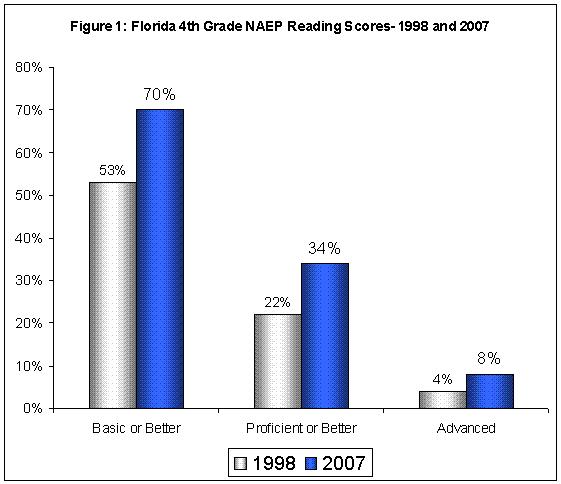
These results make the so-called “Broader and Bolder” approach seem all the more absurd. There hasn’t been any outbreak of “Socialism for the Children” in Republican dominated Florida, but there has been substantial improvement in the percentage of children learning to read.
Lucky thing too, as state budgets are being consumed by out of control Medicaid spending that it taking an increasingly large bite. Society has several other priorities besides K-12 education, such as criminal justice, higher education, transportation and social welfare. Bottom line: there isn’t the money for the Broader and Bolder approach anyway. This is just as well, as the track record on spending increases fueling academic gains stands as a dismal failure.
Given that we can’t spend our way out of our K-12 problems (and it wouldn’t work if we tried) we should instead seek ways to improve the bang we get for our existing bucks. Fortunately, Florida shows that it can be done.

 Jay P. Greene's Blog
[…] What Does Florida Tell Us About Broader/Bolder? at Jay P. Greene’s Blog Given that we can’t spend our way out of our K-12 problems (and it wouldn’t work if we tried) we should instead seek ways to improve the bang we get for our existing bucks. Fortunately, Florida shows that it can be done. […]
Where is the information as to third grade retention policy in Florida, which clears grade four of numerous students who would score poorly? Was that retention policy in effect in 1999? If so, what was the criteria and why omit information which describes the population and may differentiate it from comparison groups? If you remove unsuccessful learners from a group, is it ethical to compare this group to unfiltered groups aithout revealing such information? Is your motive political or educational??
If unsuccessful learners are removed, why celebrate stats that exclude the poor performers?
I decided to answer my own question as I already see you omit information I find needed. Sadly, and I hope you can prove me wrong, I believe I AGAIN find evidence of a faulty picture. I was even able to find this evidence using the work of Jay Greene and Marcus Winters in “Revisiting Grade Retention: An Evaluation of Florida Test-Based Promotion Policy”. The abstarct begins “In 2002, Florida adopted a test based promotion policy in third grade qs an attempt to end social promotion”. Last I knew,
your comparison year of 1998 preceded 2002 and thus the retention policy was not in effect. Do I smell deception?? Politics at any cost?