
(Guest Post by Matthew Ladner)
In 2007, a family of four needed to earn less than $20,650 to qualify for a free lunch. In Arizona, the median family income for a family of four is over $65,000.
Here’s the surprising news: Low-income students in Florida—namely, those who qualify for free lunches—outperform all students in Arizona. That’s the insight to be gleaned by sifting through the treasure trove of data generated by the National Assessment of Educational Progress (NAEP), known as the Nation’s Report Card.
Figure 1 shows fourth grade reading scores for Florida students whose family income qualifies them for free lunch compared to all students in Arizona.

Figure 2 shows the percentage of Florida’s low-income children scoring basic or above on fourth grade reading and all Arizona students scoring at the same level.
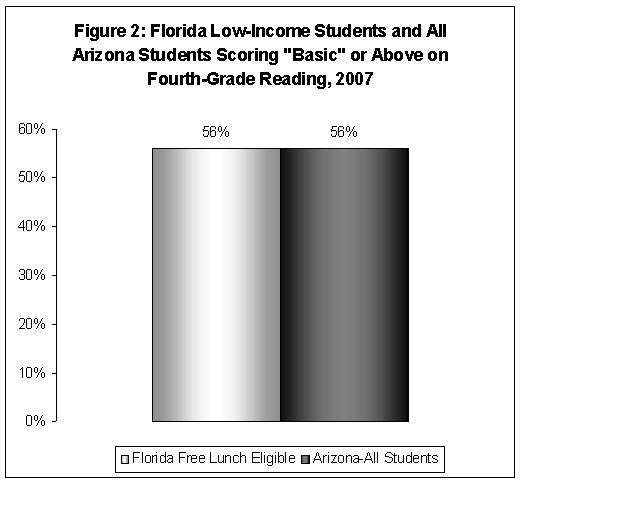
You don’t need to take my word on these scores. You can go to the National Center for Education Statistics website and see them for yourself.
The point here is not to bash the underperformance of Arizona schools. Sadly, they have plenty of company. Rather, these data point to the enormity of the opportunity for improvement which we can and must achieve. Florida has found a way to significantly boost the performance of low-income students. Others should examine how and borrow everything we can.

 Jay P. Greene's Blog
How pathetic and unhelpful it is when Florida is used as a positive example. Professors have produced studies showing the system is skewed by socioeconomic factors. Yet these studies are ignored. Could it be POLITICS in action?
I’m curious-just what sort of skew are you referring to? Florida has a challenging demographic profile to its K-12 population, and it only became more so between 1998 and 2007.
I think Diane is referring to some analyses put out by the Palm Beach school district that shows that lower SES schools are more likely to get lower grades from the A+ system, even with the inclusion of value-added aspect. Of course, what I think that shows is that low SES schools tend to have lower value-added because our system allocates to them teachers who tend to be less effective. In part, this is a function of union mandated pay scales and transfer rights. Teachers can’t make more money by being good, but they can seek to transfer to schools where the work is “easier” (because the kids are more advnantaged). If we had higher pay for working in lower SES schools, this would be much less of a problem.