(Guest Post by Matthew Ladner)
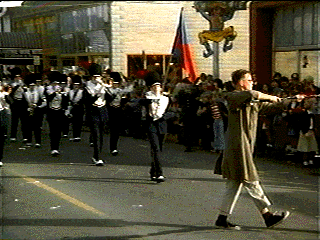
Robert Pondiscio’s now famous piece on ed reform’s leftward drift brought to mind the above scene from the masterpiece of American juvenile cinema Animal House. It’s hardly impossible to imagine ed reform going off course as, well, it happened before and in the recent past. Tom Loveless for instance argues that the entire Common Core effort has been worth less than a single NAEP point (on a 500 point scale) and that this gain is already reflected in the 2015 exams. I would not bet my left foot that Tom is absolutely correct about that, in fact I hope he’s wrong and the entire effort has some sort of delayed reaction since it is a sunk cost. I have yet to see anyone attempt to muster a credible refutation, and Tom’s analysis finds support from Hanushek’s work as well. The could be mistaken, but calling the question as of now makes it look like:

Well yes maybe that has not worked out as well as hoped, but the teacher evaluation systems pushed by Race to the Top are going to close the achievement gap by…oh wait watch out….gahhhgh my trombone!!!!!!
Not all such diversions are of recent vintage. Some are more of a persistent folly sort of phenomenon. For instance, it is fairly clear that the school voucher movement never would have launched in Milwaukee without a strange bedfellows coalition of liberals and conservatives. This was terribly exciting at first, but with the benefit of hindsight…
It now seems painfully obvious that the means testing of private choice programs has served to politically marginalize private choice vis-a-vis charter schools, district schools, magnet schools, digital learning and/or **fill in the blank here** because almost nothing else in K-12 education funding has adopted the view that actively discriminating against the children of the people who pay the highest rates of tax constitutes an inspired political strategy.
This is not at all to say that equity issues are anything less than vitally important or that we should not engage in an ongoing and thoughtful discussion about how best to reflect them in a system of private choice. The means testing fetish however has persisted so long that some very prominent charter school supporters for instance failed to recognize the rich irony of their criticism of the Nevada ESA program for being universal in nature when in fact every charter school law also involves universal eligibility by income. Come to think of it, I don’t know of many charter school laws that give additional state dollars to low-income kids, but the NVESA does provide additional state funds to low-income students….
Anyhoo, means testing for thee, but not for me won’t do- wake me up when our friends on the left means test district or charter schools. Otherwise the worthy conversation lies in settling upon the level of additional resources should be provided to disadvantaged children. All of which leads to Paul Peterson’s great valedictory piece as Editor in Chief of Education Next making the case that the regulatory approach to school reform led us down a blind alley reached its ceiling. Peterson calls on reformers to double down on parental choice as an improvement strategy. This approach, while promising, requires a level of modesty notably lacking from today’s would be technocrats. I’m happy to pass the ed reform baton to those who can snatch this particular pebble, as my next career creating Rhino Record compilation cds of Dean Martin and punk rock classics awaits (Martinis in the Mosh Pit, Volume 7!!!) and would be even more fun than anything in ed reform, other than jayblogging.


Ooops, day dreaming again, so getting back on track the above sort of issues deserve deliberation and debate in my view. I could be in the grips of an enormous folly that is invisible to me, just as my friends in the charter school movement seem oblivious to their means testing double standard. I’ve been wrong before, and I will be wrong again so have at it if you disagree. I’d rather debate these sort of issues than endure any further virtue signalling in the form of therapy sessions where Ivy League ed reformers work out their guilt from lacking an urban Horatio Alger story in public. Such burdens are best born in private with a determined stoicism, terrible though they may be, as they seem lacking in utility.


 Posted by matthewladner

 Jay P. Greene's Blog