Pass the Popcorn: Pixar as Art and Commerce

June 27, 2008

(Guest post by Greg Forster)

With Wall-E conquoring the movie universe today, how could we do anything else for this week’s Pass the Popcorn but a retrospective on Pixar?

Yet how much is there left to say, really? A retrospective of Pixar along the lines of the previous retrospectives I’ve done here would read like this: they made a really amazing movie, then they made another one, then they made another one . . .

I could tell you all about how great Toy Story and Finding Nemo are. But you already know. So I’ll skip the movie-by-movie retrospective and just look around for things to say about Pixar that everybody doesn’t already know.
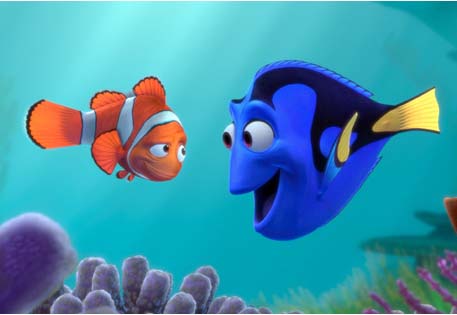
“Hey, Marlin! Didja know Pixar made a whole bunch of really great movies?”

“Yes, Dory, I knew.”

“Oh. Okay, then. . . . Hey, Marlin! Didja know Pixar made a whole bunch of really great movies?”

If I shared the view that Pixar’s more recent offerings (Cars, Ratatouille) represent a step down from its earlier accomplishments, I might write my third consecutive retrospective of a great filmmaker who succeeds both artistically and commercially, then lets fame go to his head and produces substandard work. However, I don’t think Pixar’s quality has declined. Yes, Cars is not Toy Story. But you know what? A Bug’s Life ain’t Toy Story either. Between the two, I’m not sure which I’d take – they’re both quite good for what they are, definitely well above the average “family movie” (not that that’s saying much), but they’re not great filmmaking. Same goes for Monsters Inc.

Believe it or not, this was a Pixar movie. Remember?

And I don’t care what anybody else thinks, I think Ratatouille is a very impressive accomplishment. It not only has sharp dialogue (consider, for example, the duel of wits between Linguini and Anton Ego in the press conference scene) and great humor (in its context, the moment where Ego is transported back to childhood by his first bite of Remy’s ratatouille is every bit as funny as the “I am your father” line in Toy Story 2), but also philosophical depth (the whole movie is basically Plato’s Ion in cartoon form, with cooking as a proxy for art and creativity generally – as Ego’s climactic monologue makes clear).
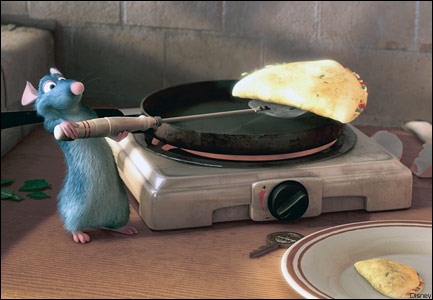
“Not by craft does the poet sing, but by power divine.”

So Pixar movies have always ranged from good family movies (A Bug’s Life, Monsters Inc., Cars) to exceptionally good family movies (The Incredibles, Ratatouille) to landmark artistic achievements (Toy Story, Toy Story 2, Finding Nemo).

But other things about Pixar have changed over time. It’s hard to remember this now, but there was a time when the name “Pixar” primarily meant “digital animation.” Of course everyone acknowledged that Toy Story was also a great story, and would have been noteworthy even without the technological breakthrough. But it was the digital filmmaking technology everybody really noticed when Toy Story hit the theaters.

Once upon a time, this wasn’t the adventures of good old Woody and Buzz. It was a revolutionary breakthrough in digital filmmaking that was going to change the role of technology in movies – which happened to come in the form of a story about a bunch of toys.

Of course, today nobody cares about Pixar as a technological innovator – and that fact is as great a testament as anything to its accomplishments as a producer of art. “Pixar” now just means “great movies.”
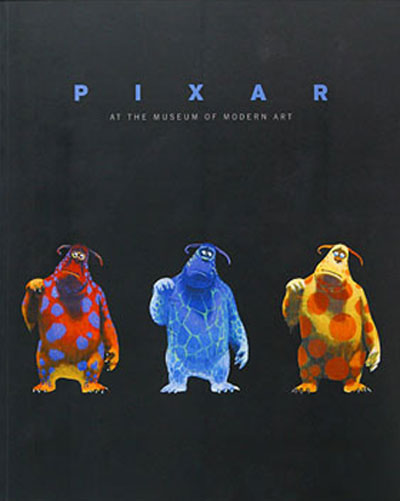

Pixar as fine art (at MOMA; HT www.rationalistic.com)

And, technology aside, Pixar’s accomplishments are breathtaking not only as art but also as commerce – in fact, I think what’s really most noteworthy about Pixar is that it appears to have developed a working business model for consistently producing good-to-great movies.

The idea of a business model for producing good art will strike some as misguided or even offensive, but it is really nothing more than the reappearance of what was the normal mode of producing art in almost all times and places. All great art before the advent of Rousseau’s philosophy – from Aeschylus and Euripides to Dante and Hieronymus Bosch to Shakespeare and Rembrandt – was produced in the context of a economic system designed to systematize financial support for artists (in the form of community festivals, household patronage, guilds, etc.) who were in turn expected to produce good work in response to something approximating market demand. The supposed antinomy between art and commerce is a prejudice of our own time. As C.S. Lewis once remarked, before the Romantic movement with its idolization of the artist and the creative process, the idea that artists should not be expected to produce good work “to order” would have been considered as absurd as the idea of a captain who could only steer the ship when the fit took him. Socrates’ remarks to Ion notwithstanding, in addition to divine power there is indeed a “craft” to the production of good art, and the divine power responds to the craft as much as the craft responds to the divine power.

Their greatest challenge: Reconcile art and commerce!

By now everyone knows the formula: Pixar collects a small stable of very talented filmmakers and gives them a long production cycle (four to five years for each project) during which they work collaboratively, each member of the team contributing actively to the other members’ projects. Everyone draws on everyone else’s talent and ideas, and the long cycle ensures that nothing has to go out the door before it’s ready.

Presumably it’s the presence of so many great artists in such a collegial and collaborative atmosphere that explains the remarkable phenomenon of Pixar shorts – the company has taken a defunct genre, the animated short, and produced enough great work in it to support a separate release on its own DVD even though they’re all already out there as bonus features on the DVDs of Pixar movies (which everybody who bought the shorts DVD probably already owns). The short Knick Knack was by itself worth the price of admission to Finding Nemo. No doubt what we’re seeing is the ideas generated during artistic bull sessions at Pixar that couldn’t support a full-length movie, but were too good to throw away.
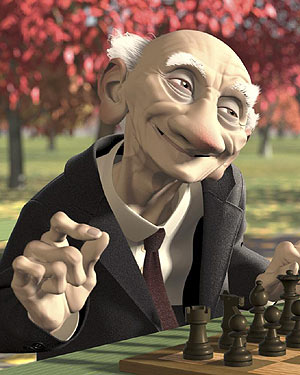
If you look at him and say, “Hey, that’s the guy who cleaned and fixed Woody in Toy Story 2!” you’re missing some of Pixar’s best work.

The Pixar formula looks very much like art-colony stuff, which is not what people expect from an intersection of art and commerce. But my point is that the Pixar formula is a formula – Pixar didn’t happen by accident, and it didn’t happen without investors who evaluated the business plan and judged (correctly, as it turns out) that the Pixar formula would produce reliable returns in the form of consistently good movies. In other words, while all the non-commercialized, anti-commercial art colonies seem to have stopped producing art worth seeing, in this case commerce produced an art colony that works. And it’s not fundamentally all that different from the household patronage system of Renaissance Italy, with Steve Jobs standing in for Lorenzo de’ Medici; capitalism just allows the patrons to draw resources from a broader base.

There’s no reason the Pixar model couldn’t be reproduced by other movie companies, by TV production houses, by music labels, etc. Even “high” art, for which there is a much more limited audience, could be produced this way. You would just have to finance it through contributions from, and sales to, the wealthy (and, presumably, through government subsidies) rather than by selling stock – which is pretty much how high art is financed now.

Of course, it takes a certain kind of person to create and sustain a collegial atmosphere among a bunch of top-flight artists – a class of personality not known for playing well with others. This is John Lasseter’s most important accomplishment, and recognizing the value of what Lasseter was doing is Steve Jobs’s most important accomplishment (at Pixar, anyway). For this, Lasseter can be forgiven even the egomaniacal introductory sgements he plastered onto the American DVD releases of the works of Hayao Miyazaki – but that’s a rant I’d better stop before it starts.

There are other Steve Jobses out there in the entertainment industry. There’s no reason they can’t find other John Lasseters and hire them to create new Pixars.

Pixar has a “formula” on the creative side as well as on the institutional side. Around the time of Toy Story 2 or so, I remember Jay remarking that Pixar movies succeed because all of them are about something, and specifically they’re about something that kids understand and adults still care about. In the early movies this was always pretty clear – Toy Story is about the anxiety of being replaced (Buzz is to Woody as a newborn baby is to the older sibling), A Bug’s Life is about standing up to bullies, Toy Story 2 is about death. In some of the later movies the subject isn’t as clear – you can make out a case that Monsters Inc. is about fear of the unknown, but you have to stretch a lot further. Nonetheless, the formula is still there for the most part, and it’s still pretty clear in most of the movies.

How will Wall-E fit in? The director (Andrew Stanton, he of Finding Nemo) has confirmed what seemed likely from the previews – namely that the movie has an environmental theme. That would of course be a disaster, since the last thing Pixar needs is to start making preachy movies. But Stanton swears the movie isn’t preachy. And I’ve long since given up judging Pixar movies by the previews, which always seem to promise disappointment, and thankfully have always proven wrong. The previews for Finding Nemo struck me as awful.

So I guess I’ll see you all at the theater tonight, and we’ll all find out together.


Pass the Popcorn: Truck Turner

June 20, 2008

(Guest Post by Matthew Ladner)

I haven’t seen any decent movies lately, so this edition of Pass the Popcorn will be opening up the treasure vault of oldies, along the lines of Flix You Should Netflix. Summer means action movies, and one of the most stunningly entertaining action films in my book: Truck Turner.

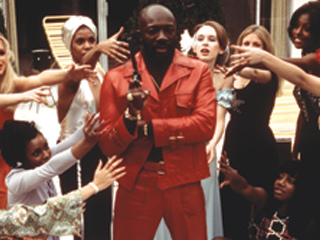
The great Isaac Hayes stars as Truck Turner, and obviously anything with Isaac Hayes in it is likely to be awesome. Before getting on the specifics of this, perhaps greatest film ever, a few notes on the genre seem appropriate.

It all started before WWII when a young army Colonel was ordered to move a military caravan from one coast to the other, to see how long it would take. Years later this same Colonel became President Eisenhower, who spearheaded the creation of the Interstate Highway system, inspired by his Oregon-trail like ordeal.

The Interstate Highway system has been great for moving goods and services rapidly across the country, but had the unintended consequence of enabling high levels of racial and economic segregation. With these new big highways in place, it became possible to work in big city X, but live in a leafy suburb. James Q. Wilson’s book Thinking about Crime discusses the profound policy consequences of this fundamental change in American life.

The so called Blaxploitation genre of film arose as white flight played itself out. The movie industry had an infrastructure of inner-city movie theaters across the country which now had a primarily African-American audience. Hollywood responded with action films aimed at African American audiences.

The content of these films are stunning in many ways by today’s standards. Filmed in the early to mid 1970s, the clothes in these films are often stunningly outrageous, like something you might see at a costume party. More broadly, these films are chock full of racial stereotypes.

The term politically incorrect doesn’t begin to describe the casual and frequent use of racial typecasts in these films. There has been much bemoaning of the rise of political correctness, but check out one of these flicks and then see what you think. Watching one of them quickly makes apparent just how much our national character has changed for the better.

I’m just old enough to remember the old Rat Pack era comedians as older men in the 1970s. It would be nothing to see a Don Rickles stand up at a Dean Martin Celebrity Roast and casually engage in ethnic humor (e.g. an Italian and a Polish guy walk into a bar…) By today’s standards, such humor is only successfully trafficked in by comedians such as Dave Chappelle, whose skits are so outrageous in part because they are so rare under current sensibilities.

In any case, Blaxploitation cinema is like a pre-political correctness time capsule, and as such very educational. Blaxploitation films usually focus on the exploits of a superhuman killing machine/babe magnet- a sort of urban James Bond fighting the villains of the inner-city instead of the Soviets or SPECTRE. Speaking of James Bond, Live and Let Die could almost be considered a Blaxploitation film, other than the pasty British super-agent.

Turner, Truck Turner…

Many of the films of this genre I have seen are impossible to enjoy. Shaft is fairly dull, Superfly was unwatchable. Truck Turner however can be considered a part of an almost subgenre of Comedy Blaxploitation, similar to the Comedy Westerns like the War Wagon or North to Alaska. These films are not comedies per se, but instead contain comedic elements, and do not take themselves seriously at all; much like the knowing twinkle Roger Moore had in his eye as his Bond enjoyed one absurd physical and romantic conquest after another.

Truck Turner has a memorable supporting cast including Star Trek’s Nichelle Nichols as a vengeful madam (check out the white satin bell bottoms!), Yaphet Kotto as the villainous Harvard Blue, and Scatman Crothers as Duke, Truck’s wise old mentor who provides guidance through the “Pimp Civil War.”

Words can scarcely describe how outrageous and funny Truck Turner is, so luckily, youtube has the original Truck Turner trailer. Watch the trailer. You’ll laugh, you’ll cry, Truck will forever be a part of you.

IMDB lists a 2008 Truck Turner project as in development. Color me skeptical- you can’t improve upon perfection.


Pass the Popcorn: Night Falls

June 13, 2008

(Guest post by Greg Forster)

Original movie title: “The Man Who Didn’t Know He Was Dead.”

(Due credit: I stole that gag from the “loading” page of an old The Critic webisode. I’d link if the creators had a page, but I can’t seem to find one.)

In addition to the new Hulk movie, M. Night Shyamalan’s comeback attempt, The Happening, opens today. As I promised in last week’s edition of Pass the Popcorn, here’s a retrospective of Night’s fall.

Before we get down to business, though, fascinating fact: did you know that Shyamalan was the lead author on the screenplay of Stuart Little? Well, that’s why God made IMDB. Come to think of it, how much difference is there, really, between writing lines for Haley Joel Osment and for a cute animated mouse?

On one level, Ang Lee (whose rise and fall we chronicled last week) and M. Night Shyamalan were two big 1990s filmmakers trying to do similar things: produce popular, mainstream movies that nonetheless had the higher ambitions of arthouse films. But other than that, you couldn’t ask for two more different filmmakers. Lee is all about emotional relationships. If you have a sibling, parent, or child whom you love but absolutely cannot even begin to understand – someone who is biologically your immediate neighbor but whose whole life is just totally alien to you – you’ll appreciate Lee’s achievement in Eat Drink Man Woman. Ditto Sense and Sensibility if you’ve ever been in love, The Ice Storm if you’ve been hurt by other people’s personal self-indulence, and Crouching Tiger Hidden Dragon if you’ve ever loved someone you couldn’t have – or had to deal with an angry teenage girl.

By contrast, Shyamalan’s films aren’t about relationships, except in the sense that they’re about man’s relationship to the universe. What ties all his movies together is that they take place in a universe that isn’t what it seems, and they’re about how we cope with the realities that lie behind the universe of appearance that makes up our ordinary lives.

His characters are mostly two-dimensional. That’s not a criticism – Aeschylus’s characters are two-dimensional, too, and for the same reason. Narratives about “man and the universe” necessarily reduce the “man” to a broadly representational figure. That’s the whole point. In the Oresteia, Orestes is the paradigmatic “man torn between conflicting duties” – in other words, Orestes is all of us. So naturally Orestes as a character isn’t developed much; that would only detract from the drama, by preventing us from identifying with Orestes. Ditto for most of Shyamalan’s work.

By this rubric, Lee is the Sophocles of the 1990s – his plots are only there to illustrate and develop the personal qualities of the characters. Raise your hand if you remember the plot of Crouching Tiger Hidden Dragon. (Okay, all of you with your hands up, report for detox at once.) And The Ice Storm barely even had a plot. Whereas in Shyamalan, as in Aeschylus, instead of the plot only being there to illustrate the characters, the characters are only there for the sake of the plot. Quick, how many main characters from Shyamalan’s films can you name without looking them up?

(Who, then, is the Euripides of 1990s film – the cynic for whom both plot and character give way to lengthy chunks of hard-bitten dialogue that either proclaim, or else ignorantly illustrate, the meaninglessness of the human world and the absence of the gods from it? My vote: David Mamet.)

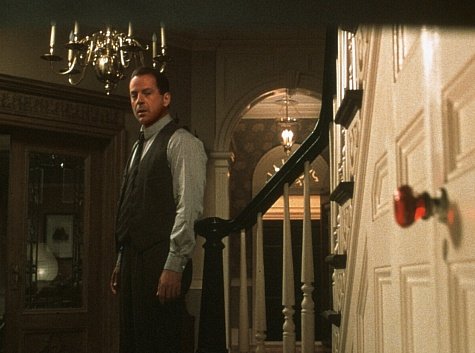
Shyamalan’s characters often don’t change at all. Of the three main characters in The Sixth Sense, all three remain the same people at the end of the movie they were at the beginning. They change only in that they start the movie ignorant of certain very important facts, and end it knowing those facts. The boy is terrified and disturbed at the beginning but calm and well adjusted at the end, not because he’s grown as a person, but because he had mistakenly thought the ghosts were a threat to him and now knows that they’re not. Similarly, the psychologist lets go of his anger at his wife, not because he’s grown as a person, but because he realizes that he’s dead. The mother’s attitude toward her son changes, not because she’s grown as a person, but because she finally sees proof that he’s really seeing ghosts and isn’t crazy. Their personalities are unchanged. Only their knowledge of the mysteries of their universe has changed.

Or consider that, as far as I can recall, the few really emotional scenes in Shyamalan’s films are all either confrontations or revelations – both of which can produce strong emotions without doing much to advance character development. The scene from The Sixth Sense that really stuck with me and haunted me, so to speak – it still does – is that harrowing moment where the mother realizes that her son’s doctor believes she’s abusing him. She boils over with furious indignation, as do we – until we remember that while she knows the true reason for the boy’s injuries, and we know it, he doesn’t – and from his perspective, abuse is the logical explanation for what he sees in front of him. We can’t help but hate him – hate him with a boiling passion – for doing the right thing.

(An interjection: I’ve heard some people criticize as vain Shyamalan’s inserting himself into each of his movies, Hitchcock-style. But look at where he inserts himself. In the first three movies, and above all in the first one, he appears as someone who makes us intensely uncomfortable: the doctor who mistakenly – but rationally, given the facts available to him – thinks one of the protagonists is abusing her son; the dark-skinned man who is singled out and pulled aside by the protagonist for a drug search; the reckless driver who killed the protagonist’s wife. And in the fourth movie he’s a lazy cynic. This is vanity?)

The Sixth Sense could have been just a shlocky thriller with a neato twist ending, but it’s something more. (Not something else instead of a shlocky thriller with a neato twist ending, but something else in addition to a shlocky thriller with a neato twist ending; it’s still that, of course.) It’s about what it’s like to encounter, and be changed by, things that you don’t understand and that the people around you don’t understand. The frustration, the isolation, the resentment, the anger – and finally the relief of coming to understand, and finding others who understand, what you’ve encountered. “I see dead people” is a proxy for “I have a mental illness” or “I didn’t kill that girl but everyone thinks I did” or “I’m a Montague and I’m in love with a Capulet”  or “I’m the only person in my family who does (or doesn’t) believe in the Bible” or any one of a thousand other strange, alienating things that happen to us in our very strange universe.

Likewise, Unbreakable – a gem of a movie if you have the patience for it – takes what could have been a comic-book-movie premise and turns it into a meditation on the metaphysics of duty and destiny. If you find yourself having been blessed in some very important way, is it mere arrogance to think that you’ve been chosen to recieve that blessing? Is that an insult to the others who presumably were not chosen, and who may be suffering (or, in this case, dead) because they lack what you have?  And do you have a duty to accept your chosenness if it doesn’t give you the life that you want? The deleted scenes to this movie are well worth watching; having seen them only once, I find it impossible to think about Unbreakable except in terms of how those scenes frame the story. One in particular, a conversation between the hero and the town priest immediately after the mass funeral for the train wreck victims, really expands the significance of the movie and should have been left in; this slow-paced movie could have stood to move faster anyway.

Then came Signs. Here, Shyamalan’s ambition to comment on man’s place in the universe becomes explicit. Rather than take a premise that could have stood on its own as an ordinary genre movie (e.g. man investigating ghosts discovers that he is one; pitiful man with broken life discovers he has superpowers) and then subtly imbuing it with greater philosophical significance, Shyamalan builds the plot directly around his philosophical reflections.

The key to the whole movie is the “miracle man” dialogue between our hero, the ex-priest – and by the way, one of the few really false notes in this movie is how it puts the hero in a priest’s collar but then carefully avoids calling him a priest, resorting to all sorts of ridiculous verbal gymnastics (“I’m not a reverend anymore.” Neither Protestants nor Catholics ever refer to a clergyman as “a reverend”). What was the point? Presumably to avoid establishing whether he was Catholic or Protestant, to allow the broadest possible audience to identify with him. But identifying him as a priest wouldn’t have established whether he was Catholic, since plenty of Protestant clergy are called priests, and in any event the unavoidable tone of falsehood this introduces to the movie does much more harm than . . .

Where was I? Oh, yes. The key to the whole movie is the “miracle man” dialogue between our hero, the ex-priest, and his brother about the concept of providence. Either all events are ordained to serve a cosmic plan – or else not. The point of the movie is that no empirical evidence can settle the question; the universe of the five senses, the universe as we experience it by living in it, equally vindicates the nihilist view and the theist one (provided, of course, that we’re talking about a real theism that robustly faces the problem of evil, not the watered down happy-talk theism that has sucked the life out of the oldline denominations in the past century . . . but I digress). And saying that it vindicates both is just another way of saying it vindicates neither. In other words, mere experience (or “evidence”) cannot by itself distinguish between a meaningless universe and a meaningful one. As a result, most people make their real choice between the two alternatives based on some combination of emotion, instinct, and inclination; Signs is the story of how one man came to change sides, and then change back.

Of course there is another way to judge between the two, namely by metaphysical reasoning – evaluating the universe not as we experience it with the five senses, but as it appears to our logic. Unforutnately, there’s no way to work this point into a movie, and Shyamalan was right not to try. Nonetheless, Signs always makes me think about this book, which is the one book anyone who wants to understand this subject should read. (Strict logicians who want the issues formulated the the technical style appropriate to a doctoral dissertation in philosophy should instead read this.)

Appropriately enough for a post about M. Night Shyamalan, the book begins with a ghost.

“In all my life I have met only one person who claims to have seen a ghost. And the interesting thing about the story is that that person disbelieved in the immortal soul before she saw the ghost and still disbelieves after seeing it. She says that what she saw must have been an illusion or a trick of the nerves. And obviously she may be right. Seeing is not believing.

“For this reason, the question whether miracles occur can never be answered simply by experience . . . . What we learn from experience depends on the kind of philosophy we bring to experience.”

Signs contains more meditation on man’s place in the universe than Shyamalan’s previous films, but the absence of an independent story that could have carried the movie on its own balances that out. On the whole, it’s not better or worse than the previous movies, just different. But the greater ambition Shyamalan displayed in Signs was, if you’ll pardon me, a good sign. Greater things were around the corner.

And then it all started going wrong. First came The Village. I went into The Village as a Shyamalan fan and thus predisposed to enjoy the movie. And I think it was for that reason that I actually did enjoy it while I was watching it – not a lot, but enough. The performances are superb, and the scene where the male romantic lead confesses his feelings for the female romantic lead is especially powerful. However, as soon as the credits started rolling, all that faded away; superb performances are the most perishable part of any film experience. What lives most vividly in the memory is not the work of the actors but the work of the writer and director – and that was subpar in this movie.

The problem, I think, is laziness. There are just too many dumb moments, and dumb moments are always a symptom of a filmmaker who couldn’t be bothered to keep reworking things until they all fit together right. So Lee and Shyamalan both got self-indulgent, but where Lee fell off one side of the horse, working too hard on the wrong things, Shyamalan fell off the other side, not working hard enough. (Or that’s my theory, anyway.)

I’m told that The Village improves with repeat viewing. I can well believe it. Repeat viewing tends to increase the relative value of the actors’ performances and decrease the relative value of the writers’ and directors’ contribution, most especially regarding this movie’s greatest weakness: plot. If a movie improves on repeat viewing, that may rescue the performances and the movie as a whole from a negative verdict, but in general it shouldn’t rescue the director.

Then, as we all know, came Lady in the Water – about which the less said the better, not that that ever stopped anybody.

When I saw that Shyamalan was staging a comeback, I had cautious hopes. If we didn’t have a two-year-old to look after, I’m sure we’d have gone to see it. But check this out:

Rotten Tomatoes Tomatometer

The Village: 43%

Lady in the Water: 24%

The Happening: 20%

Now, I know only too well – as readers of this blog will recall – that Rotten Tomatoes is not infallible. At the time of release it gave 100% to this flaming nuclear turd of a movie, although I see that with the passage of time a handful of critics who actually saw the movie rather than judging it by the name of the director have brought the average down to 96%.

But, to use this gag one last time, a rating below Lady in the Water is definitely not a good sign.


Pass the Popcorn: Curse of the Hulk

June 6, 2008

(Guest post by Greg Forster)

“I’m Gumby, dammit!”


(Gen Y readers see here for explanation.)

With no Lost episodes until at least the fall – the network isn’t saying when it’s coming back; my guess is they put the whole show into “The Vault” and transported it forward in time, so who knows when it will reappear – the weekly Get Lost feature is going on summer break and we’re starting a new Friday distraction called Pass the Popcorn.

Before moving on to new business, I’d like to report that to my very great surprise, my 12,000 line epic poem on the virtues of Speed Racer generated no negative reaction whatsoever – because it turns out I’m the only person on earth who has seen the movie.

One week from today, Marvel will unveil the latest attempt to make an Incredible Hulk movie that doesn’t suck. As all geeks and fanboys know only too well, in 2003 the career of one of the greatest filmmakers of the 1990s, Ang Lee, shipwrecked on the rocky shoals of the big mean green machine.

“I agreed to make a Hulk movie? Oh, please . . . please, no!”

It’s worth contemplating the significance of Lee’s failure. Here was a man who was perfectly positioned to make a great movie out of the Hulk. After establishing himself with his intimate portrait of family and romantic relations, Eat Drink Man Woman (1994), he turned out two of the most noteworthy movies of the decade, each of which achieved serious commercial success while retaining the deep emotional sensibility of the arthouse: Sense and Sensibility (1995) and Crouching Tiger Hidden Dragon (2000), in addition to his less widely noticed but still artistically important indictment of the sexual revolution, The Ice Storm (1997). His masterpiece, Sense and Sensibility, can make a fair bid to have been the best movie of the 1990s. Why should Emma Thompson get all the credit – sure she produced what is probably the best film script adaptation of a novel ever, but Ang Lee directed the darn thing.

Though the choice of an “arty” director to produce a Hulk movie seemed daring and risky at the time, and was thus interpreted in hindsight as a huge blunder, I don’t think that was the problem. Lee’s movies may have been “arty,” but not in an obscure way. They’re completely accessible to non-specialist viewers. Lee was always concerned to connect with a broad audience. And his gift for communicating the emotional lives of his characters should have served him very well in making a movie whose central plot device hinges on the emotional state of the main character. Moreover, with Crouching Tiger, Lee had already demonstrated a mastery of the art of fantastic narrative.

Alas, during the same period as his triumphs, he also produced Ride with the Devil (1999). It was dismissed at the time as a mere one-time stumble for an otherwise successful director, but perhaps it may now appear as a harbinger of trouble to come.

Lee’s downfall with the Hulk, I think, was his decision to experiment. His previous movies, though arty, were by and large not experimental. Yes, people flew in Crouching Tiger, but that was nothing new; Lee was building on a long tradition of visually fantastic martial arts movies. Lee and his team certainly advanced the technology of these movies in important ways – nobody had ever run up a wall quite that convincingly before – but they were building on an established genre of visual presentation.

But his critical and commercial success, combined with the big franchise he was handed, appears to have prompted the onset of hubris. Lee notriously decided that the visual presentation of his Hulk movie would be comic-style; that is, multiple views of the action would appear on the screen simultaneously, in rectangles vaguely reminiscent of comic book panels. This might have worked, if Lee had done it right; the TV show “24” has done great things with split-screen presentation – and without the benefit of the big movie-theater screen. But Lee was so busy with his panels that he forgot to use them for anything worth having them for. We got multiple views of things that didn’t reward multiple views – Dr. Banner fiddling with the switches on his big fancy science machines does not get any more interesting when you see it from different angles. And I think this fascination with form to the exclusion of content was the major reason the movie failed (though the weak script and other problems didn’t help).

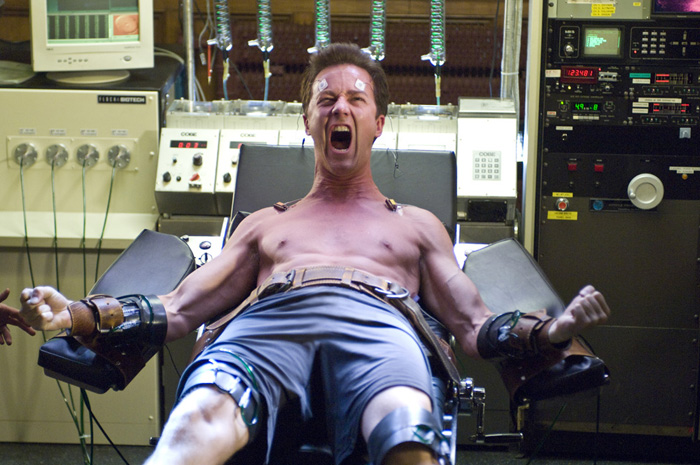
“Just sit still, Mr. Norton, and this machine will painlessly remove your desire to appear in a Hulk movie.”

After his demolition at the hands of critics and audiences alike, Lee abandoned the mainstream and ran screaming back to the arthouse from whence he had come, producing (in 2005) a movie about gay cowboys – thus ensuring his restoration to the good graces of the Hollywood illuminati, and giving new life to a priceless gag about the obscurity of arthouse films from a 1998 episode of South Park.

“These are independent films.”

“You mean like ‘Independence Day’?”

“Naw dude, ‘independent films’ are those black and white hippie movies. They’re always about gay cowboys eating pudding.”

Now Marvel is trying again, and this time it’s not letting anyone else spoil the Hulk – this time Marvel is going to spoil the Hulk for itself. (If you want something done right . . .) Though it’s being distributed by Universal, the movie was produced entirely by Marvel’s new movie production unit Marvel Studios. Iron Man was the unit’s first major film project, and obviously it’s off to a great start both artistically and commercially. So naturally they decided their second project needed to be abysmally bad, to balance the cosmic scales.

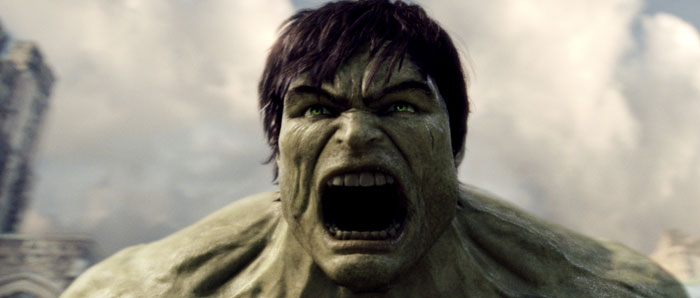
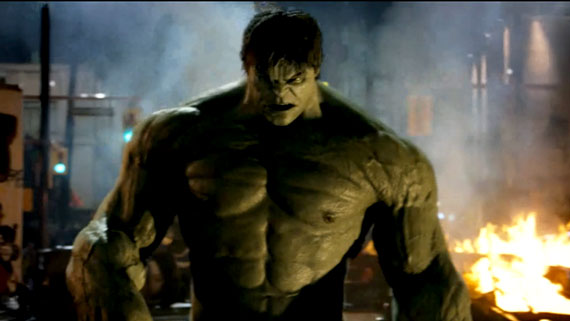
No, I haven’t seen it, but I’ve seen the trailer, and that’s more than enough. Edward Norton certainly looks like he does a good enough job in the role. But take a look at the new “Hulk”:

I mean, there’s a lot more to a good summer movie than special effects – but if the special effects look lousy, then the whole time we’re sitting there watching, we’re going to be constantly thinking about the fact that we’re watching a special effects movie with lousy special effects. In other words, no amount of great story, witty dialogue, etc. is going to overcome the fact that people will be sitting there looking at the Hulk and thinking, “Man, that thing looks so much like a clay figurine, I keep expecting Pokey to wander onto the screen.”

And for the big finale, the claymation Hulk battles – another claymation Hulk! It’s better than having him fight a magic tornado, or whatever that was at the end of Lee’s movie. But still. Did you notice that the only weak part of the Iron Man movie is where the good Iron Man fights the bad Iron Man? What’s up at Marvel Studios – did they play too many games of Mortal Kombat and decide that every movie must end in a Mirror Match? (Come to think of it, the new Hulk doesn’t just look like Gumby on steroids; with that disproportionately tiny head, he looks like Gumby and Goro’s love child.)

“Get me outta this friggin’ movie!”

So what is it about the Hulk? Is he unfilmable? Cursed? Maybe it’s a problem, not an advantage, that his superpower is so bound up with psychology. In comics, it’s remarkably easy to shift the tone of the story; that’s one of the inherent advantages of the medium. So you can have a big fight scene immediately followed (or, more likely in the case of the Hulk, immediately preceded) by an intimate emotional scene. On screen, though, it’s harder to shift tone at such a rapid pace. The sound and the fury of the big fight scenes drown out everything around them. That may also explain why the TV Hulk wasn’t an embarrassment – TV can switch moods better than film (although still not as well as comics), and in those low-tech days there were fewer highly intense “effect” scenes and the ones they did have were less intense. For that matter, the Hulk himself wasn’t an “effect,” and that alone may have been the key.

Tune in next Friday for another look back at a talented filmmaker ruined by success: M. Night Shyamalan.


Speed Racer Is Better than Iron Man. Deal with It.

May 26, 2008

(Guest post by Greg Forster)

(Guest post by Greg Forster)

With no Get Lost feature this week – the episode was postponed on account of soap opera – I figure this blog is a week shy on geekdom and it needs some ballast. So I’m going to pull on my flameproof shorts, put my affairs in order, kiss my wife and daughter good-bye, and tell the world what it needs to know:

Speed Racer is better than Iron Man.

(I don’t intend to spoil anything big here, but in deference to the prime directive of geekdom, I hereby warn you that if you want to be absolutely unspoiled for these movies, you’d be a moron to even start reading a post entitled “Speed Racer Is Better than Iron Man.”)

Don’t get me wrong; Iron Man is a good movie. But it’s missing something.

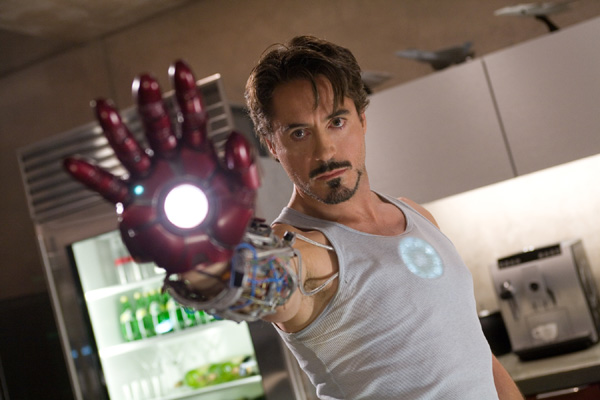
John Podhoretz (in the May 19 Weekly Standard) is right – Iron Man is not a superhero movie, it’s a 1930s screwball comedy about the wacky hijinks of a billionaire playboy. Flying around in a tin can is just another of his wacky hijinks.

Not that there’s anything wrong with that! I love “Cold Comfort Farm,” “Amelie” and “Down with Love,” so nobody can accuse me of screwball snobbery. And Iron Man works very well for what it is. (Which is a dignified way of saying that I laughed my pants off – and that’s saying a lot for a movie.)

It even manages to rise above the level of screwball in its evocation of the complex relationship between the male and female leads. Robert Downey Jr. and Gwyneth Paltrow earned every cent of the millions they’re going to make on this franchise. I went away thinking, “This is what that lousy Superman movie could have been like if they had hired an actor instead of a mannequin to play Lois Lane.”

But the tin man at the center of this movie has no heart – the psychology of the main character, which the structure of the movie intentionally draws our attention to, is never developed. The plot hinges on Tony Stark having a traumatic change of heart about his profession. But what exactly was this change? Does he repent of making weapons altogether? Some of the dialogue hints a little in this direction. But his first act of pennance is to make a big weapon and fly around using it to kill people.

So what then does he really repent of? I can see at least two other possibilities. He repents of making weapons for the US government, or perhaps making them for government (any government), or perhaps making them for anyone at all but himself. Again, a few lines of dialogue seem to point in this direction, but then the subject is dropped. Or, on the other hand, he repents of not keeping an eye on the weapons he makes and allowing them to fall into the wrong hands – but not of making weapons in itself. His actions after his repentance – making a big weapon and flying around killing people with it – seem to point toward this interpretation.

You can see why the movie never tells you which it is. If the first, then the movie is implicitly anti-war, and the conservative half of the audience is alienated. If the second, then the movie is implicitly pro-war, and the liberal half is alienated. You get bigger ticket sales by just letting each moviegoer mentally supply his or her own preferred interpretation of Stark’s psychology.

Trouble is, this turns Stark into a cipher. His motivation, his whole psychology, is truncated. That might not matter in a lot of superhero movies; Michael Keaton is a cipher in Tim Burton’s Batman, and it’s still a great movie. But the whole structure of this particular movie demands more psychology than the studio’s marketing suits are willing to permit. Iron Man could have been a tormented anti-war warrior, battling to undo the damage his life’s work has done to the world by enabling war. Or he could have been a warrior plain and simple, waging a just and noble personal war to put right the deadly consequences of his own arrogance. As it is, he falls between two stools and is . . . nothing in particular.

Winner of the 2008 Vaguest Midlife Crisis Award

OK, you might say, but do you really prefer a brainless light-show movie? Come on.

If you said, that, you’d clearly be in good company. The critics seem to agree that it’s a stupid movie. But I think the critics went into Speed Racer determined to dislike it, or at least not to like it unless it conformed to their preconcieved notion of what a “good” light-show movie is like, which it obviously doesn’t.

Critics don’t like what computer graphics have done to the movie business. And with the enormous number of lousy movies where the story is nothing but a lame excuse to show you a bunch of computer graphics, who can blame them?

To someone who sees things through that lens, if a movie has a lot of computer graphics, it had better also have a complicated plot, brilliant dialogue, gay cowboys eating pudding – something that could pass muster in an arthouse movie. If so, they get to look high-minded by praising the movie in spite of its having a lot of special effects. (“The effects serve the story” is the universal code phrase for “All of us snobs have permission to like this movie.”) Otherwise it goes in the “light show” trash bin.

Speed Racer doesn’t have anything you would ever see in a theater where the coffee at the concession stand is brewed fresh every hour. The plot is simple to the point of melodrama, and the dialogue does its job in advancing the plot, but no more.

But that doesn’t make it dumb! Simple is not the same as stupid. Melodramatic plot devices are cheap and tacky when they appear in narratives that are not otherwise melodramatic. But that’s not because melodrama itself is bad. It’s because melodramatic plot devices don’t belong in narratives that aren’t melodramas.

A well constructed melodrama satisfies a deeply rooted need in human nature. Anyone who denies this is kidding himself. Much of what passes as “serious” drama is really melodrama, but isn’t called that because the people who like it are too snobbish to think that anything they enjoy could be melodrama. And how else do we explain the near-universal popularity of melodrama? Why, for example, does practically every TV news outlet turn practically every story it covers into a melodrama?

And ultimately this same function – satisfying a universal human need – is the only claim that the allegedly more serious forms of drama have on our attention. Augustine, caught up in a violent overreaction against his own youthful obscession with “serious” drama, wrote that he understood the appeal of comedy but thought that tragedy was disgusting and perverse. Why go to the theater to intentionally make yourself miserable? In ethics and metaphysics I’ll take Augustine over Aristotle any day, but here, Aristotle knew better. We go because we must. Our spirits demand tragedy (and comedy) as our bodies demand food. That’s just how we’re built. And it’s the same with melodrama.

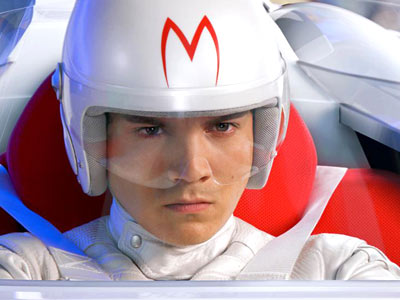
Speed Racer is the best melodrama I’ve seen in years. No doubt you already know the plot: Speed is a young racing prodigy who looks set to become the greatest racer of his time. But as soon as he wins his way into the big leagues, he discovers that the outcomes of the major races are fixed. He’s too clean to be bought and too good to be beaten, so the only way the fixers can ensure that their chosen racers win is by cheating – attaching hidden weapons to their cars. So Speed has to be twice as good to win. Cue fantastic racing-battle scenes.

Honestly, what more do you need? No doubt you could make a lousy movie out of that story. But you could also make a terrific movie out of it. And that’s what Speed Racer is.

If you want to know why it’s suddenly snowing horizontally, you’re missing the point.

Another reason people probably think Speed Racer is stupid when they shouldn’t is because it demands a full surrender to the narrative world. In the speedracerverse, everybody drives racecars, even to go shopping; monkeys are semi-intelligent; the hero’s actual, legal name is “Speed Racer” and his mother and father are named “Mom Racer” and “Pops Racer”; even the incorruptible Eliot Ness figure who helps Speed bring down the bad guys is named Inspector Detector. And no explanation is offered. The movie says, in effect: Here is the world where our story takes place; you can come in and join the party or you can go see some other movie.

Which is exactly as it should be. Every story must show you how its narrative universe differs from the real world, but trying to explain why its narrative universe differs from the real world is a fool’s errand.

And then there are the brazen plot devices. For instance, Speed is attacked while racing across a desert. Giant hammers and morningstars pop out of the cars. And just as you’re wondering how all this could be going on without the race officials noticing these giant honking weapons flying around, we cut to the TV announcer saying, “Wow, with all that sand being kicked up, it sure is hard to see what’s going on out there.”

Cheap? Stupid? It would be if it happened in an ordinary narrative, because it wouldn’t belong there. But in Speed Racer, that kind of thing is the narrative. “Stupid” stuff happens all the time in Monty Python, but nobody complains – because the stupid stuff is the whole point of Monty Python. And so, in that context, it’s not stupid at all; it’s brilliant comedy. Same here.

Or if Monty Python is too lowbrow for you, consider the point Dorothy Sayers makes, in another context, in The Mind of the Maker. If you’re writing a novel and you can’t figure out how to get your hero out of the jam he’s in, it would be stupid and wrong to end the novel by writing “Joe suddenly inherited a fortune from a wealthy relative he didn’t know he had, and he used the money to solve all his problems.” On the other hand, you could write a really great novel that opens with the same sentence – a novel about a man who suddenly inherits a fortune. If something brazen and outrageous is stuck on arbitrarily to resolve a problem because you’re too lazy to resolve it in a way that’s organic to the plot, that’s poor storytelling. But there’s nothing wrong with having something brazen and outrageous in your story if that’s what the story is about.

Finally, there is the innovation in the way the digital effects are used. The filmmakers decisively abandon visual realism to an extent that is probably unprescedented for a mainstream movie. During moments of intense conflict, the background fades away, leaving only the main characters surrounded by lights and colors. Things children imagine become momentarily real. A scene will suddenly become a visual montage (complete with people floating randomly across the screen, delivering dialogue) and then return to the scene. And in the final race, once Speed has dispatched the main villain, the rest of the race goes by in a chaotic blur. I think this last scene must be what the critics are thinking of when they complain that the effects are so heavy-handed you can’t tell what’s going on; at least it was the only scene where I couldn’t tell what was going on. But that’s clearly intentional. Once Speed has beaten the bad guy, it’s a given that he’ll win the race. So the fimmakers spare us the tedium of watching it.

To a critic worried about the negative effect of computer effects on filmmaking, all this must come across as reductive – effects intruding into scenes where they don’t belong. But the surreal visual style serves the melodramatic narrative very well. The whole point of melodrama is to clear away all the inevitable complexities of the real world in order to isolate and focus our attention on the stark, even painfully simple moral realities that always lie behind those complexities. People are always a complex blend of good and bad, but good and bad themselves are always simple. The point of melodrama is to tap into that simpler level of truth so that we can experience it, in narrative form, free of the complexities that always cloud it in the real world. What better way to visualize that experience than to have the background fade away as Speed struggles to overcome a thug sent to kill him?

Obviously all this explication is negative – an explanation of why Speed Racer is not dumb. None of that establishes that it is any good.

Fortunately, the producers have spared me a lot of effort by releasing the first seven minutes of the movie for free on the web:

If that doesn’t sell you on the movie, nothing I write will. Do yourself a favor and give it a chance.

But don’t miss Iron Man, either.