(Guest Post by Matthew Ladner)
Which states had the most success teaching math and reading to their students between grades 4 and 8 on the most recent NAEP exams?
Quick (really boring) caveat section- tracking NAEP cohort gains gets more inexact due to the larger standard error of estimate when examining subgroup scores- which exists in both the 4th and 8th grade scores. Accordingly, don’t get too excited if your arch-rival Idaho edges you out by a point, because if we knew a true population score rather than sampled estimate it could easily be the other way around. It is more appropriate to look to see whether the state nearest and dearest to your heart landed near the top, or near the bottom of the list than to obsess about their ranking. Moreover, given the possible role sampling error, it is probably best to consider looking at the math and reading scores together. If a state rocks one of the tests and performs not so great on the other, you may have gotten a lucky sampling error bounce on one test, or a bad bounce on the other, or maybe your state is just better at teaching one of these subjects than the other. You would have to consult other sources of data to figure that out. Conversely, if a state does well on both reading and math it is unlikely that sampling error is driving the result in both cases, assuming randomly distributed error.
Ok so on with the show:
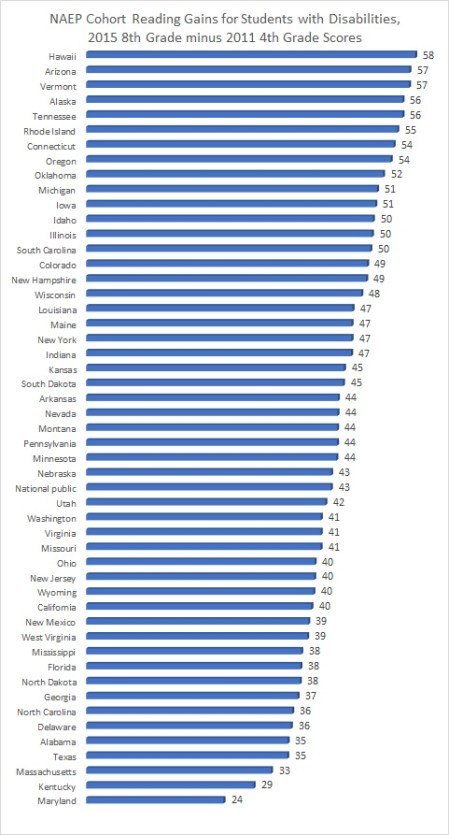
Top ranked Hawaii had gains more than twice as large as bottom ranked Maryland. Note that both of the bottom states (MD and KY) have a noted prior history of high exclusion rates for special needs children in NAEP. If they excluded a high percentage of kids in 2011 4th grade testing but not in 2015 8th grade testing, an appearance of catastrophe could sneak in. I am happy to note that my patch of cactus lies near the top. What about math?

Note that the overall gains for math are smaller than for reading. Also Hawaii is again at the top, and Arizona is near the top. Again Maryland appears to have taught a little more than one year’s worth of math to special needs students in four years, but I suspect that strange things are afoot at the MD Circle K on that one. I could dig into NAEP pdf files to check on exclusion rates but alas it is time for me to get out of my pajamas, so I will leave that to whatever you call people from Maryland. Marylanders?


 Posted by matthewladner

 Jay P. Greene's Blog