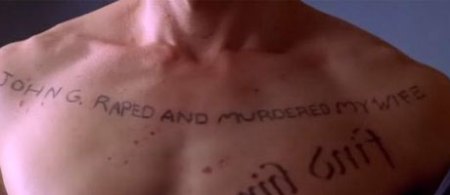
(Guest post by Greg Forster)
Hey, remember Memento?
No you don’t. You remember a really clever novelty act where they put you in the shoes of a man who can’t remember things that happen to him by telling most of the story backward. But memory is unreliable, remember?
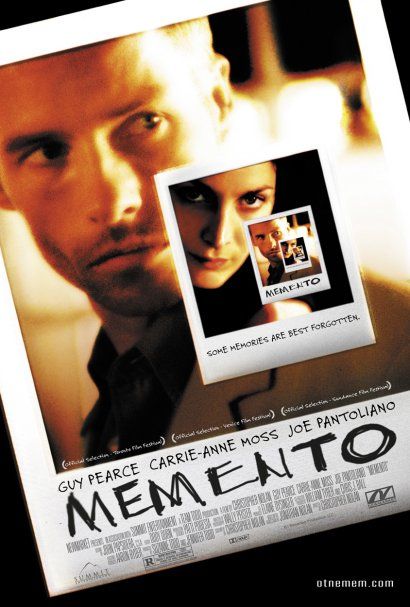
Back when you saw it, you realized that it was – in addition to being a clever novelty act, which of course it was as well – a profound meditation on the nature of human identity – on the sources of knowledge, motivation, and “habit” or “instinct,” which together make up who we are.
But since then you’ve forgetten all that. What you retain all these years later is:
Okay, what am I doing? I’m chasing this guy.
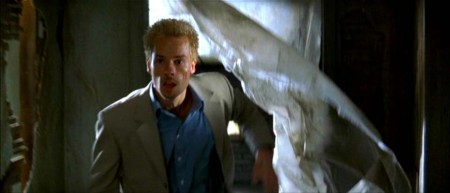
No, HE’S chasing ME!
Which is just about the cleverest gag on film, I admit. But that’s a dog and pony show compared to this, which you don’t remember:
Just because there are things I don’t remember doesn’t make my actions meaningless. The world doesn’t just disappear when you close your eyes, does it?
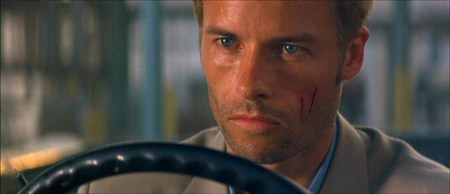
You can question everything. You can never know anything for sure.
There are things you know for sure…Certainties. It’s the kind of memory you take for granted.
Of course, “earlier” (which is to say “later”) in the movie Leonard deprecates memory to Teddy. Memory is unreliable. You want facts, not memories. But now look at what Leonard tells Natalie – certainties are the kind of memory you take for granted. What is your knowledge of “the facts” but a bunch of memories? In which case, how can you know anything? As Augustine demonstrates at length in chapter 10 of the Confessions, memory comprises virtually all of the human personality.
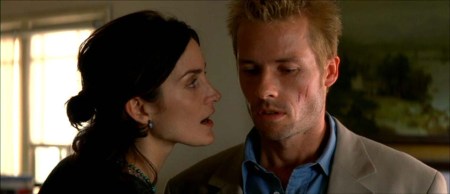
It all comes down to whether or not you can take it for granted that there’s a real reality out there. Because if you can’t take it for granted, there’s no way to prove it. You can either assume it and be sane, or doubt it and go mad. That theme winds through everything in the movie. As Leonard tells Teddy at the “end” (which is to say at the “beginning”), whether or not he’s got the right John G. makes all the difference. It’s the only thing that matters.
But why? Teddy says we all just lie to ourselves to be happy. But Leonard knows that theory doesn’t hold water. If you really were lying to yourself, it wouldn’t make you happy. The fact that his quest for the killer does in fact motivate him proves that he’s not just interested in giving himself a purpose. He really wants to find the killer.
To Natalie, he simply asserts that the world doesn’t go away when you close your eyes. At the “end” (which is to say at the “beginning”) he pushes away the doubts Teddy has planted by insisting to himself that “I have to believe in a world outside my own mind.” That’s the rub. If you take that seriously – not “I have to believe” in the sense that I want to, so I’ll lie to myself to be happy, but “I have to believe” in the sense that my mind actually cannot function in any other way – it solves the problem.
To take a parallel example, no one can prove that two contradictory statements can’t both be true, for the simple reason that the activity of proving things itself assumes that two contradictory statements can’t both be true. The law of noncontradiction can’t be argued for or supported; we believe it because our minds simply will not function unless we do. You can either assume it unquestioningly or go mad; ultimately there are no other options.
But why, then, does the movie end (i.e. begin) the way it does? (For the sake of those benighted souls who may not have seen the movie, or for those who may have forgotten the details and may want to go back and see it again, I won’t spoil the central twist.) I think it’s simply that Leonard’s exchange with Teddy makes him realize that a man in his condition is unable to do what he’s trying to do, so he’ll do the next best thing – rid himself of the person who’s using him.

At any rate, I don’t think we’re meant to accept the claims we hear at the end about Leonard’s past. The movie itself undermines this in several ways. For starters, when those new “memories” start flashing into Leonard’s head, we get this image:

Which is obviously absurd and impossible. That’s the point – mere suggestion can produce new “memories” that feel accurate but can’t possibly be real. Which is why we have no reason to accept the new “memories” at the end.
Also, think about that pivotal image of Leonard lying on the bed when his wife says “ouch!” (If you don’t remember what I’m talking about, for goodness’ sake what more excuse do you need me to give you to go back and see this movie again!) If the new “memories” are real, then the revised version of this image must be the true one and the original version a construction. But the original version makes sense and the new one doesn’t. Why on earth would he do that in that contorted position? If he were going to [activity deleted to avoid spoiling the twist] he wouldn’t do it lying on the bed at a ridiculously awkward angle while she read a frikkin’ novel. But that’s exactly the kind of absurd image your mind would invent under a false suggestion.
Well, like my interpretation of the end or hate it, Memento is still one of the most profound movies out there, and it’s well worth a reviewing if you haven’t seen it since 2000.
Oh, and I hear Chris Nolan’s made some other interesting movies since then. Guess I should check those out.
HT Movie Images for most of these shots, Beyond Hollywood for the one at the top


 Posted by Greg Forster
 Jay P. Greene's Blog