(Guest Post by Matthew Ladner)
MaryEllen McGuire of the New America Foundation takes on the unions for dealing out the least experienced teachers to the neediest children in U.S. News and World Report:
Teachers with the least experience are educating the most disadvantaged students in the highest poverty, most challenging schools. Low-income kids are being “triaged” not by experienced teachers, but by those with fewer than three years of teaching to go on.
Does it matter? Absolutely. According to the research, teacher experience is at least a partial predictor of success in the classroom and, at present, one of the only approximations for teacher quality widely available. Experienced teachers tend to have better classroom management skills and a stronger command of curricular materials. Novice teachers on the other hand struggle during their initial years in any classroom.
McGuire’s point is valid, but of course we should not be content to use experience as an approximation for teacher quality. There are both outstanding young teachers and truly awful experienced teachers, as you might recall from the Son of Super Chart:
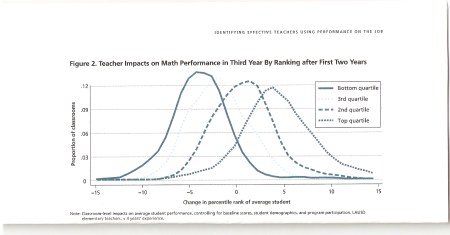
The Son of Super Chart broadly backs up McGuire-the curve for 1st year teachers is centered on -5, and the curve for 3rd year teachers on 5. All else being equal matching inexperienced teachers with high needs kids is an abominable practice.
Of course, all else need not be equal, which is why Teach for America works well.
McGuire proposes solutions:
Once we can wrap our heads around the true extent of the problem we can start taking down the second obstacle: figuring out a way to entice more experienced teachers to teach in high need schools. This will require a long-term commitment to systemic reform including investing in low-poverty schools to make them more attractive teaching placements and funding incentives to initially attract experienced and, we hope, higher quality teachers to low-income schools.
Will this require dollars beyond what we have? Not necessarily.
Federal law already provides schools with money to pay for this. It’s just that the funds typically go to reduce class sizes or provide professional development for teachers instead – strategies that have mixed results. Some of these funds should be redirected to pay for incentives drawing teachers into high-poverty schools. This is also a great use of stimulus money.
I’m glad to see to someone from the New America Foundation describe the results of class size reduction as “mixed.” Wow- you are half way there. The real word you are looking for however is “c*a*t*a*s*t*r*o*p*h*i*c” and the issue goes much deeper than the distribution of experienced teachers. On average, American colleges of education are recruiting from the bottom third of American college students based on admission scores.
Reading between the lines, the world is precisely as the unions want it to be: an emphasis on class size and seniority over teacher quality or equity. The system is also perfectly designed to deliver the most needy students low-quality teachers.
John Rawls is surely spinning in his grave.
UPDATE/CORRECTION
I loaded the wrong Brookings study Super Chart! The correct Super Chart! is from page 28 of the same study and shows a weaker relationship between experience and student learning gains, with year one teachers with a bell curve centered around -3 and second and third year teachers around zero.


 Posted by matthewladner
 Jay P. Greene's Blog