Bailouts are Bad — For Teachers as Well as Bankers

July 31, 2009

The Wall Street Journal has a front-page piece today on bonuses paid to employees at banks that had received federal bailout money:

Nine banks that received government aid money paid out bonuses of nearly $33 billion last year — including more than $1 million apiece to nearly 5,000 employees — despite huge losses that plunged the U.S. into economic turmoil…. The $32.6 billion in bonuses is one-third larger than California’s budget deficit. Six of the nine banks paid out more in bonuses than they received in profit. One in every 270 employees at the banks received more than $1 million.

Now, I’ve got nothing against banks (or any other organization) paying large bonuses to their employees — if they do it with their own damn money!  Whatever compensation and hiring system they adopt should yield improved results.  If it doesn’t, the shareholders should experience the consequence of having a foolish compensation and hiring system.  But it makes absolutely no sense to insulate shareholders from the consequences of a foolish compensation and hiring system by giving them federal funds to perpetuate their mistakes.

If this is true for banks, then it must also be true of schools.  Local school districts and states around the country have been on a teacher hiring binge over the last few decades, particularly picking up steam in the last decade.  This is a compensation and hiring scheme just like the banks have.  But instead of paying a small number of executives a huge amount of money, schools are paying a huge number of teachers a moderate amount of money. 

At some schools, as at some banks, their compensation and hiring policies have become unsustainable.  They hired more teachers than they can currently afford to pay.  Rather than making those local districts and states correct their mistakes, either by laying off teachers or raising local funds if they are truly convinced that additional teachers are educationally beneficial, we are making taxpayers nationwide enable and perpetuate those mistakes.  Similarly, providing federal money to banks enabled them to perpetuate mistakes rather than reduce compensation, lay off people, or raise additional capital from shareholders. 

We have no reason to believe that the world would have come to an end if some of those financial institutions had their shareholders wiped-out and were forced to reorganize under bankruptcy.  Similarly, we have no reason to believe that reversing some class-size reductions would have a significant negative effect on student achievement.  Class-size reductions have produced no gains in aggregate achievement and have only shown (questionable) gains in small-scale experiments where hiring additional teachers wouldn’t require hiring lower quality teachers to offset whatever benefits are derived from having fewer students per class.

If people want to be consistent, they should oppose both uses of bailout funds, for teachers as well as for bankers.


Rock Star Pay for Rock Star Teachers Part Deux

April 29, 2009

(Guest Post by Matthew Ladner)

Last year I was reading the comments section of a newstory online, and came across a comment from a public elementary school teacher. She was complaining that she had 34 students in her classroom.

So let’s do the math. The statewide average spending per pupil in the state: $11,000. Total revenue generated by this classroom = $374,000. Let’s assume the teacher gets a total compensation package of $60,000 including benefits. The question becomes- what did they do with the other $314,000?

Ah, that was what the teacher was really angry about. Her elementary school had 8 teachers in “non-classroom assignments.”

I don’t have a problem with 30 some odd kids in a classroom. It’s been done, and is being done. Remember?


Many insist that the period depicted by this photo constituted the “good ole days” of education. Jay and Greg have felt compelled to dispel the myth of the lost golden age of public education, back in the good ole days, when public schools were far more effective than they are today. The truth, of course, is that NAEP scores for 17 year olds are flat as far back as you can take them.

What has not been flat- public school spending- adjusted for inflation per pupil has steadily increased even while test scores have stagnated, even while Americans have become wealthier and poverty has declined.

Of course, there is no single explanation for this trend, but certainly the national obsession with lowering average class sizes must be viewed to have been an enormously expensive academic failure. Consider the international evidence:


class-size-11

Really big classes in Asia, really small in the United States. However, when it comes to achievement:

class-size-2

The average South Korean seventh-grader scores 21 percent higher than the average American on seventh-grade mathematics, despite having much larger average class sizes. While a variety of factors contribute to the relative deficiency of American public schools, many scholars are beginning to suspect the main factor is the relatively inferior average quality of American teachers.

In How the World’s Best Performing Schools Come Out on Top, the international management consulting firm McKinsey & Company point squarely at teacher quality as a key variable in explaining variation in international academic achievement. In its findings, McKinsey quoted a South Korean policymaker who noted, “The quality of an education system cannot exceed the quality of its teachers.”


McKinsey found that the top-performing school systems around the world recruit their teachers from the top third of each graduating cohort. Moreover, South Korean schools draw from the top 5 percent of college graduates. Larger class sizes create the resources to pay South Korean instructors much higher salaries.


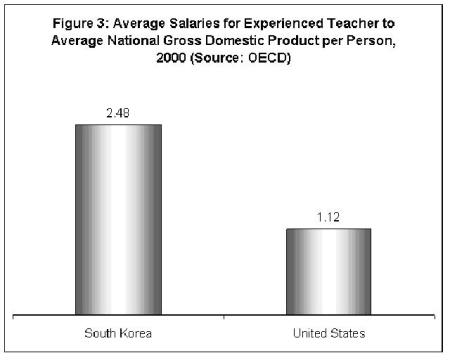
The Organisation of Economic Co-operation and Development measures relative teacher pay by comparing the average salaries of teachers with 15 years of experience with a nation’s gross domestic product (GDP) per capita. A high salary compared with per capita GDP suggests that a country invests more of its financial resources in teachers and suggests a relative prestige of the profession. By definition, the average person in each of these countries will earn a ratio of 1. Figure 3 compares teacher-salary-to-per-capita GDP for the United States and South Korea.

teacher-pay-korea

An experienced South Korean schoolteacher makes a relatively impressive wage compared with teachers in the rest of the world. In South Korea, teaching is an honored profession—not just rhetorically but in compensation as well. In the United States, meanwhile, a teacher with a college degree and 15 years of experience makes a salary relatively close to the average GDP per person. Not surprisingly, there are many qualified applicants for each open teaching position in South Korea.


McKinsey quotes the New Commission on the Skills of the American Workforce to contrast the United States with those countries having more successful education systems: “We are now recruiting our teachers from the bottom third of high-school students going to college…. [I]t is simply not possible for students to graduate [with the skills they will need] unless their teachers have the knowledge and skills we want our children to have.”


The Teacher Glut

June 4, 2008

(Guest post by Greg Forster)

Many of you will be familiar with Mike Antonucci, who is probably America’s last remaining full-time education labor reporter. On his website, he regularly compiles up-to-date Census data on enrollment, staffing, spending and teacher salaries for all school districts in each of the 50 states; he now has almost all the states done for 2005-06.

Lately he’s been commenting on how teacher hiring continues to far outpace enrollment growth; even states where enrollment is flat or shrinking are still hiring like crazy. Maryland, for example, expanded its teacher workforce 10 percent from 2001 to 2006, while enrollment grew less than 1 percent. California, which is still carrying around an extremely bloated teacher workforce from its apparently failed experiment in class size reduction, has just announced that it’s cancelling the large majority of its planned teacher layoffs.

This isn’t a new phenomenon; as somebody pointed out you-know-where, the teacher workforce has been expanding relative to the student population for decades.

What effects does this have? You might expect it to reduce class sizes. The benefits of class size reduction are seriously doubtful and can’t possibly be cost-effective anyway, but never mind that for now. The fact is, class sizes don’t seem to have been reduced. Data from the U.S. Dept. of Education’s Digest of Education Statistics indicate that while the system’s student/teacher ratio has been falling, class sizes have been flat, partly because each teacher teaches for fewer hours per day; there are also probably more teachers with non-teaching assignments (as mentor teachers, etc.) but I don’t know if we have data for that.

One effect the teacher glut is almost certainly to exert negative pressure on teacher salaries. Now, despite what you’ve been told, teachers are not underpaid. (See also the chapter on this in . . . well, you know.) But teacher salaries have remained stable, growing only a little faster than inflation. If we didn’t have a teacher glut, the laws of economics tell us salaries would be growing faster.

So who benefits? Well, the teachers’ unions make out like bandits. More teachers means bigger budgets without the hassle of selling the membership on dues hikes, and more political clout because the public school gravy train is larger. And while the unions’ political clout is badly overestimated – witness, for example, the startling political success of school choice – they do have enough power to exercise significant influence when no one else is looking, such as where staffing policies are concerned.

All of which reminds me of a story Antonucci covered recently (see Item 5 here) about a complaint filed with the IRS by the Ohio teachers’ union against White Hat Management, a charter school operator. The Cincinnati Enquirer reported: “Susan Taylor, president of the Ohio Federation of Teachers, said White Hat, which is supposedly hired by the schools’ boards, exercises too much control over the schools, boards, and finances, violating IRS rules, she said.”

The teacher’s union files an IRS complaint because a tax-exempt organization has too much influence over education policy. So when does the union disband?