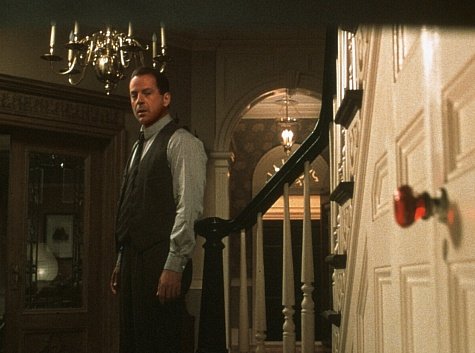
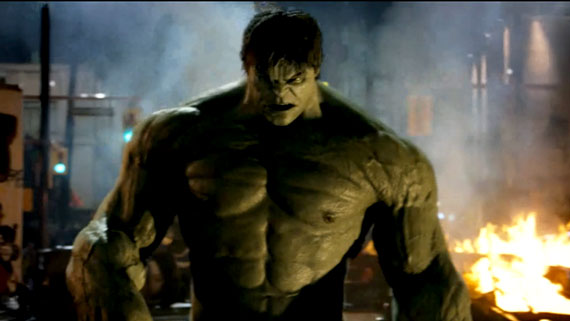
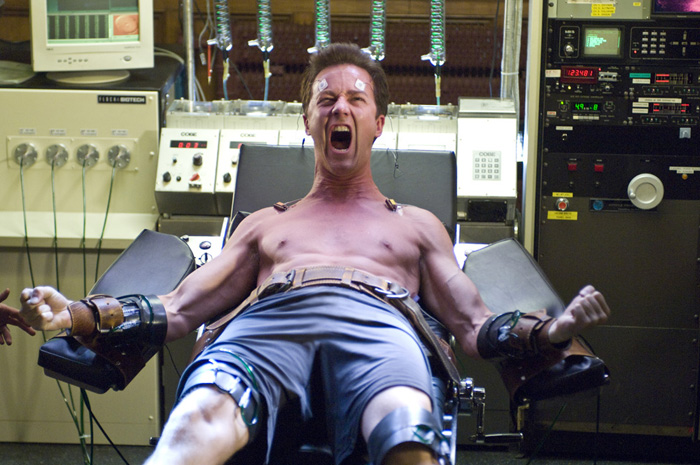
Original movie title: “The Man Who Didn’t Know He Was Dead.”
(Due credit: I stole that gag from the “loading” page of an old The Critic webisode. I’d link if the creators had a page, but I can’t seem to find one.)
In addition to the new Hulk movie, M. Night Shyamalan’s comeback attempt, The Happening, opens today. As I promised in last week’s edition of Pass the Popcorn, here’s a retrospective of Night’s fall.
Before we get down to business, though, fascinating fact: did you know that Shyamalan was the lead author on the screenplay of Stuart Little? Well, that’s why God made IMDB. Come to think of it, how much difference is there, really, between writing lines for Haley Joel Osment and for a cute animated mouse?
On one level, Ang Lee (whose rise and fall we chronicled last week) and M. Night Shyamalan were two big 1990s filmmakers trying to do similar things: produce popular, mainstream movies that nonetheless had the higher ambitions of arthouse films. But other than that, you couldn’t ask for two more different filmmakers. Lee is all about emotional relationships. If you have a sibling, parent, or child whom you love but absolutely cannot even begin to understand – someone who is biologically your immediate neighbor but whose whole life is just totally alien to you – you’ll appreciate Lee’s achievement in Eat Drink Man Woman. Ditto Sense and Sensibility if you’ve ever been in love, The Ice Storm if you’ve been hurt by other people’s personal self-indulence, and Crouching Tiger Hidden Dragon if you’ve ever loved someone you couldn’t have – or had to deal with an angry teenage girl.
By contrast, Shyamalan’s films aren’t about relationships, except in the sense that they’re about man’s relationship to the universe. What ties all his movies together is that they take place in a universe that isn’t what it seems, and they’re about how we cope with the realities that lie behind the universe of appearance that makes up our ordinary lives.
His characters are mostly two-dimensional. That’s not a criticism – Aeschylus’s characters are two-dimensional, too, and for the same reason. Narratives about “man and the universe” necessarily reduce the “man” to a broadly representational figure. That’s the whole point. In the Oresteia, Orestes is the paradigmatic “man torn between conflicting duties” – in other words, Orestes is all of us. So naturally Orestes as a character isn’t developed much; that would only detract from the drama, by preventing us from identifying with Orestes. Ditto for most of Shyamalan’s work.
By this rubric, Lee is the Sophocles of the 1990s – his plots are only there to illustrate and develop the personal qualities of the characters. Raise your hand if you remember the plot of Crouching Tiger Hidden Dragon. (Okay, all of you with your hands up, report for detox at once.) And The Ice Storm barely even had a plot. Whereas in Shyamalan, as in Aeschylus, instead of the plot only being there to illustrate the characters, the characters are only there for the sake of the plot. Quick, how many main characters from Shyamalan’s films can you name without looking them up?
(Who, then, is the Euripides of 1990s film – the cynic for whom both plot and character give way to lengthy chunks of hard-bitten dialogue that either proclaim, or else ignorantly illustrate, the meaninglessness of the human world and the absence of the gods from it? My vote: David Mamet.)
Shyamalan’s characters often don’t change at all. Of the three main characters in The Sixth Sense, all three remain the same people at the end of the movie they were at the beginning. They change only in that they start the movie ignorant of certain very important facts, and end it knowing those facts. The boy is terrified and disturbed at the beginning but calm and well adjusted at the end, not because he’s grown as a person, but because he had mistakenly thought the ghosts were a threat to him and now knows that they’re not. Similarly, the psychologist lets go of his anger at his wife, not because he’s grown as a person, but because he realizes that he’s dead. The mother’s attitude toward her son changes, not because she’s grown as a person, but because she finally sees proof that he’s really seeing ghosts and isn’t crazy. Their personalities are unchanged. Only their knowledge of the mysteries of their universe has changed.
Or consider that, as far as I can recall, the few really emotional scenes in Shyamalan’s films are all either confrontations or revelations – both of which can produce strong emotions without doing much to advance character development. The scene from The Sixth Sense that really stuck with me and haunted me, so to speak – it still does – is that harrowing moment where the mother realizes that her son’s doctor believes she’s abusing him. She boils over with furious indignation, as do we – until we remember that while she knows the true reason for the boy’s injuries, and we know it, he doesn’t – and from his perspective, abuse is the logical explanation for what he sees in front of him. We can’t help but hate him – hate him with a boiling passion – for doing the right thing.
(An interjection: I’ve heard some people criticize as vain Shyamalan’s inserting himself into each of his movies, Hitchcock-style. But look at where he inserts himself. In the first three movies, and above all in the first one, he appears as someone who makes us intensely uncomfortable: the doctor who mistakenly – but rationally, given the facts available to him – thinks one of the protagonists is abusing her son; the dark-skinned man who is singled out and pulled aside by the protagonist for a drug search; the reckless driver who killed the protagonist’s wife. And in the fourth movie he’s a lazy cynic. This is vanity?)
The Sixth Sense could have been just a shlocky thriller with a neato twist ending, but it’s something more. (Not something else instead of a shlocky thriller with a neato twist ending, but something else in addition to a shlocky thriller with a neato twist ending; it’s still that, of course.) It’s about what it’s like to encounter, and be changed by, things that you don’t understand and that the people around you don’t understand. The frustration, the isolation, the resentment, the anger – and finally the relief of coming to understand, and finding others who understand, what you’ve encountered. “I see dead people” is a proxy for “I have a mental illness” or “I didn’t kill that girl but everyone thinks I did” or “I’m a Montague and I’m in love with a Capulet” or “I’m the only person in my family who does (or doesn’t) believe in the Bible” or any one of a thousand other strange, alienating things that happen to us in our very strange universe.
Likewise, Unbreakable – a gem of a movie if you have the patience for it – takes what could have been a comic-book-movie premise and turns it into a meditation on the metaphysics of duty and destiny. If you find yourself having been blessed in some very important way, is it mere arrogance to think that you’ve been chosen to recieve that blessing? Is that an insult to the others who presumably were not chosen, and who may be suffering (or, in this case, dead) because they lack what you have? And do you have a duty to accept your chosenness if it doesn’t give you the life that you want? The deleted scenes to this movie are well worth watching; having seen them only once, I find it impossible to think about Unbreakable except in terms of how those scenes frame the story. One in particular, a conversation between the hero and the town priest immediately after the mass funeral for the train wreck victims, really expands the significance of the movie and should have been left in; this slow-paced movie could have stood to move faster anyway.
Then came Signs. Here, Shyamalan’s ambition to comment on man’s place in the universe becomes explicit. Rather than take a premise that could have stood on its own as an ordinary genre movie (e.g. man investigating ghosts discovers that he is one; pitiful man with broken life discovers he has superpowers) and then subtly imbuing it with greater philosophical significance, Shyamalan builds the plot directly around his philosophical reflections.
The key to the whole movie is the “miracle man” dialogue between our hero, the ex-priest – and by the way, one of the few really false notes in this movie is how it puts the hero in a priest’s collar but then carefully avoids calling him a priest, resorting to all sorts of ridiculous verbal gymnastics (“I’m not a reverend anymore.” Neither Protestants nor Catholics ever refer to a clergyman as “a reverend”). What was the point? Presumably to avoid establishing whether he was Catholic or Protestant, to allow the broadest possible audience to identify with him. But identifying him as a priest wouldn’t have established whether he was Catholic, since plenty of Protestant clergy are called priests, and in any event the unavoidable tone of falsehood this introduces to the movie does much more harm than . . .
Where was I? Oh, yes. The key to the whole movie is the “miracle man” dialogue between our hero, the ex-priest, and his brother about the concept of providence. Either all events are ordained to serve a cosmic plan – or else not. The point of the movie is that no empirical evidence can settle the question; the universe of the five senses, the universe as we experience it by living in it, equally vindicates the nihilist view and the theist one (provided, of course, that we’re talking about a real theism that robustly faces the problem of evil, not the watered down happy-talk theism that has sucked the life out of the oldline denominations in the past century . . . but I digress). And saying that it vindicates both is just another way of saying it vindicates neither. In other words, mere experience (or “evidence”) cannot by itself distinguish between a meaningless universe and a meaningful one. As a result, most people make their real choice between the two alternatives based on some combination of emotion, instinct, and inclination; Signs is the story of how one man came to change sides, and then change back.
Of course there is another way to judge between the two, namely by metaphysical reasoning – evaluating the universe not as we experience it with the five senses, but as it appears to our logic. Unforutnately, there’s no way to work this point into a movie, and Shyamalan was right not to try. Nonetheless, Signs always makes me think about this book, which is the one book anyone who wants to understand this subject should read. (Strict logicians who want the issues formulated the the technical style appropriate to a doctoral dissertation in philosophy should instead read this.)
Appropriately enough for a post about M. Night Shyamalan, the book begins with a ghost.

“In all my life I have met only one person who claims to have seen a ghost. And the interesting thing about the story is that that person disbelieved in the immortal soul before she saw the ghost and still disbelieves after seeing it. She says that what she saw must have been an illusion or a trick of the nerves. And obviously she may be right. Seeing is not believing.
“For this reason, the question whether miracles occur can never be answered simply by experience . . . . What we learn from experience depends on the kind of philosophy we bring to experience.”
Signs contains more meditation on man’s place in the universe than Shyamalan’s previous films, but the absence of an independent story that could have carried the movie on its own balances that out. On the whole, it’s not better or worse than the previous movies, just different. But the greater ambition Shyamalan displayed in Signs was, if you’ll pardon me, a good sign. Greater things were around the corner.
And then it all started going wrong. First came The Village. I went into The Village as a Shyamalan fan and thus predisposed to enjoy the movie. And I think it was for that reason that I actually did enjoy it while I was watching it – not a lot, but enough. The performances are superb, and the scene where the male romantic lead confesses his feelings for the female romantic lead is especially powerful. However, as soon as the credits started rolling, all that faded away; superb performances are the most perishable part of any film experience. What lives most vividly in the memory is not the work of the actors but the work of the writer and director – and that was subpar in this movie.
The problem, I think, is laziness. There are just too many dumb moments, and dumb moments are always a symptom of a filmmaker who couldn’t be bothered to keep reworking things until they all fit together right. So Lee and Shyamalan both got self-indulgent, but where Lee fell off one side of the horse, working too hard on the wrong things, Shyamalan fell off the other side, not working hard enough. (Or that’s my theory, anyway.)
I’m told that The Village improves with repeat viewing. I can well believe it. Repeat viewing tends to increase the relative value of the actors’ performances and decrease the relative value of the writers’ and directors’ contribution, most especially regarding this movie’s greatest weakness: plot. If a movie improves on repeat viewing, that may rescue the performances and the movie as a whole from a negative verdict, but in general it shouldn’t rescue the director.
Then, as we all know, came Lady in the Water – about which the less said the better, not that that ever stopped anybody.
When I saw that Shyamalan was staging a comeback, I had cautious hopes. If we didn’t have a two-year-old to look after, I’m sure we’d have gone to see it. But check this out:
Rotten Tomatoes Tomatometer
The Village: 43%
Lady in the Water: 24%
The Happening: 20%
Now, I know only too well – as readers of this blog will recall – that Rotten Tomatoes is not infallible. At the time of release it gave 100% to this flaming nuclear turd of a movie, although I see that with the passage of time a handful of critics who actually saw the movie rather than judging it by the name of the director have brought the average down to 96%.
But, to use this gag one last time, a rating below Lady in the Water is definitely not a good sign.


 Posted by Greg Forster


 Jay P. Greene's Blog