Arkansas Should Drop PARCC for an NRT Next Year

February 14, 2015

Below is my oped in the Arkansas Democrat Gazette on how Arkansas should drop the PARCC test next year and switch to a nationally normed referenced test to reduce teaching to the test, avoid unproductive fights over standards and testing, and stop bossing local schools and teachers around. It would also cost a lot less.

Opportunity arises

State has chance for better tests

Posted: February 14, 2015 at 1:58 a.m.

The Legislature is considering a number of proposals to alter the state’s current requirement that public schools administer the PARCC test, one of two federally funded tests aligned with the Common Core standards. These proposals are motivated by a variety of concerns, some of which are legitimate and reasonable and some which are not.

Whatever its legitimacy, the current debate is an excellent opportunity for Arkansas to reconsider why it requires testing and what kind of test would best serve these public purposes.

Past testing has been motivated primarily by two goals: providing transparency and directing the behavior of educators. The evidence is now clear that transparency has meaningful benefits for parents, communities and policymakers, but attempting to use testing to drive what educators teach and how they teach it has been counterproductive. Starting next academic year, Arkansas should switch to using a norm-referenced test that provides transparency but does not attempt to control how schools and teachers do their job.

The PARCC test, which Arkansas plans to administer this spring, is a criteria-referenced test, which is the type of test that tries to drive what educators teach. It is aligned with a set of standards–in this case, Common Core–and rewards schools and teachers that emphasize teaching the particular content covered by the test and expected by those standards.

Criteria-referenced tests cause three serious problems. First, because they are aligned with a set of standards, schools and educators are able to “teach to the test.” But it is also possible for educators to focus too narrowly on the content covered in the test. All criteria-referenced tests are inherently gameable. In trying to tell schools and teachers what they should teach, they also provide educators with a road map for how to drill students in the particular content of the test to raise scores artificially. This undermines the transparency benefit of testing by pushing schools to manipulate results through an inordinate amount of test preparation. It also causes schools to narrow their curriculum to coach tested content to the exclusion of other important content and subjects. The arts, history, and sciences all suffer from criteria-referenced testing in math and reading.

Second, because criteria-referenced tests are aligned with a particular set of standards, they invite a perpetual and destructive struggle over what those standards should be. I have no opinion about the merits or defects of the Common Core standards, but I do know that Brookings Institute scholar Tom Loveless and others have shown that states with “better” standards have fared no better on independent measures of academic achievement than states with what are considered lousy standards. It isn’t so easy to know what the right standards should be, and it’s even harder to push educators in productive ways to teach those standards. Given how the quality of past state standards has made no difference in student outcomes, why should people bother to fight to impose a set of standard and aligned testing over the objections of many who have legitimately different opinions about what educators should teach?

Third, criteria-referenced tests are trying to use a crude instrument from a great distance away to get schools and educators to do what state or national policymakers think is best. Even if those remote elites are well-intentioned–and sometimes they are not–schools are still run best by local educators and communities.

There is a different type of test that Arkansas could administer that avoids these dangers of excessive and narrow test prep, unnecessary political fighting, and centralized control over education. Norm-referenced tests are not aligned with any particular set of standards, but can still provide general measures of how well students are performing academically. They meet our reasonable goal of wanting transparency about how students are progressing in school. But because they are based on a generic curriculum rather than a particular set of standards, it really isn’t possible for schools to game them by focusing exclusively on a narrow set of content.

In addition, because norm-referenced tests are not pushing a particular set of standards and content, they do not invite political struggles. They also don’t boss around local schools and teachers because they aren’t trying to make them teach particular content or in a particular way.

There are plenty of already-developed norm-referenced tests from which Arkansas could choose. Because they can be bought off the shelf and do not have to be customized to Arkansas, they would also be cheaper than trying to develop another Arkansas-specific criteria referenced test. It is probably wisest to go ahead with PARCC this year, given how late in the process we are, but a change to a norm-referenced test could be made for next school year.

Don’t let anyone tell you that the federal government requires us to adopt PARCC or some other criteria-referenced test. Education is the prerogative of states, and federal law prohibits the national government from mandating specific tests or curriculum, despite the fact that it has taken steps in that direction. Arkansas needs political leaders with the courage to stand up and do what is best for Arkansas.

————v————

Jay P. Greene is the 21st Century Endowed Professor in Education Reform at the University of Arkansas, where he is head of the Department of Education Reform.

Editorial on 02/14/2015


Road Trip Heads to Oklahoma

February 12, 2015

(Guest Post by Matthew Ladner)

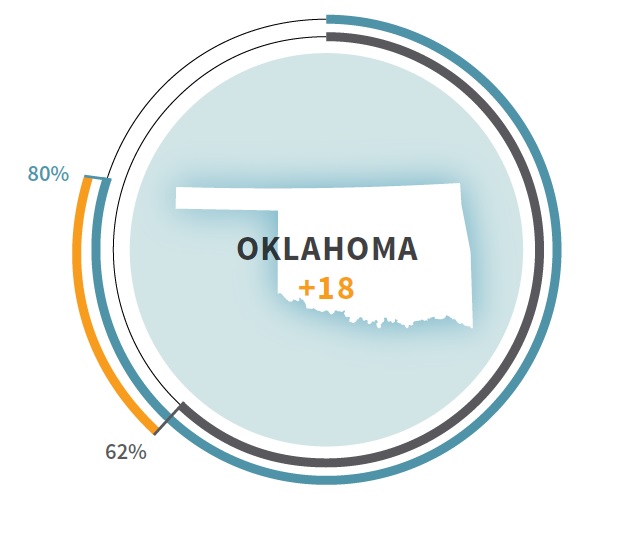
Over on the Ed Fly blog I have a post on the age demography challenge in Oklahoma from Turn and Face the Strain. Spoiler alert: if Oklahoma’s K-12 system has a next 15 years similar to the last 15 years they will be adding to what looks to be already looks to be a very considerable challenge in 2030.

Oklahoma strain


Mississippi Senate Passes ESA

February 11, 2015

(Guest Post by Matthew Ladner)

Congrats to Senator Nancy Collins on passing Senate Bill 2695.


Statement by Burke, Evers, Rebarber, Stotsky, and Wurman on ESEA

February 10, 2015

The following is a statement by Lindsey M. Burke, Williamson Evers, Theodor Rebarber, Sandra Stotsky, and Ze’ev Wurman that they asked me to post.  I have not yet had a chance to think carefully about ESEA re-authorization, but I think their views are worth consideration:

Reauthorizing ESEA: The road to effective education is paved with local control and parent power

Lindsey M. Burke, Williamson Evers, Theodor Rebarber, Sandra Stotsky, and Ze’ev Wurman

In reauthorizing the Elementary and Secondary Education Act (ESEA) in 2015, Congress should restore the power of state and local governmental authorities. The law as it currently reads has centralized education and moved decision-making to a large and ever-growing federal bureaucracy — far from the schools most students attend.

The current drafts, both the Senate and the House versions, do not return authority to the states and localities or empower parents.  The ESEA has evolved from what was described at the outset in 1965 as a measure to help children from low-income families into an instrument of testing mandates and federal control of public K-12 education and, increasingly, of private education as well. The road to effective education is paved with local control and parent power.

We need to reauthorize ESEA in a way that empowers parents and moves authority back to local communities and the state laboratories of democracy where it belongs. Moreover, the reauthorization should abandon the ill-considered idea planted in the Obama administration’s No Child Left Behind (NCLB) Flexibility Waivers that our high schools are simply college-prep factories. Instead, the reauthorization should return to the previous widely accepted idea that high schools should prepare young people for American citizenship and to fulfill their individual potential as they see fit. Toward that end, high schools should be permitted to establish several sets of challenging academic standards rather than a single set of standards that purport to deliver self-proclaimed (but actually meaningless) “college-readiness.” Similarly, instead of federal regulations that require that the testing “tail” wag the curriculum “dog,” communities and charter schools must be able to select reliable assessments that align with their locally established curriculum.

Recent attempts to provide better educational opportunities to low-income children through one-size-fits-all requirements and increased federal testing mandates in the various versions of ESEA since its inception have met with little success.  As education researcher Helen Ladd concluded in her comments on a 2010 Brookings Institution paper by Thomas Dee and Brian Jacob:

“… First, the null findings for reading indicate to me that to the extent that higher reading scores are an important goal for the country, NCLB is clearly not the right approach. That raises the obvious follow-up question: what is?…

“[T]he suggestive evidence that I have included here on Massachusetts [indicates] that states may be in a better position to promote student achievement than the federal government.”

The 2015 reauthorization of the Elementary and Secondary Education Act should restore power to states and localities by allowing states, school districts, and charter schools to opt out fully and completely from the programs and regulations of ESEA, currently reauthorized as No Child Left Behind. When they opt out, states, local school districts, and charter schools would formally and publicly explain the accountability measures that they would use to assure that federal dollars improve the K-12 education of disadvantaged children. They would also provide the rationale that supports these measures.

States and local authorities would thereby be in a position to direct federal dollars to their students’ most pressing education needs. By this we mean that the 2015 reauthorization should follow the Academic Partnerships Lead Us to Success (A-PLUS) approach, which has been offered in previous years.

In addition, the 2015 reauthorization should:

  1. Eliminate mandates, including, but not limited to: Adequate Yearly Progress (AYP), federal prescription of annual grade-level testing for each student, the Highly Qualified Teacher (HQT) mandate, and maintenance of effort (MOE) regulations. The reauthorized act should not require a single statewide set of standards or assessments in each state, nor approval or review of any state or local district or charter school standards or assessments by the U.S. Department of Education. It should instead allow states, local school districts and charters the choice of what grades and subjects to test, and the number of tests, letting them choose from among a wide range of state-approved standards and aligned valid and reliable tests. Those states that believe annual grade-level testing in specified subjects of each student doesn’t improve student learning could drop it, while those states who believe such testing makes their state more competitive and is useful for teacher and school accountability could keep it. They should provide parents and taxpayers with reasons for their choice. Eliminating the prescriptive and ineffective Highly Qualified Teacher mandate would put states instead in a position to improve teacher quality by requiring teachers to demonstrate content mastery of the subject matter they teach, instead of having to use false measures of effectiveness, such as paper credentials and licensure. 
  1. Eliminate programs and, correspondingly, eliminate the spending tied to those programs. The reauthorization bill should eliminate the competitive grant programs that have accumulated over the years (some 60 programs) and cut appropriations for those programs to zero. The proliferation of competitive grant programs is one of the primary means by which Washington has increased its intervention in local school policy over the decades.
  1. Make Title I money portable. Any reauthorization of ESEA should provide states the option to make their Title I dollars portable to follow students to any public or private school of choice. This idea has been fleshed-out by the Brookings Institution’s Russ Whitehurst. Writing in EducationNext magazine, Whitehurst suggested:

Rather than the complicated federal schemes under which funds are currently disbursed to districts, funds should be attached to the student. Individual schools would receive federal funds based on student counts, with a weighting formula to adjust for factors such as the increased burden of educating high-need students and for regional differences in costs. Sometimes called “backpack funding,” weighted funding that follows the student has been shown to direct proportionally more funds to schools that serve needy students than traditional distribution schemes.

Portability of Title I funding, however, does not mean federal mandates should also be portable. Specifically, portability must not be used to extend federal or state standards and testing mandates to any private school that receives funds under the act. Such an extension must be prohibited by specific language in ESEA.

  1. Strengthen prohibitions against national standards and tests. So long as federal K-12 competitive grant programs, conditional waivers, and conditional grants-in-aid exist, the federal education bureaucracy will have trouble resisting the temptation to dictate curriculum content. Despite prohibitions already existing in three federal statutes against meddling in curriculum, President Obama and the U.S. Department of Education incentivized states to adopt curriculum-content standards (the Common Core), and they funded national tests designed to secure those content standards in place.

Language in any reauthorization should underscore that the federal government is prohibited from directing curricula, and should further ensure that the federal government may not condition or award preferences in federal grants or contracts to states that adopt any particular academic content standards, tests or curricula, including but not limited to the Common Core standards.

With specific regard to the proposal put forward by Sen. Lamar Alexander, entitled the Every Child Ready for College or Career Act of 2015 (a title problematic in and of itself as it continues the notion that high schools are little more than college-prep or career factories), the proposal includes language that runs counter to the goal of restoring state and local control of education. It includes, for example, an assurance that states have “state standards aligned with entrance requirements, without the need for academic remediation, for an institution of higher education in the State.” This assurance needs to be eliminated.

Additionally, to allow for multiple standards and assessments, the language included in the draft that state assessments “are the same academic assessments used to measure the achievement of all students;” also needs to be eliminated. If the same assessment must be used for all students in the state, there is no possibility of multiple assessments. Moreover, if the authors are serious about restoring state and local control of education, there can be no peer review process of state plans dictated from the federal level, as the current proposal requires. There must also be no federal directives on what local report cards should look like, as the current proposal also contains.

The proposal should also go further in prohibiting the collection of individual student data from the state or other entities. It should also prohibit the federal collection of individual student data from states, contractors, and grantees and prohibit the Secretary of Education from possessing individual student data. All language mandating the content of local report cards should be removed. Parents must be empowered to shape the kind of information they want the teachers they hire and pay for to give them. Report cards are part of local accountability, which must be retained.

Above all, any reauthorization of ESEA should take meaningful steps toward curtailing federal overreach into local school policy. Reauthorization should roll back the host of programs and mandates that burden states and local boards, and allow states, school districts and charter schools to opt out completely, and allow school policy to be set at the local level. For the sake of our children and the future liberty of our country, we need to restore local control of education.

###

Lindsey M. Burke is the Will Skillman Fellow in Education Policy at The Heritage Foundation, Williamson M. Evers is a research fellow at Stanford University’s Hoover Institution and a former U.S. assistant secretary of education for planning, evaluation, and policy development, Theodor Rebarber is CEO of AccountabilityWorks, Sandra Stotsky is professor emerita in the Department of Education Reform at the University of Arkansas, and Ze’ev Wurman is a former senior policy adviser with the U.S. Department of Education. This article reflects our views individually, not necessarily the views of our organizations.


NEA “Cognitive Linguistic Analysis” Conducted by Wile E. Coyote

February 9, 2015

35eb9-wile2be-2bcoyote2bfalling

(Guest post by Greg Forster)

ALELR draws our attention to Conor Williams’ reporting on a rich, rich vein of hilarious tomfoolery at NEA. Williams has a leaked memo in which the NEA uses “cognitive linguistic analysis” to change reality by using magic words. As ALELR points out, some items in Lily Eskelsen’s “cloven hoofed minions” speech appear to have been driven by this magical thinking.

But wait, it gets better. One of the union’s magic words is “the right ZIP code.” Apparently people aren’t much moved by complaints about “inequality” so the unions will seek to advance the redistributionist agenda by saying that a quality education should not depend on living “in the right ZIP code.”

How long do you think it will take the NEA’s soooooooper geniuses to figure out the problem with that approach?


Do you really think you have a chance against us Mr. Cowboy?

February 8, 2015

(Guest Post by Matthew Ladner)

The late great George P. Mitchell, winner of the Al Coleman Humanitarian Award among various lesser honors has joined the great rodeo in the sky but those who have taken up his legacy have a very interesting fight on their hands.

First of all, you may have noticed that gasoline prices have collapsed. The vast new supply of oil unleashed by Mitchell had a great deal to do with that, although the immediate precipitating event was a decision by OPEC not to attempt to restrict supply in order to keep up the price. By all accounts, the Saudis drove this decision, and explained it as desire to preserve their market share.

The OPEC cartel has had profound difficulties in the past in actually having members keep to their production targets. When the price of oil increases, so too does the incentive for members to cheat by producing over the caps. Historically Saudi Arabia has had vast production and relatively low extraction costs, giving it the role of swing producer.  In the mid 1980s depending upon which story you believe the Saudis tired of making up for the cheating of other OPEC members or wanted to bankrupt the Soviet Union or perhaps both. In any event, the oil market flooded, the price dropped to $9 a barrel. Stateside the Savings and Loan debacle unfolded and oil-producing states like Texas crashed Icarus-like to earth.

The price of oil tumbled after the OPEC decision, inspiring various theories. The Russians think that the Saudis are out to get them, the Iranians think the Saudis are out to get them, and the frackers also think the Saudis are out to get them.  Note however that these things are not mutually exclusive, and the Iranian theory seems more plausible than others to me. In any case, the general thinking was that all three of these competitors needed prices over $100 a barrel, and with their low extraction costs the Saudis were well situated to wring “excess supply” out of the market.

Good ole fashioned American innovation however thus far is winning the day.

No that is not a shot put, but rather a disintegrating frac ball, made of “electrolytic metallic nanoconstructed material.” It eliminates a step in the fracking process, and it was only one of a number of new drilling technologies discussed at a recent conference in the Woodlands in Houston (probably not coincidentally a property development project of George P. Mitchell). The article linked above discusses how American drillers are busy figuring out how to get more oil and gas out of already drilled wells. The number of new wells drilled in the United States has declined, but total production of oil and gas has not followed suit. Other interesting developments include the development of techniques without water, substituting CO2.

Now to be sure there are going to be some highly leveraged American oil firms who are going to go bust because of the decline in prices. Many of them have been through bankruptcy before, and you can expect them to see them back out in the fields soon. Anyone want to bet on OPEC welfare states displaying this same level of flexibility?

Place your bets- I’m all in on the high-tech wildcatters. Yippie kai yay!


Politico on ESAs-“A Radical Idea is Catching Fire Across the Country”

February 6, 2015

(Guest Post by Matthew Ladner)

Two programs with 2,600 or so students in two states doesn’t feel like a wildfire yet, but it is great to see the increase in legislative interest. Our merry band of ESA warriors is having fun!


The New Education Philanthropy

February 6, 2015

Yesterday AEI hosted a conference organized by Rick Hess and Jeff Henig on the role of philanthropy in education. This will result in an edited volume published by Harvard Education Press.

You can find the draft chapters, including one by your truly, here.

And you can find a video of the conference here.

(Updated to fix links.)


Will Texas Turn to Face the Strain?

February 5, 2015

(Guest Post by Matthew Ladner)

Road trip! First stop- Texas!

Over the next few weeks I’ll pick a few states whose age demography data to examine a bit more closely from our new study Turn and Face the Strain. Rather than start with a state that looks to be in huge trouble, let’s start with one with the potential to rule the roost of the year 2030 if only it could put its affairs in order.

When we peer into the United States Census Bureau’s forecasts for Texas, the news is challenging vis a vis today but relatively forgiving compared to the rest of the nation. Texas will be one of the six states with an elderly population smaller than the percentage in Florida in 2030 according to Census projections.

Hurricane Gray is going to hit Texas, but in relative terms it will be delivering a glancing blow- mostly due to the fact that the state has a huge youth population now (potentially very handy for 2030).

Here is the Census Bureau’s projection for the total age dependency ratio of Texas between 2010 and 2030:

TX1


And here are the gory details:

TX2

Mind you, this is no walk in the park- the Census Bureau projects the elderly population to more than double and educating an additional 1.6 million students is not free. The projected total age dependency ratio is far higher than any state has now. Texas however has some powerful factors working in its favor, including robust job growth, two of the world’s great oil fields and that large youth population destined to turn into a huge working age population.

Oh, about that huge youth population, well:

Texas K-12 ethnic breakdown

And…

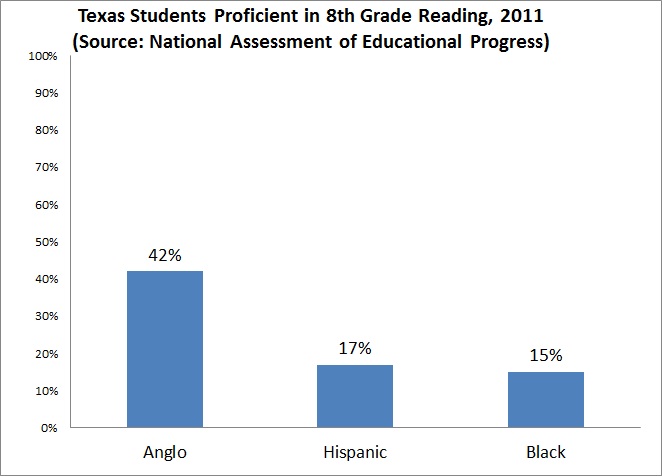
Texas 8th Grade NAEP Reading

The need to improve K-12 results is the Achilles heel of the Texas juggernaut. Among Anglo 8th graders 43% proficiency among 30 percent of the total student population gets you 12.6% of the total student population reading proficiently as 8th graders. Seventeen percent of the 50% of Texas students who are Hispanic nets you another 8.5% of the total population. African-Americans contribute less that 2 percent. There is nothing acceptable about any of this.

Call me crazy but this does not look like a recipe for either prosperity or a stable democracy in the decades ahead. Let’s just put it on the table that having far more Hispanic students scoring “Below Basic” than proficient in reading is incredibly dangerous for the future of Texas.

Texas Hispanic

It’s not too late for Texas but her policymakers are going to need to walk outside of the school district industrial lobbying complex echo chamber (aka the Texas Capitol) and think deeply about where the education status-quo is taking the nation’s leading state. Alternatively a new set of voices need to intrude on the conversation in a dramatic fashion. Sure the state can import college educated workers from other states with less vibrant economies, but no one should be under the delusion that simply going through the motions of educating a huge majority of students is not going to bite you in the end-it inevitably will.

Just as important, it places an incredible strain on the way Texans desperately want to see ourselves-as an opportunity society.  Texas can go either way-towards a nationally leading and globally significant society or towards a deeply bifurcated state with a small and pale minority nervously attempting to prosper among a large majority ill-equipped to prosper in a changing world (see California circa now). Texas will need to choose to embrace the ideals of America or the realities of Brazil. Every additional year of inaction brings the state another step closer to Brazil.