Time to Bet on Black in 2017

January 11, 2018

(Guest Post by Matthew Ladner)

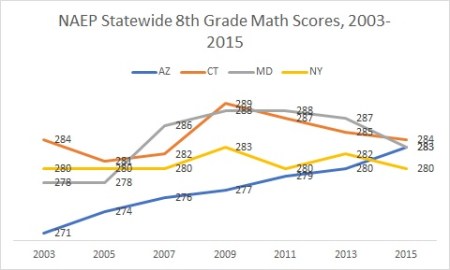
I am going to be on a panel at the Arizona Townhall tomorrow about racial achievement gaps, so this had me taking a look at data. Arizona’s Black students had the highest NAEP 8th grade math scores in the country in 2015, so this got me curious to how close this would get them to the lowest average statewide scores for White students (not that this bar is high enough but better to pass it than not and sooner rather than later or never).

Put me down for $20 on the 2017 NAEP- I’m betting on Arizona Black baby!


Winners and Losers in the John Rawls Reading Challenge 2003 to 2015

January 8, 2018

(Guest Post by Matthew Ladner)

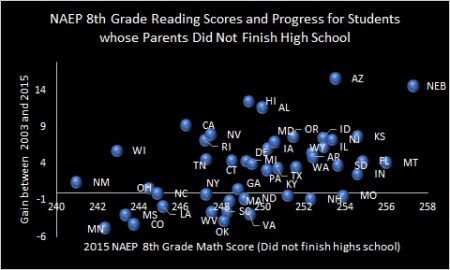
So I’m just going to leave this chart here:

Feel free to blubber in the comment section about how somehow the kids with parents that did not finish high school are the hardest to educate in the planet in state X. On second thought feel free to skip it. Every state has their excuse. That sound you hear is us laughing them off here in our pleasant patch of cactus (our state’s excuse used to be kids crossing the border not being able to read English or Spanish).

Scores unavailable in Alaska, Maine, Utah and Vermont. Rawls background here.

The 2017 NAEP results will arrive in March or April. I hope your state does better next time. I’ll update this chart when the new data comes out, but in the meantime, I am reminded of the below quote:


Studies: Teachers Unions Hurt Students’ Future Earnings, Employment (Minorities Hardest Hit)

January 7, 2018

(Guest Post by Jason Bedrick)

At this week’s annual meeting of the prestigious American Economic Association, Stanford economist Caroline Hoxby chaired a paper session titled, “New Evidence on the Effects of Teachers’ Unions on Student Outcomes, Teacher Labor Markets, and the Allocation of School Resources.”

I haven’t read these studies yet, so I won’t provide any commentary on them, but I figured JayBlog readers would be interested to see these two papers in particular:

“The Long-run Effects of Teacher Collective Bargaining” by Michael Lovenheim (Cornell University) and Alexander Willen (Cornell University)

This paper presents the first analysis of the effect of teacher collective bargaining on long-run labor market and educational attainment outcomes. Our analysis exploits the different timing across states in the passage of duty-to-bargain laws in a difference-in-difference framework to identify how exposure to teacher collective bargaining affects the long-run outcomes of students. Using American Community Survey (ACS) data linked to each respondent’s state of birth, we examine labor market outcomes and educational attainment for 35-49 year olds. Our estimates suggest that teacher collective bargaining worsens the future labor market outcomes of students: living in a state that has a duty-to-bargain law for all 12 grade-school years reduces earnings by $800 (or 2%) per year and decreases hours worked by 0.50 hours per week. The earnings estimate indicates that teacher collective bargaining reduces earnings by $199.6 billion in the US annually. We also find evidence of lower employment rates, which is driven by lower labor force participation, as well as reductions in the skill levels of the occupations into which workers sort. The effects are driven by men and nonwhites, who experience larger relative declines in long-run outcomes. Using data from the 1979 National Longitudinal Survey of Youth, we demonstrate that collective bargaining leads to sizable reductions in measured cognitive and non-cognitive skills among young adults. Taken together, our results suggest laws that support collective bargaining for teachers have adverse long-term labor market consequences for students. [emphasis added]

In short, the paper finds evidence that teachers unions’ collective bargaining reduce the future level of employment and earnings of students, especially minorities.

But wait, there’s more!

“Unions, Salaries, and the Market for Teachers: Evidence From Wisconsin” by Barbara Biasi (Princeton University)

A careful study of teachers’ labor demand and supply, while extremely relevant for policy, is challenging due to a lack of variation in pay, as teacher salaries are usually set using steps-and-lanes schedules based entirely on seniority and academic credentials. This paper exploits the passage of Act 10 in Wisconsin in 2011, which changed the scope of collective bargaining on teacher salaries, to study the effects of changes in pay on teachers’ labor market, and on the composition of the teaching workforce. As a result of this law some districts started to individually negotiate salaries with each teacher, whereas other districts continued setting salaries using seniority-based schedules. I first document an increase in salary dispersion in individual-salaries districts, and show that it is correlated with teacher value-added. Teachers responded to changes in pay by sorting across districts or by exiting: I find a 34 percent increase in quality of teachers moving from salary-schedule to individual-salary districts, and a 17 percent decrease in quality of teachers exiting individual-salary districts. Building from this reduced-form evidence, I estimate the parameters of teachers’ labor supply and demand using a two-sided choice model. Simulating the model on different salary schemes shows that an increase in the quality component of salaries in one district is associated with an improvement in average quality of the teaching workforce, driven by both in-movements of higher-quality teachers and out-movements and exits of lower-quality teachers. An increase in all districts is, however, associated with a smaller improvement, entirely attributable to exits of lower-quality teachers. [emphasis added]

In other words, the study finds that, after enacting Act 10, high-quality teachers in Wisconsin tended to move to districts that paid them based on their individual performance, whereas low-quality teachers gravitated to districts that paid for them staying alive an additional year.

Whether these findings are robust or generalizable is an open question that I’ll leave it to others to debate. But I do hope that these studies receive the consideration that they deserve.


EDRE Alumnus, Lynn Woodworth, Named to Lead NCES

January 5, 2018

Woodworth

James Lynn Woodworth, who goes by Lynn, has been picked to lead the National Center for Education Statistics in the US Department of Education.  Lynn enrolled in the Department of Education Reform‘s PhD program as part of its inaugural class in 2009. He completed his doctorate in 2013 and began work as a researcher with CREDO at Stanford University.  Before coming to the University of Arkansas, Lynn was a teacher and band instructor at Mansfield High School for 11 years.  Before that he was a Marine, where he worked in Intelligence and developed a proficiency in Arabic.

We are extremely proud of Lynn as we are of the successes of all of our Alumni.  If you would like to see a list of our graduates and their impressive accomplishments, visit this web site.  And if you are interested in joining the ranks of these amazing people, you still have until January 10 to apply to our doctoral program for next academic year.  You can read more about the program and how to apply here.


The Need for BAEO’s Struggle Continues

January 2, 2018

(Guest Post by Matthew Ladner)

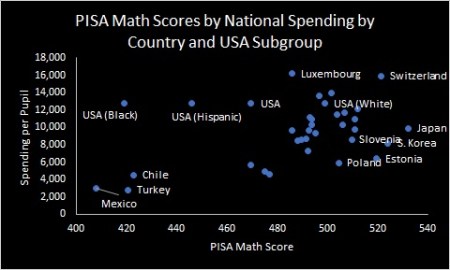
New Year’s Eve was the end of an era with the closing of the Black Alliance for Educational Options (BAEO). The PISA data show just how vital BAEO’s mission remains. Developing countries like Chile and Estonia outscore American Black students despite spending a fraction of what American schools spend per pupil. It staggers the imagination to believe that the structure of our incredibly generously funded K-12 system plays no role in this appalling state of affairs imo.


“We know why parents want school choice…”

December 20, 2017

(Guest Post by Jason Bedrick)

In Mike Antonucci’s end-of-the-year roundup of quotes by and about teachers’ unions, this one stood out for me:

“We know why parents sometimes embrace these voucher schemes. They move their kids to these programs because they want smaller class size, safer environments and less and more sensible testing. That’s exactly what we want for public schools.” — Joanne McCall, president of the Florida Education Association

Wow, it’s almost as though — contrary to popular opinion among the ed establishment — parents know what’s good for their kids and where to get it!

McCall’s list is amusing for several reasons. First, if the district schools really want smaller class sizes, wouldn’t giving families other options accomplish that goal?

The same goes for safer environments. As Dr. Kevin Currie-Knight and I have explained, school choice not only gives bullied students an escape hatch, it also creates a strong incentive for district schools to take student safety seriously.

As for “less and more sensible testing,” I’m all for that. Would the teachers’ unions take a grand bargain that expanded school choice to all students while reducing top-down regulations on district schools (such allowing districts to decide which nationally norm-referenced test their students will take rather than being forced to administer the state test)?

Most school choice advocates would take that deal in a heartbeat, but I suspect that the people who constantly complain that “private schools aren’t held to the same high standards (that, ahem, we want to eliminate)” wouldn’t be willing to take that deal.

Of course, I hope I’m wrong about that. And the school choice movement will be waiting by the phone in case the unions call.


Yippie kai yay!

December 19, 2017

(Guest Post by Matthew Ladner)


The Option to Escape Bullying

December 11, 2017

(Guest Post by Jason Bedrick)

By now you’ve probably seen the heartbreaking video of Keaton Jones detailing the torments he suffers in the lunchroom. As Dr. Kevin Currie-Knight and I explained recently in Education Next, educational choice policies can give kids like Keaton a much-needed escape hatch — and provide schools with a stronger incentive to address bullying.

A Florida mom, Elsi Greciano, explains how school choice saved her daughter:

When my daughter [Maria] finished fifth grade, she begged me not to send her to the neighborhood middle school, because her tormenters would be there. So we enrolled her in an arts magnet. Maria loved the classes and was excited to start over.

But bad things kept happening. One boy groped her. Another humiliated her when she wouldn’t give him her phone number. When a teacher saw a group of boys taunting her in the cafeteria, she sent them to the principal, who suspended them. But then Maria heard the boys were going to beat her up because they got in trouble. She was so upset that she couldn’t sleep.

Sometimes the school tried to help. Sometimes it didn’t. After the cafeteria incident, I emailed the principal, but never heard back. That was the last straw.

We searched for private schools that would be good for Maria, and found One School of the Arts. It had a curriculum like the school we left, but a safe, family atmosphere. We fell in love with it.

We cut all our expenses so we could enroll Maria right away, then got a tax-credit scholarship. Four years later, Maria is in 10th grade and a totally different girl.

She’s confident. She speaks beautifully. She loves to debate in class. At the moment, she’s not sure whether she wants to be a missionary when she grows up, or a fashion designer, or president of the United States.

Fortunately, the Florida legislature is taking steps to ensure that bullied students like Maria and Keaton have other options. Florida already has a tax-credit scholarship program and an education savings account program, but not all students are eligible. The proposed Hope Scholarships would empower families of students who had been bullied or victims of abuse.

Hopefully other states will follow Florida’s lead.


Real Victories + Imaginary Defeats = “Unsettled Law”

December 9, 2017

(Guest Post by Jason Bedrick)

The constitutionality of tax-credit scholarships is in the news again, as Montana’s state supreme court will soon consider the issue. What makes Montana’s case unique is that the roles of the petitioners and respondents is reversed. Usually it’s school choice opponents who sue a state over its choice program. In Montana, the Department of Revenue decided — against the wishes of the legislature — to block tax-credit scholarship recipients from using them at religious schools based on its own squirrelly interpretation of the state constitution. That drew the ire of choice proponents, including the heroes at the Institute for Justice, who sued.

A district court judge ruled in favor of the Institute for Justice, but the state has appealed the decision to the Montana Supreme Court.

Based on the track record, tax-credit scholarships are very likely to win. But Kevin Welner, a long-time critic of tax-credit scholarships (he calls them “neovouchers,” but no one serious has followed his lead), disagrees:

“If you’re asking if this is an area of unsettled law, the answer is yes,” Welner said. “Generally, the differences that you see are reflective of the blue-red differences we have in this country.”

Is that so? Let’s see what the scorecard shows. First, the victories:

Tax-Credit Scholarship Legal Victories

  • Supreme Court of the United States
  • Alabama
  • Arizona
  • Florida
  • Georgia
  • Illinois
  • New Hampshire

It should be noted that the unanimous decision in Georgia was written by a justice appointed by a Democrat. In Florida and Illinois (not a red state, last I checked), the state supreme courts refused to hear appeals of lower-court victories. Also, before anyone objects “some of these were decided on standing, not the merits!” — there’s very little difference. First, all the decisions but New Hampshire’s explicitly state that tax credits do not constitute public expenditures in their decisions ruling against the plaintiffs’ standing, which is essentially ruling on the merits. Even New Hampshire’s state supreme court (which had a liberal majority) unanimously ruled against standing because the plaintiffs could not demonstrate any harm. Second, there’s functionally no difference between “constitutional” and “may or may not be constitutional on the merits but no one has standing to sue so the program may legally continue.”

Anyway, let’s now look at the losing side of the ledger to see how truly “unsettled” this area of law is:

Tax-Credit Scholarship Legal Defeats

  • None

This looks less like a “red state vs. blue state” divide than a “real state vs. imaginary state” divide.

My question for Welner is: how many states have to follow the U.S. Supreme Court’s lead before he believes the law is “settled”?

Also, a closing word of advice:
Screen Shot 2017-12-09 at 9.39.53 PM.png


Oklahoma’s Doubleminded ESSA Plan

December 8, 2017

(Guest Post by Greg Forster)

In OCPA’s Perspective I review Oklahoma’s ESSA plan, and the story will be of interest to those outside Oklahoma. The basic problem with imposing reform on school systems that don’t want it is that the “reforms” become two-faced – they say what they need to say to please the reformers, but the substance of reform is another story:

Throughout the document, the bright, photogenic images and superficial, focus-group-tested buzzwords favored by the professional education reformers who run the ESSA regime collide over and over again with dense, esoteric clouds of opaque legalese, emitted—like ink from an octopus—by education special interests protecting their budgetary turf from scrutiny.

The document even has two title pages. The first is slick and professionally designed: a gorgeous, full-page image of a little girl with her hand over her heart is juxtaposed with the title under which the plan is being marketed—Oklahoma EDGE—in the form of a branded logo, like Pepsi or Google. The second title page is plain white with nothing on it but a little bit of text and the state education department’s logo. This page delivers the plan’s legal (i.e., actual) title, which is: “Revised State Template for the Consolidated State Plan: The Elementary and Secondary Education Act of 1965, as amended by the Every Student Succeeds Act.” Try making a branded logo out of that.

The report’s visual and verbal doublemindedness is reflected in the structure of the underlying plan, which dumps tons of money (the plan is always careful to set minimum goals for spending levels) into programs that don’t tend to improve educational outcomes. This makes both the system and the reformers look bad:

All this indictment of the Old Guard, for putting their own voracious desire for money and power ahead of real educational reform, is also an indictment of the New Guard. The professional education reformers, frustrated by decades of limited results from state activism, got impatient and decided to take a shortcut to power through Washington, D.C. But the Constitution’s federalist system, and the striking Left/Right political coalition suspicious of federal meddling in schools, really will not allow Washington to exercise the level of control the reformers want.

The end result is this ridiculous dance where Oklahoma has to submit a 218-page “eight-year strategic plan” for change and reform … under which it will continue to do the same thing it has done for decades: dump truckloads of money into expensive programs with no proven or even probable relationship to education outcomes. Which is exactly what the professional reformers have spent decades trying to stop the system from doing. Welcome to Wonderland.

Let me know what you think – and dont’ worry, your comments do not have to be accompanied by glossy graphics or popular buzzwords.