Charter Regulation Keeps Out Minority Charter Operators

March 9, 2018

Image result for minority charter school operators nacsa

My student, Ian Kingsbury, will be presenting a paper next week at the annual meeting of the Association for Education Finance and Policy examining factors that help explain which applications to operate charter schools are more likely to be approved.  He is still in the early stages of this project and I’m sure will benefit from feedback on how to improve the work, but he has already analyzed nearly 400 applications to operate charter schools in 7 states.  His basic findings, which seem unlikely to change as he gets feedback, should surprise no one but should shock everyone interested in charter schools — the more burdensome the regulatory environment for approving charters, the less likely charters led by minority applicants are to be approved by authorizers.

Using the score that the National Association of Charter School Authorizers (NACSA) gives to each state’s charter policies as a proxy for regulation, Ian finds that for each 1 point increase in a state’s NACSA score (on a scale from 0 to 33), African-American and Hispanic-led charter applications are 1.7 percentage points less likely to be approved.  Given that one state included in the study has had a NACSA score as low as 9 and other states, like Indiana and Nevada, have a 33, the variation in regulatory environments Ian observed is associated with about a 41 percentage point difference in the probability that minority-led charter applications would be approved.

Of course, the charter regulations favored by NACSA, the National Alliance of Public Charter Schools, and most of the charter establishment are meant to promote quality.  Unfortunately, there is no evidence that these regulations are in fact associated with higher quality charter schools. But they clearly make it harder for charter applications to get approved, especially for minority-led charter applicants. Even when Ian controls for whether the minority-led charter applicants attended more selective colleges or were affiliated with CMOs/EMOs, which might be proxies for the quality of those applications, minority-led applicants were still 1.7 percentage points less likely to get approved for each 1 point increase in NACSA score.  In other words, if the purpose of regulations is quality control, those regulations still tend to keep out minority-led charter schools even after adjusting for reasonable proxies of the quality of those proposed charter schools.

This pattern of regulations in the name of quality posing a disproportionate barrier to minorities without actually being related to quality should sound familiar to anyone who has paid attention to the issue of occupational licensure.  A variety of groups, from the Obama White House to the Institute for Justice, have noted that raising requirements to enter many occupations has been an important barrier to opportunity, especially for disadvantaged groups.  Requiring people to spend 2,100 hours and about $22,000 to obtain a cosmetology license before they can braid hair has little to do with quality but is an important obstacle to opportunity.  The same can be said of the type of regulations favored by NACSA and the charter establishment — they have little to do with quality but seem to be large obstacles to minority operated charter schools.

Keeping out minority-led charter schools has potentially serious educational and political implications.  There is some evidence that minority students fare better when educators are of their same race/ethnicity.  Minority-led charter schools may be more likely to provide this type of educational benefit for minority students.  In addition, excluding minority leaders of charter schools severely damages the political prospects for charter schools by making minority community leaders significantly less invested in the growth and success of the charter sector.

If any of you will be at the Association for Education Finance and Policy conference next week, I would encourage you to stop by Ian’s panel on Thursday (March 15) at 10:15.  While Ian’s project is not finished, the evidence is becoming clear enough that NACSA and the rest of the charter establishment need to explain why the policies they favor have such a negative effect on minority-led charter schools.  And if they are going to defend that negative effect by claiming that the policies they favor promote quality, they need to provide evidence to support that claim.  The way it looks now, the types of regulations favored by NACSA and others seem to just keep minorities out without producing any increase in quality.

Update — I’ve added a link to the paper, which is available here.


The Abyss Gazes into TFA…

March 5, 2018

(Guest Post by Matthew Ladner)

Max Eden provides a helpful summary of the various scandals plaguing the District of Columbia Public School system. After three Teach for America alumni chancellors we find the district scandal-ridden and clinging to a vastly overrated NAEP record as a life preserver. Upon close examination however that life preserver looks more like an anvil than a life-vest:

The best proxy for disadvantage is parental education. The achievement of students whose parents had high school diplomas but no postsecondary education decreased by three points in math and one point in reading. That puts DCPS two points below Detroit Public Schools in reading and one point above in math. But at least Detroit improved by two points in reading and 10 points in math.

Although there’s apparently little difference between DCPS and Detroit for disadvantaged students, there should be for “evidence-based” policy experts. Given that DCPS’s spending is about twice that of Detroit, DCPS appears to be one of the worst school districts in the country for serving disadvantaged students.

The two bright spots for DC K-12 are as follows: in the choice sector for disadvantaged students and in select pockets of excellence in the District. Momma always said that DCPS would be good at something- who knew that it would be educating highly advantaged kids?

Take a good long look at the above chart. DCPS 8th grade Black students are had nowhere even close to the level mathematics achievement that DCPS White students had as 4th graders (272 for 4th grade White students in 2011 compared to 248 for 8th grade Black students in 2015).

Perhaps some of our friends who remain committed to the DCPS teacher evaluation system could grace the comment section to explain why Black students in DCPS only progressed 36 points (very meh) on NAEP math between 2011 and 2015. DCPS Black students made 38 points of math progress between 2003 and 2007, which isn’t meaningfully different- oh brave new world!

The question isn’t whether the DCPS teacher evaluation system is a magic bullet- it isn’t. Given these numbers I’m wondering if the teacher evaluation system constitutes a bullet at all. Not only did DCPS achievement remain stalled in DCPS, it actually slowed in DC charter schools. Between 2003 and 2007 Black students in DC charter schools displayed a cohort NAEP gains of 54 points, but only 46 between 2011 and 2015. I’ll put it on my to-do list to look at these numbers again when the 2013-2017 cohort gains become available.

For now, teacher evaluation looks more like a pea that got stuck in someone’s straw than a magic bullet imo. In any case, DCPS provides a cautionary tale of those holding a torch for better living through proper management. Chubb and Moe called this almost three decades ago: the fundamental problem with American K-12 is politics and the sad conclusion to draw from the DCPS experience is that the ability of school district politics to corrupt the TFA alumni network >>> than the network’s ability to redeem school district politics. Would that it were otherwise, but this conclusion is as unavoidable as it is disappointing.

Where to go from here? Eden lays out a compelling case:

DCPS is no longer a case study for education reformers, but for teachers unions. Union leaders can look at what weakened job protections and metric-chasing mandates have wrought and say, “I told you so.”

So, what should come next? Admitting a problem is the first step toward fixing it. A movement that talks incessantly about “accountability” ought to practice it within its own ranks. To maintain basic credibility, reformers must admit failure and ostracize, rather than celebrate, those responsible.


Lax School Policing Lets Kids Become Killers

March 2, 2018

25BEF620-46A0-40A9-AD00-C2DC0B6C0DD5

(Guest post by Greg Forster)

RealClearInvestigations carries a well reported and persuasive article by Paul Sperry documenting how Broward County has for years been among the most enthusiastic adopters of initiatives to stop the “school to prison pipeline” by . . . not arresting students when they commit crimes.

A surer way to make sure a kid stays in the pipeline to prison would be harder to imagine.

“If you commit crimes, there will be no consequences.” Yes, that’s exactly the lesson we want to teach at-risk youth. That’s going to work out just great for them in the long run.

Not to mention everyone else. The failure of police to take any action against the kid who went on to become the mass shooter, even as he committed crime after crime after crime and was never arrested – so he had a clean record when the time came – suddenly makes much more sense in this light.

What we need to look into now is the extent to which the whole system of having police officers assigned to schools has been subverted to serve purposes other than school safety. The more comes to light about the Broward Coward, Scot Peterson, the more it looks like being a school officer is something other than a legit police assignment. Is it merely a cushy job for lousy cops who want to draw a salary for no real work, which would be bad enough? Or is something more sinister going on – is there an organized system for placing officers in schools who know that they’re not supposed to make arrests?

Why did Peterson refuse to share information with a Department of Children and Families investigator about an incident involving the kid who went on to become the shooter? Is it normal for a cop to withhold information from investigators?

It is when they have something to hide.

HT David French 


Somebody Stop Me-2017 NAEP predictions

March 2, 2018

Mamma Mia- Here we go again!

(Guest Post by Matthew Ladner)

NAEP has announced that it will release new math and reading results on April 10. I am going to do something truly foolish and dare to make a few predictions.

Making predictions is foolish because the reality is that our understanding of NAEP trends is imperfect at best. In any case, I have a theory about what has been driving NAEP gains here in the Cactus Patch, and I’m willing to make a few calls in advance on the 2017 NAEP based upon that theory.

Prediction 1: Arizona continues to improve.

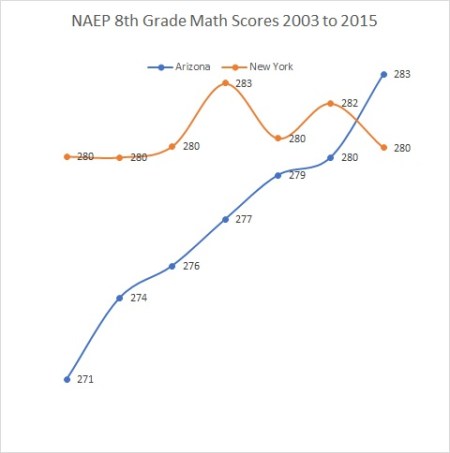
Arizona’s improvement process is multi-faceted but the elephant in the room in my book is a hyper-active open enrollment market, the nation’s largest and most geographically inclusive charter sector and private choice programs. Arizona lead the nation in academic gains even during a period in which it had the largest cuts in spending due to the Great Recession. If we can do this during a period of funding cuts, we ought to manage it during a period of funding recovery given the broad consistency of policy. Note however that the state’s A-F letter grades has been turned off during the entirety of the 2015 to 2017 period, the demographics of students have continued to move further into majority-minority status, etc. Put me down for Arizona improving anyway based on the AZMerit improving in both 2016 and then again in 2017.

Prediction 2: North Carolina climbs.

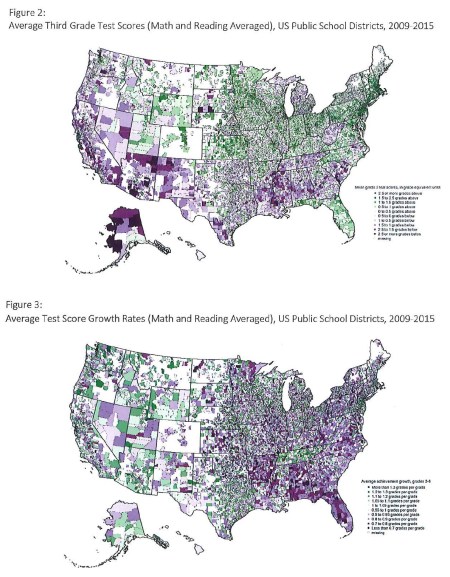
Recent NAEP trends have not been great in NC. Notice in the Reardon tables that North Carolina starts with a (good) greenish tint on the top map-showing good early scores-but turns purple on the second map (bad) on cohort NAEP gains during the 2011 to 2015 period.

I suspect North Carolina will do better in 2017 based upon the information in this news report- basically that while statewide enrollment is growing, school district enrollment has been relatively flat due to the growth of choice options. North Carolina lifted a statewide cap on charter schools in 2011, created voucher programs for low-income and special needs children. I’m not sure whether they’ve done enough to start the open-enrollment virtuous cycle, but I think they may have done enough to shake things up a bit.

Third prediction: Indiana improves.

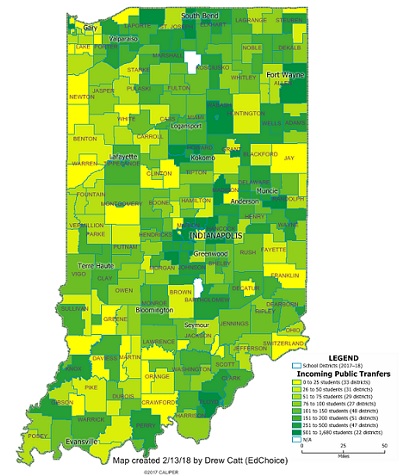
Give Indy a good stare in the Reardon chart, and it looks a bit like the green/purple undesirable combo between the two maps. It looks to me though like the districts are getting into the choice act (until 2007 you had to pay tuition in order to attend an out of zone school) and so I’m willing to buy some Hoosier stock.

Anyone else willing to dare a prediction should spell out their theory/evidence in the comment section.


Gender Gaps in College STEM Education: Boys Tend to be Over-Confident in Math and Benefit from It

February 15, 2018

Related image

(Guest Post by Gema Zamarro & Lina M. Anaya)

Employment in the so-called STEM (Science, Technology, Engineering and Mathematics) fields is projected to continue growing according to the Bureau of Labor Statistics. Additionally, wages in STEM field occupations are estimated to be on average nearly double the national average of wages for non-STEM jobs. Despite this promising future, women continue to be under-represented in STEM. Women are less likely to enroll in STEM degrees in college and represent a smaller share of STEM occupations. The question is why? Only after understanding the possible sources of such gender gaps we can have an idea of what can be done about it.

This question has haunted me (Gema) since my daughter, then a kindergartener, came home one day saying a boy in her class told her “girls are not good in math.”  Indeed, researchers have pointed out at gender differences in math performance and math perceived ability as possible drivers of later gender gaps in STEM. I wondered if parents could somehow counter these effects. After all, my previous work indicated that parental occupation type could be important for women’s long term STEM outcomes. In a recent working paper, I partnered with Lina M. Anaya, a Ph.D. student at the Department of Education Reform at the University of Arkansas, and Frank Stafford, Economics professor at the University of Michigan, to try and shed some light on these questions, using data from the Panel Study of Income Dynamics (PSID).

Using information from the multiple supplements of the PSID, we measured gender gaps in performance  on the standardized Woodcock  Johnson Applied problems test (W-J AP) and self-reported perceived math ability, measured on children from PSID families when they were between 6 and 17 years old (on average around 11 years old). Then, we are able to track these children and study their likelihood of majoring in a STEM field in college. We found that boys are more confident in their abilities than is warranted by their performance, while girls are less confident than is warranted by their performance.  But the problem isn’t just one of lack of confidence — boys’ confidence contributes more to their pursuit of STEM majors than girls’ confidence, even if they had the same true ability and same level of confidence.

Our results corroborated significant gender differences in W-J AP test performance and in perceived math ability during childhood. Even after conditioning in a given level of math performance in the W-J AP test, girls reported significantly lower levels of perceived math ability than boys (See Table 1). In the highest percentiles of math performance, 64% of boys reported the highest levels of perceived math ability, as compared to 50% of the girls. Even in the lowest levels of math performance, boys tended to be more optimistic with respect to their math ability, 29% of the boys reported the highest levels of perceived math ability, relative to 17% of the girls doing so. Having a parent with an occupation in STEM helped increase math performance but did not seem to help improve perceived math ability, if anything it seemed that those with parents in science were more pessimistic.

Table 1: Perceived Math Ability by Gender, given W-J AP scores (% of sample)

    Perceived Math Ability
W-J AP (percentile) Gender 1 to 3 4 to 5 6 to 7
0-50 Boys 15.9% 55.1% 29.0%
Girls 18.7% 64.2% 17.1%
51-80 Boys 4.1% 44.3% 51.6%
Girls 6.5% 49.9% 43.6%
81-100 Boys 2.8% 32.7% 64.4%
Girls 4.6% 45.2% 50.2%

Note: Weighted percentages reported using child population weights

Interestingly, girls’ lack of perceived ability seems to be something specific to math and not the result of girls generally reporting lower levels of perceived ability. The PSID also included results in the Woodcock Johnson reading test (W-J reading) and asked kids to report on their perceived ability in reading. We use this information to study perceived ability in reading conditional on performance. As it can be seen in the results in Table 2, gender patterns are very different for reading, a subject where girls, on average, outperform boys. In this case, we observe smaller gender differences of perceived reading ability among those scoring in the higher percentiles of the W-J reading test while girls performing in the lower percentiles report higher levels of perceived ability than boys.

Table 2: Perceived Reading Ability by Gender, given W-J reading scores (% of sample)

    Perceived Reading Ability
W-J Reading (percentile) Gender 1 to 3 4 to 5 6 to 7
0-50 Boys 13.4% 57.8% 28.8%
Girls 9.2% 50.1% 40.7%
51-80 Boys 4.3% 47.1% 48.6%
Girls 3.4% 32.4% 64.1%
81-100 Boys 1.9% 29.5% 68.6%
Girls 1.5% 33.5% 65.0%

Note: Weighted percentages reported using child population weights

Finally, since the PSID tracked these kids, we study to what extent math performance and perceived math ability, during childhood, and parental occupation type are related to the probability of majoring in STEM during college. Overall, as expected, we find that women are less likely to major in STEM in our sample, especially when we look at the so called “hard sciences” fields of engineering, architecture, mathematics and computer sciences. Both higher levels of math performance in the W-J AP test and higher levels of perceived math ability are related to higher probabilities of majoring in a STEM field.

But, here is where it gets interesting, the effects of higher levels of math performance and perceived ability are much bigger for boys than for girls. Performing in the highest percentiles of the W-J AP distribution, as compared to performing in the lowest percentiles, is associated with an increase in the probability of majoring in a “hard sciences” STEM field of about 13 percentage points for boys but only 6 percentage points for girls. Similarly, reporting the highest levels of perceived math ability, as compared to the lowest levels, is associated with an increase in the probability of majoring in a “hard sciences” field of about 7 percentage points for boys but only 2 percentage points for girls. These results suggest a loss of STEM enrollment by otherwise capable women.  And we can’t simply fix the problem by trying to boost women’s confidence in their true abilities, because women’s confidence contributes less to pursuing STEM than men’s confidence.  Perhaps men are rewarded for over-confidence in a way that women are not.

Interestingly, having a parent who works in a STEM occupation could help girls and not so much boys. The probability of majoring in “hard sciences” STEM fields increases by about 14 percentage points for girls when one of the parents works in a science job. For boys the increase of this probability is only 4 percentage points. Whatever the reason, these results suggest that parental occupation type could be an important factor reducing gender differences.

As for the answer I gave to my daughter, I said “It is not true that girls are bad at math. Look at your mother. My job is doing math all day!” I work on the field of applied econometrics and so, I guess that was close enough.


Public Service Announcement

February 14, 2018

(Guest post by Greg Forster)

Citizens! You are hereby notified that Mary and the Witch’s Flower, which I reviewed here, is returning to US theaters for two days only next week, due to overwhelming demand.

If you missed it the first time, attendance is mandatory. Otherwise, attendance is merely meritorious.

A theater near me has brought back Darkest Hour, the surprise hit of the Oscar noms – perhaps one near you has done so as well. As I said before, you should see that one on the big screen, too!

End transmission.


The Legacy of Andrew Coulson

February 8, 2018

Screen Shot 2018-02-08 at 11.57.16 AM

(Guest Post by Jason Bedrick)

Yesterday marked the second anniversary of the tragically early passing of Andrew J. Coulson, the brilliant and (in the words of his beloved wife, Kay) “happy, effusive, relentlessly upbeat” education reformer, policy analyst, and director of the Cato Institute’s Center for Educational Freedom.

IMHO, the best tribute we can pay to Andrew is to reflect on his ideas. Although he didn’t live to see it, PBS ran his magnum opus documentary, School, Inc., about how and why our education system lacks the progress, innovation, and efficiency gains seen in nearly every other industry. Last year, the Friedmanesque three-part series won the Anthem Film Festival’s award for Excellence in Filmmaking – Documentary Feature, and now Free to Choose Media is making the documentary available to view for free online.

The Cato Institute has also made Educational Freedom: Remembering Andrew Coulson, Debating His Ideas, available to download as a free e-book.

Andrew’s voice is greatly missed in today’s debates over education policy, but as Neal McCluskey wrote, “Thankfully, his ideas remain, and they will always illuminate the pathway forward.”


NOTE: This post has been updated to clarify that it is Free to Choose Media that is making School, Inc. available to watch free online.


Choice Opponent Claims Families Don’t Want Choices

February 7, 2018

Screen Shot 2018-02-07 at 2.48.18 PM

(Guest Post by Jason Bedrick)

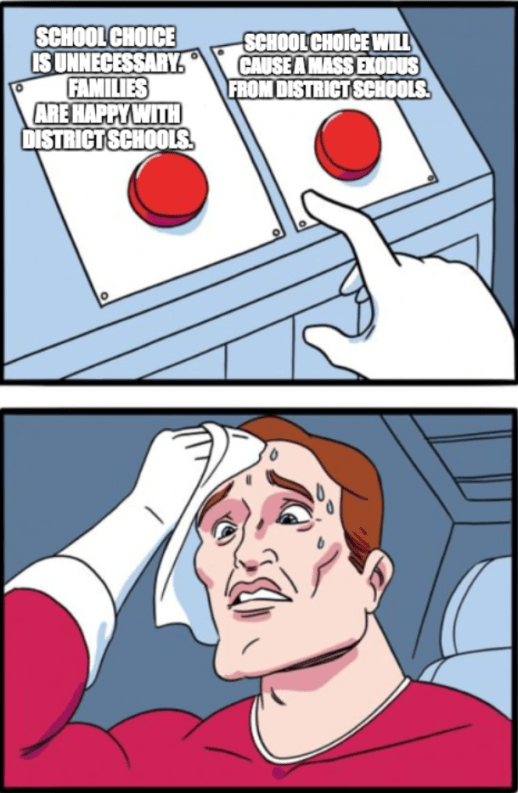
Opponents of school choice frequently claim that the sky will fall if a school choice program is enacted. For example, the School Superintendents Association (AASA) claims that choice programs would “‘starve’ public education of critical funding” because so many students would leave their assigned district school in favor of alternatives.

Leaving aside how such concerns treats kids as mere funding units, choice opponents making this claim fail to take into account why families want other alternatives. Indeed, as the Cato Institute’s David Boaz has pointed out, such arguments reveal “the contempt that the [education] establishment has for its own product.”

Perhaps it is a new modicum of self-awareness that prompted a spokesperson of the AASA to abruptly (if unpersuasively) reverse course in a recent interview with EdWeek:

“Conservative think tanks are trying to solve problems that families and communities aren’t asking them to solve through school choice,” said Sasha Pudelski, the advocacy director at AASA, the School Superintendents Association. “When you talk to stakeholders, you don’t hear, ‘Please provide our families with more educational options;’ they want their own schools to be better. They are not looking for an alternative. It’s a solution without a problem.”

So which is it? Either no one is looking for alternative education options, in which case educational choice programs pose no threat because no one will use them anyway, or a significant number of families are looking for alternatives, in which case the district school establishment needs to explain why they shouldn’t have any (or, at least, why those options should only be open to children whose parents can afford them).

In case you were wondering about the answer, I’ll let 100,000+ low-income tax-credit scholarship students in Florida do the talking:

ednext_20111_figlio_open

Image: “Rally in Tally” to support school choice on March 24, 2011. h/t Step Up for Students


The Not-So-Wild West in Oklahoma

February 7, 2018

sunset-3085578_640

(Guest post by Greg Forster)

While we’re on the subject of the Arizonan wild west, here’s my latest for OCPA’s Perspective on some very non-wild-west Oklahoma school overregulation:

The more prominent strategy, the one that got the most attention and funding, was toward greater centralized control. If schools are given more inputs and they fail to use them to produce better outcomes, then the schools are clearly working to enrich themselves. They can’t be trusted to carry the ball for fixing education.

Who could be trusted? Why, the reformers, of course.

Some interesting information from a state think tank:

The 1889 Institute’s database of public school regulations is the cumulative legacy of these earlier forces and the dramatic increase of regulations in the last generation. It runs to 610 entries. Schools are required to track every individual student’s progress in financial literacy education and every individual teacher’s professional development “points,” spend at least a certain minimum amount on their libraries, and meet test score targets or be subject to sanctions. They must also master obscure laws governing everything from inter-district transfers to the nutritional value of diet soda…

Very few of the regulations in the 1889 Institute’s database deal with issues that really need to be handled at the district level, never mind the state. I honestly think that the nutritional value of diet soda might not even need to be managed by schools at all. But if it does, why not let the principal hire lunchroom staff who are up to the job?

If you want to let me know what you think, the comment section below is not overregulated!


Providing Computers Does Not Improve College Enrollment, Employment, or Earnings

February 6, 2018

Image result for terminator

In a fascinating new study by Robert W. Fairlie and Peter Riley Bahr, they examine the effects of an experiment in which some community college students received free computers and others did not by lottery.  Comparing these randomly assigned treatment and control groups, the researchers found that computer skills rose among students who were given computers, but those skills did not translate into higher college enrollment, employment, or earnings for the treatment group.

These results are particularly important because many politicians have focused on improving computer skills as the key to improving educational outcomes.  In Arkansas, the main education policy initiative championed by the governor is a law that requires all public schools to offer computer science classesTexas has adopted a similar policy.  Leaving aside all of the obvious practical concerns, like whether schools have or can develop staff qualified to teach computer science, this new research raises questions about the aim of these policies.  How important is increasing computer skills for the vast majority of students?  No one doubts that most workers have to use computers, but many students may already possess the skills they need and it seems doubtful that raising average computer skills would lead to significant changes in employment outcomes — and that’s assuming we can improve computer skills in a meaningful way.

The new study is also incredibly useful in that it reminds us of how important it is to rely on randomized experiments rather than studies that use matching or controls for observables.  They conclude:

Importantly, our null effect estimates from the random experiment differ substantially from those found from an analysis of CPS data, raising concerns about the potential for selection bias in non-experimental estimates of returns.  Estimates from regressions with detailed controls, nearest-neighbor models, and propensity score models all indicate large, positive, and statistically significant relationships between computer ownership and earnings and employment, in sharp contrast to the null effects of our experiment.  It may be that non-experimental estimates overstate the labor market returns to computer skills.

It is simply false that matching studies are just as good or almost as good as randomized experiments.  Sometimes you get the same result in a matching and RCT study, but that could simply be because selection did not bias the result in that case or you were just lucky.  Sometimes a coin flip will also give you the same result.  Theoretically, we know that selection bias is a serious concern, which means that we can never have strong confidence in research designs that assume selection issues don’t exist.

(edited slightly)