
Don't cross our union masters...errrrrr...allies again cool kids!
(Guest Post by Matthew Ladner)
Politico has more on the Cool Kids vs. Caveman power struggle.
Don't cross our union masters...errrrrr...allies again cool kids!
(Guest Post by Matthew Ladner)
Politico has more on the Cool Kids vs. Caveman power struggle.
 2 Comments |
  politics, school funding | Tagged: David Obey, Politico |
  Permalink
 Posted by matthewladner
(Guest Post by Matthew Ladner)
So back in 2006, I wrote a daily email for the Goldwater Institute commenting on Wyoming’s plan to lavish money on their K-12 schools. Titled “Oil Millions Didn’t Make Jethro Smart” I focused on the following statement from Wyoming State Superintendent of Public Instruction Bill McBride:
Wyoming’s state coffers have been filled by the booming natural gas market. Last year the state had a $1.8 billion surplus. The state government has poured much of this windfall into its public K-12 education system.
Jim McBride, the state’s superintendent of public instruction, has offered some rather startling predictions saying, “We probably will have the nation’s No. 1 graduation rate, maybe college attendance rate. We probably will have the highest NAEP scores.”
They got the spending part down, spending a cool $16,000 + per student in 2006-07. How is the academic part working out?
Well, not so great actually…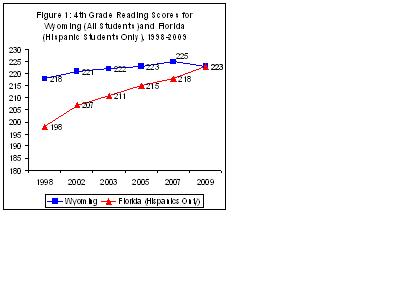 So just in case you are reading this on your phone, that would be Wyoming’s statewide average as the flat blue line being all students in Wyoming, and the red line being Hispanics in Florida. Back in 2006, I wrote:
Jethro Bodine of Beverly Hillbillies fame, flush with petrodollars, often predicted he would be either a movie star or a brain surgeon. That never worked out either.
I’d be willing to bet that Mr. McBride is a patriotic American who loves Wyoming and wants what is best for the kids of his great state, so I don’t mean to ridicule him as a person. This idea that we should simply throw money at schools however is demonstrably WRONG and deserving of scorn. If we really want to help children, it means doing the tough work of improving the productivity of the resources in the system.
3 Comments | school funding | Tagged: Beverly Hillbillies, Bill McBride, Jethro Bodine, Wyoming NAEP Scores | Permalink
Posted by matthewladner
1 Comment | school funding | Tagged: Race to the Top | Permalink
Posted by matthewladner
(Guest Post by Matthew Ladner)
Speaking of things we can’t afford…check out this excellent piece from RiShawn Biddle.
Leave a Comment » | school funding | Tagged: RiShawn Biddle | Permalink
Posted by matthewladner

(Guest Post by Matthew Ladner)
When Arizona Governor Jan Brewer announced her proposed budget, she established a benchmark in calling for the termination of a state program that currently serves 17,400 seriously mentally ill adults to save $37 million, the Arizona Republic reported. The governor’s budget chief, John Arnold, said this spending reduction is especially hard for the governor because she has been a strong advocate for mental-health causes.
“That benchmark means that anyone who seeks more funding from the state must first make the case why the cause is more important than providing services to 17,400 mentally-ill adults,” Arnold told the Republic.
Arizona is spending far, far more money than it is bringing in and lawmakers must make difficult choices. The concept of a benchmark to justify any new spending is therefore a good one. But it cuts both ways. What about continuing to spend in areas that are nowhere near as worthy as services to the mentally ill?
Consider administrators in the K-12 public educational system. The National Center for Education Statistics reveals that of the 104,630 employees at Arizona school districts in 2007-08, only 54,032 of them were teachers. What is more worthy of funding: maintaining an almost 1-to-1 teacher to bureaucrat ratio or maintaining services for the mentally ill?
Here’s another example: community colleges. The Maricopa County Community College District has a current operating budget of more than $683 million. The total budget from all sources is almost $1.5 billion. The district will spend only $276 million on instruction, making it around only 40 percent of its operating budget and only 18.6 percent of its total budget. MCCCD spends more than three times as much for administration and academic support as the state spends on the mentally ill, and the district’s three-year student completion rate is 11 percent. It is not clear what MCCCD is doing with that additional $130 million, but it does not seem to involve quality administration or academic support.
Defenders of the education status-quo will be quick to point out the federal government’s “maintenance of effort” requirements for using stimulus funds. However, there are waivers for such requirements, and Governor Brewer should seek them immediately. When we are cutting services for the mentally ill, we can hardly afford to maintain wasteful spending as a sacred cow.
1 Comment | school funding | Tagged: education spending, sacred cow, sacred cows | Permalink
Posted by matthewladner
(Guest Post by Matthew Ladner)
An outfit called the Arizona Education Network took issue with a piece I wrote showing that Arizona K-12 spending has increased by 20% since 2000 while math and reading NAEP scores are up by less than 1% during approximate same period.
Unsheathing their flaming sword of justice, they wrote the following:
US Census Department Figures show that the Arizona population increased 28.6% from April of 2000 to July 2009.
During the same period, average daily membership (the term used to refer to the total enrollment of students through the first 100 days of the school year) in Arizona schools increased 22.7%. (According to a report to the Arizona Senate) .
So when special interest groups decry a 20% increase in education funding in the 2000-2009 period, they should notice that this increase did not even keep up with the increase in the number of school children in Arizona during the same period.
**AHEM**
Let me help you out here guys, since you seem new to this whole policy analysis thing. As a rule of thumb, it’s a good idea to read something before you criticize it. Sometimes, that will include clicking on hyperlinks when they are provided.
For example, if you had taken the trouble to do so in this case, you would have gone to an Arizona legislative website and learned that I had used an inflation adjusted spending per pupil number to calculate the 20% increase.
Keep at it though- some day you guys may be ready to swim to the deep end of the pool.
22 Comments | money myth, school funding | Tagged: Arizona Education Network | Permalink
Posted by matthewladner

The new book from Rick Hanushek and Alfred Lindseth, Schoolhouses, Courthouses, and Statehouses, is a remarkably comprehensive and accessible review of K-12 education reform strategies. It’s a must-read for education policymakers, advocates, and students — at both the graduate and undergraduate levels. Even experienced researchers will find this to be an essential reference, given its broad sweep and extensive citations.
The book basically makes four arguments. First it establishes how important K-12 educational achievement really is to economic success and how far we are lagging our economic competitors in this area. Second, it demonstrates the dominance and utter failure of input-oriented reform strategies, including across-the-board spending increases and class-size reductions. Third, it describes how the court system has perpetuated failed input-reform strategies after having bought intellectually dishonest methods of calculating how much spending schools really need. And fourth, it makes the case for reform strategies that involve “performance-based funding,” including merit pay, accountability systems, and choice.
None of these arguments is original to this book. But to the extent that others have made these arguments, they have drawn heavily on Rick Hanushek’s research. In this book you get to hear it directly from the source and you get to hear it all so persuasively and completely.
If I have any complaint about the book it is that they are too restrained in their criticisms of the methods by which adequate school spending has been determined and the “researchers” who have developed and profited from those methods. These fraudulent analyses have justified court decisions ordering billions of dollars to be taken from taxpayers and blown ineffectively in schools. And the quacks promoting these methods have made millions of dollars in consulting fees in the process.
Those methods include the “professional judgment approach,” which essentially consists of gathering a group of educators and asking them how much money they think they would need to provide an “adequate” education, Naturally, they need flying saucers, ponies, and a laser tag arena to ensure an adequate education.
Another method is the “evidence-based approach,” which selectively reads the research literature to identify what it claims are effective educational practices. It then sums the cost of those practices while paying no attention to how many are really necessary for an adequate education or whether any of them are really cost-effective.
There is also the “successful schools approach,” which looks at how much money a typical successful school spends and calls for all schools to spend at least that much. This of course ignores the fact that many successful schools spend less than the typical amount and are still successful. One would have thought it impossible for them to be successful with less money than that deemed necessary to succeed.
And lastly, there is the “cost-function approach.” This approach takes the conventional finding that higher spending, controlling for other factors, has little to no relationship with student achievement, and then turns that finding on its head. It does this by switching the dependent variable from student achievement to cost. The question then becomes: how much each unit of achievement contributes to school costs. Switching the dependent variable does nothing to change the lack of relationship between spending and achievement. If you hide behind enough statistical mumbo-jumbo you can hope that the courts won’t notice that there is still virtually no relationship between spending and achievement controlling for other factors.
The Hanushek and Lindseth book lays all of this out (see especially chapter 7), but they are remarkably restrained in denouncing these approaches and the people who cynically profit from them. I don’t think we should be so restrained. The promoters of this snake oil are often university professors with sterling national reputations. They’ve cashed in those reputations to market obviously flawed methods. We shouldn’t let them do this without paying a significant price in their reputation.
The University of Southern California’s Larry Picus, and the University of Wisconsin’s Allan Odden, are both past presidents of the well-respected American Education Finance Association. They shouldn’t be able to sell the “evidence-based approach” to 5 states for somewhere around $3 million without people pointing and laughing when they show up at conferences.
I know that Rick Hanushek and Alfred Lindseth are too professional and scholarly to call these folks frauds, but I’m not sure what else one could honestly call them. Rick comes close in his Education Next article on these school funding adequacy consultants, entitled, “The Confidence Men.” But in this book,perhaps with the tempered emotions of his co-author, he adopts a more restrained tone. Perhaps this is all for the best because the book maintains the kind of scholarly temperament that strengthens its persuasiveness to those who would be more skeptical.
This has been a great year for education reform books. Schoolhouses, Courthouses, and Statehouses joins Terry Moe and John Chubb’s Liberating Learning, released earlier this summer, as members of the canon of essential education reform works.
4 Comments | methodology, school accountability, school funding | Tagged: chubb, hanushek, Jay Greene, Jay P. Greene, lindseth, moe, odden, picus | Permalink
Posted by Jay P. Greene

(Guest Post by Matthew Ladner)
One of my favorite scenes from Die Hard is when the evil villain Hans gets found by our hero, John McLain. Hans, dastardly fellow that he is, passes himself off as an American. John gives him a gun to have him help fight the bad guys. John turns his back, and the villain confidently pulls the trigger, only to hear a loud
McLain looked at Hans, shocked to be holding what he now knew to be an unloaded gun, and said, if memory serves: “OOOOOOOPS!!!! Do you think I’m f****** stupid Hans?!?”
Apparently, an outfit calling itself the “Arizona Economic Council” thinks that Arizonans are stupid. They shot an advertisement in Africa claiming that the looming budget cuts in K-12 threaten to move Arizona to Third World Status.
There is just one little problem with this: objective reality.
The Organization for Economic Cooperation and Development has this pesky habit of actually collecting spending per pupil data. Here is Arizona compared to the Third World Countries:
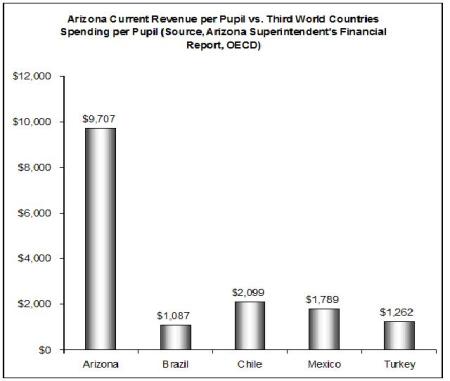
Oooops! Arizona spends five to nine times more than any of them. How does Arizona compare to Second World (former Communist) countries?
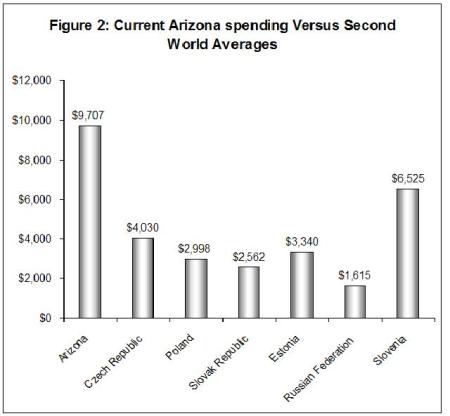
Ooops! All the former communist countries would kill to switch places with Arizona. How does Arizona compare to First World European Countries?
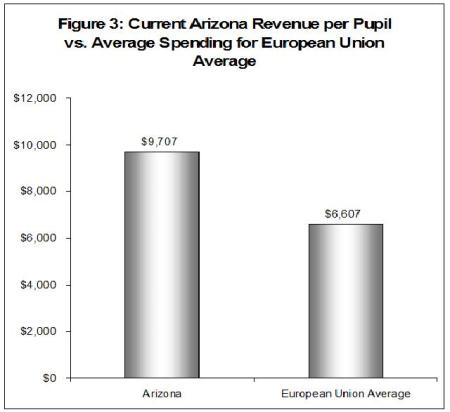
Ooops! Arizona’s figure is 48% higher.
I could dig up comparisons on academic outcomes but that would just be running up the score. Like Hans, the so-called Arizona Economic Council is shooting blanks. And given that they could have looked up these numbers before flying to Africa, I have to say they look pretty stupid.
5 Comments | school funding | Tagged: Alan Rickman, Arizona Economic Council, Die Hard, Hans Gruber | Permalink
Posted by matthewladner
(Guest Post by Matthew Ladner)
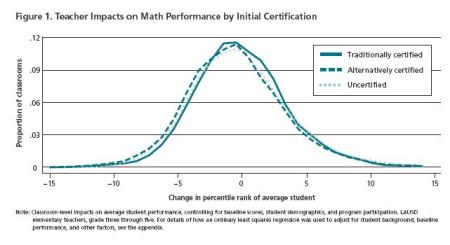
The Wall Street Journal reports that Education Secretary Arne Duncan is planning on leveraging stimulus money for states to improve their collection and use of data demonstrating progress on student achievement and teacher quality.
How well states collect — and act upon — that data will determine whether they qualify for money, Mr. Duncan said. “In order for us to improve, we must be much more open and honest about what works in the classroom and what doesn’t,” he said in a conference call with reporters. Mr. Duncan added that the funding would be carried out with “absolute transparency and accountability.”
So far so good.
However, the article then says it wants states to track qualifications, especially in high-poverty schools.
There is of course a very large problem with that. Low-income students with high quality but “poorly qualified” teachers are lucky to have them. Far luckier than those with low quality but highly qualified teachers.
Overall, however, I like the direction they are going. If you are going to be doling out an absurd amount of money, you may as well try to get something in return for it. Participation is voluntary, and competitive, which is also good.
Leave a Comment » | school funding | Tagged: Arne Duncan, Wall Street Journal | Permalink
Posted by matthewladner
(Guest Post by Matthew Ladner)
I thought that DC public schools were burning through a mountain of cash because they spent enough to send two students to the University of Texas at Austin. Amateurs! Mere amateurs!
Lo and behold, Vicki Murray of the Pacific Research Institute sent me the following, which finds that there are school districts in California spending over $200,000 per student. Take it away Vicki:
More Money, Lower Achievement
How Californians can get the real story on California education finance.
By Vicki E. Murray
California’s budget deficit is getting worse, fueling fears about the impact on school funding. Fortunately, California taxpayers and policy makers now have the just-released California School Finance Center online database to help make informed decisions about education policies that affect six million students, the country’s largest share of public school children, six million in all.
Last year when California ranked 48th on Education Week’s national ranking of school funding, California Teachers Association president David A. Sanchez warned that the state would be “locked at the bottom nationwide.” Trouble is, five other states also claimed to be 48th in school funding last year: Florida, Illinois, Nebraska, Nevada, and Oklahoma.
The CTA, along with State Superintendent of Public Instruction Jack O’Connell, now say that California “sank” to “a dismal” 47th place on this year’s Education Week ranking. Meanwhile, the CTA’s own parent organization, the National Education Association, ranks California much higher, around the middle of the pack, a statistic prominently posted on the website of O’Connell’s own education department. With so many competing claims, no wonder Californians are confused—including, it seems, some of the very people running the state’s public schooling system.
What really matters to most Californians isn’t how much other states are spending; it’s the money and the results their children’s schools are getting—or not getting. That is why the California School Finance Center database compiles information from a dozen California Department of Education sources and puts it right at users’ fingertips. It presents total and per-student revenue for more than 1,300 California school districts and charter schools spanning five years.
Unlike other resources, the California School Finance Center database presents complete revenue from local, state, and federal sources, all broken down into the finest level of detail currently available. The database also presents student achievement, demographic, census, and staff salary data. It even includes a “Return on Investment” feature developed by Just for the Kids-California to help quantify the relationship between a school district or charter school’s revenue, and its ability to increase student achievement.
For the 2006-07 school year per-pupil revenue averaged $11,600 per student, but Californians will probably be shocked by the staggering sums many school districts are receiving—sums that could even make “more money than God” districts, as education secretary Arne Duncan recently put it, like Washington, D.C, blush.
Dozens of California school districts exceed D.C.’s $26,555 per-student funding. Mattole Unified in Petrolia, for example, gets more than $225,000 per student. Less than one percent of its students are English learners, but only 43 percent score proficient in English language arts on the California Standards Test.
California finance experts will object to this example. Mattole’s small size qualifies it for substantial additional state funding through the state’s necessary small-schools allowance, which is supposed to help such districts achieve economies-of-scale parity with regular school districts. This funding, the reasoning goes, shouldn’t count. But consider the Ocean Grove Charter School in Placerville, which receives less than $2,500 per student. With proportionally four times more English learners than Mattole, as well as more low-income students, this charter school manages a 56-percent proficiency rate in English.
Mineral Elementary, another small-schools allowance district in Tehama County, receives even more funding than Mattole, $243,000 per student. Yet with no English learners, just 48 percent of Mineral Elementary students achieve English proficiency. Compare that performance with Hydesville Elementary in Humboldt County. English learners represent less than one percent of enrollment, but with just under $9,000 per student, a full 73 percent of Hydesville Elementary students score proficient in English.
Such examples defy the conventional wisdom that more money means better achievement, but so do most California school districts. The number of regular school districts where a majority of students is not proficient outnumbers the school districts where a majority of students is proficient by about three to one. In fact, average student proficiency rates in English language arts and math at the state’s bottom 20 revenue districts averaging $8,900 per student are actually higher than proficiency rates at the top 20 revenue districts averaging more than $19,200 per student. Yet superintendent O’Connell and the CTA think more money for more of the same will improve California public school performance.
“What I am asking for is greater investment at a time when the state is virtually broke,” O’Connell explained in his State of Education Address earlier this year. “We must expect a different commitment from the citizens of California.”
Most reasonable people would agree that average funding worth nearly $12,000 per pupil ought to be enough to teach native-speaking elementary and secondary school children English. The Golden State fails to manage that, at $12,000 or $200,000 per student. Instead of an increasingly expensive bill for such foundering, the California schools chief should demand a commitment from the public schooling system that is truly “different.”
In good economic times and bad California schools should make the most of every education dollar. Some school districts and charter schools are doing a much better job of that than others. The California School Finance Center database makes it easier to identify them and replicate their success.
UPDATE: I made a bigger deal about the $243,000 figure than the PRI folks did, and mea culpa, I should have suspected that they were some sort of strange outlier.
4 Comments | school funding | Tagged: California School Finance, Pacific Research Instute, the Joker, Vicki Murray | Permalink
Posted by matthewladner
You are currently browsing the archives for the school funding category.


 Jay P. Greene's Blog
