A Market of Memorials

July 30, 2009

When I visited the Gettysburg Civil War battlefield a few years ago I was bothered by the clutter of memorials.  There are so many scattered across the battlefield, all of different size, style, and theme, that it seemed to me that they littered what should be a pristine place.

I visited again this summer and have completely changed my mind.  It was an authoritarian impulse to think that there should be one memorial with one style and one message.  Instead, Gettysburg shows us what a market of memorials can do.  Basically, anyone able to raise enough money could build a memorial honoring a state, division, regiment,or individual.  As the Gettysburg Battlefield Wikipedia page describes the process:

The first monument to be placed on the battlefield was in the National Cemetery in 1867, a marble urn dedicated to the 1st Minnesota Infantry, the gallant regiment that was virtually annihilated on Cemetery Ridge, July 2. The first monument to be erected outside of the cemetery was on Little Round Top on August 1, 1878, when the Strong Vincent GAR Post of Erie, Pennsylvania, memorialized their namesake with a marble tablet on the spot where he was mortally wounded.  As the 25th anniversary of the battle approached, veterans groups stepped up the pace of erecting monuments and many of the state governments got into the act as well. By the 1890s, Gettysburg had one of the largest outdoor collections of bronze and granite statues anywhere in the world. For the Union side, virtually every regiment, battery, brigade, division, and corps has a monument, generally placed in the portion of the battlefield where that unit made the greatest contribution (as judged by the veterans themselves)…. There are over 1,600 monuments and markers on the field.

Yes, having over a thousand monuments on a battlefield makes it look noisy and disorderly, but freedom is noisy and disorderly.  By permitting a market of memorials, Gettysburg allowed groups of people to choose who should be honored and how that honor should be conveyed.  If there had been a strong central authority controlling battlefield memorials, as is the norm, the central authority would have decided the subjects and manner of conveying honor.  What if the central authority’s emphasis or style differed with yours?  Too bad. 

Just ask Vietnam vets and relatives what recourse they have if they oppose the controversial gash in the ground that the central authorities chose for the exclusive memorial on the DC Mall.  They can’t, as Gettysburg veterans could, just add their own memorial with their dissenting perspectives. 

And you really can see clashing perspectives among the Gettysburg memorials.  There are multiple efforts to claim credit for who saved Little Round Top for the Union.  There are different framings of the nature of the conflict.  There are different architectural visions.  It’s all there at Gettysburg in its wonderful disorderly freedom.

When I caught myself wishing for a neat and orderly battlefield memorial I could see the difficulty many of us have in really embracing liberty.  In some ways we are all little authoritarians, wishing for perfectly structured, centrally-determined, solutions to problems.  But of course, when we indulge these authoritarian fantasies, we all imagine that we will be the central authority or that the central authority will act in the way we prefer.  That rarely happens in actuality.  We need freedom, with all of its messiness and despite our desire for order and perfection, because we each differ on the nature of the desired order.  Rather than having any one of us impose his or her vision on all others, a marketplace of those visions can allow competing visions to be expressed, with the best persuading others to voluntarily agree.


No Jack Jennings Is Not on Fire

July 29, 2009

No two people are not on fire

(Guest post by Greg Forster)

Stop the press! How did I miss this on Eduwonk last week?

At this point if Jack Jennings doused himself in gasoline and set himself ablaze in front of the NEA, would anyone notice?

Hey, that’s what happens when you spend too long peddling political hackery trumped up as research. Sooner or later, people get wise to the con and stop taking you seriously.

Of course, Andy feels the need to call Jennings’ work “important.” But if all the empty, generic words of praise people rotely intone about Jennings doused themselves in gasoline and set themselves ablaze in front of the Merriam-Webster publishing comany, would anyone notice?

In other Eduwonk news, give Andy credit for not drinking too much of the yesterday’s new Race to the Top flavor Kool-Aid; he linked to this item, which helps illustrate just how deep the kabuki goes.


Racial Excuses: What Obama Says v. What DOE Does

July 27, 2009

(Guest post by Greg Forster)

Continuing the theme of Jay’s excellent post this morning on the debauching of the nation’s rhetorical currency, Pajamas Media carries my column on how the president’s denouncing of racial excuses in education to the NAACP stacks up against how the DOE has started making racial excuses that will pave the way for quotas in AP courses. I also had something to say about the NAACP’s own debauching of the currency:

The fact that [the NAACP attendees] feel the need to applaud is a good sign. Hypocrisy really is the tribute that vice pays to virtue — and when do nations make payments of tribute? When they’ve lost a power struggle with a stronger neighbor. The all-excuses culture of the NAACP pays tribute to the “no excuses!” culture of Barack Obama because it knows it has lost the fight for public opinion.

If only the Obama administration lived up to the “no excuses!” culture promoted by its president.

At almost the same time Obama was giving that speech to the NAACP, Russlynn Ali, the new head of the Office of Civil Rights at the Department of Education, gave an interview with Education Daily (subscription only, but you can see coverage here) in which she implicitly signaled that school districts had better make sure they have enough minority students in advanced courses, such as AP courses.

Backfill; HT Mike Petrilli.


The Meaning to Word Ratio

July 26, 2009

Politicians haven’t just been debasing our currency; they have also been debasing our language.  Over time presidents have been talking more and more (see Jeff Tulis’ excellent book, The Rhetorical Presidency), but they’ve been saying less and less. 

This point struck me as I read the inscriptions on the Lincoln and FDR memorials during a recent visit to DC.  On Lincoln’s memorial is inscribed the entire text of two speeches, the Gettysburg Address and Lincoln’s Second Inaugural Address.  The Gettysburg Address is only 244 words and the Second Inaugural has only 698.  But in less than a thousand words, these speeches say so much.

The FDR memorial has 21 quotations drawn from 18 different speeches prepared by Roosevelt.  Presumably those 559 words are the most memorable and important portions of those speeches.  Yet even these greatest hits sound empty compared to the full text of speeches inscribed on the Lincoln memorial. 

For example, one inscription on the FDR memorial reads: “In these days of difficulty, we Americans everywhere must and shall choose the path of social justice, the path of faith, the path of hope and the path of love toward our fellow men.”  These are certainly lofty sentiments, but what exactly do they mean?  What are we supposed to do to pursue social justice, faith, hope, and love?

Here are more bits of empty rhetoric from the FDR memorial: “This Generation of Americans has a rendezvous with destiny…” and “I pledge you, I pledge myself, to a New Deal for the American People.” and  “The only limit to our realization of tomorrow will be our doubts of today. Let us move forward with strong and active faith.” and “More than an end to war, we want an end to the beginnings of all wars.”  They all sound great, but I have no idea what any of them really mean. 

But I know exactly what Lincoln means when he says: “Both parties deprecated war, but one of them would make war rather than let the nation survive, and the other would accept war rather than let it perish, and the war came.” Lincoln has an extremely high meaning to word ratio.  The same is true of speeches given by Washington or Jefferson.

More recent speeches by presidents are crammed with words but remarkably lacking in meaning.  George W. Bush’s second inaugural address comes in at 2,073 words, more than eight times as long as Lincoln’s.  Barack Obama’s inaugural address was 2,399 words, almost ten times as long as Lincoln’s second inaugural.  What has produced this bloat?  Empty lines like this: “On this day, we gather because we have chosen hope over fear, unity of purpose over conflict and discord.”

Just as there is a real cost to inflation (Keynes described it as: “By a continuing process of inflation, governments can confiscate, secretly and unobserved, an important part of the wealth of their citizens… There is no subtler, no surer means of overturning the existing basis of society than to debauch the currency.”), there is also a cost to the debasement of political rhetoric.  Politicians talk so much and say so little that almost no one outside of those who derive a living or entertainment from it bother to pay attention.  What will happen when politicians really have something important to tell us?  Will they be the politicians who cried wolf?

This is why it is worthwhile to note and denounce empty rhetoric from politicians.  We have to increase the meaning to word ratio.


A Slam Dunk from Mickey Kaus

July 23, 2009

Slam dunk

(Guest post by Greg Forster)

Kausfiles:

“I would like to see Dems apply Orszag’s logic — that all Medicare expenses can obviously, without sacrifice, be cut to the level of the cheapest provider — to the school system.”


Detroit Public Schools Consider Bankrupcy

July 22, 2009


(Guest Post by Matthew Ladner)

An enormous experiment in school choice is going on in Michigan, and it doesn’t receive a fraction of the attention it deserves. The Detroit Public Schools- perhaps the most dysfunctional of the nation’s large urban districts- has been bleeding students and is now actually considering seeking bankruptcy protection.

The Wall Street Journal lays it out:

DPS’s enrollment — which largely determines its allotment of state funding — is about half what it was in 2001, as suburban districts and charter schools have siphoned off tens of thousands of students. By this fall, DPS will have 172 schools open and more than 100 vacant. Meanwhile, the high-school-graduation rate is 58%; coupled with the enrollment losses, only about one-quarter of students who start high school in the district graduate from it in four years, according to outside estimates.

But DPS’s problems go beyond the type that sank GM and Chrysler. Wide-scale corruption has depleted district coffers, which held a $103.6 million surplus as recently as 2002. In June, Mr. Bobb’s new team of forensic accountants found DPS paychecks going to 257 “ghost” employees who have yet to be accounted for. A separate Federal Bureau of Investigation probe in May led to the indictment of a former payroll manager and another former employee on charges of bilking the district out of about $400,000 over four years.

Given the longterm academic results of DPS, shrinking it in half in 8 years should be considered a humanitarian triumph. Don’t cry for the people working for DPS- all that money has shifted to schools where parents would rather have their children. Instead- celebrate for the students.

In the late 1990s, state lawmakers abolished the Detroit school board and appointed a CEO. I recall that person studied the situation for a few months and concluded that not a single business function of the district worked as it should. Contractors were being paid for work they didn’t do. The reported high school dropout rate was around 75%.

The inescapable conclusion: DPS was a money trough for adults that might occasionally educate a student here and there, but only by accident.

Further- bankruptcy could be very much in the best interest of the students in the district. It would allow administrators to modify union contracts and perhaps, gasp, make it feasible to let teachers go for academic failure or professional misconduct. Perhaps even reward teachers for outstanding work.

An interesting set of dynamics led to this point. In 1999, I coauthored a study for the Mackinac Center exploring the dynamics of public school choice. I interviewed a number of inner-ring suburban superintendents, some of whom were quite candid with me.

The basic story is that initially, the suburbs were not interested in participating in open enrollment competition for students. One superintendent, when I asked him why his district didn’t participate, replied “I think the feeling around here is that we’ve got a pretty good thing going, and we want to keep the unwashed masses out.”

As the charter schools got into the act, however, it compelled some of the school districts to defect and begin accepting open enrollment transfers. This had a snowball effect- now districts were losing students to both charter schools and school districts. This motivated them to accept transfers themselves.

As more districts opened their doors to transfers, and more charter schools continued to open, the biggest opportunitity gains were realized by students in Detroit.


More Administration Talk/Walk Disconnect

July 22, 2009


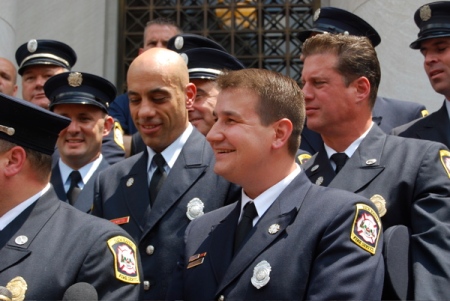
Ricci firefighters

They won their case, but it changes nothing – the administration is now imposing racial quotas that will keep their kids out of AP.

(Guest post by Greg Forster)

In today’s post, the disparity between talking the reform talk and walking the reform walk once again “rises to the top.”

Mike Petrilli has again put on his Pollyanna dress and bought into Hope And Change, praising Obama’s NAACP speech in shockingly hyperbolic terms – “It was transcendent. It was inspirational. It was honest, direct, bold, and, I hope, important, maybe a turning point.”

Look, as has always been the case, Obama says a lot of the right things, and that does matter. But come on, Mike, let’s maintain a grip on reality. Of the descriptors you offer, only “direct” seems plausible. Ask the DC voucher kids how “honest” Obama is being when he poses as a reformer. I’m not sure how you can call him “bold” while simultaneously joining the choruses that endlessly sing his praises everywhere I turn – what would he say if he were a coward? (FWIW, McCain has the exact same issue – he’s a “straight talker” who never tells the public anything it doesn’t love to hear. But that doesn’t excuse Obama.) And while Obama’s choice to talk like a reformer is important, if nothing new emerged in this speech – and it didn’t, unless I’m missing something – then this speech adds nothing “important” to the previously established fact that Obama talks like a reformer. (HT Adam Schaeffer, who got to this party before me.)

As for “maybe a turning point” – only in terms of the channel on my radio.

You know whom you should listen to, Mike? There’s this really great blogger on Flypaper who just did an eye-opening post on the Obama administration’s little-noticed threat to bring race discrimination lawsuits against school districts if they don’t have enough “students of color” in advanced courses. Once the threat has been made, of course, the lawsuit never need be brought – school districts across the country have now recieved the message and will quietly adopt racial quotas to avoid attracting the attention of the people playing with matches near the gas tanks at the DOE’s civil rights office. The threat is the quota.

How does that square with the president’s telling the NAACP that black students shouldn’t use social disadvantages as excuses for slacking in school? What will that do to a couple decades’ worth of work you and Checker and so many others have put into promoting rigorous academic standards against all the charlatanry of the radical left?

If I were you, Mike, I’d start following that blogger’s work on a regular basis. A guy who digs up that kind of shocking story when nobody else found it, and has the guts to broadcast it even if it might get him in trouble with the administration – well, in my book, that’s a guy who’s going places.


Question for Leo: Why is the Citizen’s Civil Rights Commission on your case?

July 16, 2009

(Guest Post by Matthew Ladner)

I’m just starting to read the Citizen Commission on Civil Right’s report National Teacher Unions and the Struggle Over Education Reform, but I’ve already found a wonderful quote:

While teachers’ unions are legitimately concerned with securing fair and unbiased treatment at the hands of management, these concerns have often been translated into fierce opposition to reforms designed to hold schools and their faculties accountable for how their students perform.

This resistance has posed a barrier to improving educational opportunity for the most disadvantaged students and closing the performance gap between them and their more advantaged peers. It has also led to calcified systems in which talented people are deterred from applying or staying as teachers because they believe their skills will not be recognized or rewarded.

Hmmm…does this statement have more than a faint echo of this? I predicted that the political marriage between progressives and education unions would come under increasing strain, and this report is the latest signal.

Question for Leo: how does it feel pretending to be a “progressive” when you are actually a part of the most reactionary force in American politics?


General Powell Brings in the Heavy Artillery

July 16, 2009

(Guest Post by Matthew Ladner)

Leonard Greene of the New York Post turns in an account of Colin Powell telling it like it is at the NAACP convention:

Former Secretary of State Colin Powell joined an NAACP panel of civil-rights giants yesterday and urged a new generation of leaders to declare war on failure in America’s schools. “There’s nothing more important for us as a nation than to sit back down with our kids and return a sense of pride and dignity,” Powell said at the Hilton New York. The retired general was joined by a who’s who of activists, including the Rev. Jesse Jackson, former UN Ambassador Andrew Young, Washington power-broker Vernon Jordan and five of the famed Little Rock Nine students, who faced violent mobs to integrate an Arkansas high school in 1957.

Powell rattled off a string of ignoble statistics, including a 50 percent dropout rate among African-American students, 30 percent of whom are born out of wedlock. “There’s a connection,” Powell said before pointing to the Little Rock alumni. “Is this what they fought for?”


Texas has nothing to learn from California except…

July 10, 2009

2809LD1(Guest Post by Matthew Ladner)

Interesting article from the Economist on California vs. Texas: America’s future.

I’ve been an Economist reader for 20 years now, and their work is usually outstanding. They do however occassionally fall prey to an easy stereotype, and this article contains such a folly.

Read the article for yourself, but keep in mind that Texas has among the highest NAEP scores for Hispanic students in the nation (now edged out by Florida on 4th grade reading) and spends over $10,000 per child per year.

The only thing Texas has to learn from California is what not to do.

P.S.

This has been a settled question on the only true field of battle for some time now.