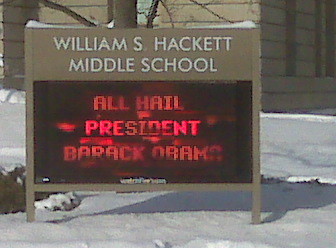
(Guest post by Greg Forster)
I guess they heard how much money is going to be thrown at schools in the stimulus.
Hat tip to Jim Geraghty, who quips, “I would have preferred a zombie warning.”
(Guest post by Greg Forster)
I guess they heard how much money is going to be thrown at schools in the stimulus.
Hat tip to Jim Geraghty, who quips, “I would have preferred a zombie warning.”
 3 Comments |
  civic values, economics, politics | Tagged: Greg Forster |
  Permalink
 Posted by Greg Forster

HT Wall Street Journal
(Guest post by Greg Forster)
Continuing the Arkasas theme, the Wall Street Journal has a fascinating story today about the little rock for which Little Rock was named.
And continuing the theme of government spending, the story notes that $650,000 is about to be spent to excavate the remains of the original little rock for public display. $350,000 of the money was privately raised, the city is kicking in $100,000 from bonds, and the county is kicking in $200,000.
My more libertarian-leaning friends may scoff at that, but I’m for it. Even Adam Smith insisted that it’s important for government to spend money to “maintain the dignity of the state.” He meant all the lavish pomp that surrounds the king and Parliament, but this is the American equivalent of that – it’s affirming the role of our shared past (even in the form of a rock we dug up out of the mud of the Arkansas River) in the foundations of our nationhood.
UPDATE: Of course, it’s not my money, so it’s easy for me to support spending it.
Leave a Comment » | civic values, economics | Tagged: Greg Forster, Little Rock, Wall Street Journal | Permalink
Posted by Greg Forster

(Guest post by Greg Forster)
Last week the president of the UAW claimed that workers at auto companies receiving federal bailout money shouldn’t have to take a wage cut because they already make $2 per hour less than Toyota workers if you include bonuses. I was going to point out everything that’s wrong with his argument, but it looks like the contract for this particular demolition job has already gone to Mickey Kaus (possibly as part of the federal stimulus plan).
3 Comments | economics | Tagged: auto bailout, Greg Forster, UAW | Permalink
Posted by Greg Forster
(Guest post by Greg Forster)
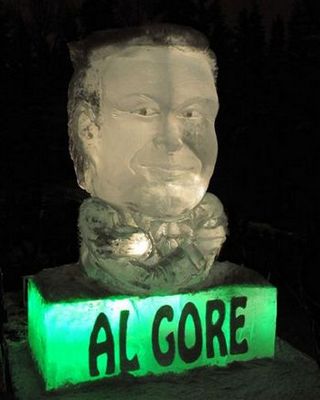
Since we’re on an economics kick today: Craig Compeau of Fairbanks, Alaska has sponsored the creation and display of an 8 1/2 foot tall, five-ton ice sculpture of Al Gore. He has organized a local contest to guess how much colder the winter will be in 2008-09 compared to the winter of 1947-48, the year of Al Gore’s birth, with proceeds going to a local charity. This winter Fairbanks has already hit 47 degrees below zero (as in 79 degrees below the freezing point) so the guesses are going to have to be almost as low as Gore’s credibility.
The Associated Press dryly reports that the ice sculpture will be on display “through March unless it melts before then.”
(edited for typos)
8 Comments | economics | Tagged: Al Gore, Craig Compeau, Frozen Gore, global warming, Gore ice sculpture, Greg Forster | Permalink
Posted by Greg Forster

I have a plan to get the economy going again — click our heels together three times.
Look, the economy will eventually get better. People will claim that whatever policies are adopted are responsible for that recovery regardless of whether those policies had any effects and even if they were harmful. We’ll never be able to sort out the causal relationships.
Did the New Deal bring us out of the Depression? Many economists doubt it, but decades of Democratic dominance in American politics were built on that claim. Times were awful, the New Deal involved a lot of activity, and eventually the economy got better. But if the New Deal didn’t deserve any of the credit or was actually harmful, then giving it credit led to decades of faulty policy prescriptions.
I fear we are about to make the same mistake. Before all is said and done we will spend trillions on various schemes and eventually the economy will get better. Are we going to wrongly credit the huge government spending?
That’s why I say that I am going to click my heels together three times to fix the problem. When things eventually get better I am going to claim that heel-clicking really did the “magic” of the recovery. Post hoc ergo propter hoc.
And if things don’t get better soon enough I am going to say that I didn’t click heels enough. It should have been six times.
2 Comments | economics | Permalink
Posted by Jay P. Greene

As we at JPGB have been arguing for many months and in many posts, giant federal bailouts are unlikely to have any beneficial effects and may well do harm. (See for example here, here, and here.) But if we have to have a new $800 billion stimulus package on top of the already adopted $700 billion financial bailout on top of the trillions in implied or explicit loan guarantees via the federal takeovers of Fannie, Freddie, AIG, Bank of America, Citi, etc…, there might be a smarter way to do it.
So I would like to offer my modest proposal for the new $800 billion stiumuls package — voucherize it. Give every man, woman, and child in the US a check good for an equal portion of the $800 billion. With 300 million people that works out to about $2,667 dollars. A family of four would get a total of $10,667.
If it’s true that the federal government needs to tax, borrow, or print the money to stimulate the economy (a theory that makes no sense to me), can’t we at least empower everybody to use the money in the way they think best rather than the way that a bunch of log-rolling, pork-eating, back-slapping politicians think best?
If schools really need to be rebuilt, let local communities pass a bond referendum and raise their taxes,whose cost could be defrayed by the extra cash we just put in everybody’s pockets. If the community thinks that they need better roads instead of better school buildings, they could direct their bailout voucher funds in that direction. If banks really need more capital, then they can earn the deposits from these bailout vouchers. If the consumer needs more resources to keep spending, the bailout voucher puts cash in their pocket. If people are having trouble paying their mortgages, the bailout voucher eases their burden.
Rather than having the priorities set in Washington, the bailout voucher lets the priorities of the stimulus package be determined by everybody. Do we have any reason to believe that Washington knows best which schools need to be remodeled or which bridges need to be built or which mortgages should be refinanced?
Much of the intellectual work over the next four years is going to be to reshape dumb policy ideas that are going to get passed even though they shouldn’t. Let’s start by urging that the stimulus package be voucherized.
(edited to correct typos)
4 Comments | economics | Tagged: Jay Greene, Jay P. Greene, stimulus package | Permalink
Posted by Jay P. Greene
(Guest post by Matthew Ladner)
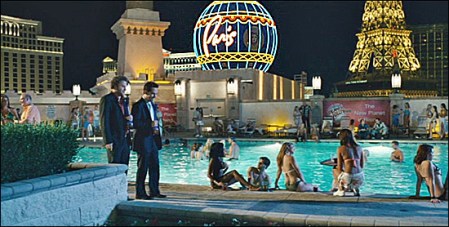
I returned from Las Vegas last night, where the Nevada Policy Research Institute put on an excellent forum on education reform in the Silver State.
If you want to get increasingly worried about the depth of the current recession, wander around the high-end shops in the casinos. You’ll see three immaculately dressed sales people, usually in black attire, standing around hoping that someone will come in the door. Few people ever do.
The black attire is quite appropriate.
I also had a chance to inspect Encore, Steve Wynn’s followup to the Wynn. My expectations were high, and I must confess that I was a little disappointed to find that he hadn’t done a grand work of public art like the Bellagio Fountains or the Wynn Waterfall. Perhaps that is still in the works, but for now, the Encore looks like a copy of the Wynn with more red hues in the interior.
Not that its a bad thing, mind you, but I was expecting to be hit with the unexpected.
Leave a Comment » | economics | Permalink
Posted by matthewladner


(Guest post by Greg Forster)
Lots of people are picking up on the temper tantrum about alleged “demonizing of teachers” begun by a Randi Weingarten speech and continued in Bob Herbert’s column on the speech.
Even that notorious right-winger Eduwonk points out that Weingarten and Herbert are hitting a straw man. I think the real problem is not that school reformers demonize teachers but that defenders of the government school monopoly angelize them. When we reformers insist that teachers should be treated as, you know, human beings, who respond to incentives and all that, rather than as some sort of perfect angelic beings who would never ever allow things like absolute job protection to affect their performance, it drives people like Weingarten and Herbert nuts.

A typical teacher, as seen by Randi Weingarten
But what I’d like to pick up on is the question of whether the troubles of the government school system are comparable to the troubles of the auto industry.
Of the alleged demonizing of teachers, Herbert had written:
It reminded me of the way autoworkers have been vilified and blamed by so many for the problems plaguing the Big Three automakers.
Eduwonk points out Herbert’s hypocrisy (though he delicately avoids using that word) on this point, because elsewhere in the column, Herbert praises Weingarten for expressing a willingness to make concessions on issues like tenure and pay scales. Union recalcitrance on these types of reform, Eduwonk points out, is precisely why the auto industry is in so much trouble, and Weingarten has been driven to make noises in favor of reform because a similar dynamic has been at work in the government school system.
On the other hand, Joanne Jacobs thinks the comparison between the AFT and the UAW is inapt:
I don’t think skilled teachers and unskilled auto workers have much in common. Auto unions pushed up costs, especially for retirees, making U.S. cars uncompetitive. In education, the problem isn’t excessive pay, it’s the fact that salaries aren’t linked to teacher effectiveness, the difficulty of their jobs or the market demand for their skills.
But teachers’ unions have pushed up costs – dramatically. In the past 40 years, the cost of the government school system per student has much more than doubled (even after inflation) while outcomes are flat across the board. And this has mainly been caused by a dramatic increase in the number of teachers hired per student – a policy that benefits only the unions.
It’s true that high salaries aren’t the main issue in schools, although teacher salaries are in fact surprisingly high. The disconnect between teacher pay and teacher performance is much more important. But the UAW has the same problem! Their pay scales don’t reward performance, either.
The source of Jacobs’ confusion is her mistaken view that auto workers are “unskilled.” Farm workers are unskilled, but not auto workers. The distinction she’s reaching for is the one between white-collar or “professional” work and blue-collar work. But some blue-collar work is skilled and some is unskilled, and auto workers are in the former category. This matters because with skilled blue-collar workers, as with white-collar workers, there’s a dramatic increase in the importance of incentives as compared with unskilled labor.
In fact, a lot of smart people have been arguing (scroll down to the Dec. 26 post) that exorbitant salaries and benefits aren’t nearly as much of a problem in the auto industry as union work rules – including poor performance due to absolute job protection, pay scales that don’t reward performance, and rigid job descriptions that make process modernization impossible.
Sound familiar?
(Edited)
4 Comments | economics, teacher pay, teacher quality, teacher union | Tagged: AFT, Andy Rotherham, Best of Greg, Bob Herbert, Eduwonk, Greg Forster, Joanne Jacobs, Randi Weingarten, UAW | Permalink
Posted by Greg Forster

(Guest Post by Matthew Ladner)
Yeeeee Ha…Jester’s dead! Great News from the Goldwater Institute, congratulations to Clint, Carrie Ann and the clients!
Appeals Court Voids CityNorth Subsidy
Court says $97.4 million subsidy violates Arizona ConstitutionPhoenix–Today the Arizona Court of Appeals ruled unanimously in favor of the Goldwater Institute, deciding the $97.4 million taxpayer subsidy given to the developer of the CityNorth shopping mall by the City of Phoenix is unconstitutional.
“Santa got a head start on Christmas this year,” said Goldwater Institute litigation director Clint Bolick. “This ruling is an early present for the citizens of Phoenix.”
In 2007, the City of Phoenix provided the subsidy to the Klutznick Company for its CityNorth retail center in north Phoenix, despite a constitutional prohibition on corporate subsidies in Arizona. The Goldwater Institute’s Scharf-Norton Center for Constitutional Litigation filed suit in July 2007 claiming the agreement violated the Arizona Constitution’s Gift Clause.
Today the three-member Appeals Court agreed. In an opinion written by Judge Patrick Irvine, joined by Judge Winthrop and Judge Hall, the court said, “We think these payments are exactly what the Gift Clause was intended to prohibit.”
The Goldwater Institute represented six small business owners in the lawsuit: Meyer Turken, owner of Turken Industrial Properties, a small real estate development and management company; Kenneth D. Cheuvront, owner of Cheuvront Wine and Cheese Cafe and Cheuvront Construction; Zul Gilliani, who owns an ice cream shop at Paradise Valley Mall; James Iannuzo, who owns Sign-a-Rama; Kathy Rowe who owns Music Together; and Justin Shafer, owner of Hava Java.
“This ruling vindicates this important provision of the Arizona Constitution,” added Bolick. “No longer will cities and towns be able to give away our tax dollars to pay private businesses to pursue a profit. At a time of tight budgets, those tax dollars should be paying for essential services, not for corporate subsidies.”
1 Comment | economics | Tagged: City North lawsuit, corporate welfare | Permalink
Posted by matthewladner

The Disturbinator 4000XL, a state-of-the-art disburbance generator.
(Guest post by Greg Forster)
A while back, in his well-read takedown of the “free market” think tanks endorsing the original bailout that got us into the present mess, Jay mentioned that the donors to those think tanks probably didn’t intend for their money to be used to endorse a radical expansion of government intrusion into the economy.
I thought of that post when I opened an e-mail this morning from the Ford Foundation. The e-mail was sent to people (like myself) who work for grantmaking foundations.
To help us “think and talk about” good grantmaking, Ford is distributing a deck of “role cards” representing the roles grantmaking staff play, such as “advocate,” “talent scout,” and “disturbance generator.”
It makes you wonder what life at the Ford Foundation is like. They spend all day inventing decks of cards, apparently.
Not only that, but being insulated from the discipline of the market, it looks like Ford isn’t up with the latest technology. As soon as I arrived at my new workplace in August, I had a state-of-the-art disturbance generator installed in the basement. But at Ford they’re still generating disturbance by hand.
I’m sure this is exactly what Henry Ford had in mind for his money when he gave it to a charitable foundation. On the other hand, given what Ford does with most of its time and money, I suppose we should be glad for every cent and every working hour that gets diverted into activities that are merely useless rather than actively destructive.
2 Comments | economics | Tagged: Ford Foundation, Greg Forster | Permalink
Posted by Greg Forster
You are currently browsing the archives for the economics category.

 Jay P. Greene's Blog