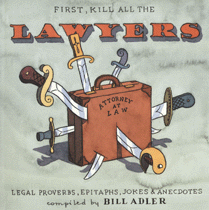
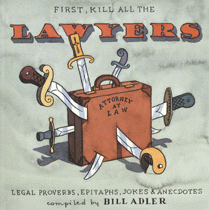
Lawyers, lawyers everywhere

October 27, 2010

(Guest Post by Matthew Ladner)

Four years ago or so I attended the graduation ceremony of Arizona State University’s law school. I remember thinking to myself that there were a rather large number of new attorneys walking across the stage. Later I was told that ASU is not considered a large law school,  and this was during the bubble years.

Now law students who went in hoping to wait the recession out are graduating heavily in debt and underemployed.

From the Slate article:

One Boston College Law School third-year—miraculously, still anonymous—begged for his tuition back in exchange for a promise to drop out without a degree, in an open letter to his dean published earlier this month. “This will benefit both of us,” he argues. “On the one hand, I will be free to return to the teaching career I left to come here. I’ll be able to provide for my family without the crushing weight of my law school loans. On the other hand, this will help BC Law go up in the rankings, since you will not have to report my unemployment at graduation to US News. This will present no loss to me, only gain: in today’s job market, a J.D. seems to be more of a liability than an asset.”

Hooo boy.


They Can’t Help It

October 13, 2010

Politicians lie.  Bless their hearts, they just can’t help it.  There are things that they want and they’ve discovered that it is much easier to get those things if they don’t tell us the whole truth.  And on some level we don’t really mind their lies.  We want them to get things done and we’ve just grown accustomed to it.  Besides, we all lie — at least about small things to facilitate daily living.  So who are we to expect better from our politicians?

But maybe we should hold our politicians to a higher standard of truthfulness.  After all, they do have a legal and moral responsibility to us.  And their fibs have a much broader impact on other people than the lies of us regular people because they have power over the rest of us.

I’ve been thinking about all of this as I’ve been watching the machinations of local politics in Fayetteville.  If the politicians were honest they would just announce that they want to raise our taxes, reduce spending on the popular trail system, and don’t really advocate for the interests of most businesses.  But politicians can’t just tell us what they want.  They have to lie.

Earlier this year city officials asked us to approve a referendum allowing the portion of the HMR tax that was dedicated to the development of parks to no longer have that restriction.  They assured us that our parks won’t get cut.  They just wanted more “flexibility.”

At the time I predicted that the “flexibility” they were seeking was to cut park development spending, including for further construction of our wonderful trail system.  Sure enough, that is exactly what Alderman Bobby Ferrell proposed yesterday.  According to the Northwest Arkansas Times, “Ferrell suggested cutting money budgeted for trail improvements…”  I could have told you that they were lying when they said they only wanted “flexibility” over HMR tax proceeds, but then again I actually did tell you.

And no one should be fooled by the falsehood that Steve Clark, the head of the local Chamber of Commerce, advocates for the interests of businesses.  He doesn’t.  First, the Chamber only represents existing businesses, not future businesses.  Unfortunately, existing businesses often favor regulations and other barriers to entry that would protect them from competition from yet-to-be-created businesses.  There is no greater supporter of government-enforced monopolies than businesspeople.  So, no one should confuse the Chamber of Commerce for an organization that advocates free-market policies that facilitate business formation and growth.

Second, Steve Clark doesn’t even appear to represent the existing businesses in Fayetteville.  He and the Chamber clearly didn’t do a good enough job of advocating for local businesses to convince enough of them to pay the voluntary dues to keep him and the Chamber in the lifestyle to which they are accustomed.  So, they convinced the city to tax businesses to pay the Chamber. Yes, they called the tax a “business license fee,” but that is just part of the honesty-challenged pattern. Steve Clark doesn’t really work for local businesses.  He works for the city since a large chunk of his salary is paid by the city and not by voluntary dues to the Chamber.

If you don’t believe me that Steve Clark really represents the interests of city government and not business interests, just listen to what he said in support of the latest proposal to increase the city’s property tax. According to the Northwest Arkansas Times: “Steve Clark, president of the Fayetteville Chamber of Commerce, said avoiding major cuts in city services, such as fire, police and sanitation, are his main priorities when it comes to finding ways to balance the budget.” (emphasis added)

I thought that protecting city worker jobs was the main priority of their unions or the politicians beholden to those workers.  Advancing the interests of business is normally the main priority of the Chamber of Commerce, but I guess that changes when the Chamber staff effectively become city employees along with the police, firefighters, etc…

“Lie” is such a strong word that we have developed more polite terms for this regular behavior by politicians.  We call it “spinning” or “packaging.”  We have these more polite terms because it is probably unfair to expect politicians to avoid distorting or shading the truth altogether.  They have to do it to get what they want done.

The problem is when we no longer recognize what is spin and what is truth.  If we get fooled into believing that “flexibility” means something other than “cutting” and that the “Chamber of Commerce” necessarily means “business interests” we are the ones to blame, not the politicians.  It’s part of their job to lie (or spin) and it is our job to be suspicious.  Unfortunately, our local media and elites are overly credulous.

So Put All the Blame on VCR…

October 11, 2010

(Guest Post by Matthew Ladner)

Interesting read from James Surowiecki on how Netflix killed Blockbuster, and how Netflix itself could be next. Blockbuster’s “Clicks and Mortar” strategy turned out to work about as well as “balanced literacy.”

I suspect however that “Clicks and Mortar” has a brighter future in education if we can get the education market to reflect a small fraction of the dynamism of the movie rental market.


Obama Believes in Trickle-Down?

September 7, 2010

I know the Obama Administration is scrambling to do something about lackluster employment and growth figures to lessen gigantic Democratic losses in the mid-term election.  But I am completely puzzled about why their latest stimulus proposal involves granting large corporations tax breaks for new capital investment.  Does the Democratic Party now believe that the best way to stimulate the economy is to give big corporations tax breaks in the hopes that this will trickle-down to help the middle and lower classes?

I know that this is a targeted tax break, but they way in which it is targeted makes it all the less likely to spur job growth.  Most job growth comes come from small businesses.  Small businesses tend not to be capital intensive, so a tax break for capital investments should make little difference for them.  In addition, most of our economy is in the service sector, which also has relatively little capital investment.  A tax break for new capital investment shouldn’t make much of a difference there either.

The main beneficiary of a capital investment tax break would be large corporations in the manufacturing sector.  That’s a relatively small and shrinking sector of our economy, regardless of tax policy.  And fueling capital investment in the manufacturing sector may well reduce the number of jobs — rather than create more jobs — since the trend in that sector has been to substitute capital for labor.  As companies build new and improved manufacturing facilities they tend to need fewer people to operate those machines and build things.

If the Obama Administration thinks tax breaks lead to trickle-down benefits, how about if they focus on reducing capital gains and dividend taxes, which would broadly encourage investment in the service and manufacturing sectors?  This would also benefit small as well as large businesses and would reward the investment in people as much as machines.  Instead the Obama Administration seems determined to raise capital gains and dividend taxes.  Things that make you go hmmmm.


A Canadian Path out of Debt Quagmire

June 27, 2010


(Guest Post by Matthew Ladner)

Excellent article in FP making the point that Canada looked into the yawning maw of a Greek style debt crisis 15 years ago and stepped away from it. Now they are doing quite nicely.

UPDATE: Paul Krugman doesn’t get it.


Computers Hurt Children

June 21, 2010

(Guest Post by Stuart Buck)

Helen Ladd and Jacob Vigdor have a new CALDER Center/NBER working paper looking at how home computers and broadband access help students. (Interestingly, an earlier version of the same paper listed Charles Clotfelter as a third author.)

Turns out that home computers harm students:

Do students’ basic academic skills improve when they have access to a computer at home? Has the introduction of high‐speed internet access, which expands the set of productive tasks for which home computers might be used, caused further improvements? This paper addresses these questions by studying administrative data covering the population of North Carolina public school students between 2000 and 2005, a period when home computer access expanded noticeably, and the availability of home high‐speed internet rose dramatically.

. . .

Models with student fixed effects, which restrict identification to within‐student variation, by contrast, show modest but statistically significant negative impacts. In these models, we can trace the impact of home computer introduction for periods of up to three years; there is no indication that the negative effect of access diminishes over this time period. . . .

Similarly, the introduction of high‐speed internet service is associated with significantly lower math and reading test scores in the middle grades. Moreover, student fixed‐effect specifications reveal that increased availability of high speed internet is associated with less frequent self‐reported computer use for homework. On the margin, then, access to broadband internet appears to crowd out studying effort, presumably by introducing new options for recreational use by students and other family members. In addition, we find that the introduction of broadband internet is associated with widening racial and socioeconomic achievement gaps.

Gee, I wonder why giving kids computers would drag down academic achievement. Aren’t they all using computers to do math problems, read classics on the Gutenberg Project, watch science videos, etc.?


Greece Ordered to “Consider” Privatizing Health Care

May 19, 2010

(Guest post by Greg Forster)

Under the latest amazing plan, it’s not just the Germans who will be paying for 45-year-old Greek hairdressers to retire to the beaches of the Agean. You and I have that privilege now, too, via a special deal that funnels US taxpayer dollars to the Greece bailout via the IMF.

But it gets better. Real Clear Markets (with story attribution to Investor’s Business Daily) reports the following jaw-dropper:

Greece was told that if it wanted a bailout, it needed to consider privatizing its government health care system. So tell us again why the U.S. is following Europe’s welfare state model.

The requirement, part of a deal arranged by the IMF, the European Union and the European Central bank, is a tacit admission that national health care programs are unsustainable. Along with transportation and energy, the bailout group, according to the New York Times, wants the Greek government to remove “the state from the marketplace in crucial sectors.”

Let’s save the schadenfreude for another time. (Like maybe a time when we might be more able to rise to the challenge of resisting the temptation to indulge our schadenfreude.) Inquiring minds want to know: who demanded this requirement?

The Obama administration?

The Germans?

The French?

The EU bureaucracy?

Is there anyone who could plausibly be behind this without being an astonishing hypocrite?


Health Care Wars: A New Hope

April 30, 2010

(Guest post by Greg Forster)

I recant!

When Obamacare passed, I lost hope. All the arguments that were being offered at the time for the feasability of repeal seemed to run from flimsy to transparently bogus. And Mark Steyn kept raising the question – has a victory like this ever been rolled back?

But since then some better arguments have been made that a rollback, culminating in repeal, could happen. The best of these is Ramesh Ponnuru’s article in the current NRODT, now generously made available to the world on NRO. Long story short, Obamacare has a long lead time before the corrupting influence of its subsidies on the general populace can be expected to take hold (the subsidies don’t even start flowing for years) and there’s a window of opportunity that can be seized – not for repeal immediately, but to set the stage for repeal. Plus, when the rest of the world’s developed countries adopted their big welfare states, most people saw themselves as the winners and only “the rich” as the losers. Today, most people seem to see themselves as the losers.

The clincher for me, though, was Randy Barnett’s article in yesterday’s Journal on the legal merits of the constitutional lawsuit. My argument last month was that if Social Security (mandatory retirement savings) is legal, then Obamacare (mandatory health insurance) must be. I was ignorant of two key factors, one that I didn’t know and one that I forgot. The one I didn’t know is that the legislative language in Obamacare actually makes the Social Security comparison legally problematic – they didn’t realize until too late that they would need to appeal to the tax authority to protect themselves (funny how hard it is to get everything exactly right in a 50,000 page bill that you have to ram through in a hurry to avoid scrutiny).

And the thing I forgot is that court cases are not decided on the merits. There’s no excuse for a voucher supporter to forget that!

Image by FireWire


Tanning Is Addictive and So Are Class-Action Lawsuits

April 20, 2010

Here’s the formula:  Class-action lawyers find companies that sell products or services that could be harmful, especially if over-used or mis-used.  Then the lawyers establish that the consumer is not at fault for over-use or mis-ise by claiming that the product is addictive.  Since the consumer ceases to be in control of his or her actions if there is an addiction, the company and not the consumer is responsible for the harmful behavior.  Then the lawyers collect large sums of money from the companies for whatever harms are alleged.  Ka-Ching!

The next target for this formula — indoor tanning companies.  According to this LA Times piece, researchers at Memorial Sloan-Kettering Cancer Center in New York surveyed college students who use tanning salons and found that a large percentage of them met several of the criteria for suffering from an addiction.  That’s right, tanning is addictive.  You can be sure that the class-action lawyers are not far behind.

I actually think that filing class-action lawsuits is an addictive behavior.  Maybe we should file a class-action lawsuit to curtail them.  Here are the criteria for an addiction and my analysis of how filing class-action lawsuits meets those criteria:

(1) Tolerance, as defined by either of the following: (a) A need for markedly increased amounts of the substance to achieve intoxication or desired effect. (b) Markedly diminished effect with continued use of the same amount of the substance.

Check! Class-action lawyers seem to need larger and larger settlements to be content.

(2) Withdrawal, as manifested by either of the following: (a) The characteristic withdrawal syndrome for the substance (refer to Criteria A or B of the criteria sets for Withdrawal from specific substances). (b) The same (or a closely related) substance is taken to relieve or avoid withdrawal symptoms.

Check!  If class-action lawyers don’t get their money they get very cranky.  An alternative substance, like diamonds, seems to alleviate these symptoms.

(3) The substance is often taken in larger amounts or over a longer period than was intended.

Check!  See answer to (1).

(4) There is a persistent desire or unsuccessful efforts to cut down or control substance use.

Check!  Politicians keep talking about the need to reduce class-action lawsuits to little avail.

(5) A great deal of time is spent in activities necessary to obtain the substance (such as visiting multiple doctors or driving long distances), use the substance (such as chain smoking) or recover from its effects.

Check! Filing these class-action lawsuits consumes an enormous amount of time, as does conducting junk-science research to support them.

(6) Important social, occupational, or recreational activities are given up or reduced because of substance use.

Check!  The class action lawyers work incredible hours on those suits, depriving them of time with family and having fun.

(7) The substance use is continued despite knowledge of having a persistent or recurrent physical or psychological problem that is likely to have been caused or exacerbated by the substance.

Check!  Frivolous class-action lawsuits continue despite societal awareness that this is nonsense and harmful to commerce.


The Mirage

March 24, 2010

(Guest post by Greg Forster)

It’s fitting that Matt and Jay are posting this morning about their experiences in Vegas, because I was already planning to post about a really big Mirage.

Over the weekend, a lot of conservatives in the blogosphere were consoling themselves with the thought that “now they own the system.”

Jim Geraghty: Direct All Future Health-Care Complaints to 1600 Pennsylvania Avenue

K-Lo: Every hiccup. Every complaint. Every long line. All yours.

I’d love to believe this line, but it’s obviously not true. Dozens of other countries have gone down this road, to their manifest ruin. Did any of them produce this kind of backlash against the party that led the socialization process?

They want to own the system. That’s the whole point. I don’t just mean that they want the wealth and power that comes with actually owning it, although that’s a nontrivial factor. (Just look at how they’re already using the nationalization of student loans to coercively redistribute wealth from grads who choose private-sector jobs to grads who choose public-sector jobs.) They also – even more importantly – want to own it in perception, want to be seen as owning it.

Why? Because in a socialized system, the presumption is that the party that owns the system wants to make it (and hence your health care) bigger and better, while the party that doesn’t own the system wants to redirect resoucres away from it (and hence hurt your health care).

They own the system, therefore they own the issue. If everybody gets their health care from “the system,” then when people want better health care, they’ll always vote for the party that owns “the system.” And, of course, socialized medicine does a lot of damage to health care, and thus generates a lot of desire for better health care. It’s a self-reinforcing dynamic.

Game over, man! Game over!

We do have a limited window in which the law could be repealed before “the system” takes over. But the Journal is right to sound a hard note of caution about the realistic prospects for that. You can’t get repeal until you get a new president. And Obama has three full years to live down the damage he took in this fight. If he gets smart, which it’s very likely he will, he’ll take his licks in 2010 and come roaring back (or at least drag himself over the finish line) in 2012.

Plus, will the GOP commit to repeal? Would they even be smart to commit to repeal given the unlikelihood they’ll get it?